Programmatic campaigns use technology, data and automated rules to buy digital advertising inventory across publishers, apps, video platforms, connected TV, audio and other media environments. Programmatic is not one ad format. It is a way of buying media.

The main advantage is controlled automation at scale. The main risk is buying large volumes of low-quality impressions if goals, inventory controls, brand safety, creative and measurement are weak. Programmatic can be valuable for mature advertisers, but it is not automatically better than Google Ads, Meta Ads or direct publisher deals.
TL;DR
- Programmatic advertising means automated buying of digital media, usually through platforms such as DSPs, SSPs and exchanges.
- RTB is one programmatic buying method, but programmatic also includes private marketplaces and programmatic guaranteed deals.
- Programmatic can cover display, video, mobile, native, digital audio, CTV and some digital out-of-home inventory.
- It makes most sense when scale, reach control, frequency management, premium inventory or cross-channel buying justify the complexity.
- Smaller advertisers may get better value from Google Ads, Meta Ads, YouTube, Shopping or Performance Max before moving into direct programmatic buying.
- The biggest risks are poor inventory quality, ad fraud, low viewability, weak brand safety, measurement confusion and cheap CPM optimization.
- Good programmatic strategy starts with a media goal, not with a platform.
- First-party data, contextual strategy, privacy governance and verification are increasingly important.
What is programmatic advertising?
Programmatic advertising is automated media buying. Instead of manually negotiating every placement, advertisers use technology to decide where ads should run, how much to bid, which creative to show and how delivery should be optimized.
The ecosystem can include:
- advertisers;
- agencies;
- demand-side platforms (DSPs);
- supply-side platforms (SSPs);
- ad exchanges;
- publishers;
- data providers;
- ad servers;
- verification partners;
- measurement tools;
- consent and privacy infrastructure.
The term "programmatic" describes the buying method, not the creative format. A programmatic campaign may use banners, video, audio, native ads or CTV spots.
Programmatic glossary
| Term | Meaning |
|---|---|
| DSP | Demand-side platform used by buyers to plan, bid and optimize |
| SSP | Supply-side platform used by publishers to sell inventory |
| Ad exchange | Marketplace connecting buyers and sellers |
| RTB | Real-time bidding auction for individual impressions |
| PMP | Private marketplace with selected publishers or inventory |
| Programmatic guaranteed | Automated buying with agreed volume and price |
| CTV | Connected TV inventory delivered through internet-connected TVs |
| Viewability | Whether the ad had an opportunity to be seen |
| Brand safety | Avoiding harmful or unsuitable contexts |
| Frequency cap | Limit on how often a user sees an ad |
How programmatic campaigns work
A simplified programmatic campaign includes four layers.
1. Strategy
The advertiser defines the goal:
- reach;
- awareness;
- video completion;
- retargeting;
- demand generation;
- traffic quality;
- assisted conversions;
- lead quality;
- ecommerce revenue;
- incremental reach beyond walled gardens.
Without a clear goal, optimization becomes a fight over proxy metrics.
2. Buying setup
The team chooses the platform, inventory type, buying model, targeting, budget, bid strategy, frequency rules, creative formats and verification setup.
3. Auction or deal execution
Depending on the model, impressions may be bought through open auctions, private marketplaces, preferred deals or programmatic guaranteed agreements.
4. Optimization and measurement
The team reviews delivery, inventory quality, viewability, frequency, creative performance, audience quality, conversions, assisted impact and brand or sales outcomes.
Programmatic is automated, but it is not self-managing. The platform can execute bids and delivery rules, but the advertiser still owns the media logic: which inventory is acceptable, what frequency is reasonable, what context is suitable, which creative should run, and which results count as success.
Programmatic buying models
| Model | How it works | Best fit | Main trade-off |
|---|---|---|---|
| Open auction | Many buyers bid on available impressions | Scale, testing, broad reach | Lower control if not managed |
| Private marketplace | Selected buyers access selected inventory | Premium supply, safer reach | Less scale than open auction |
| Preferred deal | Buyer gets preferred access at agreed terms | Strategic publisher access | Inventory not always guaranteed |
| Programmatic guaranteed | Price and volume agreed upfront | Planned premium campaigns, CTV | Less flexible than auction buying |
| Direct IO | Traditional direct buy | Sponsorships and custom integrations | Less automation |
The right model depends on the goal. Performance testing and broad reach may use auctions. Premium video or CTV may need private or guaranteed deals.
RTB vs programmatic
RTB is one part of programmatic advertising. It means impressions are bought through real-time auctions.
Programmatic is broader. It can include:
- RTB open auctions;
- private marketplace deals;
- preferred deals;
- programmatic guaranteed;
- automated direct buying;
- CTV and premium video deals;
- digital audio and DOOH buying.
For a deeper RTB explanation, see RTB campaigns and real-time bidding.
Programmatic vs Google Ads
Google Ads is simpler, more accessible and often better for smaller advertisers. It gives access to Search, Shopping, YouTube, Display and Performance Max with integrated bidding, tracking and reporting.
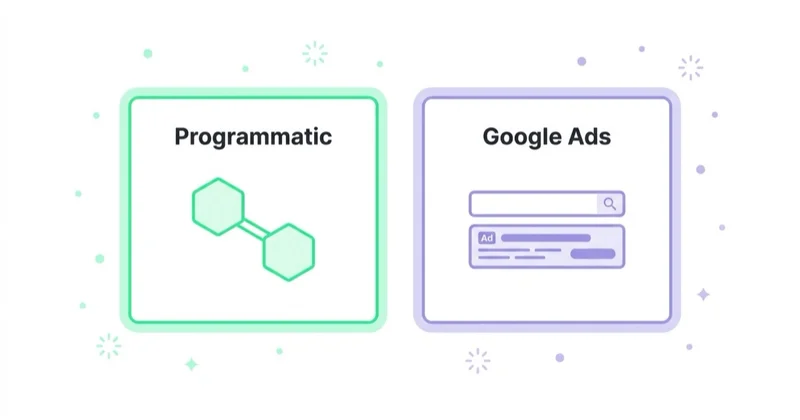
Programmatic platforms such as DV360 can provide more control over:
- inventory sources;
- publishers;
- private marketplaces;
- frequency across buys;
- third-party verification;
- creative sequencing;
- cross-channel planning;
- advanced audience and data integrations;
- CTV and premium video buying;
- supply path decisions.
That control has a cost. It requires expertise, budgets, creative planning and operational discipline.
For many advertisers, the practical sequence is:
- Build reliable tracking and conversion measurement.
- Make Search, Shopping, Meta, YouTube or Performance Max work.
- Add remarketing and upper-funnel creative.
- Consider programmatic when scale, inventory or measurement needs outgrow simpler platforms.
Programmatic readiness checklist
Programmatic is easier to justify when the business can answer these questions before launch.
| Area | Readiness question |
|---|---|
| Goal | Is the campaign for reach, consideration, retargeting, CTV, assisted demand or sales support? |
| Budget | Is there enough budget for learning, verification and optimization, not only media spend? |
| Creative | Are there format-specific assets for display, video, native, audio or CTV? |
| Data | Are first-party audiences, CRM segments or contextual rules available and compliant? |
| Inventory | Is there a clear plan for open auction, PMP, guaranteed deals or curated supply? |
| Brand safety | Are suitability categories, exclusions and verification partners defined? |
| Measurement | Are platform metrics, analytics, lift, CRM or sales outcomes connected to the goal? |
| Governance | Is someone responsible for reviewing placements, frequency, fraud and delivery quality? |
If most answers are unclear, programmatic may still run, but it will be hard to prove that it created value.
When programmatic is worth using
Programmatic may be a strong fit when:
- the campaign needs large reach;
- frequency control across publishers matters;
- the brand wants premium display, video or CTV inventory;
- first-party data can be activated responsibly;
- private marketplace access is valuable;
- the team needs independent verification;
- the media plan spans formats and publishers;
- there is enough budget to optimize;
- the advertiser understands post-view and assisted impact;
- the brand wants incremental reach beyond Google and Meta.
It may be a weak fit when:
- budget is too small for learning;
- there is no clear KPI;
- creative assets are poor;
- measurement is not ready;
- the team cannot monitor inventory quality;
- brand safety requirements are high but unmanaged;
- the advertiser only wants direct response with short payback;
- Search and paid social basics are not yet mature.
A practical rule: programmatic should solve a specific media problem. It may be incremental reach, premium video access, CTV, controlled frequency across publishers, account-based awareness, or curated inventory. If the only argument is "we should try programmatic because it is advanced", the strategy is not ready.
Programmatic channels
Display
Display programmatic is useful for reach, retargeting, sequential messaging and support around other channels. It needs careful viewability and inventory controls.

Video
Programmatic video can support awareness and consideration. Creative quality, completion rate, screen environment and inventory quality matter more than cheap impressions.
Connected TV
CTV is attractive for brand and reach strategies, but measurement is different from click-based channels. It often needs incremental reach, completion, frequency and brand metrics.
Digital audio
Audio can support awareness and frequency in podcast, music and streaming contexts. Creative fit and message clarity are essential because the format is not visual.
Digital out-of-home
Programmatic DOOH can automate buying across digital screens. It is usually evaluated by location, audience context, reach and campaign-level lift rather than direct clicks.
Programmatic by funnel stage
Programmatic can support different stages, but each stage needs different creative and measurement.
| Funnel stage | Useful programmatic role | Better KPI |
|---|---|---|
| Awareness | Reach a defined audience across premium display, video, CTV or audio | on-target reach, viewability, completion, brand lift |
| Consideration | Promote educational assets, comparisons or product stories | engaged visits, content depth, video completion, assisted search |
| Retargeting | Re-engage warm users outside walled gardens | assisted conversions, frequency, incremental lift |
| Account-based marketing | Reach buying committees at target accounts | account reach, content engagement, pipeline influence |
| Retail or ecommerce support | Add reach around seasonal products or categories | category sales, new customers, assisted revenue |
| Retention | Reach known customers with compliant first-party data | repeat purchase, reactivation, LTV |
The same campaign should not be asked to do all of these jobs at once. A CTV awareness campaign and a retargeting display campaign need different budgets, creatives and reporting.
First-party data and privacy
Programmatic strategy has moved away from careless third-party tracking. A modern setup should consider:
- consent management;
- first-party audiences;
- CRM data governance;
- clean room or platform matching where appropriate;
- contextual targeting;
- data minimization;
- regional legal requirements;
- measurement limitations;
- frequency strategy without overexposure;
- source transparency.
Privacy is not a checkbox at the end of the campaign. It affects targeting, bidding, measurement and reporting.
Strong programmatic teams document:
- which data sources are used;
- what consent or legal basis applies;
- where data is stored or matched;
- which partners receive data;
- how long audiences are retained;
- which sensitive categories are excluded;
- what happens when users opt out;
- how measurement changes when identifiers are unavailable.
That documentation protects users and makes performance analysis more credible.
Measurement: what to look at
Programmatic campaigns should be measured according to the objective.
| Goal | Useful metrics |
|---|---|
| Reach | unique reach, frequency, on-target reach |
| Awareness | viewability, completion rate, brand lift, search lift |
| Traffic | engaged sessions, bounce quality, landing page actions |
| Retargeting | assisted conversions, conversion rate, frequency, incrementality |
| Ecommerce | revenue, margin, assisted sales, product category impact |
| B2B | account reach, content engagement, pipeline influence |
| CTV | completion, frequency, incremental reach, brand outcomes |
Cheap CPM is not enough. The campaign can be inexpensive and still ineffective.
A healthy reporting view should separate:
- delivery quality: impressions, viewability, invalid traffic, brand suitability, completion rate;
- audience quality: reach, frequency, geography, device, publisher and context;
- engagement quality: engaged sessions, landing-page actions, video attention and content depth;
- business quality: assisted conversions, revenue, margin, pipeline, lift or downstream customer value.
When these layers are mixed into one dashboard number, weak inventory can hide behind cheap reach or post-view attribution.
Programmatic for ecommerce
Ecommerce brands often use programmatic for:

- retargeting;
- new customer prospecting;
- seasonal promotions;
- video awareness;
- product feed-based display;
- category campaigns;
- CTV support for brand growth;
- incremental reach beyond Google and Meta.
Before using programmatic for ecommerce, fix the basics: tracking, product feeds, landing pages, mobile checkout and margin-aware reporting. See Performance Max campaigns, Google Shopping campaigns and M-commerce.
Programmatic for B2B
B2B programmatic can help reach buying committees and named accounts, but it should not be judged only by immediate form fills.
Useful B2B applications:
- account-based awareness;
- content promotion;
- webinar promotion;
- retargeting engaged visitors;
- category education;
- competitor conquesting where legal and platform rules allow;
- supporting Search demand.
CRM and pipeline data are important because B2B value often appears later than the ad click.
Inventory quality and supply path control
Inventory quality is one of the main differences between a useful programmatic plan and a wasteful one.
Useful controls include:
- domain and app reports;
- inclusion lists for trusted publishers where appropriate;
- exclusion lists for unsuitable sites or apps;
- pre-bid brand safety and suitability filters;
- post-bid verification;
- viewability thresholds;
- invalid traffic monitoring;
- frequency caps;
- seller transparency;
- supply path optimization;
- PMP or guaranteed deals for premium contexts.
Open auction buying can provide scale, but scale without quality control is dangerous. PMP and programmatic guaranteed deals can improve control, but they also require negotiation, pricing discipline and clear reporting. The best choice depends on the media goal, not on the label.
How we approach this at Space Ads
Programmatic can work at scale, but for most mid-market clients the bulk of effective demand already sits in the Google and Meta auctions. We reach for a DSP selectively, where it genuinely adds new audience or premium inventory, rather than as a default channel. Buying reach is the easy part; the hard part is guarding against what quietly eats budget: ad fraud, low viewability, junk placements across networks. That means tight exclusion lists, a close eye on viewability, and never trusting impressions on their own. Reach no real human ever saw doesn't exist, however nice it looks in a report. So when we turn programmatic on, it carries a specific goal and hard quality control.
Common programmatic mistakes
| Mistake | Impact | Better approach |
|---|---|---|
| Starting with a DSP before defining the goal | Platform-led strategy | Define KPI, role and audience first |
| Optimizing only for CPM | Cheap but weak delivery | Use quality and business metrics |
| No brand safety plan | Reputation risk | Apply suitability and verification controls |
| No frequency governance | Waste and irritation | Use caps and reach analysis |
| Weak creative | Poor attention and recall | Build format-specific assets |
| Ignoring supply paths | Budget leakage | Review exchanges, sellers and placements |
| Treating CTV like display | Bad measurement | Use CTV-appropriate KPIs |
| Poor landing pages | Media gets blamed for UX issues | Audit mobile and conversion paths |
FAQ
What are programmatic campaigns?
Programmatic campaigns are digital ad campaigns bought through automated technology, using platforms, data and rules to purchase media across publishers and channels.
Is programmatic the same as RTB?
No. RTB is a real-time auction model within programmatic. Programmatic also includes private marketplaces, preferred deals and programmatic guaranteed buying.
Is programmatic better than Google Ads?
Not always. Google Ads is often simpler and more efficient for Search, Shopping, YouTube and many performance campaigns. Programmatic can be better when broader inventory control, CTV, private deals or cross-publisher reach are needed.
Is programmatic only for big brands?
It is not only for big brands, but it usually requires enough budget, measurement and expertise. Small advertisers should often master simpler paid channels first.
Can programmatic drive sales?
Yes, especially through remarketing, prospecting and ecommerce display or video. However, many programmatic campaigns also work as upper-funnel or assisted channels, so measurement should match the role.
What is the biggest risk in programmatic?
The biggest risk is buying low-quality impressions at scale. Inventory quality, brand safety, viewability, fraud prevention and measurement must be actively managed.
What is DV360?
Display & Video 360 is Google's enterprise DSP within Google Marketing Platform. It is used for programmatic planning, buying, creative, measurement and optimization across multiple inventory sources.
What is the difference between open auction and PMP?
Open auction gives broad access to available inventory and can scale quickly. A private marketplace limits access to selected buyers or selected supply, which can improve control and quality but may reduce scale.
Should programmatic be measured by clicks?
Not usually as the main metric. Some programmatic campaigns can drive traffic, but many are designed for reach, video, CTV, account influence, assisted demand or brand outcomes. Clicks can be useful, but they are often too narrow.
Conclusion
Programmatic advertising is valuable when automated buying supports a clear media strategy. It can provide scale, reach control, premium inventory, CTV access and advanced optimization, but it also creates more responsibility for quality control.
It should be used when the campaign has a defined role, enough budget, strong creative, privacy-aware data, measurement discipline and a plan for inventory governance. Without those foundations, simpler channels may deliver better results with less complexity.
Sources and further reading
- IAB Tech Lab: Programmatic
- IAB Tech Lab: OpenRTB
- Google Marketing Platform: Display & Video 360
- Google Marketing Platform: Display & Video 360 product overview
- Display & Video 360 Help: Programmatic Guaranteed deals
- Google Authorized Buyers Help: Introduction to real-time bidding
- IAB Europe: Updated Guide to Quality 2024
- Privacy Sandbox: Protected Audience API overview
Continue learning
Continue reading

What Are RTB Campaigns (Real-Time Bidding)?
RTB is automated auction-based buying of individual ad impressions. Performance depends on inventory quality, supply paths, privacy signals, creative, frequency and measurement.
Google Marketing Platform's DV360: Everything You Need to Know
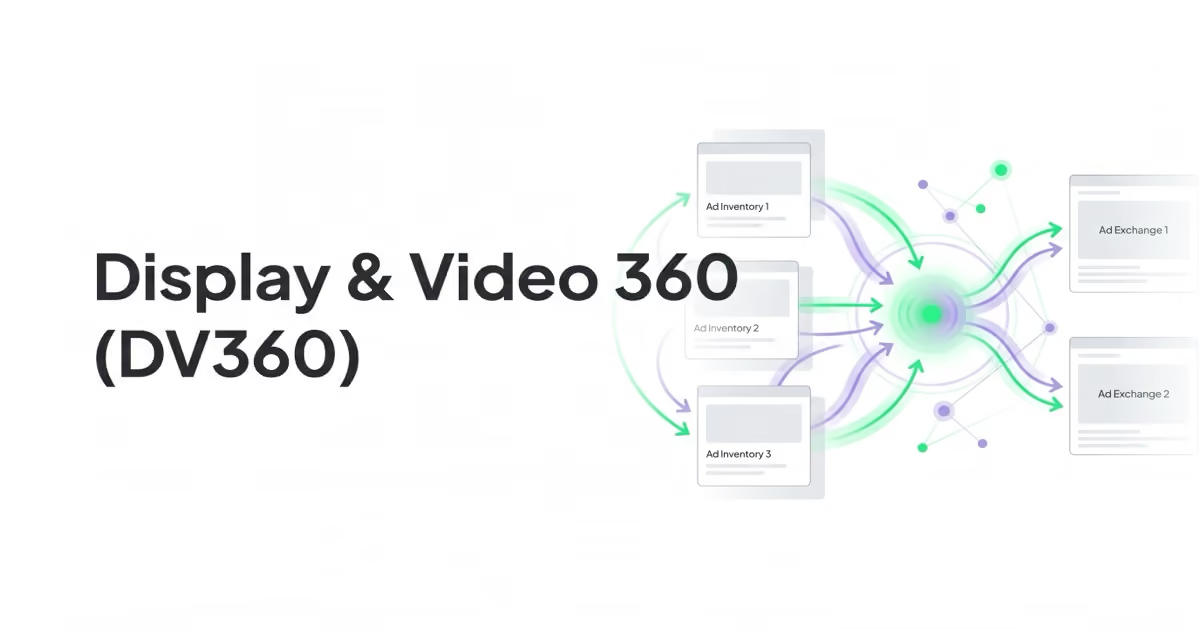
Display & Video 360 (DV360) is Google Marketing Platform's enterprise programmatic buying platform for teams that need inventory control, CTV, private deals, Floodlight measurement, audience governance and programmatic workflows. This guide explains how DV360 differs from Google Ads, when the business case is strong and what must be ready before launch.
What Are Dynamic Search Ads (DSA) and Are They Worth Using?
Dynamic Search Ads use website content to match searches, generate headlines and choose landing pages. In 2026, DSA strategy should focus on AI Max migration and URL control.