Performance Max is a goal-based Google Ads campaign type that uses Google AI to serve ads across multiple Google channels from one campaign. Depending on eligibility and setup, it can reach users across Search, YouTube, Display, Discover, Gmail, Maps and other Google inventory.
The short version: Performance Max can be very effective, but only when the inputs are strong. It needs reliable conversion tracking, meaningful conversion values, useful creative assets, audience signals, landing pages, product feed quality where relevant, and clear business rules outside the Google Ads interface.
Performance Max should not be treated as a black box that solves weak marketing. It is better to think about it as an automated system that needs accurate data, good creative, a clean offer and sensible guardrails.
TL;DR
- Performance Max is a goal-based, AI-powered Google Ads campaign type.
- It is designed to complement keyword-based Search campaigns, not automatically replace them.
- Google AI works across bidding, budget optimization, audiences, creatives, attribution and placements.
- Core inputs matter: conversion goals, values, assets, audience signals, Search themes, landing pages and feeds.
- For ecommerce, Merchant Center feed quality is central. Titles, images, prices, availability, categories, custom labels and margin logic affect performance.
- For lead generation, lead quality feedback is critical. PMax can generate volume, but weak conversion actions can teach the system the wrong goal.
- PMax can blend prospecting, remarketing, brand demand and Shopping demand, so reporting needs careful interpretation.
- Search, Standard Shopping and Demand Gen can still be useful when more control, intent capture or visual demand creation is needed.
What is Performance Max?
Performance Max, often shortened to PMax, is a Google Ads campaign type built around a selected business goal. Instead of creating separate campaigns for every channel, the advertiser gives Google a set of inputs and lets the system find conversions or conversion value across eligible Google inventory.
The campaign can use:
- conversion goals;
- conversion values;
- Smart Bidding;
- text assets;
- image assets;
- logos;
- video assets;
- final URLs;
- asset groups;
- audience signals;
- Search themes;
- brand exclusions;
- URL exclusions;
- Merchant Center product feeds;
- listing groups for retail;
- store goals where relevant;
- account-level brand safety settings.
The important point is that PMax is automated, but it is not strategy-free. The campaign still needs a clear role in the account.
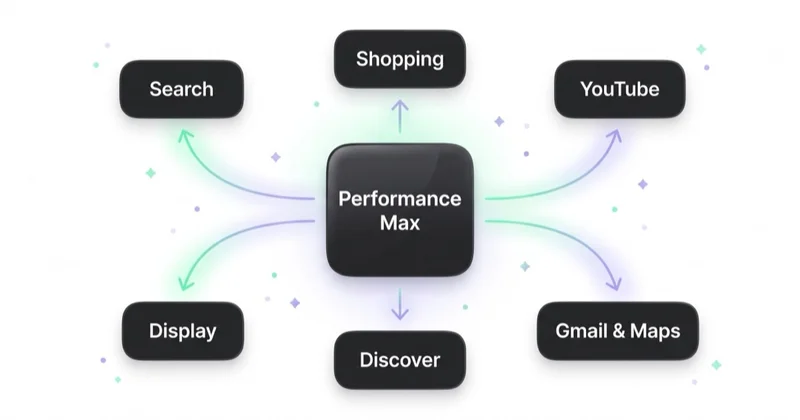
How Performance Max works
The simplified process looks like this:
- A goal is selected, such as sales, leads or store visits.
- Conversion tracking tells Google Ads what actions matter.
- Conversion values tell the system which actions or purchases are more valuable.
- Assets and feeds give the campaign material to build ads.
- Audience signals and Search themes provide extra context about likely customers and relevant demand.
- Google AI decides where, when and how to show ads across eligible inventory.
- Smart Bidding optimizes toward the selected conversion or value goal.
- Reporting, search term insights, asset reports and business data are used to improve the inputs.
This means PMax performance depends on both platform optimization and business quality. A clean feed, strong landing pages and accurate values can make the campaign smarter. Broken tracking, weak assets and inflated micro-conversions can make it learn the wrong pattern.
When Performance Max is a good fit
Performance Max is usually worth considering when:
- conversion tracking is reliable;
- the account has a clear sales or lead objective;
- Search campaigns already capture important keyword demand;
- the business can provide useful assets and landing pages;
- ecommerce product data is clean;
- lead generation has quality feedback or offline conversion imports;
- the account needs more reach across Google inventory;
- conversion value can be measured or estimated sensibly;
- brand and non-brand performance can be interpreted separately.
It is usually a weak first move when:
- the website does not convert;
- GA4 and Google Ads tracking disagree heavily;
- every form submission is treated as equally valuable;
- the product feed has many disapprovals or wrong prices;
- the budget is too low for meaningful learning;
- the account has no clear offer or conversion goal;
- stakeholders expect full keyword-level control;
- results will be judged after only a few days.
For deeper account diagnosis, read What Is a Google Ads Audit and How to Do It?.
Performance Max vs Search
Search campaigns are built around queries and keywords. They are useful when people already express intent by searching for a product, service, brand, comparison or problem.
Performance Max can also appear on Search-related inventory, but it does not work like a normal keyword campaign. Google documentation describes PMax as complementary to keyword-based Search campaigns. Exact-match Search keywords can be prioritized in specific situations, while broader overlap needs controls such as brand exclusions, negative keywords where available and careful campaign architecture.
| Area | Search campaign | Performance Max |
|---|---|---|
| Main control | Keywords, match types, ads, landing pages | Goals, assets, feeds, audience signals, Search themes |
| Best role | Capture explicit intent | Scale conversion opportunities across Google inventory |
| Query visibility | Stronger | More limited, mostly insight-led |
| Creative scope | Search ads and assets | Text, image, video, feed and multi-channel combinations |
| Ecommerce role | Strategic text ads for selected intent | Shopping-style and cross-channel sales automation |
| Risk | Overly narrow or expensive keyword setup | Blended brand, remarketing and prospecting results |
Search should usually remain active for high-value queries where message, landing page and keyword control matter. PMax can then expand reach and conversion volume beyond what keyword campaigns can cover alone.
For more detail, read Search Advertising in Google Ads: What to Know.
Performance Max vs Shopping
For ecommerce, PMax often replaces or sits next to Standard Shopping. The difference is control.
Standard Shopping gives more direct control over product groups, bids, negative keywords and Shopping-only structure. Performance Max uses the feed but can also use assets and show across a broader set of channels.
PMax is often useful when:
- the store has clean Merchant Center data;
- purchase value is tracked correctly;
- the goal is profitable sales growth across inventory;
- products have enough demand and stock;
- creative assets can support product discovery;
- custom labels can separate margin, seasonality or priority products.
Standard Shopping may still be useful when:
- the account needs more Shopping-specific control;
- product economics differ strongly;
- a specific category needs isolated testing;
- query control is important;
- PMax is hiding too much detail for the decision being made.
For product-feed fundamentals, read What Is a Product Feed and How to Use It? and What Is Google Merchant Center and How to Manage It?.
Performance Max vs Demand Gen
Demand Gen and Performance Max can both use visual assets, but their role is different.
Demand Gen is more focused on visual demand generation, audience strategy, YouTube and discovery-style placements. It can be useful when the goal is to create consideration, build remarketing pools, use lookalike-style logic where available, or distribute image and video creative before users search.
Performance Max is broader and more conversion-led. It is often used to convert demand across Google inventory, especially when sales or lead conversion data is strong.
In practice:
- Search captures active intent.
- Demand Gen creates and warms demand.
- Performance Max scales conversion opportunities across inventory.
- Shopping and Merchant Center feed quality support ecommerce visibility.
- GA4, CRM and backend data explain whether the growth is actually valuable.
Read What Is a Demand Gen Campaign in Google Ads and How to Launch One? for the visual demand side.
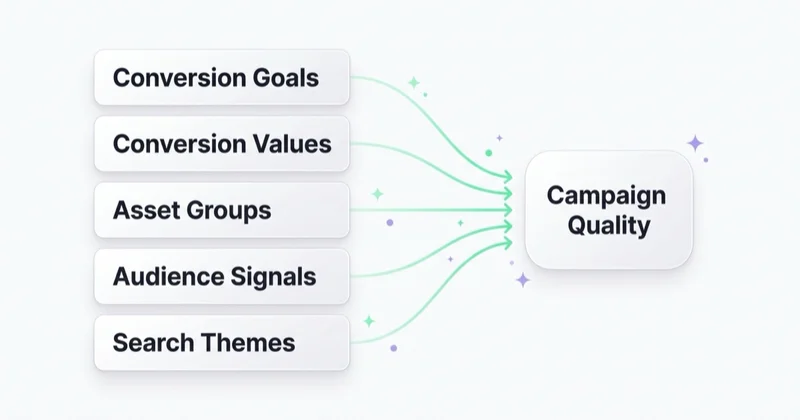
Inputs that decide Performance Max quality
PMax is often discussed as automation, but the controllable inputs decide how useful the automation can be.
Conversion goals
Use only conversion actions that represent real business value. For ecommerce, this usually means purchases and revenue. For lead generation, it may mean qualified forms, calls, booked meetings, opportunities or offline conversion stages.
Avoid optimizing a main PMax campaign toward weak actions such as generic page views, low-intent clicks or unqualified forms. Those actions can be useful as diagnostics, but they can distort bidding if treated as primary conversions.
Conversion values
Value-based bidding needs useful values. In ecommerce, this usually comes from transaction revenue. In lead generation, values may come from lead score, CRM stage, expected revenue or imported offline conversions.
Not every lead is equal. A demo request from the right market may be worth far more than a newsletter signup. If both have the same value, the bidding system has no reason to prefer the better lead.
For measurement setup, read Enhanced Conversions in Google Ads: What They Are and How to Set Them Up.
Asset groups
An asset group is a collection of creatives organized around a theme or audience. It can include headlines, descriptions, images, logos, videos, sitelinks and other assets. Google combines assets from the group to build ads for different placements.
Good asset groups are usually organized by:
- product category;
- service line;
- audience need;
- market segment;
- margin group;
- season;
- offer;
- funnel stage.
Weak asset groups mix unrelated products, generic copy and one image. That gives the system little useful context and makes reporting harder.
Creative assets
PMax needs assets that can work across multiple environments. Search-style copy alone is not enough.
Useful asset mix:
- benefit-led headlines;
- clear descriptions;
- product or service images;
- lifestyle or in-use images;
- logos;
- short video;
- vertical video where relevant;
- proof points;
- trust elements;
- offer-specific creative;
- category-specific creative.
Creative should not only say that the company is professional. It should show the product, explain the use case, reduce risk or answer a real objection.
Audience signals
Audience signals do not limit PMax to one audience. They help Google AI understand who may be relevant.
Strong signals can include:
- Customer Match lists;
- high-value customers;
- recent purchasers;
- qualified leads;
- remarketing lists;
- YouTube viewers;
- website visitors from important categories;
- custom segments based on search behavior;
- CRM segments.
Weak signals include very broad visitors, mixed low-quality leads or audiences that have no business meaning.
Read Customer Match in Google Ads: What It Is and How to Use It for first-party audience planning.
Search themes
Search themes are an extra signal for PMax. They help communicate relevant topics, categories and demand areas that may not be obvious from the landing page, assets or feed.
They are useful when:
- the landing page is broad;
- the category has multiple names;
- the offer is new;
- the website does not describe every use case clearly;
- the campaign needs to learn about an important demand area;
- the account wants to add topic context without building a keyword campaign.
Search themes are not a replacement for Search campaigns. They are a signal inside an automated campaign.
Final URL expansion
Final URL expansion allows PMax to send users to more relevant pages on the same domain when Google predicts that another page better matches the query or intent. It can also generate more relevant text assets when related settings are enabled.
This can help scale, but it needs controls. Exclude pages that should not receive paid traffic, such as:
- blog posts not built to convert;
- policy pages;
- recruitment pages;
- support pages;
- out-of-stock categories;
- outdated landing pages;
- informational pages with no next step;
- low-margin sections where paid traffic is not wanted.
If the campaign must send traffic to a single page, Final URL expansion may need to be turned off or tightly controlled.
Ecommerce setup checklist
For ecommerce, Performance Max is only as good as the commercial and feed data behind it.
Before launch, check:
- Merchant Center account is active and connected;
- website is verified and claimed;
- product titles describe what people actually search for;
- product images are clean and compliant;
- prices match the website;
- availability is correct;
- shipping and return information is configured;
- product categories are accurate;
- disapprovals and warnings are fixed;
- high-priority products are marked with custom labels;
- low-margin or problematic products are separated;
- purchase value and currency are tracked correctly;
- enhanced conversions are configured where appropriate;
- new customer acquisition settings are considered where relevant;
- product pages load quickly and answer buying questions.
PMax can help find buyers, but it cannot fix wrong feed data, confusing product pages or weak stock availability.
Lead generation setup checklist
Lead generation PMax needs even stricter measurement because lead volume can be misleading.
Before launch, check:
- forms are tracked correctly;
- phone calls are tracked if they matter;
- spam leads are filtered;
- lead source is passed into the CRM;
- qualified lead stages can be imported where possible;
- conversion values reflect lead quality;
- sales feedback is reviewed;
- low-intent micro-conversions are not primary goals;
- landing pages explain the offer clearly;
- the thank-you page or event cannot be triggered accidentally;
- regions, languages and service availability match the business.
For B2B and services, the question is not "Did PMax generate leads?" The question is "Did PMax generate leads that sales can use profitably?"
Brand, non-brand and incrementality
One of the biggest risks in PMax reporting is blended demand.
A campaign may include:
- people who already know the brand;
- returning visitors;
- Shopping demand;
- remarketing traffic;
- new customers;
- generic category demand;
- competitor-adjacent searches;
- YouTube or Display assisted demand.
If all of this is read as one number, performance can look better or worse than reality.
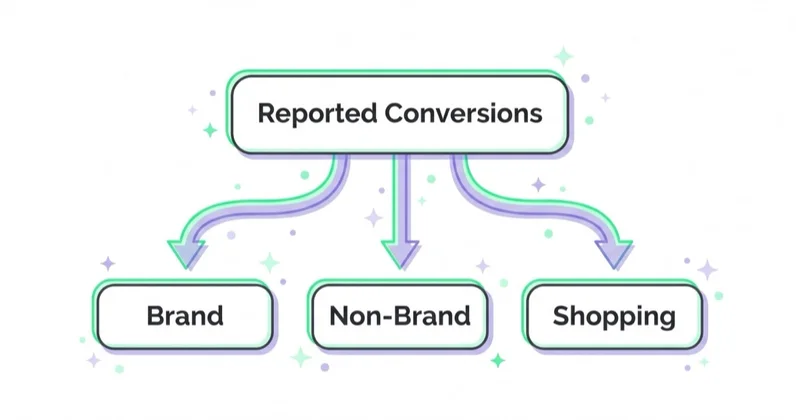
Useful controls and diagnostics:
- separate brand Search reporting;
- monitor brand search volume in Search Console and Google Ads;
- use brand exclusions when appropriate;
- compare new customer and returning customer value;
- review product-level contribution;
- compare GA4, Google Ads and backend revenue;
- check whether PMax growth is incremental or just reallocating existing demand;
- run experiments where available and commercially sensible.
PMax should be judged by business contribution, not only interface ROAS.
How to structure Performance Max
There is no universal structure, but campaign structure should follow business logic.
Possible segmentation:
| Segmentation | When it helps | Risk |
|---|---|---|
| One broad campaign | Simple catalogue, enough data, similar margins | Low control over product priorities |
| Category campaigns | Different product groups need different budgets or assets | Too many campaigns can reduce learning |
| Margin-based campaigns | Profitability differs strongly by product | Requires reliable custom labels and margin data |
| New customer campaign | Acquisition is a separate goal | Needs correct customer data and reporting |
| Lead-quality campaign | Different services produce different lead value | Needs CRM feedback and values |
| Seasonal campaign | Time-limited offer or collection | Short windows can limit learning |
Avoid splitting campaigns only because the account looks neater. Split when budgets, goals, margins, assets or reporting decisions genuinely differ.
First 30 days after launch
PMax usually needs a measured launch period. Daily overreaction can hurt learning.
Days 1-7: check hygiene
Review:
- tracking fires correctly;
- conversion values look plausible;
- products are approved;
- landing pages are correct;
- assets are approved;
- spend is delivering;
- no unwanted pages receive traffic;
- no obvious geo or language mismatch exists.
Do not rewrite the whole campaign because of one day of data.
Days 8-21: review signals and search demand
Review:
- search term insights;
- asset performance direction;
- product-level performance;
- category performance;
- audience signal relevance;
- brand overlap;
- lead quality;
- GA4 engagement and revenue;
- backend revenue or CRM quality.
This is the phase for correcting weak inputs, not for chasing every fluctuation.
Days 22-30: decide what to scale or isolate
Decisions may include:
- adding better assets;
- excluding poor URLs;
- separating a high-margin category;
- adjusting conversion values;
- importing qualified leads;
- improving feed titles;
- changing budget after enough signal exists;
- creating a Search campaign for queries that need more control;
- adding Demand Gen for visual demand creation.
Optimization should be based on patterns, not single metrics.
How to measure Performance Max
Useful metrics include:
- cost;
- conversions;
- conversion value;
- ROAS;
- CPA;
- revenue;
- gross margin;
- new customer revenue;
- lead quality;
- qualified lead rate;
- offline conversion value;
- product-level sales;
- search term insights;
- asset performance labels;
- landing page performance;
- GA4 assisted conversions;
- branded search movement;
- customer lifetime value where available.
For ecommerce, ROAS without margin can be misleading. A campaign selling low-margin discounted products may look efficient in Google Ads and still be weak commercially.
For lead generation, CPA without lead quality can be misleading. Cheap leads can be expensive when sales rejects them.
For broader measurement, read What Is Ecommerce Analytics and Why Is It So Important?.
How we approach this at Space Ads
At Space Ads, we treat Performance Max as an automated campaign type that still needs deliberate operating constraints. Before scaling, we check conversion goals, value logic, Merchant Center feed quality, product or service margins, asset groups, landing pages, brand overlap and search demand. We do not judge PMax from one blended ROAS or CPA number, because the campaign can mix brand, non-brand, remarketing, Shopping and prospecting demand. For ecommerce, we segment where product economics, feed quality or stock priorities differ. For lead generation, we only trust volume when CRM feedback or offline conversions show lead quality. The campaign should earn more budget through cleaner inputs and verified business value, not through platform reporting alone.
Common mistakes
| Mistake | Why it hurts | Better approach |
|---|---|---|
| Launching with weak tracking | Bidding learns from unreliable signals | Fix conversion actions first |
| Treating every lead as equal | The system optimizes for volume, not quality | Import qualified stages or assign values |
| Using one generic asset group | Creative and reporting become vague | Build asset groups around real themes |
| Ignoring Merchant Center issues | Product ads lose eligibility or accuracy | Fix feed quality before scaling |
| Leaving Final URL expansion uncontrolled | Traffic can go to weak or irrelevant pages | Use exclusions and landing-page checks |
| Mixing brand and non-brand reporting | ROAS can look artificially strong | Separate interpretation and use controls |
| Changing settings every day | Learning becomes unstable | Use a measured test window |
| Measuring only Google Ads ROAS | Business impact may be different | Compare backend revenue, margin and GA4 |
| Using PMax to replace all Search | Query and message control is lost | Keep strategic Search campaigns |
FAQ
What is Performance Max in Google Ads?
Performance Max is a goal-based Google Ads campaign type that uses Google AI to optimize ads across eligible Google inventory from one campaign.
Is Performance Max the same as Shopping?
No. PMax can use Merchant Center product feeds and show Shopping-style ads, but it is broader than Standard Shopping because it can also use assets and serve across more Google channels.
Does Performance Max replace Search campaigns?
No. Google describes Performance Max as complementary to keyword-based Search campaigns. Search should still be used when keyword, query, ad copy and landing-page control are important.
Does Performance Max use keywords?
Not like a Search campaign. PMax can use Search themes and search-related signals, but it does not provide the same keyword structure as standard Search campaigns.
What are asset groups in Performance Max?
Asset groups are collections of creative assets organized around a theme or audience. Google combines assets from a group to create ads for different placements.
Should Final URL expansion be enabled?
It can be useful because it allows Google to send users to more relevant pages, but it should be controlled with URL exclusions. Pages that are not suitable for paid traffic should be excluded.
Is Performance Max good for ecommerce?
Yes, when the Merchant Center feed is clean, product economics are understood, purchase value is tracked and product pages convert. Feed quality and margin logic matter heavily.
Is Performance Max good for lead generation?
Yes, but only with strong lead-quality measurement. Optimizing toward all form submissions can produce weak leads. CRM feedback, offline conversions and realistic values make the setup safer.
How long should Performance Max run before judging results?
The account needs enough conversion and value data to see a pattern. Early days should focus on tracking, feed and landing-page hygiene. Strategic changes are better after enough data has accumulated.
What should be checked before scaling Performance Max?
Check conversion quality, feed status, search term insights, asset performance, landing pages, brand overlap, new customer value, margin and backend sales or CRM quality.
Key takeaways
Performance Max works best when automation is paired with strong business inputs. It needs clean conversion tracking, realistic values, useful creative, audience context, relevant landing pages and feed quality.
For ecommerce, the strongest PMax setups usually start with Merchant Center quality, product segmentation and profit logic. For lead generation, the strongest setups usually start with qualified conversion data and CRM feedback.
PMax should not replace strategic Search, Demand Gen, analytics or commercial judgment. It should sit inside a broader account structure where each campaign type has a clear role and results are measured against real business value.
Not sure whether Performance Max is spending without control? A Google Ads audit shows how much traffic and value PMax really delivers and what to fix first.
Sources and further reading
- Google Ads Help - About Performance Max campaigns
- Google Ads Help - Search targeting and controls for Performance Max
- Google Ads Help - About Final URL expansion in Performance Max
- Google Ads Help - How asset groups work
- Google Ads Help - Build an asset group
- Google Ads Help - Retailer best practices for AI-powered Performance Max campaigns
- Google Ads Help - Performance Max best practices for lead generation
- Google Ads Help - About asset reporting in Performance Max
- Space Ads - Google Ads service
Continue learning
- Google PLA / Shopping Campaigns in Google Ads: What to Know
- How to Use Google Shopping Campaigns Effectively?
- What Is Google Merchant Center and How to Manage It?
- What Is a Product Feed and How to Use It?
- What Is a Google Ads Audit and How to Do It?
- Enhanced Conversions in Google Ads: What They Are and How to Set Them Up
- Customer Match in Google Ads: What It Is and How to Use It
- What Is a Demand Gen Campaign in Google Ads and How to Launch One?
Continue reading

Google PLA / Shopping Campaigns in Google Ads: What to Know
Google PLA, now usually called Shopping ads, use Merchant Center product data to show product images, titles, prices and store details. Learn how feed quality, PMax, Standard Shopping and profitability measurement work.

What Is a Google Ads Audit and How to Do It?
A Google Ads audit should show whether spend, conversion data, account structure, search demand, Merchant Center quality and landing pages support the actual business goal. This guide explains how to turn tracking gaps, wasted queries and Performance Max risks into a prioritised roadmap, not a list of generic settings.

Dynamic Remarketing: What It Is and How It Works
Dynamic remarketing personalizes ads using previous behavior and a feed or catalog. Learn how product IDs, events, Google Ads, Meta catalog ads, exclusions and measurement work together.