RTB, or real-time bidding, is a way of buying digital ad impressions through automated auctions that happen while a page, app or connected TV environment is loading. Instead of buying a fixed placement in advance, advertisers bid on individual impressions based on available signals, campaign goals, inventory quality and expected value.
RTB is part of the broader programmatic advertising ecosystem. It is not an ad format and it is not the same thing as Google Ads. It can power display, video, mobile, native, audio and CTV buying across exchanges, supply-side platforms and demand-side platforms. The strategic question is not "Should RTB be used because it is automated?" The question is whether it gives enough scale, control and measurable value for the campaign goal.
TL;DR
- RTB stands for real-time bidding: an automated auction for individual ad impressions.
- It is a buying mechanism inside programmatic advertising, not a creative format.
- The main actors are the user, publisher, SSP, ad exchange, DSP, advertiser and verification partners.
- RTB can support display, video, mobile, native, CTV and audio campaigns.
- It works best when there is enough budget, data, creative variation and quality control.
- Brand safety, fraud prevention, viewability, frequency, inventory quality and measurement are critical.
- RTB is broader than Google Ads, but Google Authorized Buyers and DV360 are part of the wider programmatic ecosystem.
- For smaller advertisers, simpler Google Ads or Meta Ads setups may be more practical than direct programmatic buying.
What is RTB?
Real-time bidding is a process where an advertising impression is offered to multiple buyers, each buyer decides whether to bid, and the winning ad is served automatically.
A simplified example:
- A user opens a website or app.
- The publisher has an available ad slot.
- The publisher's SSP or ad server sends a bid request.
- DSPs evaluate the impression.
- Advertisers bid according to campaign rules.
- The auction selects a winner.
- The winning creative is served.
- Measurement and verification systems record delivery.
This process happens very quickly. The advertiser does not manually choose every impression. The buying logic is handled by technology, data and rules.
RTB glossary
| Term | Meaning |
|---|---|
| Impression | A single opportunity to show an ad |
| Publisher | Website, app or media owner selling inventory |
| SSP | Supply-side platform used by publishers to sell inventory |
| DSP | Demand-side platform used by buyers to bid and optimize |
| Ad exchange | Marketplace connecting supply and demand |
| Bid request | Data sent about an available impression |
| Bid response | Buyer's bid and creative response |
| CPM | Cost per thousand impressions |
| Viewability | Whether the ad had a chance to be seen |
| Brand safety | Controls that reduce exposure to unsuitable contexts |
| Ad fraud | Invalid or deceptive traffic, impressions or clicks |
| Frequency cap | Limit on how often a user sees an ad |
Understanding these terms matters because RTB performance depends on the whole chain, not only the bid price.
What information can be in a bid request?
A bid request is not a simple message that says "show an ad here." Depending on the environment, consent status, seller configuration and technical integration, it can include signals such as:
- inventory type;
- ad format and size;
- page, app or content context;
- device and browser information;
- approximate location;
- language;
- floor price;
- deal ID;
- user or audience signals where allowed;
- consent and privacy signals;
- viewability or placement information;
- video, audio or CTV attributes;
- publisher or seller identifiers.
The available data affects both bidding and measurement. If the bidstream has weak or inconsistent signals, a DSP may struggle to value impressions accurately. If consent or privacy rules limit identifiers, contextual quality, first-party data and clean measurement become more important.
This is why RTB should not be sold as magic automation. The technology can make buying decisions quickly, but the quality of those decisions depends on signals, rules, creative, inventory and feedback data.
How an RTB auction works
The mechanics vary by platform, but the logic is usually similar.
1. A bid request is created
When an impression becomes available, the seller side sends information about it. Depending on privacy rules, consent, inventory type and integration, the request may include contextual data, device type, placement, format, geography, floor price and other signals.
2. Buyers evaluate the impression
The DSP decides whether the impression is valuable for a campaign. It may consider:
- campaign goal;
- targeting rules;
- context;
- audience signals;
- geography;
- device;
- frequency;
- historical performance;
- viewability expectations;
- brand safety settings;
- bid strategy;
- creative eligibility.
3. Bids are submitted
Interested buyers submit a bid. The bid is not only a price. It is tied to creative, campaign rules, compliance checks and technical requirements.
4. The auction selects a winner
The exchange or selling system evaluates eligible bids. Many programmatic auctions use first-price mechanics, where the winner pays the price they bid, although auction mechanics can vary by environment and deal type.
5. The ad is served and measured
The winning ad is displayed, and delivery is tracked. Verification partners may check viewability, fraud, brand safety and attention signals depending on setup.
RTB vs programmatic advertising
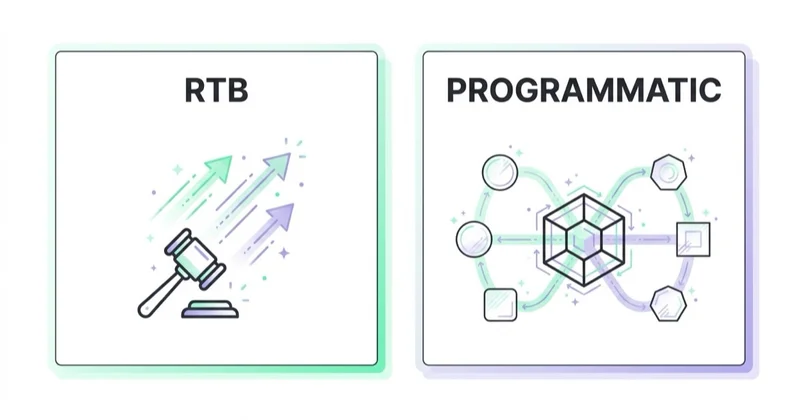
Programmatic advertising means automated media buying. RTB is one type of programmatic buying.
| Buying model | How it works | Best fit |
|---|---|---|
| Open auction RTB | Many buyers compete for impressions | Scale, testing, performance and broad reach |
| Private marketplace (PMP) | Selected buyers access curated inventory | More control and premium supply |
| Programmatic guaranteed | Inventory and price are agreed in advance | Brand, CTV, premium or planned campaigns |
| Direct IO | Traditional direct media agreement | High control, sponsorships, custom placements |
RTB is flexible and scalable, but it can have more variability in inventory quality. Guaranteed and private deals may provide more control, but usually require stronger planning and minimum spends.
RTB vs Google Ads
Google Ads campaigns can use auction-based buying, but "RTB" usually refers to a broader ad tech ecosystem involving DSPs, SSPs and exchanges.
Google Ads is often easier for smaller advertisers because it provides:
- simpler campaign setup;
- integrated billing;
- familiar reporting;
- Search, Shopping, YouTube and Display access;
- automated bidding;
- lower operational complexity.
Direct RTB or DSP buying can make more sense when the advertiser needs:
- broader programmatic inventory access;
- advanced audience strategy;
- private marketplace deals;
- CTV or digital audio planning;
- frequency control across publishers;
- custom data integrations;
- independent verification;
- more control over supply paths.
For many SMEs, Google Ads and Meta Ads are the practical starting point. Direct RTB becomes relevant when media scale, measurement maturity and governance justify the complexity.
RTB or a simpler ad platform?
The decision should be practical, not ideological.
| Situation | Better starting point | Reason |
|---|---|---|
| Local service with limited budget | Google Search or Meta Lead Ads | Higher intent and lower operational complexity |
| Ecommerce with product feed and clear demand | Shopping, Performance Max or Meta catalog campaigns | Product data and conversion signals are easier to activate |
| Brand wants broad display/video reach across publishers | Programmatic or RTB via DSP | More inventory access and frequency control |
| B2B wants account-level awareness | Programmatic plus CRM/account strategy | Can support account coverage and content distribution |
| Premium CTV or publisher package | PMP or programmatic guaranteed | More control over context and supply quality |
| Early-stage tracking setup | Fix analytics first | RTB cannot compensate for weak measurement |
RTB should usually be considered after the basics are stable: conversion tracking, landing pages, creative production, consent, audience definitions and reporting. If those foundations are weak, a DSP may simply buy impressions faster than the team can learn from them.
Where RTB is used
RTB can support several media types:
- display banners;
- rich media;
- online video;
- mobile in-app ads;
- native ads;
- connected TV;
- digital audio;
- digital out-of-home in some programmatic environments.
The buying logic is similar, but each channel has different creative, measurement and inventory quality requirements. CTV, for example, often needs stronger attention to completion rate, device environment, household reach and premium supply quality.
When RTB makes sense
RTB can be useful when:

- reach across many publishers is needed;
- display or video scale matters;
- remarketing or prospecting audiences are available;
- the team can control brand safety and fraud risk;
- budget is large enough to learn;
- creative can be tested in variations;
- conversion or reach measurement is clear;
- the advertiser needs inventory beyond walled gardens;
- a DSP strategy is already in place.
It is weaker when:
- the budget is very small;
- conversion tracking is poor;
- there is no creative testing plan;
- brand safety requirements are strict but unmanaged;
- the advertiser wants guaranteed premium placement;
- the team will judge performance only by cheap CPM;
- there is no capacity to optimize supply and frequency.
What to control in RTB campaigns
Inventory quality
Not every impression has the same value. Review domains, apps, exchanges, placements, viewability, completion rate and conversion quality.
Brand safety and suitability
Set category exclusions, keyword/context controls, sensitive-content rules and blocklists where appropriate. Brand safety should be aligned with the advertiser's risk tolerance.
Fraud and invalid traffic
Use platform controls and verification partners where scale justifies it. Cheap impressions can become expensive if they are not real, not viewable or not relevant.
Frequency
RTB can create overexposure if frequency is not managed. Excess frequency wastes budget and can damage brand perception.
Creative quality
Automation does not remove the need for strong creative. Poor banners or weak video assets will still underperform even if bidding is sophisticated.
Measurement
Use a measurement plan before launch. Define whether the campaign is judged by reach, viewability, qualified visits, assisted conversions, incremental lift, sales or lead quality.
Supply path review
Supply path review means checking where impressions are actually bought, not only which audience was targeted. In RTB, the same publisher or app inventory can sometimes be reached through different intermediaries, deals or exchanges. Without review, budget can flow through inefficient or low-quality paths.
Review:
- top domains and apps;
- exchanges and SSPs;
- deal IDs;
- floor prices;
- win rate;
- viewability;
- invalid traffic;
- completion rate for video;
- conversion or engagement quality;
- duplicated access to similar inventory;
- placements that spend but do not contribute.
Supply review is not only about blocking bad placements. It is also about finding where quality inventory performs and where a private deal or allowlist may be justified.
Creative and frequency sequencing
RTB often works across multiple touchpoints. A user may see several display or video impressions before clicking, searching for the brand or converting later. Frequency should therefore be managed with creative sequencing in mind.
Example sequence:
- Awareness creative: problem, category or brand introduction.
- Consideration creative: benefit, proof or product explanation.
- Remarketing creative: offer, objection handling or case study.
- Conversion creative: direct CTA and clear destination.
Showing the same banner too many times is rarely a strategy. It is usually a sign that frequency and creative planning need work.
RTB in a privacy-conscious environment
RTB has changed because privacy regulation, consent frameworks, browser limits and platform policies affect which signals can be used.
Modern RTB planning should consider:
- consent and regional law;
- first-party data governance;
- contextual targeting;
- clean audience definitions;
- frequency without overreliance on third-party cookies;
- modeled measurement limitations;
- platform-specific privacy technologies;
- server-side and offline conversion data where relevant.
Google's Privacy Sandbox work, including Protected Audience API, reflects the broader shift toward privacy-preserving advertising technology. Advertisers should treat identity, consent and data minimization as campaign infrastructure, not legal paperwork.
RTB measurement framework
Useful metrics include:
- CPM;
- reach;
- frequency;
- viewability;
- completion rate for video;
- click-through rate;
- qualified sessions;
- assisted conversions;
- post-view and post-click conversions;
- cost per incremental reach;
- conversion quality;
- brand lift where available;
- invalid traffic rate;
- placement and supply-path performance.
CPM alone is a weak metric. A low CPM can mean efficient reach, but it can also mean poor inventory, low viewability or weak user attention.
RTB for ecommerce
In ecommerce, RTB is often used for:

- remarketing;
- prospecting;
- category promotions;
- seasonal offers;
- product feed-based display;
- video retargeting;
- upper-funnel awareness before Shopping or Search.
The key is to connect RTB with product margin, audience quality, creative, landing pages and conversion tracking. For retail automation inside Google, compare this with Performance Max campaigns and Google Shopping campaigns.
RTB for B2B and services
For B2B, RTB can support awareness, account-based reach, content distribution and retargeting. It is usually not enough to judge it only by last-click leads.
Useful B2B goals:
- reach target accounts;
- promote thought leadership;
- retarget engaged visitors;
- support event or webinar campaigns;
- create assisted demand before Search;
- control frequency across content sites.
CRM quality and pipeline influence matter more than raw form volume.
RTB pre-launch checklist
Before launch, confirm:
- campaign goal and KPI hierarchy;
- audience or context strategy;
- inventory type and allowed formats;
- brand safety and suitability settings;
- sensitive categories and blocklists;
- allowlists or PMPs where needed;
- frequency caps;
- creative variants and sizes;
- landing pages and UTMs;
- conversion tracking and consent setup;
- verification tools;
- reporting cadence;
- optimization owner;
- budget learning period;
- post-campaign evaluation method.
This checklist matters because RTB has more operational surface area than many self-serve ad platforms. A missing brand safety rule, weak creative set or unclear measurement plan can make the campaign look cheap while producing little business value.
How to evaluate RTB after launch
Post-launch review should separate delivery quality from business effect.
Delivery questions:
- Was the budget spent in the intended inventory?
- Were viewability and invalid traffic acceptable?
- Did frequency stay within the planned range?
- Which domains, apps, exchanges or deals drove quality?
- Did creative fatigue appear?
Business questions:
- Did the campaign reach the right audience?
- Did it increase qualified visits, assisted conversions or brand demand?
- Did remarketing improve conversion paths?
- Did CRM or ecommerce data show value beyond clicks?
- Did the campaign create learnings worth repeating?
If RTB is evaluated only by last-click conversions, upper-funnel and assisted effects can be undervalued. If it is evaluated only by impressions and CPM, poor-quality delivery can be overvalued. The right view depends on the campaign's role in the media plan.
How we approach this at Space Ads
RTB captures our whole mindset. In the auction you bid in milliseconds for one impression shown to one specific person — not a fixed slot — so the winner isn't the highest bidder but whoever's signal and creative convince the system the impression is worth more. That's why the investment goes into conversion data and creative rather than "bid tricks": in an auction-per-person world, those are what actually lower the cost, letting you bid with confidence where the value is and ease off where it isn't. The open web adds a risk we watch hardest — ad fraud and viewability. The mechanics are interesting; the practical lesson is plain: a better signal and a better ad win the auction more cheaply than a bigger bid.
Common RTB mistakes
| Mistake | Impact | Better approach |
|---|---|---|
| Treating RTB as an ad format | Strategy becomes confused | Define format, inventory and buying model separately |
| Optimizing only for cheap CPM | Low-quality delivery | Include viewability, fraud and business outcomes |
| No brand safety setup | Reputational risk | Use suitability rules and verification |
| No frequency control | Overexposure and waste | Apply caps and monitor reach curves |
| Weak creative | Poor response | Test messages, formats and sequencing |
| No supply review | Budget leaks into weak placements | Analyze domains, apps and exchanges |
| Overusing third-party audiences | Privacy and quality risk | Build first-party and contextual strategies |
FAQ
What does RTB mean?
RTB means real-time bidding. It is an automated auction process where digital ad impressions are bought and sold in real time.
Is RTB the same as programmatic advertising?
No. RTB is one type of programmatic advertising. Programmatic can also include private marketplaces, programmatic guaranteed deals and other automated buying methods.
Is RTB a type of Google Ads campaign?
No. RTB is a broader buying mechanism used across the programmatic ecosystem. Google has programmatic products and Authorized Buyers technology, but RTB is not limited to Google Ads.
What channels use RTB?
RTB can be used for display, video, mobile, native, CTV and audio inventory, depending on the platforms and integrations.
Is RTB good for performance marketing?
It can be, especially for remarketing, prospecting and scalable display or video buying. It needs strong measurement, creative testing and inventory control.
Is RTB suitable for small businesses?
Sometimes, but many small businesses get better simplicity from Google Ads, Meta Ads or managed platforms. Direct RTB buying usually needs more budget, expertise and control.
What is the biggest risk in RTB?
The biggest risks are poor inventory quality, ad fraud, weak viewability, brand safety issues, excessive frequency and judging performance only by CPM.
What is supply path optimization?
Supply path optimization is the process of reviewing and improving the routes through which impressions are bought, so spend flows toward efficient, transparent and higher-quality inventory paths.
Does RTB work without third-party cookies?
RTB can still work, but targeting, frequency and measurement depend more on consent, first-party data, contextual signals, platform-specific privacy technologies and modeled reporting.
Conclusion
RTB is a powerful automated buying mechanism, but it is not a strategy by itself. It can provide scale, flexibility and access to programmatic inventory, but it also requires controls that simpler campaign types hide from the advertiser.
The best RTB campaigns combine clear goals, good creative, strong measurement, supply quality review, brand safety, frequency control and privacy-aware data use. Without those controls, automation can buy impressions quickly without buying real value.
Sources and further reading
- IAB Tech Lab: OpenRTB
- Google Authorized Buyers Help: Introduction to real-time bidding
- Google Developers: Real-time bidding
- Google Developers: Process the RTB request
- Privacy Sandbox: Protected Audience API overview
Continue learning
Continue reading

What Are Programmatic Campaigns and Are They Worth Using?
Programmatic campaigns automate digital media buying across display, video, CTV, audio and more. Learn when they make sense, how buying models work and what risks to control.
What Are Dynamic Search Ads (DSA) and Are They Worth Using?
Dynamic Search Ads use website content to match searches, generate headlines and choose landing pages. In 2026, DSA strategy should focus on AI Max migration and URL control.
What Are Keyword Match Types in Google Ads and How to Choose Them?
Google Ads keyword match types control how search queries match keywords. Learn broad, phrase, exact, negatives, Smart Bidding, campaign structure and search term workflows.