Answer Engine Optimization (AEO) is an industry term for improving how a brand or source appears in experiences that answer a question directly. Depending on who uses the term, AEO may include featured snippets, voice assistants, Google AI Overviews, AI Mode and search-enabled tools such as ChatGPT or Perplexity.
There is no universal AEO standard, certification or fixed set of deliverables. The label overlaps heavily with SEO and Generative Engine Optimization (GEO). Google is explicit that optimizing for its generative Search features is still SEO: the same ranking and quality systems are involved, and there is no special AI markup or technical shortcut.
That does not make AEO meaningless. It can be a useful way to organize work around direct answers, accurate brand representation, original evidence, platform-specific crawler choices and answer-surface measurement. The value lies in the deliverables—not in renaming ordinary SEO or promising a guaranteed citation.
TL;DR
- AEO is a broad industry label, not a formal platform standard. Ask what systems, pages and business outcomes are actually in scope.
- AEO does not replace SEO. A page still needs classic SEO foundations: indexability, useful content, technical accessibility, authority and clear internal linking.
- AEO and GEO overlap heavily. AEO can include older direct-answer formats; GEO usually refers specifically to generative output. Many projects use the terms interchangeably.
- There is no guaranteed AI ranking. Answers can vary by tool, wording, market, context and time, so AEO should improve probability and accuracy—not promise fixed positions.
- Google rejects common AEO hacks. It does not require
llms.txt, AI-only schema, tiny content chunks or a separate page for every prompt variation. - Original value beats template compliance. First-hand evidence, expert analysis and accurate product or business data create a stronger reason to retrieve a page.
- Measurement is sampled, not universal. Combine Search Console, analytics, business outcomes and a documented set of answer checks; do not market prompt screenshots as a stable rank.
What is Answer Engine Optimization (AEO)?
Answer Engine Optimization (AEO) describes work intended to improve visibility and accuracy in answer-led search experiences. An answer engine may show a short factual result, a generated comparison, a recommendation, a plan or a conversational response with supporting links.
Classic SEO asks whether the right page can be discovered, understood, selected and clicked. AEO adds questions about answer-surface visibility: is the brand represented accurately, is the page shown as a supporting source and does that exposure lead to useful demand even when the user does not click immediately?
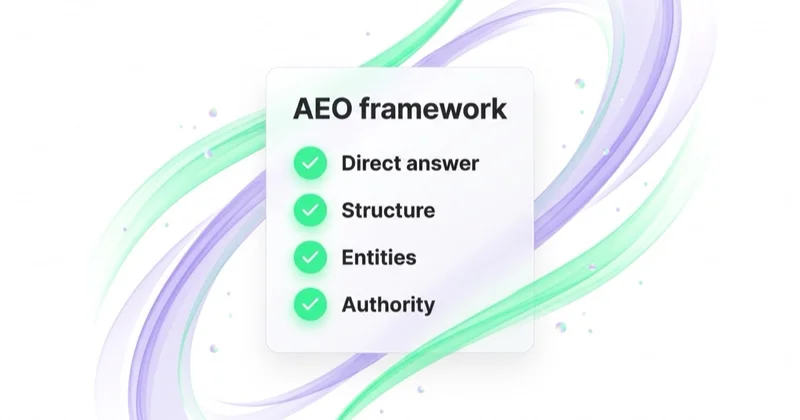
That requires four layers:
- Accessibility: the page can be crawled, indexed, rendered and read.
- Substance: the page adds experience, evidence or analysis beyond a generic summary.
- Clarity: the page explains the subject, conditions and limitations in language the intended reader understands.
- Trust: material claims have identifiable authors, primary sources, current information and a correction path.
AEO is not limited to blog posts. Product pages, service pages, category pages, original research, case studies, documentation, help centers and About pages can all provide the best answer to a specific need. The right page type follows the user's task.
AEO vs GEO vs SEO
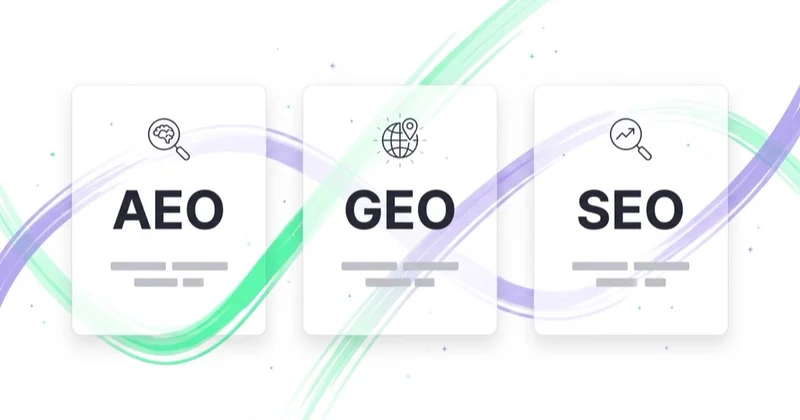
AEO, GEO and SEO are often used as if they were separate channels. In practice, their borders depend on the vendor or team using the term.
| Area | SEO | AEO | GEO |
|---|---|---|---|
| Main emphasis | Discovery and performance in organic search | Visibility in direct or conversational answers | Visibility in generated answers and supporting sources |
| Typical surfaces | Organic listings, rich results, images, video and local results | Featured answers, voice results and AI answer tools | AI Overviews, AI Mode and generative assistants |
| Common work | Technical access, useful content, links, business and product data | Clear factual answers, documentation, crawler policy and answer review | Original evidence, source eligibility, brand accuracy and generative-search measurement |
| Useful metrics | Search impressions, clicks, qualified organic visits and conversions | Answer presence, accuracy, supporting links and assisted demand | Platform reports, answer samples, referrals and business outcomes |
| Important caveat | A ranking does not guarantee a conversion | There is no consistent “answer rank” across tools | Source selection and output can change between runs |
The safest operating model is to treat AEO and GEO as focus areas within search, content and digital PR—not as replacements for them. A team can use a separate workstream and budget, but the technical and editorial foundations remain shared.
The visibility pattern is different. A user may see the brand or supporting link without visiting the site, then search for the company later or return through another channel. That makes description accuracy and assisted demand worth measuring, but it does not justify assigning a monetary value to every mention without evidence.
A procurement test: ignore the label and inspect the work
When comparing an AEO, GEO or AI SEO proposal, ask for concrete answers:
- Which platforms and markets are included?
- Which page groups will be audited or changed?
- What original evidence will be created?
- Which crawler and preview-control decisions are in scope?
- How will duplicate or low-value content be handled?
- What is the answer-sampling protocol?
- Which Search Console and analytics reports will be used?
- How will the team separate visibility from causation and revenue impact?
- Who reviews legal, medical, financial or product claims?
If the answer is mostly “add schema, publish FAQs and track citations”, the scope is too shallow for a premium search strategy.
How answer engines use content
Answer tools differ in architecture, retrieval, source display and publisher controls. A product may use a search index, live web retrieval, licensed data, model knowledge, user-triggered page access or several methods together. Vendors change these systems frequently, so no universal checklist can guarantee inclusion.
When a system retrieves current web information, the workflow commonly involves some combination of:
- understand the user query and intent;
- retrieve or select candidate sources;
- identify information relevant to the whole question or one sub-question;
- compare candidate sources and available evidence;
- synthesize a response;
- decide whether and how to show citations or supporting links.
Google publicly describes query fan-out for AI Overviews and AI Mode: its systems may issue several related searches to address subtopics. This means a useful page can be surfaced for part of a complex question, even if it does not mirror the user's exact wording. It does not mean every paragraph must be engineered as a standalone “chunk”.
Useful editorial patterns include:
- headings that match real user questions;
- concise definitions followed by material conditions and exceptions;
- tables that compare alternatives clearly;
- numbered steps for processes;
- explicit dates and caveats for changing features;
- consistent naming of brands, tools, services and products;
- links to primary sources and a visible “checked as of” date when facts may change;
- first-hand examples, methods or data that distinguish the page from a generic summary.
What makes content ready for AEO?
Content intended for answer-led search should first satisfy the reader. It should resolve the query, show the evidence and make limitations easy to find. A short direct answer may be right for a definition; a complex legal or strategic question may need context before a responsible conclusion.
| Factor | What it means in practice |
|---|---|
| Clear purpose | The page solves one coherent user problem without chasing every keyword variation |
| Original contribution | First-hand evidence, expert reasoning, data or a useful tool adds something new |
| Structure | Headings, paragraphs, lists, tables and visuals are chosen for readability |
| Source support | Changing or technical claims link to official documentation or credible references |
| Authorship and accountability | The reader can identify who created or reviewed the work and how to request a correction |
| Freshness | Dates and limitations appear where features, policies or interfaces change |
| Commercial usefulness | The page helps the reader make a decision, not only learn a definition |
For example, “create high-quality AI-friendly content” is not actionable. A useful service page explains scope, fit, exclusions, process, pricing model, risks, proof and next step in plain language. An expert can then add what commonly goes wrong and how the team knows whether the work succeeded.
A practical AEO framework
The work should start with business questions, not with a generic AI checklist. For a service company, priority questions often cover cost, scope, process, risk, comparison against alternatives and proof of expertise. For e-commerce, they may cover product fit, sizing, materials, delivery, returns, availability, reviews and comparisons. For B2B or SaaS, they often cover integrations, security, implementation, procurement, ROI and switching risk.
A practical workflow:
- Map decision questions. Build a list of questions users ask before they buy, enquire, book a demo or shortlist a vendor.
- Establish a documented answer sample. Record the exact tool, market, prompt, date, login state, answer and linked sources for a small set of representative questions.
- Identify evidence gaps. Determine what useful information existing sources provide that the brand does not: original data, clearer documentation, independent proof or better product detail.
- Prioritize the right page types. Improve the product, service, case study, documentation or editorial page best suited to each need instead of sending every query to a blog post.
- Create non-commodity value. Add first-hand experience, methods, data, examples, useful visuals and explicit limitations.
- Make public facts consistent. Align brand, service, author, location and contact information across relevant owned profiles and pages.
- Support changing claims. Use official documentation, primary research or the underlying dataset, and record when the fact was checked.
- Improve navigation and internal links. Help visitors move between the explanation, evidence and relevant commercial next step.
- Measure with the same protocol. Review platform reports, sampled answers, referrals and qualified outcomes without treating correlation as proof.
This work should be applied at page level. A homepage, service page, case study, documentation page and product category answer different needs. One long blog post cannot do the job of the whole site, but that does not mean every question deserves a new URL. Consolidate pages whose purpose is effectively the same.
Technical foundations for AEO
Technical SEO is not a side issue for AEO. If the important content is blocked, hidden, duplicated or rendered in a way crawlers cannot reliably access, an answer engine has less to work with.
The core checklist:
- pages are indexable and not accidentally blocked by
noindex; - crawling is allowed in
robots.txtand by CDN or hosting settings; - canonical tags point to the intended version of the page;
- important content is available as text, not only as images or client-side widgets;
- internal links expose important pages naturally;
- supported structured data matches the visible content on the page;
- organization, author, product, article and local business details are consistent where relevant;
- sitemap and URL structures are clean enough for discovery.
For Google AI Overviews and AI Mode, a page must be indexed and eligible for a Search snippet to appear as a supporting link. Google's July 2026 guide also says Search does not need llms.txt, AI text files, special Schema.org markup, tiny content chunks or a version rewritten specifically for generative search.
That does not make structured data useless. Supported markup can make a page eligible for relevant Search features. The key rule is accuracy: it should reflect visible page content and follow the documentation for the selected type. Adding every available schema type is not an AEO strategy.
Snippet controls, robots and AI features
AEO also requires deliberate decisions about crawler access and previews. For Google Search, Googlebot plus controls such as nosnippet, max-snippet, data-nosnippet and noindex govern eligibility and how much page content can appear. More restrictive preview settings can reduce visibility in Google's AI features.
The practical question is not "should every site block AI?" It is: which pages should be discoverable, which snippets are commercially useful, and which content has restrictions?
Typical examples:
- a public service page usually benefits from clear snippets and answer visibility;
- a free guide may benefit from citation because it builds demand;
- a paywalled report may need stricter preview controls;
- sensitive legal, medical, financial or proprietary content needs a more cautious policy;
- duplicate or outdated content should not compete with the canonical version.
Non-Google tools need separate policies. OpenAI uses OAI-SearchBot for ChatGPT search and GPTBot for content that may be used to train foundation models; allowing one does not require allowing the other. Perplexity publishes separate search and user-request agents. Security teams should validate user agents against the platforms' current published IP ranges and inspect logs rather than allowlisting a name blindly.
For many commercial sites, the immediate priority is to avoid blocking useful public pages by accident. Training, search discovery and user-requested retrieval are different decisions. Make them with legal, licensing, security and commercial context rather than one blanket “AI bot” rule.
AEO for service businesses, e-commerce and B2B
AEO looks different depending on the business model.
| Site type | What especially helps |
|---|---|
| Professional services | service scope, process, pricing model, credentials, case studies, FAQ, limitations |
| E-commerce | product attributes, category guides, comparisons, stock, delivery, returns, reviews, sizing |
| B2B / SaaS | use cases, integrations, implementation, security, procurement, switching risk, ROI logic |
| Local services | location, service area, opening hours, reviews, contact paths, clear service pages |
| Content publishers | topical hubs, author expertise, original reporting, source transparency, updates |
For e-commerce, AEO is not just a blog exercise. Product feeds, category descriptions, product pages, buying guides, shipping information, return policies and reviews all help answer engines understand whether a product is relevant for a specific need. For B2B, the most useful pages often answer practical buying questions that marketing copy avoids: implementation time, integration limits, contract model, proof, onboarding and risk.
Commercial pages and informational articles should work together. A guide can explain the problem and alternatives. A service page can show scope, process, evidence and next step. A case study can demonstrate real-world application. A healthy AEO cluster makes that path easy to follow.
How to measure AEO
AEO measurement is less stable than classic rank tracking because answers can change with wording, market, account state, context, time and the tool's available sources. A single screenshot is not a measurement system.
Useful metrics include:
| Metric | What it shows |
|---|---|
| Sample presence | How often the brand, domain or page appears in a documented set of answer checks |
| Supporting-source presence | Which owned pages are linked in the sampled answers |
| Description accuracy | Whether the tool describes the brand, offer, limitations and proof correctly |
| AI referral traffic | Visits from tools such as ChatGPT, Perplexity, Copilot and similar systems |
| Search visibility | Standard Search Console performance plus generative AI impressions where the new report is available |
| Lead quality | Whether AI-influenced visits or brand searches create qualified enquiries |
The answer sample should include definitional, comparison, problem, commercial and branded questions. Record the exact prompt, tool, market, date and test conditions. Use the same protocol on each review, while accepting that the sample cannot represent every user or response.
Google began rolling out a dedicated Generative AI performance report in Search Console in 2026. It currently reports AI Overview and AI Mode impressions by page, country, date and device for eligible properties, but rollout is limited. The data is also included in the standard Web search dataset, so do not add the two reports together as separate exposure.
Separate observation from causation. More referrals may reflect broader adoption of an AI tool, while more brand mentions may follow PR, product news or classic SEO rather than an AEO edit. Combine Search Console, analytics, CRM outcomes and qualitative answer review, and state what the evidence can and cannot prove.
Common AEO mistakes
| Mistake | Better approach |
|---|---|
| Treating AEO as a replacement for SEO | Build it on a technically healthy, indexable SEO foundation |
| Rewriting every paragraph into a tiny answer block | Use the structure that best explains the subject to the reader |
Creating llms.txt as the main strategy |
Google Search ignores it; use it only for a documented system that consumes it |
| Adding schema that does not match visible content | Use structured data only when it accurately reflects the page |
| Copying the same FAQ across many pages | Answer genuine follow-up questions once in the most useful location |
| Chasing manufactured mentions | Earn credible coverage and publish verifiable proof |
| Measuring only organic rankings | Add the Generative AI report, answer sampling, referrals and qualified outcomes |
| Promising guaranteed AI citations | Work on probability, quality and measurement rather than fixed guarantees |
How Space Ads approaches AEO
At Space Ads, AEO is treated as a focus area within SEO, content strategy and measurement—not as a standalone trick. The work starts with the questions that appear before a purchase, enquiry or sales conversation, then reviews whether the site provides evidence strong enough to answer them.
The plan then prioritizes the right page type, removes overlap, improves technical access and preview controls, aligns supported structured data with visible content, and adds original proof where the current material is generic. A marketing audit can reveal whether the real blocker is weak evidence, technical access, inaccurate business data, measurement or a commercial page that does not answer the buyer's decision questions.
The goal is not a fixed “AI ranking”. It is to improve eligibility, source quality and accurate representation, then test whether that visibility contributes to qualified traffic, assisted conversions and more informed enquiries.
FAQ
What is Answer Engine Optimization (AEO)?
Answer Engine Optimization (AEO) is an industry term for improving visibility and accuracy in answer-led search experiences. The work can include established SEO, original content, product and business data, crawler policy, digital PR and answer-surface measurement.
Is AEO the same as GEO?
AEO and GEO describe very similar work and have no universal boundary. AEO can include direct-answer formats that predate generative AI, while GEO usually refers specifically to generated outputs. A useful proposal should define platforms, pages, deliverables and metrics instead of relying on either label.
Does AEO replace SEO?
No. For Google, generative search optimization is still SEO because AI Overviews and AI Mode use core Search ranking and quality systems. Other answer tools add platform-specific crawler and measurement decisions, but they do not remove the need for accessible, useful and trustworthy pages.
Does Google require special optimization for AI Overviews or AI Mode?
No. A page must be indexed and eligible for a Search snippet, but Google does not require AI-only schema, special machine-readable files or a special writing style. Eligibility never guarantees that a page will be selected.
Is llms.txt required for AEO?
No. Google's July 2026 guidance says Google Search ignores llms.txt, so it neither improves nor harms visibility in Google Search. Implement the file only if a named service documents that it uses it and someone will keep the contents accurate.
How long does AEO take?
Technical corrections can be deployed quickly, but discovery, recrawling, source selection and business impact do not follow a guaranteed timetable. Timing depends on the platform, site, query set, competitive evidence and scale of the change. A responsible proposal defines review intervals, not a promised citation date.
How should AEO be measured?
Use Search Console—including the Generative AI report where available—analytics, qualified conversions and a documented sample of answers across relevant tools. Record test conditions and description accuracy. Treat answer presence as sampled visibility, not a universal rank, and do not infer revenue causation from a mention alone.
Key takeaways
- AEO is an industry label whose scope must be defined in concrete deliverables.
- AEO and GEO overlap, while established SEO remains the technical and quality foundation.
- Original evidence, accurate business data and a satisfying answer matter more than a rigid “AI-friendly” template.
- Google Search ignores
llms.txtand does not require special AI schema, chunking or AI-only copy. - Measurement should combine platform reports, a documented answer sample, analytics and qualified outcomes.
- No agency can guarantee a citation or fixed position in a generated answer.
Sources and further reading
- Google Search Central - Optimizing for generative AI features in Google Search
- Google Search Console - Generative AI performance report
- Google Search Central - AI features and your website
- Google Search Central - Creating helpful, reliable, people-first content
- Google Search Central - Robots meta tag,
data-nosnippet, andX-Robots-Tag - Google Search Central - Structured data general guidelines
- OpenAI - Overview of OpenAI crawlers
- Perplexity - Perplexity crawlers
- Aggarwal et al. - GEO: Generative Engine Optimization
Continue learning
Continue reading
Generative Engine Optimization: How Brands Get Mentioned in AI Search Results
Generative Engine Optimization helps brands become useful, verifiable sources for AI-generated search experiences. Learn what GEO can influence, what it cannot guarantee and how to measure visibility without mistaking a single answer for a ranking.

LLM SEO: How to Make Your Brand Easier for AI Tools to Cite
LLM SEO helps language models understand, describe and cite a brand correctly. This guide covers entities, crawlability, answer-ready content, sources, prompt monitoring and commercial paths.
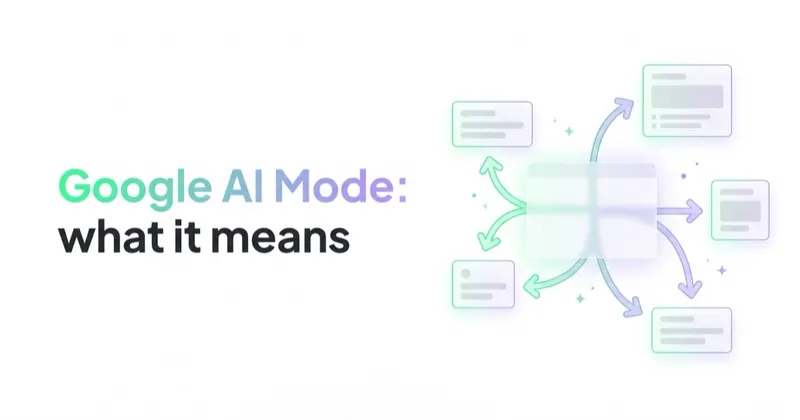
Google AI Mode: What It Is and What It Means for Your Brand's Visibility
Google AI Mode is Google's conversational and increasingly agentic Search experience. Learn how query fan-out, personalization, links, ads and new 2026 reporting affect brand visibility—and what Google actually recommends website owners do.