Google AI Mode is Google's conversational and increasingly agentic experience inside Search. It can divide a complex question into subtopics, issue several searches, synthesize a response and show links for further exploration. Users can continue with follow-up questions and, where available, provide images, files, videos or other contextual inputs.
By July 2026, AI Mode is no longer a small experimental tab. Google reports more than one billion monthly users and made Gemini 3.5 Flash the default AI Mode model globally in May. Google is also rolling out information agents, broader personal context and agentic booking or shopping capabilities. Availability still varies by country, language, account, subscription and experiment, so brands should verify the experience in each target market rather than plan from a U.S. screenshot.
This topic connects directly with Answer Engine Optimization, AI Overviews and GEO and the broader shift toward conversational search.
TL;DR
- Google AI Mode is a conversational Search experience. It supports complex questions, comparisons, planning, follow-ups and increasingly multimodal or agentic tasks.
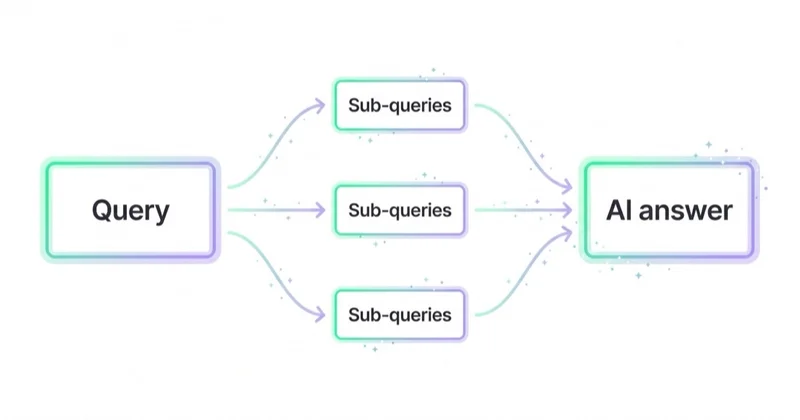
- The key mechanism is query fan-out. Google can break one question into related sub-searches across subtopics and data sources, then synthesize the response.
- The boundary with AI Overviews is becoming less rigid. An AI Overview can flow directly into an AI Mode conversation while retaining context, but the interfaces and reporting concepts remain distinct.
- AI Mode is not Google AI Max for Search. AI Max is a Google Ads feature for Search campaigns. AI Mode is a user-facing search experience.
- There is no magic technical shortcut. Google says standard SEO best practices remain relevant for AI features in Search and that no special AI files or schema are required.
- Website owners gained new controls and reporting in June 2026. Google is testing an opt-out toggle and dedicated generative AI impression reports with subsets of properties.
- Shopping has additional data requirements and reports. Product feeds, Merchant Center's new conversational attributes and AI performance pilot matter alongside page content.
- A prompt check is not a rank. Personalization, model changes, market, language, conversation history and generated variation affect what appears.
What is Google AI Mode?
Google AI Mode lets users express a need in natural language and continue refining it. Someone might ask: “Should a new fashion ecommerce brand start with Google Ads, SEO or Meta Ads if launch is two months away and the budget is limited?” AI Mode may explore several aspects and return a response with inline links, source previews and suggestions for further research.
Google says the experience combines Gemini capabilities with its Search systems and information such as web, real-world and shopping data. As of May 2026, Gemini 3.5 Flash is the default AI Mode model globally. The Search box is also becoming multimodal, with support rolling out for inputs such as text, images, files, video and Chrome tabs.
AI responses can still be wrong. Google states that AI Mode may show a set of web links instead of an AI response when confidence in the response's quality or helpfulness is not high enough. High-stakes decisions still require verification against the original source, professional advice where appropriate and current terms or availability.
From answers to actions
AI Mode increasingly does more than summarize information. Google has announced information agents that monitor changing information, agentic booking flows for categories such as local services and experiences, and shopping journeys that can progress toward checkout. For a brand, this raises the importance of accurate availability, location, product, price, policy and booking data. A persuasive article cannot compensate for a closed location, stale feed or unavailable appointment.
How query fan-out works
Query fan-out is the technique that makes AI Mode strategically important for SEO and AEO. Instead of treating one user question as one keyword, Google can split the question into multiple related searches across subtopics and data sources.
For example, the system might explore subtopics such as:
| User question | Possible subtopics |
|---|---|
| "Should I choose Google Ads or SEO for a new store?" | time to results, margin, search demand, new-domain risk, seasonal pressure, tracking setup |
| "What marketing agency fits a premium fashion brand?" | premium experience, creative quality, paid media mix, reporting, case studies, discount risk |
| "How should a footwear brand grow in Europe?" | sizing, product feed, localization, returns, drop strategy, marketplaces, creators |
These subtopics are illustrative; website owners do not receive a complete log of fan-out queries. The editorial implication is to resolve connected user questions where they naturally belong—not to repeat every phrase on one oversized page. Use a central guide, focused supporting pages and accurate commercial information when each serves a distinct decision.
AI Mode vs AI Overviews vs Google AI Max
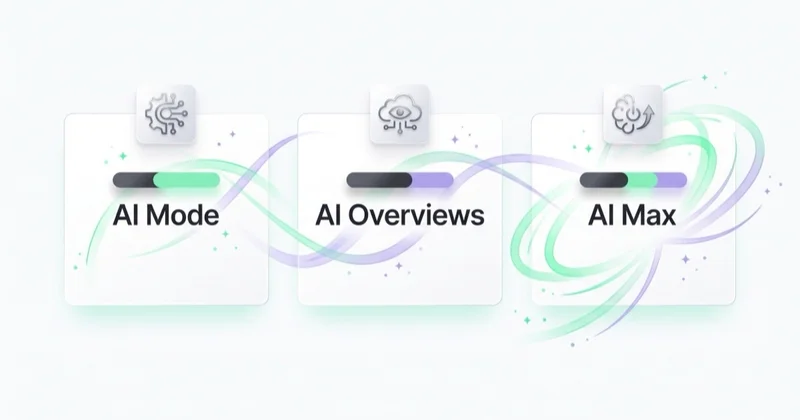
These names are similar, but they refer to different parts of Google's ecosystem.
| Area | What it is | Main brand implication |
|---|---|---|
| AI Overviews | Generated responses that can appear in standard Search results | Supporting links, organic impressions and changed exploration behavior |
| Google AI Mode | A conversational Search experience with follow-ups, query fan-out and emerging agents | Links, comparisons, recommendations and action-oriented journeys |
| Google AI Max for Search | A Google Ads feature set for Search campaigns | Matching, text customization and final URL expansion in paid Search |
AI Overviews and AI Mode are user-facing Search experiences. AI Max is an advertiser configuration. An ad can also appear in an AI experience where Google has made the format and advertiser eligible, but paid inclusion is marked as sponsored and is not the same as earning an organic supporting link.
What changes for SEO, AEO and LLM visibility
Google's documentation for AI features says the same fundamental SEO practices remain relevant: pages should meet Search technical requirements, follow policies, be useful to people, be crawlable, use internal links, provide important content as text and keep structured data aligned with visible page content. Google also states that there are no special AI text files or special schema.org structured data required to appear in AI Overviews or AI Mode.
That does not mean every existing page is sufficient. It means improvements should solve recognizable Search and user problems rather than invent a technical ritual.
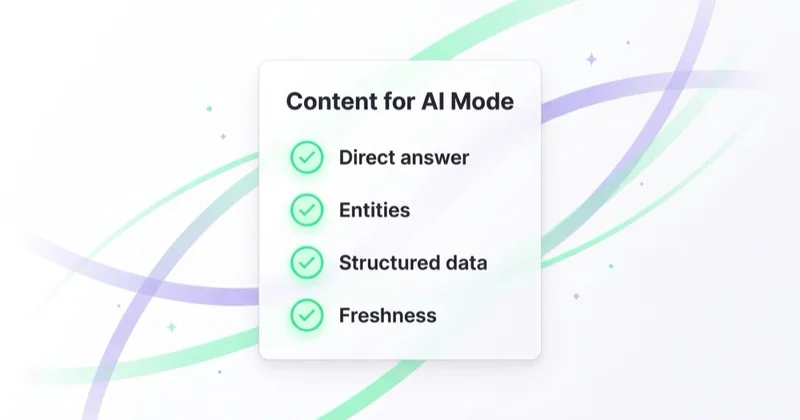
Content prepared for Google AI Mode should:
- answer the question directly before adding context;
- include definitions, comparisons, examples, limitations and exceptions;
- show decision logic, not only generic tips;
- use clear headings that match real sub-questions;
- link to relevant service pages, case studies, guides, product categories or audit pages;
- include primary sources, applicable dates and caveats where the topic changes;
- make important information available as crawlable text;
- keep controlled facts consistent: company name, services, authors, locations, product names and current availability.
Do not describe these practices as disclosed AI Mode ranking factors. They improve content quality and make information easier for people and systems to interpret; Google does not guarantee that a compliant page will be crawled, indexed, linked or shown.
What AI Mode means for brand visibility
AI Mode can shape a decision before a site visit. It can also personalize parts of the experience. Google expanded opt-in Personal Intelligence in 2026, allowing eligible users to connect services such as Gmail and Google Photos. This makes a single “neutral” prompt check even less representative of every customer's result.
Brands should therefore think about four visibility goals:
- Accurate representation. Controlled pages should state the offer, eligibility, locations, price logic and limitations unambiguously.
- Useful discovery. Educational and commercial pages should answer genuine category and decision questions with appropriate evidence.
- Verifiable proof. Case studies need context and methodology; reviews and independent coverage should be authentic.
- Action-ready data. Products, appointments, shipping, returns and availability should remain current in the systems Google can use.
- Relevant next steps. A supporting link should lead to the page that fulfills the expectation, not a generic homepage or forced lead form.
The balance differs by category. A B2B buyer needs scope, integration and procurement information. An ecommerce shopper needs variants, price, delivery and returns. A local-service user needs geography, credentials, real availability and a reliable booking route.
How to prepare content for Google AI Mode
Start with questions, not only keywords.
For each important service, product category or market segment, map:
- definition questions: "what is it," "how does it work";
- decision questions: "is it worth it," "when not to use it," "who is it for";
- comparison questions: "A vs B," "alternatives," "pros and cons";
- commercial questions: "price," "scope," "timeline," "risks";
- proof questions: "case studies," "examples," "how to measure";
- implementation questions: "step by step," "checklist," "common mistakes."
Then close the content gaps.
| Content gap | Why it hurts in AI Mode | Better approach |
|---|---|---|
| Generic article with no position | The system has little to cite beyond a definition | State when an option makes sense and when it does not |
| Unsupported current claims | Users cannot verify platform, legal or technical information | Cite the primary source and state its applicable date |
| No commercial path | Visibility does not turn into leads or sales | Link to service pages, audits, categories and case studies |
| No first-hand value | The page repeats commodity summaries | Add original data, tested methodology, examples and limitations |
| Important content hidden in images or scripts | Crawlers may not access the answer reliably | Publish key information as text HTML |
The goal is not to make every article huge or generate an FAQ for every synonym. The goal is to resolve the decision completely enough for the intended reader and connect to a more specialized page when necessary.
Product and local data now matter more
For ecommerce, page copy is only one input. In 2026 Google added optional Merchant Center conversational attributes, including product questions and answers, related products, documents, item-group titles and variant options. Use them to supplement accurate core product data, not duplicate or contradict descriptions. The 2026 specification also introduced video_link and additional shipping fields, with video serving and quality validation beginning on 30 June 2026.
Merchant Center is also piloting AI performance insights for a limited number of U.S. accounts, with more countries announced. The report focuses on organic AI shopping visibility, query themes, journey stages and structured attribute gaps; it does not include paid traffic and its comparison set has limitations.
For local and bookable services, maintain accurate Business Profile details, opening hours, service areas, booking destinations and availability with the relevant provider systems. Because AI Mode can support agentic actions, an inconsistency can now interrupt the transaction—not just create a poor snippet.
Paid search and Google AI Mode
AI Mode includes both organic and commercial opportunities. Google has tested ads inside or below AI Mode responses and in 2026 described new sponsored retailer formats and Direct Offers. Availability depends on market, account, campaign and ongoing tests; brands should not assume every Search or Shopping campaign receives AI Mode distribution.
For advertisers, the key actions are:
- Keep Search measurement clean. Campaigns should not optimize toward weak forms, accidental calls or micro-conversions that do not correlate with revenue.
- Use reliable conversion values. E-commerce and lead generation accounts need value signals that reflect margin, lead quality or customer value where possible.
- Maintain feed quality. Product titles, categories, availability, pricing, images, variants and landing pages provide context for automated systems.
- Separate AI Mode from AI Max. AI Max changes eligible Search campaigns; it does not buy an organic source link or guarantee an AI Mode placement.
- Review landing pages. Conversational queries often reveal more specific needs; weak or generic pages waste that intent.
Evaluate paid AI formats using realized conversion value and incrementality where feasible. A placement being new does not make it valuable by default. Keep the feed, landing experience, consent, measurement and post-purchase adjustments accurate before assigning more budget.
How to measure AI Mode visibility
Measurement is different from classic rank tracking because answers vary with query wording, follow-up context, location, language, model, interface, account settings and time. One screenshot is an observation, not a stable position.
Use a combined measurement layer:
| Area | What to measure |
|---|---|
| Answer visibility | Whether the brand or URL appears for priority questions |
| Description accuracy | Whether the offer, specialization and limitations are described correctly |
| Source type | Which URLs appear: blog, service pages, case studies, third-party mentions |
| Google AI impressions | Pages, countries, devices and dates in the dedicated test report, where available |
| Search demand | Overall Search Console exposure and clicks without double-counting AI impressions |
| Lead or sales quality | Whether visibility leads to audits, enquiries, qualified leads or purchases |
| Sampled presence | Brand and supporting links across a documented, repeated prompt sample |
In June 2026, Google began testing dedicated generative AI reports in Search Console. They expose impressions for AI Overviews and AI Mode, with page, country, device and date dimensions, to a subset of sites. The data remains included in the overall Web report. The dedicated report is therefore a diagnostic view, not extra impressions to add to the total and not a complete revenue-attribution system.
Track clusters of questions, not a single prompt. Record the account state, personalization, country, language, device, date, exact prompt, visible links and answer accuracy. Repeat the sample, but do not call sampled presence “share of search” unless the methodology actually supports that metric.
The new Search generative AI control
Google also began testing a Search Console toggle in June 2026 that lets website owners opt their site out of generative AI Search features. The initial rollout covers a subset of UK site owners. Google says opted-out sites will not receive traffic or impressions from those generative features, and the control is not used as a ranking signal outside them. Treat this as a product and governance decision with a measurable trade-off, not a routine SEO setting.
How Space Ads approaches Google AI Mode
At Space Ads, we treat AI Mode as part of Search visibility and customer acquisition, not a standalone channel with a guaranteed rank. We map the questions and actions that precede purchase: eligibility, cost, risk, alternatives, proof, timeline, availability and criteria for choosing.
The audit covers normal Search eligibility, content and evidence, internal journeys, controlled brand facts, product or local data and available AI reporting. On the paid side, it covers campaign eligibility, feeds, landing pages, conversion quality and realized values. We use prompt observations as qualitative evidence and platform reports as quantitative evidence within their stated limits.
For existing websites, a marketing audit can show whether the main gap is content quality, technical accessibility, weak service pages, missing case studies, poor internal links, tracking quality or paid search setup. The objective is not a mythical fixed "AI Mode rank." The objective is repeated visibility for priority questions, accurate brand description and more qualified demand.
Common mistakes
| Mistake | Why it hurts | Better approach |
|---|---|---|
| Confusing AI Mode with AI Max | Mixes SEO/AEO work with Google Ads configuration | Separate organic visibility from paid automation |
| Writing for one head keyword | Query fan-out works across subtopics | Build question clusters and answer gaps |
| Adding "AI" to titles without substance | It does not improve usefulness or citation value | Add concrete answers, sources, examples and limitations |
| Hiding key content in images | Important details may be hard to crawl or extract | Publish key information as text |
| Calling a prompt screenshot a ranking | Results vary by context, model and time | Use a documented repeated sample and state uncertainty |
| Ignoring product or availability data | Agentic journeys can fail after discovery | Maintain feeds, profiles, policies and booking paths |
| Assuming all AI impressions are new | Dedicated report data is included in overall Web data | Use it as a filtered diagnostic view |
| Treating clicks as the only signal | Some influence occurs without a visit | Track impressions, links, accuracy and business outcomes |
| No commercial path | AI visibility does not become revenue | Link to service pages, audits, case studies and contact routes |
FAQ
What is Google AI Mode?
Google AI Mode is a conversational experience in Google Search for complex questions, follow-ups and increasingly multimodal or agentic tasks. It uses Gemini capabilities and Google's Search systems to generate responses and provide links for exploration.
How does query fan-out work?
Query fan-out means Google can divide a question into subtopics and issue several related searches. Website owners do not receive a complete list of those generated queries. Build connected, useful resources around real user decisions rather than trying to predict and repeat every wording.
How is AI Mode different from AI Overviews?
AI Overviews can appear within standard results; AI Mode supports a continuing conversation and deeper exploration. Since 2026, users can move directly from an AI Overview into AI Mode with context preserved, so the experiences are more connected even though they remain distinct features.
Is Google AI Mode the same as Google AI Max for Search?
No. Google AI Mode is a user-facing Search experience. Google AI Max for Search is a Google Ads feature set for Search campaigns, matching, creative support and landing page expansion. AI Mode is a visibility and content topic; AI Max is a paid campaign management topic.
Are special files required for AI Mode?
No. Google says no special AI file, schema.org markup or additional technical requirement is needed. A page must be indexed and eligible to appear in Search with a snippet, and structured data should match visible content. Eligibility does not guarantee inclusion.
Will AI Mode reduce SEO traffic?
It can change impressions, clicks and the path to a website, but the effect differs by query and site. Use the dedicated generative AI report when available, overall Search data, onsite behavior and business outcomes. Do not infer total impact from a handful of prompts or industry-wide click studies.
How should a brand prepare for Google AI Mode?
Keep standard Search eligibility healthy; answer material buyer questions with evidence; maintain product, local and booking data; connect educational and commercial pages; and establish reliable conversion values. Then monitor the available platform reports and a documented prompt sample.
Can a website opt out of AI Mode?
Google began testing a Search generative AI control in Search Console in June 2026. For participating properties, opting out removes the site from generative AI Search features and their associated traffic and impressions, without affecting ranking signals outside those features. Availability is still limited, so check the current property settings and documentation.
Key takeaways
- Google AI Mode is a conversational, multimodal and increasingly agentic Search experience.
- Query fan-out breaks questions into subtopics, but marketers cannot see or control every generated search.
- AI Mode, AI Overviews and Google AI Max are different: search conversation, SERP AI summaries and Ads automation.
- There is no magic file or schema for AI Mode; standard SEO and helpful content remain the foundation.
- In 2026, selected properties gained dedicated AI impression reporting and an opt-out control; Merchant Center also began piloting AI shopping insights.
- Brands should measure platform impressions, link and description accuracy, qualified visits and realized business outcomes.
Sources and further reading
- Google Search - I/O 2026 updates: a new era for AI Search
- Google Search - New controls and insights for website owners
- Google Search - New ways to explore the web with generative AI
- Google Search Central - AI features and your website
- Google Search Central - Generative AI performance reports in Search Console
- Google Merchant Center - Use conversational attributes
- Google Merchant Center - About AI performance insights
Continue learning
Continue reading

LLM SEO: How to Make Your Brand Easier for AI Tools to Cite
LLM SEO helps language models understand, describe and cite a brand correctly. This guide covers entities, crawlability, answer-ready content, sources, prompt monitoring and commercial paths.
Generative Engine Optimization: How Brands Get Mentioned in AI Search Results
Generative Engine Optimization helps brands become useful, verifiable sources for AI-generated search experiences. Learn what GEO can influence, what it cannot guarantee and how to measure visibility without mistaking a single answer for a ranking.

AI SEO: How to Optimize for Search Engines, AI Overviews and LLMs
AI SEO applies proven SEO principles to Google AI Overviews, AI Mode and answer tools. Learn what improves visibility, what Google says to ignore, how crawler controls differ and how to measure results without inventing an ‘AI ranking’.