Google Ads and SEO can both make a business visible when people search Google, but they are not interchangeable. Google Ads buys eligible auction exposure and gives the advertiser direct control over bids, budget, targeting, ad assets and landing pages. SEO improves a site's eligibility and usefulness in organic Search through technical accessibility, content, site architecture, reputation and ongoing maintenance.
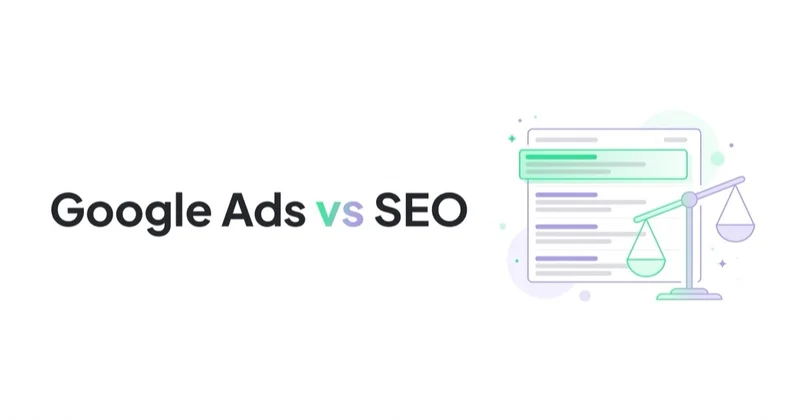
Neither mechanism guarantees visibility or profitability. An approved ad can still lose the auction or attract the wrong click. An indexable page can still fail to rank, lose visibility or receive impressions without qualified visits. The useful questions are: which searches justify paid coverage now, which needs deserve a durable organic resource, and where does an ad add incremental business rather than reassign credit for demand that already exists?
This article focuses on Google-specific paid and organic visibility. For the broader discipline-level comparison across paid media and organic search, see PPC vs SEO.
TL;DR
- Google Ads offers faster activation and more direct control. It is useful for high-intent demand, bounded offer tests, new pages and time-sensitive campaigns, but results still depend on review, auctions, data and conversion lag.
- SEO can create durable visibility, not free traffic. Content and technical improvements may continue producing value without a media charge per click, but they require investment and can lose visibility.
- Many—not all—businesses benefit from both. The mix should follow search demand, economics, content opportunity and operational capacity.
- Bidding where SEO already ranks is not always waste. It can defend brand, control messaging and own more of the page, but it should be tested for incrementality.
- Brand Search needs separate reporting. Branded paid search often looks efficient because it captures demand created elsewhere.
- AI features change both visibility and measurement. Google says normal SEO practices still apply and in June 2026 began testing dedicated generative AI impression reports in Search Console.
- Paid data can inform SEO, but it is incomplete. Search-term reports contain queries used by a significant number of people and omit some low-volume terms for privacy.
How Google Ads and SEO share the Google results page
Google results are no longer a simple list of ten blue links. Depending on the query, the page may include text ads, Shopping results, Maps, organic listings, videos, images, People Also Ask, featured snippets, product grids, AI Overviews and other search features.
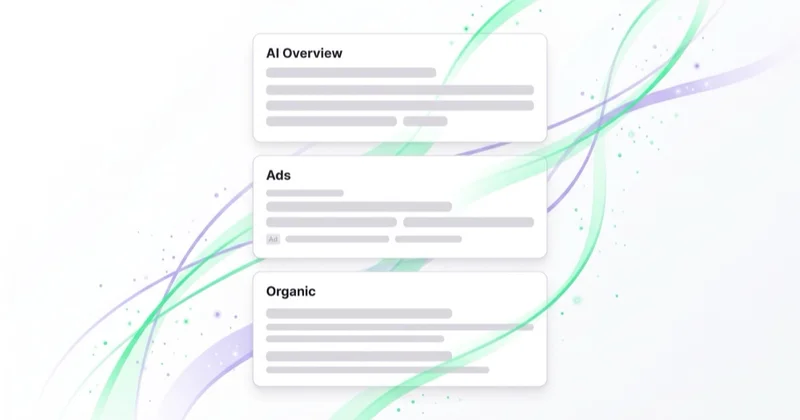
Google Ads can enter paid auctions once the campaign, account, assets and policies are ready. Delivery and useful learning can still take time. Organic visibility depends on crawling, indexing and Google's query-specific serving systems; there is no fixed “weeks or months” timetable and no amount of compliant SEO work guarantees ranking.
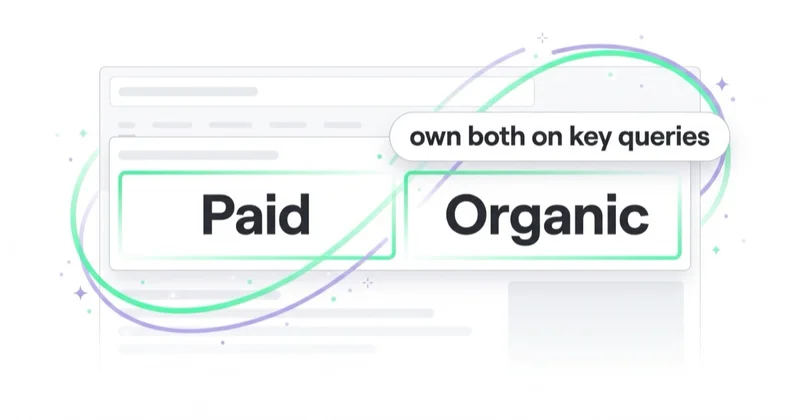
Paid and organic visibility are not mutually exclusive. A brand may appear in an ad, an organic result, a product result, a local listing or a supporting link in a generated answer. More coverage can add qualified demand, but it can also concentrate several forms of credit on the same customer. Only an appropriate test—not the number of reported touchpoints—can estimate the incremental effect.
Google Ads vs SEO at a glance
| Area | Google Ads | SEO |
|---|---|---|
| Mechanism | Paid ad auction | Organic search visibility |
| Activation | Eligible traffic can begin relatively quickly | Timing is uncertain and depends on crawling, competition, site and demand |
| Cost base | Media, management, creative, landing pages and measurement | Research, content, engineering, digital PR, tools and maintenance |
| Control | High control over copy, landing page, targeting and budget | Influence over title, snippet and rankings, but no full control |
| Durability | Auction exposure stops when campaigns stop; learning and brand effects may remain | Pages can continue earning visibility but rankings and SERP layouts change |
| Best use | High-intent capture, testing, launches, non-rankable terms | Durable coverage, authority, informational and long-tail demand |
| Main risk | Rising CPC, weak tracking, brand cannibalization | Slow payback, algorithm changes, SERP changes |
Google Ads is a controllable distribution system; SEO improves an owned site's access to organic discovery. Compare the total cost and business value of covering a query group, not merely CPC against “free clicks.”
Decide by query intent
A practical way to choose the channel is to map search intent.
| Query type | Example | Primary role |
|---|---|---|
| Brand | brand name, store name, own product name | Accurate owned pages as the base; test whether ads add value |
| Transactional | "buy," "price," "Google Ads agency," "near me" | Google Ads now; SEO in parallel |
| Comparison | "Google Ads vs SEO," "best agency for..." | Decision content, sometimes Search and selective remarketing |
| Problem-led | "why are my Google Ads not converting" | Expert content, diagnosis, lead capture, remarketing |
| Informational | "what is AEO," "how SEO works" | SEO, AEO and LLM visibility; paid only selectively |
| Local | "dentist in Austin," "bike repair near me" | Google Ads + local SEO + Google Business Profile |
| Product research | "best trail running shoes for flat feet" | SEO, Shopping, remarketing and feed-led paid search |
Intent labels are a planning aid, not proof. The same query can mean research, purchase, support or navigation depending on the user and context. Verify the actual search terms, landing behavior and downstream outcomes.
Should a business bid on keywords it already ranks for?
This is the most practical Google Ads vs SEO question. A business ranks organically for its brand, category or product. Should it still pay for the same keyword?
Reasons to bid:
- Brand defense. If competitors appear on the brand name, an ad may protect the click and control the first message.
- Landing page control. Organic results may lead to the homepage, while an ad can send users to a specific offer, category, form or campaign page.
- SERP coverage. Paid plus organic can occupy more space and reduce competitor visibility.
- Commercial segmentation. The same keyword may include research, buying, support, comparison and local intent; paid landing pages can segment better.
- Time-sensitive messaging. Ads can show offers, availability, event information or launch copy faster than organic snippets.
Reasons not to bid:
- Cannibalization. The ad may buy clicks the organic result would have earned.
- Inflated brand ROAS. Brand campaigns often look highly profitable because they capture existing demand.
- Budget distraction. Money spent on easy brand traffic may not reach new customers, non-brand queries or remarketing.
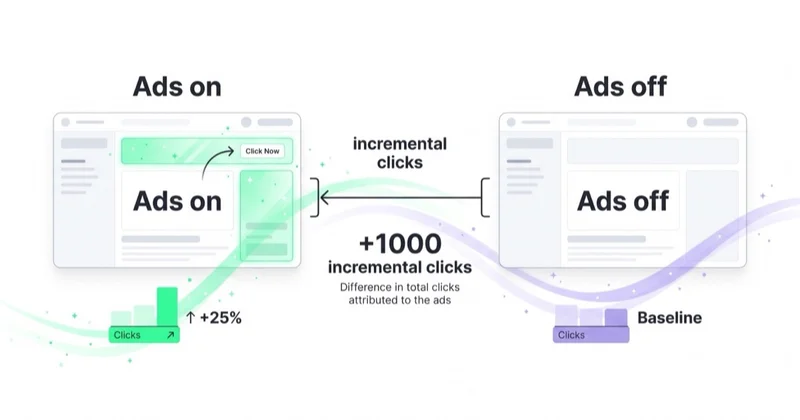
The right answer is an incrementality test designed around the available scale. Where feasible, compare equivalent geographic markets, query or product groups, or randomized treatment and control conditions. A simple “ads on this month, off next month” comparison is vulnerable to seasonality, promotions, competitor changes and shifts in demand. Measure combined paid and organic outcomes, confidence intervals and downstream value—not just brand CPC.
When Google Ads is the right lever
Google Ads is useful when the business needs faster market access, controlled messaging or bounded commercial learning.
Use it for:
- new offers or new websites where SEO has not built visibility yet;
- high-intent queries with commercial language;
- local, urgent or appointment-driven searches;
- seasonal campaigns, promotions, launches and short windows;
- landing-page and offer testing when traffic is sufficient for a meaningful comparison;
- categories where organic rankings are too competitive to wait for;
- high-value conversions where a higher click cost can still work.
The condition is measurement quality. Separate purchases, qualified leads and completed bookings from page views, weak forms, accidental calls and duplicated events. Adjust values for cancellations or returns where possible. Otherwise automated bidding can pursue the easiest recorded action rather than the outcome finance recognizes.
When SEO is the right lever
SEO is useful when the business can create a genuinely better resource or commercial page for recurring demand and maintain it over time.
Use it for:
- informational and long-tail queries that are too broad or expensive to buy;
- comparison content that helps buyers choose;
- service pages that explain scope, process, pricing logic and proof;
- category and product pages for durable ecommerce demand;
- expert content that supports sales, trust and answer-engine visibility;
- reducing exposure to paid-auction economics for queries where organic visibility is achievable;
- building authority around a stable offer or category.
The page, data and internal knowledge become owned assets; the ranking does not. Google describes SEO as helping search engines understand content and users decide whether to visit. Build for the decision after the click as well as for the result: accurate scope, evidence, limitations, price logic and a relevant next step.
How AI Overviews and AI Mode change the decision
AI features change the Search page because some queries receive generated answers with supporting links. Click behavior can change by query, but a site still needs normal Search eligibility. Google says no special schema, AI text file or additional technical requirement is needed for AI Overviews or AI Mode.
The practical implication:
- paid Search still matters for high-intent commercial queries;
- SEO still builds crawlable, useful and trusted content;
- GEO and AEO are useful planning labels for accurate, useful answers, but they do not replace SEO eligibility;
- content needs clear answers, appropriate evidence, internal links and a structure that serves the reader;
- snippet controls, indexability and technical SEO should be intentional.
In June 2026, Google announced dedicated generative AI performance reports for a subset of Search Console properties. The initial Search report exposes impressions for AI Overviews and AI Mode with page, country, device and date dimensions. That data remains part of the overall Web performance report, so it should not be added to the total as separate exposure. For more on the answer layer, see Answer Engine Optimization and Google AI Mode.
How to combine Google Ads and SEO
The best strategies treat Google Ads and SEO as one visibility system.
- Use Google Ads to capture demand now. Search, Shopping, Performance Max or local campaigns can work on queries that can generate leads or sales immediately.
- Use paid search data as one SEO input. Visible search terms, conversion value, qualification and landing-page behavior can identify promising needs, but the report is not a complete query universe.
- Build organic coverage around high-value intent. Service pages, category pages, comparison articles, guides and FAQ content should answer queries that paid data proves valuable.
- Connect Search Console, analytics, CRM and finance. Search Console reports Search exposure; analytics reports observable journeys; CRM and commerce systems report qualification, sales and adjustments.
- Reallocate through controlled evidence. If organic coverage grows, test paid reductions or alternative uses of the budget without assuming that organic automatically replaces every paid conversion.
- Protect priority SERPs. For the most important queries, paid and organic together may be worth more than either alone.
Example: visible Ads search terms and CRM records show that questions about Google Ads audit costs repeatedly produce qualified opportunities. Build a page that explains price logic, scope, inputs, limitations and deliverables. Continue paid coverage while the organic page is evaluated, then test combined performance rather than assuming one channel replaces the other.
A 90-day combined plan
| Period | Google Ads work | SEO work | Shared measurement |
|---|---|---|---|
| Days 1-30 | Launch or clean high-intent campaigns; split brand and non-brand | Technical audit, page inventory, intent map | Define source of truth, conversions and lead quality |
| Days 31-60 | Review search terms, CPA, value and landing page data | Build or improve pages for proven intent clusters | Compare paid + organic visibility by query group |
| Days 61-90 | Design overlap or brand tests where volume permits; refine budgets | Publish decision pages and improve internal links | Evaluate combined qualified outcomes, contribution and uncertainty |
This sequence avoids two extremes: waiting for SEO while demand is available now, or spending indefinitely on paid clicks without building organic assets.
How Space Ads approaches Google Ads vs SEO
At Space Ads, we evaluate paid and organic Search through acquisition economics and the buyer's decision, not a channel quota. We first establish what the conversion system measures, which outcomes have business value, where organic visibility exists and where a query-to-page mismatch loses qualified demand.
Paid search provides fast, controlled distribution and directional intent data. SEO provides the opportunity to build useful, maintained resources for recurring demand. For brand and overlap terms, we distinguish platform attribution from incremental business. For content, we ask whether the page resolves a buyer's question with evidence rather than repeating definitions already available everywhere.
This model connects Google Ads, performance marketing, SEO audit, Search Console analysis and marketing audit. The goal is not to win the argument "ads or SEO." The goal is to stop overpaying for easy demand while avoiding passive waiting where paid search could create revenue faster.
Common mistakes
| Mistake | Why it hurts | Better approach |
|---|---|---|
| Judging everything by last click | Paid, SEO, brand and remarketing influence each other | Use combined paid + organic measurement |
| Mixing brand and non-brand Search | Brand campaigns can hide weak acquisition | Separate reporting and budget decisions |
| Buying informational queries like sales queries | Budget goes to research-stage users | Serve education with SEO and remarketing |
| Expecting instant SEO | Organic visibility needs time and maintenance | Use Google Ads while SEO matures |
| Treating organic clicks as free | Research, production, engineering and maintenance disappear from ROI | Compare fully loaded cost and contribution |
| Treating every Ads query as SEO demand | Search-term reporting is incomplete and campaign-shaped | Combine Ads, Search Console, customer and sales evidence |
| Publishing content without experience | Thin pages do not support trust or conversion | Add first-hand expertise, evidence and real decision support |
| Ignoring landing page CRO | Traffic cannot fix unclear offers | Improve page clarity, proof and next step |
| Never testing brand bidding | Spend may buy clicks organic would have earned | Use holdouts and total SERP impact |
FAQ
What is the difference between Google Ads and SEO?
Google Ads buys eligible exposure in Google's advertising auctions and gives direct control over budgets, targeting, assets and landing pages. SEO improves a site's eligibility and usefulness in organic Search through technical, editorial and reputational work. Organic clicks do not carry a media fee, but SEO still has production and maintenance costs.
Is Google Ads or SEO better?
Neither is universally better. Google Ads fits faster distribution, controlled tests and time-sensitive or high-intent demand. SEO fits recurring demand where the company can create and maintain a useful resource. Many businesses combine them, but the mix should be justified by economics and opportunity.
Should I use Google Ads if I already rank organically?
Sometimes. Ads may add message control, route users to a better destination or counter competing offers. They may also buy clicks organic results would have earned. Use a well-designed overlap test where scale permits, and compare combined qualified outcomes rather than paid ROAS alone.
Does Google Ads improve SEO rankings?
No. Running Google Ads does not directly improve organic rankings. It can help SEO indirectly by revealing search terms, conversion rates, landing page performance, customer language and valuable intent clusters. That data can make the SEO roadmap more commercial and less dependent on keyword volume alone.
How do AI Overviews affect Google Ads vs SEO?
AI Overviews and AI Mode can change exposure and click behavior. Google says standard SEO practices and Search eligibility still apply, with no special AI schema required. Its 2026 generative AI report gives some properties a separate view of impressions, which should be read alongside overall Search, onsite and business outcomes.
What should a business do first with a limited budget?
Start with the customer journey, measurement and the narrowest valuable demand. A bounded Google Ads test can provide faster evidence while essential technical and commercial pages are improved. Do not spread a small budget across paid campaigns and a large publishing calendar without enough capacity to learn from either.
Key takeaways
- Google Ads vs SEO is a decision about channel role, not a permanent winner.
- Google Ads provides faster controlled distribution; SEO can build durable organic discovery, but both require investment and maintenance.
- Brand bidding and organic overlap should be tested incrementally.
- Google Ads data should inform—not dictate—the SEO roadmap; organic performance should influence paid tests.
- AI Search increases the value of useful, expert, structured content rather than removing the need for SEO.
Sources and further reading
- Google Ads Help - Your guide to Google Ads
- Google Ads Help - About conversion measurement
- Google Ads Help - About the search terms report
- Google Ads Help - About Conversion Lift
- Google Search Central - SEO Starter Guide
- Google Search Central - AI features and your website
- Google Search Central - Generative AI performance reports in Search Console
Continue learning
Continue reading
PPC vs SEO: What to Choose, How to Measure and When to Combine Both
PPC vs SEO is not a channel popularity contest. PPC buys controlled demand now; SEO builds durable organic visibility. This guide shows how to choose and combine them using margin, LTV, payback period, intent, measurement quality and AI search risk.
Who Owns Your Google Ads, Meta, and GA4 When You Leave an Agency?
Your company should control its ad and analytics assets while the agency receives revocable access. This guide separates legal rights, platform roles, billing and infrastructure, then shows what to verify before an agency change.
Marketing Dashboard: What Growth Teams Should Track Across Ads, SEO and Sales
A marketing dashboard should connect ad spend, SEO, GA4, CRM and sales outcomes into one decision view. This guide explains what growth teams should track and how to avoid dashboard noise.