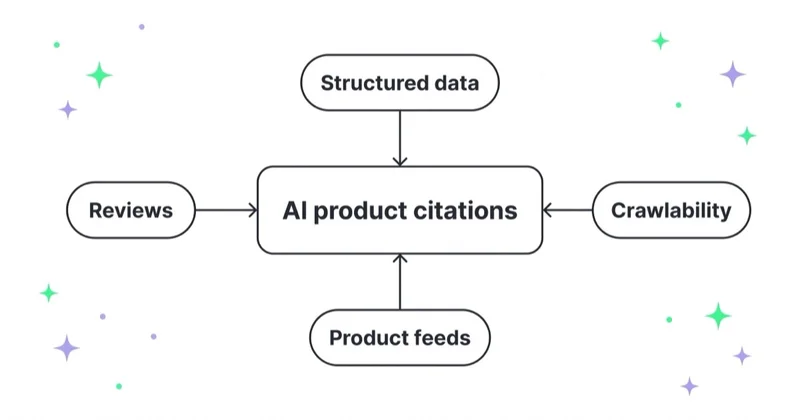
Generative engine optimization for e-commerce is the work of making products easy for AI search systems to identify, compare and cite. It is not a separate trick added on top of SEO. It is the discipline of keeping product data, structured markup, crawl access, reviews and buying content accurate enough for AI Overviews, AI Mode, ChatGPT, Perplexity and other answer engines to use with confidence.
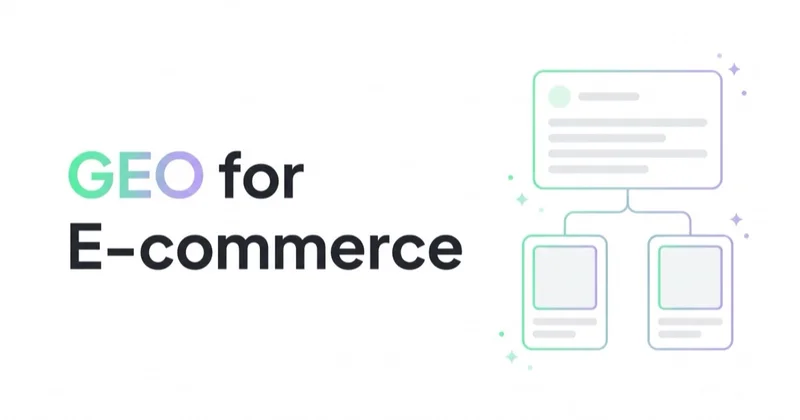
The important shift is the unit of visibility. Classic SEO tries to make a product page or category page rank. AI shopping answers often name a product, compare it with alternatives, summarise review themes, show a price, or point to a seller. The page still matters, but the answer is assembled from more than page copy: feed attributes, identifiers, availability, reviews, product metadata, merchant data and third-party citations all contribute.
For e-commerce teams, GEO is therefore less about inventing a new content format and more about fixing the product truth layer. If the feed is thin, the schema conflicts with the page, the product title hides the real attributes, or the crawler cannot access the content, AI systems have little reason to cite the store.
Key Takeaways
- GEO for e-commerce is product-level visibility. The goal is not only to rank a page, but to make a product, seller and claim legible enough to appear in AI-generated shopping answers.
- Google does not require special AI markup. Google Search Central says AI Overviews and AI Mode use the same fundamentals as Search: indexable pages, useful content, crawl access, structured data that matches visible content, Merchant Center and Business Profile data.
- Product feeds are now a visibility asset, not only an ads asset. Google's Shopping Graph is built around structured product information; Google said in May 2026 that shopping across Google is powered by more than 60 billion product listings.
- ChatGPT Shopping has its own commerce layer. OpenAI says product results are selected independently and are not ads; merchant selection can consider availability, price, quality and whether the seller is the maker or primary seller. Shopify Catalog and direct product feeds are part of that ecosystem.
- Crawler policy needs precision. OpenAI separates OAI-SearchBot for ChatGPT search from GPTBot for model training. Blocking everything by default can remove search visibility the business wanted to keep.
- Perplexity should be measured empirically. It can cite sources and show product-style answers, but merchant and crawler behaviour has changed over time. Treat it as a channel to test, not a system with stable public controls.
- Measurement is limited. Google reports AI Overviews and AI Mode traffic inside Search Console's Web search type, while chatbot referrals can be incomplete in analytics. Query tracking and citation checks matter.
For the brand-level version of this topic, see AI Overviews and GEO: how to make AI search cite your brand. This article focuses on products, feeds and catalogue visibility.
Why E-commerce GEO Is Different from General AEO
General answer engine optimization often focuses on articles: explain a topic clearly, cite sources, add expert detail and structure the page so an AI answer can quote it. That is useful, but e-commerce has another layer.
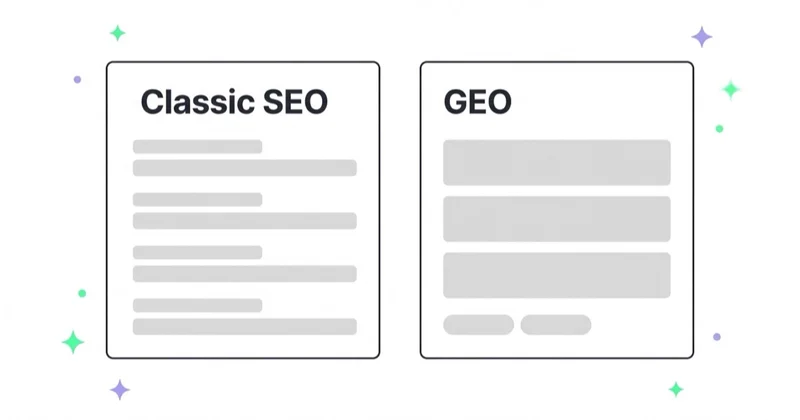
When someone asks "best carry-on suitcase for a week in Europe" or "which running shoe works for overpronation under $150", the answer is not only a paragraph. It may become a shortlist of products, a comparison of attributes, a review summary, a price check and a route to purchase.
That output needs structured commerce data. An AI system has to know whether two retailers are describing the same product, whether the product is available, what size or colour options exist, whether the claim is backed by reviews, and whether the seller is credible. A well-written category page can lose to a plainer competitor if the competitor has clearer identifiers, richer attributes and stronger review evidence.
This is why the work should start with the catalogue, not with a new "AI content calendar." Content matters, but it is the second layer. The first layer is whether the product is machine-readable enough to be compared.
How the Main AI Shopping Surfaces Use Product Data
Each platform has different mechanics, but the pattern is consistent: better product data creates more eligibility, and better proof creates more confidence.
Google AI Overviews and AI Mode
Google's own guidance is conservative. The same SEO fundamentals apply to AI Overviews and AI Mode. To be eligible as a supporting link, a page must be indexed and eligible to show in Google Search with a snippet. Google also says there are no extra technical requirements and no special schema.org markup required for AI features.
That does not make product data optional. Google's AI features still sit on top of Google's understanding of the web and commerce ecosystem. Its AI-features documentation specifically points site owners toward crawl access, textual content, structured data matching visible content, and up-to-date Merchant Center and Business Profile information.
For e-commerce, that means the practical work is familiar:
- keep product pages indexable;
- keep important product details visible in text, not only images;
- use Product structured data accurately;
- keep Merchant Center price, availability and shipping data current;
- use stable identifiers such as GTIN, MPN, SKU and brand where they exist;
- make product and variant URLs clean enough for Google to understand.
Google's shopping direction makes that more important. In May 2026, Google described shopping across Google as powered by the Shopping Graph and more than 60 billion product listings. It also introduced Universal Cart and agentic shopping features across Search and the Gemini app in the U.S. For retailers, the signal is clear: product data quality now supports paid, organic and AI-assisted shopping journeys.
ChatGPT Shopping
OpenAI's Shopping with ChatGPT Search documentation says ChatGPT can show product options with imagery, product details and links when a question has shopping intent. It also says product results are selected independently by ChatGPT and are not ads; ads are separate from product results.
OpenAI describes several inputs:
- the user's query and context;
- structured metadata from first-party and third-party providers;
- product details such as price, reviews and ease of use when relevant;
- merchant metadata from third-party providers or merchants directly.
Merchant ranking can consider availability, price, quality and whether the seller is the maker or primary seller. OpenAI also says Shopify product data is integrated through Shopify Catalog, and that merchants can provide direct product feeds so ChatGPT can reflect up-to-date product information.
The developer documentation for Agentic Commerce Protocol adds the technical direction. ACP is the connective layer between merchants and ChatGPT users. It lets ChatGPT ingest structured catalogue data, understand merchant inventory and surface relevant products in context. The product feed API includes product and variant fields such as title, description, canonical URL, media, barcode, price, availability, category, condition and seller metadata.
The operating takeaway is practical: ChatGPT visibility is not only about a page being mentioned on the open web. Product data has to be clean enough for a commerce system to understand the item and the seller.
Perplexity
Perplexity is useful to watch because it presents answers with cited sources and has introduced shopping-style experiences, but it should be handled with more caution than Google or OpenAI from a merchant-operations perspective. Public reporting around Perplexity shopping, product cards and "Buy with Pro" has changed over time, and crawler behaviour has also been publicly disputed.
That does not make Perplexity irrelevant. It means the measurement should be empirical:
- define priority shopping prompts;
- check whether Perplexity cites the store, marketplaces, review sites or competitors;
- inspect server logs for identifiable referrers and user agents;
- compare citation patterns before and after content and feed improvements;
- avoid assuming a single robots.txt rule or merchant programme controls all visibility.
In practice, the same assets that help elsewhere also help here: clean product pages, structured comparisons, strong reviews, consistent product identifiers and third-party mentions.
The Product Data Layer
The strongest GEO work for e-commerce usually starts with a feed and schema audit. This is not glamorous, but it is where most stores leak visibility.
Product Feed
A product feed should answer the questions an AI shopping system needs to answer before recommending anything:
- What is the product?
- Who made it?
- Which variant is this?
- What is the current price?
- Is it in stock?
- Where does it ship?
- What category does it belong to?
- Which attributes matter for comparison?
- Is this listing the same item another retailer is describing?
Priority attributes:
| Attribute | Why it matters |
|---|---|
title |
The first machine-readable summary of the product and variant |
description |
Helps map the product to use cases and decision queries |
brand |
Separates branded demand from generic catalogue noise |
gtin / mpn / sku |
Helps match the same product across sources |
google_product_category |
Places the item in the right commercial taxonomy |
price and sale_price |
Lets systems compare current value |
availability |
Prevents unavailable products from being recommended |
size, color, material, gender, age_group |
Critical for apparel and variant-heavy categories |
condition |
Important for resale, refurbished and marketplace contexts |
The mistake is treating feed optimisation as keyword stuffing. A title should not read like a search-term dump. It should make the product and its decision-relevant attributes clear early: brand, model, product type, key variant and use case where appropriate.
Product Structured Data
Product schema should match the page and the feed. It is not a place to invent ratings, hide prices or push claims that users cannot see.
Useful types and properties:
| Markup | What it helps with |
|---|---|
Product |
Name, brand, identifiers, image and description |
Offer |
Price, currency, availability and condition |
AggregateRating |
Review score and count, when visible and valid |
Review |
Individual review evidence when shown on page |
BreadcrumbList |
Catalogue context and page hierarchy |
ProductGroup / variants |
Variant relationships where supported |
Two rules protect the site:
- Mark up only what is visible and true.
- Keep feed, page and schema in sync.
AI systems are designed to reconcile across sources. If a product is in stock in the feed, out of stock on the page and missing a variant in schema, the store is making itself harder to trust.
The Content Layer: What AI Answers Can Quote
Once the product data is stable, content becomes the differentiator. The best product content for AI search is not generic category copy. It is decision support.
Useful formats:
- product comparisons;
- "best for" guides tied to real use cases;
- sizing, fit and compatibility guides;
- ingredient, material or specification explainers;
- honest pros and cons;
- FAQ sections based on pre-purchase objections;
- expert or tester notes where the brand has first-hand experience;
- review summaries with transparent methodology.
The Princeton GEO paper is relevant here because it found that GEO methods can improve visibility in generative responses by up to 40%, and that effectiveness differs by domain. For e-commerce, the practical interpretation is not "add random citations." It is to make claims specific, sourced and useful.
Weak content:
- "premium quality";
- "right for every occasion";
- copied manufacturer descriptions;
- short category text with no decision value;
- claims without specification or proof.
Stronger content:
- "fits cabin baggage limits for airlines using 55 x 40 x 20 cm";
- "compatible with Shimano 12-speed drivetrains";
- "fragrance-free formula for sensitive skin";
- "tested on tile and low-pile carpet";
- "choose size down if between sizes, based on 428 verified reviews."
Specificity gives AI systems something to retrieve and cite. It also helps human buyers, which is the point.
Crawler and Access Policy
Crawler policy should be deliberate, not inherited from a broad "block AI" template.
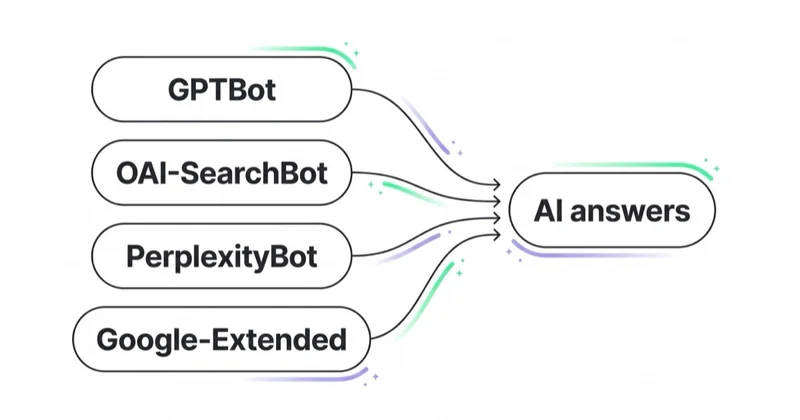
| Bot or control | Main role | Practical decision |
|---|---|---|
| Googlebot | Crawls for Google Search, including eligibility for AI features in Search | Blocking it removes normal Search and AI Overviews eligibility |
| Google-Extended | Controls use for Gemini app and Vertex AI generative APIs, not Search indexing | Use when separating Google Search visibility from some AI training or grounding uses |
| OAI-SearchBot | OpenAI search crawler for ChatGPT search features | Allow it if ChatGPT search visibility is wanted |
| GPTBot | OpenAI crawler for training generative foundation models | Can be disallowed separately from OAI-SearchBot |
| ChatGPT-User | User-triggered OpenAI agent for certain ChatGPT actions | Not used to determine ChatGPT Search inclusion |
OpenAI's crawler documentation is especially useful because it separates search visibility from model training. A webmaster can allow OAI-SearchBot so the site can appear in ChatGPT search results while disallowing GPTBot to indicate that content should not be used for training OpenAI's foundation models.
For Perplexity and other answer engines, keep crawler handling empirical. Document the policy, inspect logs, run prompt tests and watch whether visibility changes. The market is still moving too quickly for a single crawler table to be treated as permanent truth.
Measurement: What to Track When Referrals Are Incomplete
Measurement is the weakest part of GEO because platforms do not expose full citation and impression data.
Google is the clearest case: Search Central says AI Overviews and AI Mode are included in overall Search Console traffic in the Web search type. That means Search Console can show the resulting search traffic, but it does not give a clean "AI Overview impressions" report for each product query.
For ChatGPT, Perplexity and other answer engines, analytics is fragmented. Some visits arrive with visible referrers. Some do not. A store should not judge AI visibility only by one referral bucket in GA4.
Track four signals together:
| Signal | How to use it |
|---|---|
| Citation checks | Build a fixed list of prompts and record which products, retailers and sources are cited |
| Search Console | Watch product and category query movement, branded search, long-tail informational queries |
| Analytics | Create a custom channel group for visible AI referrers such as ChatGPT and Perplexity |
| Server logs | Inspect user agents, bot access and unusual referral patterns |
The goal is not exact attribution. The goal is directional evidence: more citations on priority prompts, fewer product-data errors, more qualified organic demand, and less dependence on a single platform report.
A 30-Day GEO Plan for an E-commerce Catalogue
Days 1-5: Eligibility and Access
Confirm indexation, robots.txt, CDN rules, noindex tags, canonical logic and snippet eligibility. For ChatGPT, check whether OAI-SearchBot is allowed if search visibility is desired. For Google, do not confuse Google-Extended with Googlebot.
Days 6-10: Feed Health
Clear disapprovals, fix missing identifiers, update price and availability, enrich variant attributes and remove keyword-stuffed titles. Prioritise products with margin, stock and search demand instead of trying to fix the whole catalogue at once.
Days 11-15: Structured Data
Validate Product, Offer, AggregateRating and BreadcrumbList markup. Check that schema matches visible page content and the feed. Pay attention to variants, reviews, shipping, returns and availability.
Days 16-20: Decision Content
Build content around the buying questions that AI systems actually answer: "best for," "X vs Y," compatibility, size, ingredients, use cases and objections. Add proof: specifications, review counts, test notes, expert comments and clear limitations.
Days 21-25: External Corroboration
Review which marketplaces, review sites, editorial lists and partner pages mention the products. Fix inconsistent product names and identifiers across retailers. Where possible, earn third-party references that describe the product accurately.
Days 26-30: Measurement Baseline
Create the prompt set, citation sheet, GA4 channel group and Search Console query view. Record the baseline before declaring success. GEO gains are easier to defend when the before-and-after evidence is disciplined.
Common Mistakes
| Mistake | Better decision |
|---|---|
| Treating GEO as a new content format only | Start with feed, schema, crawl access and page truth |
| Adding AI-specific markup that Google does not require | Use standard SEO and Product structured data correctly |
| Blocking all AI crawlers by default | Separate search, training and user-triggered agents where controls exist |
| Publishing thin buying guides | Answer real comparison, fit, compatibility and use-case questions |
| Optimising only for visible referrals | Track citations, Search Console movement, analytics and logs together |
| Letting feed and page data disagree | Keep price, availability, identifiers and variants consistent |
How Space Ads Approaches GEO for E-commerce
In e-commerce accounts, the problem is rarely one isolated page. It is usually a system issue: product feed quality, schema coverage, Merchant Center health, campaign data, analytics, page content and review evidence are owned by different people or tools.
Space Ads treats GEO as part of the wider performance system. The same data layer that supports Shopping, Performance Max and product SEO also supports AI shopping visibility. That is why feed audits, structured data checks, crawl policy, product-page content and measurement should sit in one operating rhythm, not in separate SEO and media silos.
Space Ads OS helps with that operating rhythm by surfacing feed, account and measurement issues across client accounts. The point is not to automate judgement. It is to catch quiet failures early: a feed stopped refreshing, a product group lost identifiers, a crawler rule changed, or a reporting source started showing a gap that the platform interface hides.
FAQ
What is GEO for e-commerce?
GEO for e-commerce is the work of making products visible in generative and answer-based search systems. It focuses on product feeds, structured data, crawlability, page content, reviews and third-party corroboration so AI systems can identify, compare and cite the right products.
Does Google require special schema for AI Overviews?
No. Google says there are no additional technical requirements and no special schema.org structured data required for AI Overviews or AI Mode. For e-commerce, standard SEO still matters: crawlable pages, useful content, structured data that matches visible content, and current Merchant Center information.
How does ChatGPT choose products?
OpenAI says ChatGPT can show product options when a question has shopping intent, and that product results are selected independently rather than as ads. It can use structured metadata, third-party content, price, reviews, user context and merchant information. Merchant ranking can consider availability, price, quality and whether the seller is the maker or primary seller.
Should a store allow OAI-SearchBot?
If ChatGPT search visibility is desired, yes. OpenAI says OAI-SearchBot is used to surface websites in ChatGPT search features. GPTBot is separate and relates to content that may be used for training foundation models, so a site can make different decisions for search visibility and training use.
Does product feed quality affect AI visibility?
Yes, especially for shopping surfaces. Feeds help systems understand product identity, price, availability, variants and seller data. A feed built only for ads can still leave organic and AI visibility on the table if identifiers, categories or attributes are thin.
How do I measure AI search visibility for products?
Use a mixed measurement model: fixed prompt checks for citations, Search Console for product and category queries, analytics for visible AI referrers, and server logs for crawler access. Do not rely on one referral report, because many AI-driven interactions are not cleanly attributed.
Is GEO different from product SEO?
It builds on product SEO rather than replacing it. Product SEO helps pages rank and become eligible. GEO adds the commerce-data and citation layer that helps AI systems name the product, compare it and trust the seller.
In Short
- E-commerce GEO is product-level visibility in AI answers, not only page ranking.
- Google requires normal Search eligibility for AI features, not special AI markup.
- Product feeds, identifiers, schema and Merchant Center data are core visibility assets.
- ChatGPT Shopping uses structured metadata and merchant data; OpenAI separates OAI-SearchBot from GPTBot.
- Perplexity should be tested with prompt tracking and logs because platform controls are less stable.
- Measurement should combine citations, Search Console, analytics and server logs.
Sources
- Google Search Central - AI features and your website
- Google Search Central - Intro to Product structured data on Google
- Google - Introducing the Universal Cart and more ways to help you shop
- OpenAI Help Center - Shopping with ChatGPT Search
- OpenAI Help Center - ChatGPT Search
- OpenAI Developers - Overview of OpenAI Crawlers
- OpenAI Developers - Agentic Commerce Protocol
- Princeton University - GEO: Generative Engine Optimization
Continue Learning
- AI Overviews and GEO: how to make AI search cite your brand
- What is a product feed and how to use it
- What is Google Merchant Center and how to manage it
- Shopify, Google Shopping and Performance Max for DTC
- Marketing audit for feeds, structured data and measurement
- Performance marketing run as one system across channels
Continue reading

AI SEO: How to Optimize for Search Engines, AI Overviews and LLMs
AI SEO applies proven SEO principles to Google AI Overviews, AI Mode and answer tools. Learn what improves visibility, what Google says to ignore, how crawler controls differ and how to measure results without inventing an ‘AI ranking’.
AI Overviews and GEO: How to Make AI Search More Likely to Cite Your Brand
A practical GEO and AEO guide for AI search: how to structure content so Google AI Overviews, ChatGPT, Perplexity and other answer engines are more likely to understand, retrieve and cite your brand.
SEO Contract: What to Look For, the Red Flags, and Why 'No Lock-In' Matters
An SEO contract should define the work, implementation dependencies, evidence, content rights, link practices, platform access, reporting and exit without promising control over Google's rankings. Use this checklist to evaluate scope and lock-in in the context of the actual engagement.