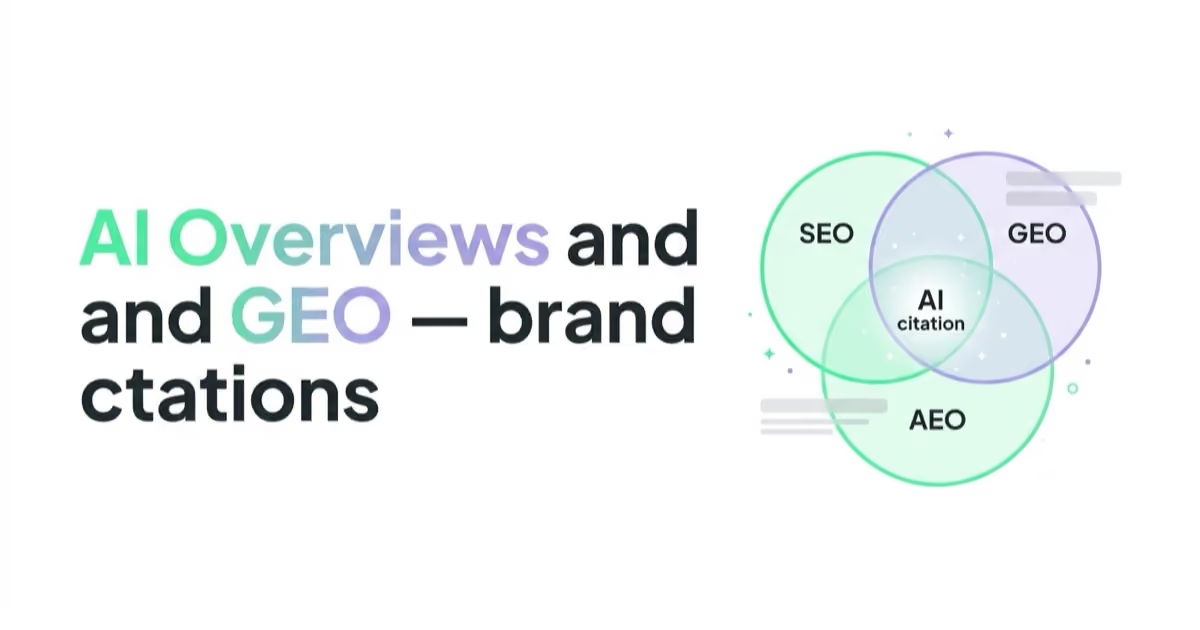
Google AI Overviews are generated summaries shown for some Search queries, with links that let users explore supporting web pages. GEO — Generative Engine Optimization — is an industry term for work intended to improve visibility in generated answers. Google treats optimization for its generative Search features as part of SEO: foundational Search eligibility, helpful non-commodity content and a clear technical structure still matter. In July 2026, Google also began rolling out a Search Console control that manages whether a site can appear in these generative features. Inclusion is the default, but eligibility and inclusion never guarantee selection.
Generated answers change how users discover sources: the response may address several related questions and present links within or around the answer rather than only as a ranked list. Google documents retrieval-augmented generation and query fan-out for its generative Search features, but it does not publish a simple formula for which page receives a supporting link. A page can perform well in classic results without appearing in an AI Overview, and the reverse may also occur for some queries.
No method can force Google AI Overviews, ChatGPT or Perplexity to cite a page. The defensible work is useful even when no generated answer appears: keep important content crawlable and indexable, publish clear answers for people, support factual claims, maintain accurate business information and add first-hand evidence or original analysis that commodity summaries lack.
TL;DR
- AI Overviews are generated summaries with supporting links, produced from Google's ordinary index rather than a separate AI catalogue.
- Google's Search requirements still apply: a page must be indexed and snippet-eligible. Google does not require AI markup,
llms.txtor artificial chunking. - Check the new Search generative AI control in Search Console. Inclusion is the default, but an excluded property cannot contribute links or content to the covered features. The control is still rolling out.
- Snippet directives control direct use of page text.
nosnippet,data-nosnippetandmax-snippetlimit what Google may use; they are not equivalent to the new site-level inclusion control. - Clear structure helps users and machines, but Google rejects “chunking” as a requirement. There is no documented paragraph-level ranking system or ideal answer length.
- Diagnose eligibility before editorial quality: Search Console inclusion, indexing, snippet eligibility, rendering, canonicalization and policy compliance come before hypotheses about content selection.
llms.txtis a proposal, not a standard, and Google states its Search AI features do not use it.- Measurement takes several instruments — Search Console's generative AI report, the standard Performance report, referrals and a fixed prompt set each answer a different question, and none is an AI ranking.
- The durable asset is useful, non-commodity content: first-hand experience, a checkable method, original evidence and clear limitations — written for the user rather than a crawler persona.
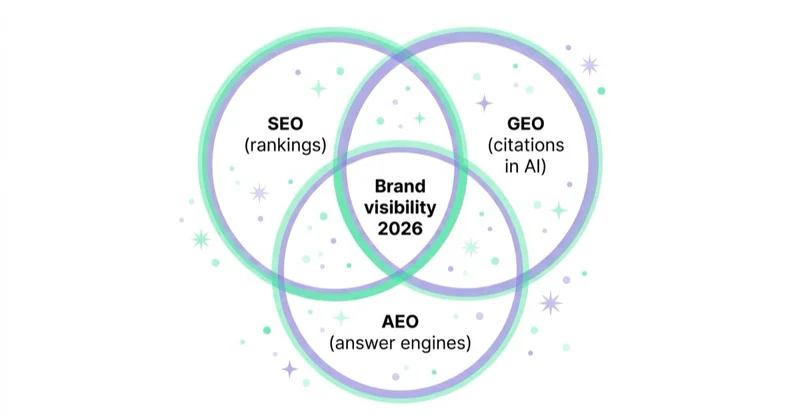
This article stays on one lane — how generated answers pick their sources, and what to change on a page so it survives that selection. The umbrella view sits in AI SEO: how to optimise for search engines, AI Overviews and LLMs; GEO as a discipline is defined in generative engine optimization, and its overlap with the answer-engine label in AEO vs GEO vs SEO. Query fan-out belongs to Google AI Mode, product-level visibility to GEO for e-commerce, and the user-agent map to AI crawlers: GPTBot, ClaudeBot, PerplexityBot and what to allow.
What an AI Overview is, and what it is not
An AI Overview is a generated response with supporting links, not simply a longer featured snippet. Google says its systems can issue related queries, retrieve relevant pages from the Search index and show prominent links that support the response. The exact models, techniques, answers and links can vary. Site owners can control eligibility and presentation inputs, but they cannot submit a preferred paragraph or see a complete list of pages considered.
| Surface | What it is | Where the source shows up | What a site owner controls |
|---|---|---|---|
| Featured snippet | A highlighted answer extracted from a web page | A prominent source link with the extracted answer | Search eligibility, content quality and snippet controls |
| AI Overview | A generated summary shown for eligible queries | Supporting links within and around the response | Search Console inclusion, index and snippet eligibility, content and Search policies |
| AI Mode | A conversational Search experience that may use query fan-out | Links surfaced within a longer generated response | The same Google Search foundations and site-level inclusion control |
| Standalone answer engine | A separate product such as ChatGPT or Perplexity | Inline citations or a source list; presentation varies | Product-specific search crawler access and the quality and relevance of available sources |
Do not infer visibility on one surface from another. Google Search, ChatGPT search and Perplexity document different crawlers, controls and reporting. Measure each product separately, and keep classic Search performance in the same business reporting context rather than treating “AI traffic” as an isolated objective.
What Google says decides whether a page can appear
Google's July 2026 guidance retains the ordinary Search foundation and adds one site-level participation setting. A page must meet Search technical requirements, be indexed and be eligible to appear with a snippet. The site must also be included through the Search generative AI control in Search Console. Google says inclusion is the default for properties, while the control and dedicated report are still rolling out to subsets of site owners. None of these conditions guarantees crawling, indexing or selection.
| Lever | What it actually does | What it does not do |
|---|---|---|
| Search generative AI control | Includes or excludes a property from covered Search generative AI features; inclusion is the default | Change ranking or inclusion in other parts of Search |
| Indexing and snippet eligibility | Page-level preconditions for appearing in AI Overviews and AI Mode | Guarantee selection for any query |
nosnippet / data-nosnippet / max-snippet |
Prevent or limit page text as a direct input and preview, at page or element level | Provide the same site-wide participation control as Search Console |
noindex |
Removes the page from Google Search, including its generative features | Offer generative-only exclusion while preserving normal Search visibility |
Google-Extended |
Lets publishers manage use for training Gemini models and grounding in certain Google systems | Control Search inclusion, ranking or grounding in AI Overviews and AI Mode |
| Structured data | Helps machines parse entities, relationships and page type | Act as an AI Overviews eligibility flag |
llms.txt |
Serves as an optional content index for any consumer that chooses to read it | Feed Google's Search AI features, which do not use it |
data-nosnippet deserves a specific warning. If a template wraps the main content in this attribute, Google cannot use that text as a direct input for AI Overviews or AI Mode, even though the URL may remain in Search. Inspect the rendered HTML before changing copy. If the intention is to exclude the whole site from the covered generative features, use the Search Console control rather than trying to recreate it with page templates.
Google's published myth-busting is equally important: Search ignores llms.txt; no special Schema.org type is required; tiny content chunks and AI-specific writing are unnecessary; and scaled pages created mainly to target every query variation can violate spam policy. Google's advice is to create helpful, non-commodity content for people, add useful images or video where appropriate and retain the same technical SEO foundations.
A diagnostic model from question to supporting link
The table below is a troubleshooting framework, not a published ranking pipeline. Google confirms that its generative Search can interpret a question, use query fan-out and retrieve pages from the Search index before generating a response with links. Providers do not disclose every selection or attribution step. The practical value of the model is keeping technical eligibility, relevance, evidence and presentation as separate hypotheses.
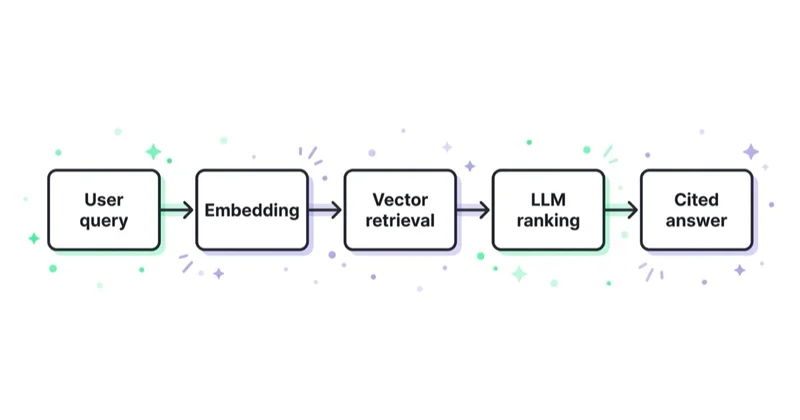
| Step | What the system is doing | Why a page drops out here | The matching fix |
|---|---|---|---|
| Eligibility | Checking whether content can participate | Site excluded in Search Console, page not indexed or not snippet-eligible | Confirm the property control, URL Inspection, canonical and snippet directives |
| Retrieval | Finding relevant indexed pages for the question and related queries | Page does not satisfy the intent or is poorly connected to the topic | Improve usefulness, internal discovery and coverage of the real user need |
| Understanding | Interpreting the page's main content and claims | Important information is ambiguous, stale or only present in inaccessible UI | Use clear structure, visible text and accurate, dated facts |
| Evidence | Assessing claims alongside available sources and Search quality systems | Unsupported superlatives, copied summaries or conflicting facts | Add first-hand evidence, primary sources and transparent limitations |
| Response and links | Generating an answer and selecting helpful supporting links | Another source better supports the response, or no generated feature appears | Improve the page for users; monitor a query set without assuming one cause |
Start at the top of the table. If a property is excluded or a page cannot be indexed, rewriting its introduction will not restore eligibility. Once the technical conditions are sound, focus on user value and evidence rather than reverse-engineering one missing link. Accurate external sources may help users verify reputation or relationships, but exact repetition across the web is neither required nor a published selection factor. That distinction is covered in where AI gets its sources: Reddit, Wikipedia and third-party citations.
Glossary
- AI Overview — a generated summary shown in Google Search results, composed from indexed web pages and displayed with links to supporting sources.
- Answer engine — any product that responds to a question with a written answer rather than a list of results.
- Passage — a section or block of text within a page. Clear passages help readers scan and understand content, but Google does not document a separate “passage citation score”.
- Retrieval — the step in which a system assembles candidate documents for a question before writing anything.
- Citability — an editorial shorthand for content that another author can accurately reference because the claim, context, evidence and limitations are clear. It is not a provider metric.
- Entity consistency — a practical state in which core public facts identify the same organisation without material contradiction; wording and platform categories need not be identical.
- Snippet control — a robots directive (
nosnippet,data-nosnippet,max-snippet) that limits what text Google may display or use.
Writing answer blocks that help the reader
A strong answer block tells the reader what the answer is, under which conditions it applies and what to do next. It should make sense to someone who enters at the heading, but it does not have to follow a rigid word count or sound like an encyclopedia. This improves scanning, accessibility and editorial reuse; it does not guarantee an AI citation.
### When should server-side tagging be used?

Server-side tagging is most useful when a business has meaningful ad spend, multiple marketing platforms, consent complexity and a need to improve conversion data quality. It does not replace a consent banner.
The pattern is simple: use a real question, give the decision-relevant answer, then add conditions and evidence. The examples below show how to replace vague copy with information a buyer can evaluate.
| Weak passage | Why it cannot be used | Citable rewrite |
|---|---|---|
| As we discussed above, this approach has several advantages | Depends on prior text; states nothing | Server-side tagging improves data quality in three specific ways: … |
| We are the leading agency for premium brands | Unverifiable self-claim, unusable as neutral text | The agency works with premium brands on paid acquisition and measurement, with published case studies at … |
| Results vary depending on many factors | True and empty | Results depend on four measurable inputs: budget, offer, data quality and creative volume |
| Our proprietary methodology drives growth | No mechanism, no definition | The method runs in four stages — diagnosis, instrumentation, testing, scaling — and each produces … |
Both failing habits — the buried answer and the unqualified superlative — can often be corrected in an editorial pass before a team commissions another article.
Structure makes a page usable; it does not make it distinctive. Google now explicitly recommends non-commodity content: first-hand experience, a unique point of view and material that does more than recycle what is already available. Use documented methods, decision criteria, examples, original evidence and honest caveats where they genuinely help the user.
The page-level conditions that come first
Before editing copy, verify that the property is included in Search generative AI features and that the page is crawlable, indexable, canonical and snippet-eligible. Google can process JavaScript when it is not blocked, but JavaScript SEO is more complex and rendering is not guaranteed in every situation, so important content should be available reliably in the rendered page. Use descriptive headings and internal links for people first, and audit snippet controls deliberately rather than inheriting them blindly from a template. The full technical checklist sits in the AI SEO pillar.
Crawler and participation controls need a documented owner because search retrieval and model training can use different controls. For Google, the Search Console setting covers inclusion in the listed Search generative features, while Google-Extended addresses model training and certain grounding uses without controlling Search ranking or AI Overview grounding. Other providers publish their own user agents. The full map is in the AI crawlers guide. Whether to publish llms.txt is covered separately in llms.txt and AI crawler controls; Google Search ignores it.
Match the format to the user's question
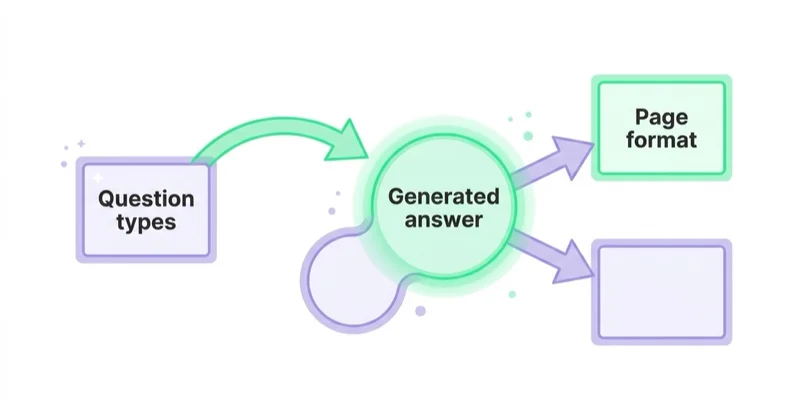
Google shows generative features when its systems determine that they add value, and the same query may not trigger one every time or in every market. Do not publish pages merely because a query looks likely to produce an AI Overview. Use the question type to choose a format that helps the user whether they encounter the page through a classic result, a supporting link or another channel.
| Question type | Example shape | What the answer engine wants | What to publish |
|---|---|---|---|
| Definitional | what is X | A clear definition, scope and boundaries | A concise definition followed by examples and limitations |
| Comparison | X vs Y | Named dimensions with unambiguous rows | A table with explicit column headers and a stated verdict per use case |
| How-to | how do I do X | Ordered steps with prerequisites | A numbered procedure with inputs, order and failure points |
| Suitability | is X right for a company like mine | Conditions, not enthusiasm | Explicit when-to-use and when-not-to-use criteria |
| Pricing and scope | how much does X cost | Model structure and what changes it | Billing models, scope drivers and the reasons a range moves |
| Troubleshooting | why is X not working | Symptom mapped to cause | A symptom → cause → check table |
| Vendor selection | best X for Y | Independent corroboration | Documented method and third-party evidence, not self-description |
The last row needs special care. A vendor's own page can document capabilities, process and evidence, but it cannot serve as independent proof that the vendor is “best”. Publish verifiable material and make it easy for buyers to compare; earn independent coverage or reviews without scripting the verdict.
Business model changes the useful evidence. B2B buyers often need diagnostic criteria, scope and pricing logic. E-commerce pages depend on accurate product data and feeds — see GEO for e-commerce. Software buyers benefit from maintained documentation and release information. Local businesses should keep their website and Business Profile accurate. These are user needs, not a published hierarchy of AI ranking factors.
How we approach this at Space Ads
At Space Ads, we treat generative Search visibility as part of SEO and content quality, not as a separate hack. We first verify the Search Console participation setting, indexing, canonicalization, rendering and snippet directives. We then map important user questions to the pages that should answer them, distinguish unsupported claims from claims with evidence, and improve the content for a buyer. Structured data remains aligned with visible content and eligible Search features; it is not presented as an AI citation switch. Measurement combines Google's own reports with repeatable answer sampling and business outcomes. This is the basis of our AI SEO work, adapted to the client's market, evidence and risk.
Measuring whether AI search cites you
There is no AI ranking, and any report presenting one is treating a single sample as a position. What exists is a set of partial instruments, each answering a different question, and the discipline is keeping them separate.
- Search Console — generative AI performance report. Google is rolling out a dedicated report for impressions from AI Overviews and AI Mode to a subset of properties. It groups data by page, country, date and device, subject to normal reporting limits.
- Search Console — standard Performance report. The generative report's data is already included in the Web search type. Treat the dedicated report as a subset view, not incremental traffic to add to the standard totals.
- A controlled prompt sample. Log the exact prompt, product or mode, language, market where relevant, date, answer and displayed sources. Repeat under comparable conditions and report volatility; this is observational research, not a rank tracker.
- Referrals, server logs and business outcomes. Referrals capture only visits that preserve identifiable source data. Logs can show that an agent fetched a URL, not that the content was used in an answer. Connect qualified visits, leads and assisted revenue where attribution permits, and state the gaps.
Build the sample around user questions and buying situations, while retaining keyword and landing-page data for Search demand. Tools can automate repeated prompts; they cannot decide which questions matter commercially, establish causality from changing answers or judge whether a brand description is materially accurate. That boundary is examined in AI SEO tools and visibility platforms: what they do not fix.
An eight-step plan
- Select a manageable question set. Cover branded facts, category discovery, comparison, suitability, objections and high-intent decisions. Prioritise business relevance over an arbitrary count.
- Record a reproducible baseline. Capture the prompt, product or mode, language, market where relevant, date, response, sources and factual accuracy.
- Check Search Console participation. Confirm that the correct parent and child properties inherit the intended Search generative AI setting; inclusion is the default, but owners can override it.
- Audit page eligibility and rendering. Check indexing, canonicalization,
robots.txt, rendered content and snippet controls on the templates that answer priority questions. - Map intent to the right page. Consolidate overlapping variants where one strong page satisfies the user; split topics only when the task, audience or required evidence materially differs.
- Improve clarity without a word-count formula. State the useful answer early, then explain conditions, trade-offs, steps and evidence at the depth the decision requires.
- Add non-commodity value. Use first-hand experience, documented methods, original examples, decision criteria, limitations and primary sources where they support factual claims.
- Measure change cautiously. Repeat the sample under comparable conditions, use the dedicated Search Console report where available, and connect visibility to qualified outcomes without claiming causality from one response.
Common mistakes and what to do instead
| Common mistake | Do this instead |
|---|---|
| Treating AI Overviews as a switch to flip with a file or a schema type | Fix access, then passage clarity, then evidence — the order Google's own guidance implies |
| Missing the Search Console participation control | Check the property and its inheritance; inclusion is default, but an owner may exclude a parent or child property |
| Publishing thin AI-written articles to increase surface area | Publish fewer pages carrying material a generic model could not produce |
| Ignoring classic SEO because AI is the new channel | Keep ranking and crawlability healthy; retrieval draws on the same index |
| Delaying the useful answer with generic framing | Give the reader the decision-relevant answer early, then add the context it needs |
Wrapping content columns in data-nosnippet by template default |
Audit snippet controls deliberately and scope them to the block that needs them |
| A separate page for every long-tail phrasing | Consolidate variants that share intent; split only when the user task or evidence differs |
| Reporting a single ChatGPT answer as proof of visibility | Report a logged prompt set as a trend, with market, date and product recorded |
| Adding Search Console's AI report to the standard Performance numbers | Read them as overlapping views of the same activity, never as a sum |
| Chasing citations with no commercial thread | Tie visibility to qualified visits, leads and assisted revenue |
FAQ
What are AI Overviews?
AI Overviews are generated summaries that Google shows for some Search queries, with links to relevant supporting pages. Google says these features use its Search index and core ranking and quality systems, including retrieval-augmented generation and query fan-out. A site must also be included through the Search generative AI control in Search Console, which defaults to inclusion and is still rolling out.
How can a brand get cited in AI Overviews?
There is no guaranteed method. Confirm that the site is included through Search Console and that the page is indexed and snippet-eligible. Then improve the page for the user with a clear answer, first-hand or original evidence, transparent sourcing and accurate business information. These practices support eligibility and quality; Google still decides whether a generative feature appears and which links it shows.
Does Google require special markup for AI Overviews?
No AI-specific Schema.org type is required. Google's guidance says ordinary technical Search requirements, indexing and snippet eligibility still apply, and the site must be included through the Search generative AI control. Structured data remains useful for supported Search features when it matches visible content, but it is not an AI Overview citation switch.
What do nosnippet and data-nosnippet do in AI Overviews?
nosnippet prevents page text from being used as a direct input for AI Overviews and AI Mode, while data-nosnippet excludes selected elements and max-snippet limits the amount. These controls can affect generated features while the URL remains otherwise eligible for Search. To exclude an entire property from the covered Search generative features, use the separate Search Console control.
Does llms.txt improve AI visibility?
There is no confirmed ranking benefit, and Google states its Search AI features do not use the file. llms.txt is a proposal rather than a web standard; it can serve as a lightweight content index if a named consumer reads it and someone owns its maintenance, but it does not substitute for crawlability, structure or content quality.
Should content be written differently for ChatGPT and Perplexity?
Write one accurate, useful page for people rather than separate versions for crawler personas. Then verify product-specific access: OpenAI and Perplexity document their own search user agents, while Google uses its Search controls. Retrieval, presentation and citations differ, so measure each product rather than inferring visibility from Google.
How should AI search visibility be reported?
Use the dedicated Search Console generative AI report where available and remember that its impressions are already included in the standard Web Performance data. Add a controlled prompt sample, qualified referral visits and sales outcomes where available. State coverage and attribution limits, and never present one response as a stable ranking.
Why does a page rank well but never get cited?
There may be no AI Overview for the query, the property may be excluded, the URL may not meet indexing or snippet requirements, or Google's systems may choose other supporting pages. Check technical eligibility and the new Search Console control first. Then compare whether the page actually satisfies the question with useful, original and well-supported information. Google does not expose a definitive reason for one missing citation.
In short
- AI Overviews use Google's Search systems and index, so foundational SEO, indexing and snippet eligibility remain entry conditions.
- Search Console now has a site-level generative AI control, defaulting to inclusion, and a dedicated impressions report; both are still rolling out.
- Google requires no AI-specific schema or
llms.txt, and explicitly advises against artificial chunking and pages made for every query variation. - Snippet directives limit direct use of page text; the Search Console control separately includes or excludes a property from covered generative features.
- Clear, non-commodity content with first-hand value and checkable evidence helps users and aligns with Google's current guidance, but never guarantees selection.
- Diagnose eligibility first, then content relevance and evidence, and report visibility as variable observations rather than a stable rank.
- Measure with several instruments, keep Search Console's overlapping views separate, and report trend rather than a single answer.
Sources and further reading
- Google Search Central: optimising for generative AI features in Search
- Google Search Central: AI features and your website
- Google Search Console: Generative AI performance report
- Google Search Console: Search generative AI control
- Google Search Central: robots meta tag, data-nosnippet and X-Robots-Tag
- Google Search Central: structured data introduction
- Google Search: AI Overviews and AI Mode PDF
- OpenAI: overview of OpenAI crawlers
- Perplexity: Perplexity crawlers
- llms.txt proposal
Product behaviour and documentation above reflect the state as of July 2026. Providers rename agents, move reporting and revise guidance without notice, so re-check the source pages before changing a live configuration or a measurement plan.
Continue Learning
- AI SEO: how to optimise for search engines, AI Overviews and LLMs
- Generative Engine Optimization: how brands get mentioned in AI search results
- AEO: Answer Engine Optimization vs GEO and SEO
- Google AI Mode: what it means for brands and marketing
- Where AI gets its sources: Reddit, Wikipedia and third-party citations
- LLM SEO: how to make your brand easier for AI tools to cite
- What is an SEO audit and how to do it properly?
- AI SEO · Marketing audit
Continue reading
Generative Engine Optimization: How Brands Get Mentioned in AI Search Results
Generative Engine Optimization helps brands become useful, verifiable sources for AI-generated search experiences. Learn what GEO can influence, what it cannot guarantee and how to measure visibility without mistaking a single answer for a ranking.

AI SEO: How to Optimize for Search Engines, AI Overviews and LLMs
AI SEO applies proven SEO principles to Google AI Overviews, AI Mode and answer tools. Learn what improves visibility, what Google says to ignore, how crawler controls differ and how to measure results without inventing an ‘AI ranking’.

LLM SEO: How to Make Your Brand Easier for AI Tools to Cite
LLM SEO helps language models understand, describe and cite a brand correctly. This guide covers entities, crawlability, answer-ready content, sources, prompt monitoring and commercial paths.