Generative Engine Optimization (GEO) is the work of making a brand's information easier to discover, understand, verify and use in AI-generated search experiences. It applies to interfaces such as Google AI Overviews, Google AI Mode and ChatGPT Search, where the user may receive a synthesized response supported by links instead of only a conventional list of search results.
GEO cannot force a model to mention a company or guarantee a permanent position. The practical goal is to publish accurate, accessible and genuinely useful sources that deserve to be surfaced for the questions buyers ask. In 2026, that still starts with sound SEO—not a secret schema, an “AI text file” or content written for machines at the expense of people.
TL;DR
GEO is an extension of search and content strategy. Crawlability, indexability, helpful content, internal links, reputation and accurate product or service information remain foundational.
There is no universal AI ranking. Answers vary by platform, model, prompt, market, language, account context and time.
Clear sections improve usefulness, not guaranteed citations. Definitions, comparisons and evidence should make sense to a human even when read outside the surrounding article.
Owned claims need proof. Product pages, methodology pages and case studies should explain what the company actually does; independent, authoritative sources should support external facts.
Google requires no special AI markup. Its official guidance says normal Search eligibility and SEO practices apply to AI Overviews and AI Mode.
Measurement needs several signals. Combine platform visibility, citation accuracy, Google Search Console data, AI referral traffic and qualified business outcomes.
A mention is not the final outcome. GEO becomes commercially useful only when accurate visibility leads to consideration, a qualified visit, a lead or revenue.
What is Generative Engine Optimization?
Generative Engine Optimization is a working discipline for improving visibility and accurate representation in search experiences that generate answers. Depending on the product and query, a system may use an index, live retrieval, licensed data, model knowledge or a combination of sources. It may show citations, source cards or ordinary links—or provide no visible source at all.
That distinction matters. Google AI Mode is part of Google Search, whereas ChatGPT Search is a separate product with its own crawler and retrieval process. A practice that helps one interface is not automatically a documented ranking factor in another. GEO should therefore be treated as a testable operating framework, not a universal formula for “training the AI about your brand.”
GEO asks:
can intended search crawlers access and render the important information;
is the page eligible to appear in the relevant search product;
does it answer a real user question clearly and completely;
are current or consequential claims supported by appropriate evidence;
are the company, product, people and location described consistently;
does the page show first-hand knowledge where experience matters;
can a reader verify what the company offers and what the evidence proves;
is there a useful next step for the person who wants to investigate further.
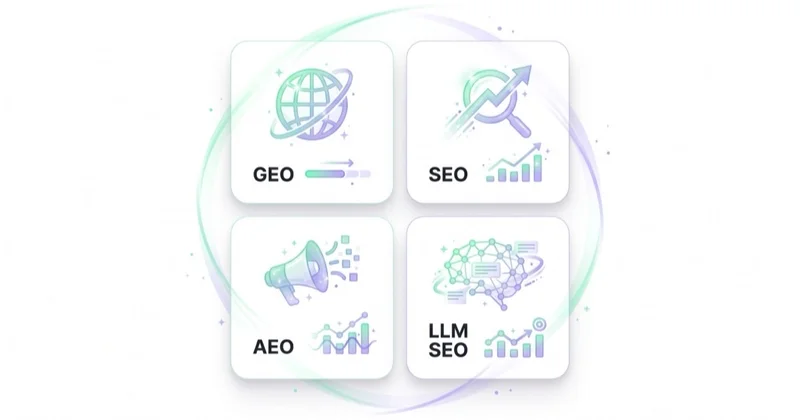
Practitioner term for visibility and representation in LLM-based products
accurate brand description or cited page
GEO
Practitioner and research term for visibility in generated answers
supporting link, citation, source card or relevant mention
The labels overlap and the industry does not use them consistently. They are useful only if they clarify the job to be done. In practice, teams need one coordinated system: technical SEO makes important pages accessible; editorial work answers the question; product and company information establishes facts; digital PR and reputation create independent evidence; analytics connects visibility to business impact.
What we know—and do not know—about source selection
Search providers do not publish complete ranking or source-selection systems. A simplified workflow can still help teams plan content, as long as it is treated as a model rather than a disclosed algorithm:
Interpret the user's question.
Identify entities and subtopics.
Retrieve or select candidate information.
Identify material that may support the response.
Generate an answer.
Display citations, links or source cards when the interface supports it.
Google explicitly says AI Overviews and AI Mode may use “query fan-out”: the system issues multiple related searches across subtopics and data sources. This makes complete topical coverage useful, but it does not mean every AI product works the same way or that marketers can see every generated query.
Example: a prompt like "how should a B2B company improve lead quality from paid ads?" may fan out into:
B2B lead generation;
paid media lead quality;
CRM offline conversions;
landing page qualification;
sales accepted leads;
Google Ads enhanced conversions for leads;
lead nurturing.
A practical response is not to repeat all those phrases on one page. Build a useful central guide, then create focused resources where a subtopic deserves its own explanation, evidence and user journey.
Write sections that remain accurate in isolation
“Passage citability” is a useful editorial shorthand, not a ranking factor documented by Google or OpenAI. It means writing a paragraph, table or answer that remains clear and accurate when a reader encounters it without the entire article around it.
Strong sections:
answer the section's question early;
identify the relevant product, market, time period and limitations;
distinguish a documented fact from an expert recommendation;
use a table only when it makes a comparison easier to understand;
cite primary sources for changing platform rules and regulated topics;
explain calculations and methodology behind original data;
avoid unsupported superlatives, invented statistics and circular definitions.
Example:
Generative Engine Optimization is the work of making a brand's information easier to discover, understand and verify in AI-generated search experiences; it can improve eligibility and usefulness but cannot guarantee a citation or mention.
The second half prevents the definition from becoming a promise the evidence cannot support.
The GEO content stack
Layer
Purpose
Example
Pillar page
Define the topic and framework
Generative Engine Optimization guide
Supporting articles
Cover subtopics and long-tail prompts
LLM SEO, AEO, AI SEO, crawler access
Service pages
Explain commercial capability
marketing audit, Google Ads, Meta Ads
Case studies
Provide proof and context
fashion, luxury, lead generation examples
FAQ or Q&A sections
Resolve genuine follow-up questions
“Can GEO guarantee a citation?”
Author and methodology pages
Explain who created the content and how
reviewer, research method, limitations
External sources
Verify facts that the brand does not control
official documentation, regulators, peer-reviewed research
Reporting
Connect exposure to outcomes
platform reports, analytics, CRM and revenue
This structure serves people first. An article explains the subject, a service page describes the engagement and a case study shows what happened in a specific context. None of those pages should pretend to prove more than it does.
Use the right source for each claim
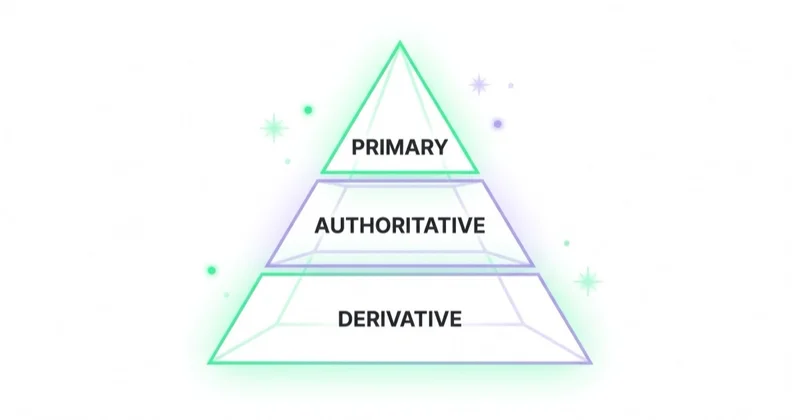
There is no public, universal “source hierarchy” used by all generative systems. There is, however, a sensible evidence hierarchy for editors. Match the source to the claim rather than adding links for appearance.
Claim
Preferred evidence
Example
Platform capability or crawler rule
Platform's current documentation
Google Search Central, OpenAI Help Center
Law, regulation or health guidance
Regulator or recognized public authority
government or supervisory body
Academic finding
Original paper and its stated limitations
peer-reviewed conference paper
What the agency provides
Agency's service and scope documentation
deliverables, exclusions, process
A client outcome
Verifiable case study with context
period, market, baseline and methodology
Customer sentiment
Authentic reviews with disclosed collection method
verified review source or customer research
An owned page is the appropriate source for an owned fact—such as what a service includes—but not independent proof that the company is the market leader. Similarly, one client result demonstrates what happened in that engagement, not what every future client should expect.
Editorial checklist for useful, verifiable content
Before publishing a GEO-focused page, each important section should pass a basic extraction test:
does the introduction confirm who the page is for and what it will answer;
are key definitions clear without inventing certainty;
does each heading reflect a real decision or follow-up question;
are claims supported when the topic is current or technical;
are experience, opinion, research and platform documentation clearly distinguished;
are limitations, exclusions and dates visible where they affect the answer;
does internal linking connect the cluster;
does the page avoid redundant sections created only to target another keyword;
is the next step relevant to the reader rather than forced.
Use a simple isolation test: if a paragraph appeared in a search result or generated answer without the previous section, would it still be accurate? If not, add the missing qualifier. Then use the human test: does that extra context make the decision easier, or merely make the paragraph longer?
GEO for service pages
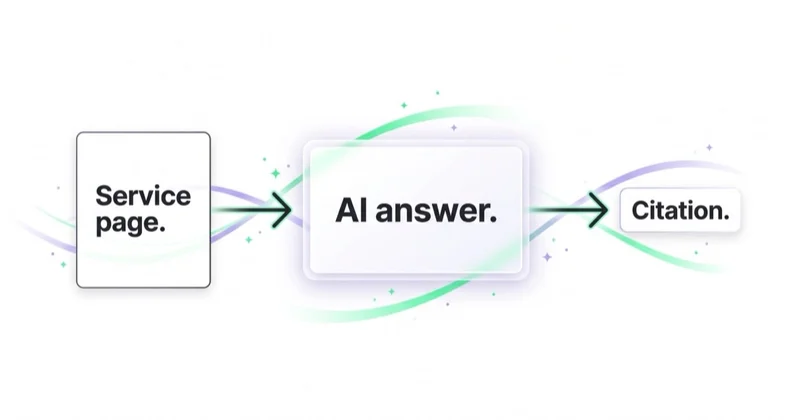
Commercial pages should not be vague landing pages that only say "we help brands grow." They should provide enough information for humans and AI systems to understand the service.
A useful service page should explain:
what the service is;
who it is for;
what problems it solves;
what data or access is needed;
how the process works;
how success will be measured and what outcomes are realistic;
The content architecture should follow buyer questions and business economics. A B2B article should not default to checkout metrics; a luxury page should not treat discount-led conversion as the only objective; a local service page must clarify geography and availability. Relevance comes from specific answers, not from publishing the same template across industries.
Technical foundations for GEO
GEO has a technical layer, but it is smaller and more familiar than many vendors imply. For Google AI Overviews and AI Mode, a page must be indexed and eligible to appear in Google Search with a snippet. Google says there are no additional technical requirements and no special schema or AI-specific file is needed.
Checklist:
important Google-facing pages are indexable and eligible for snippets;
canonical tags are correct;
important content is visible in HTML;
robots.txt reflects an intentional, crawler-specific policy;
snippet controls do not accidentally prevent use in search features;
sitemap includes important pages;
internal links connect the cluster;
structured data is valid, relevant and consistent with visible content;
WAF and bot protection do not block intended crawlers;
server errors and redirects are monitored.
Crawler names also matter. OpenAI says OAI-SearchBot is used for discovery and surfacing in ChatGPT search, while GPTBot concerns potential model training. Blocking one is not the same decision as blocking the other. Teams should review the provider's current documentation, their legal requirements and the value of each content area before changing crawler access.
For Google, nosnippet, data-nosnippet, max-snippet and noindex can affect how content is shown or used in Search features. Do not copy a generic robots file from another website: test the actual production response, CDN and firewall because a correct file cannot compensate for a bot blocked at the infrastructure layer.
Third-party sources and distribution
Independent coverage can help buyers verify a company's reputation and may create additional discoverable sources. It should be earned for a real reason: expertise, data, a useful partnership, a noteworthy result or an informed point of view. No platform promises that a particular mention will directly improve inclusion in generated answers.
Good distribution is not mass syndication. It is consistent public evidence:
expert commentary;
case-study mentions;
partner pages;
podcasts or webinars;
industry resources;
selective, relevant directories;
documentation or playbooks;
social profiles that match the category.
Keep basic facts—name, website, product category, locations and leadership—accurate across controlled profiles. Do not try to “standardize” independent editorial opinions or manufacture corroboration through paid placements and mass syndication. That creates weak evidence for users and can create search-policy risk.
How Space Ads approaches this
At Space Ads, we treat GEO as part of a broader search, content and measurement system. We begin with the questions buyers ask before contact: definitions, comparisons, costs, risks, alternatives, implementation and vendor criteria. We then review the current answers in selected markets and platforms, recording whether the brand appears, which sources are shown and whether the response is accurate.
The content plan connects a main resource with focused supporting articles, commercial pages and relevant proof. Recommendations are based on gaps that matter to the audience, not a quota of AI-themed pages. Measurement can combine a controlled prompt sample, platform-native reporting, Search Console, analytics and CRM outcomes. We do not report a sampled mention as a guaranteed “AI ranking.”
Measuring GEO
GEO measurement should combine qualitative and quantitative signals. Start by stating exactly what the program is expected to change: correct brand representation, visibility for a defined topic, qualified referral traffic, assisted conversions or a mixture of these.
Signal
What it shows
Sampled prompt visibility
How often the brand appears in a controlled set of observations
Citation and link review
Which URLs support the answers and whether the attribution is accurate
Answer accuracy
Whether important claims about the brand, product and eligibility are correct
Google generative AI impressions
Which pages receive impressions in AI Overviews and AI Mode when the test report is available
Search performance
Whether relevant pages gain impressions, clicks and qualified organic visits
AI referrals
Visits passed by tools that expose a referrer or tracking parameter
Business quality
Qualified leads, assisted conversions, revenue and contribution after delivery
Prompt sets should include:
definitional prompts;
problem prompts;
comparison prompts;
brand prompts;
service prompts;
commercial recommendation prompts.
For every observation, record the platform, product or mode, date, market, language, device or account state when relevant, exact prompt, visible citations and a screenshot or export. Repeat important prompts rather than relying on one run. Personalization, model changes, conversational context and stochastic output mean a prompt sample is not equivalent to a conventional rank tracker.
What Search Console can show in 2026
Google announced dedicated Generative AI performance reports in June 2026. They show impressions for supported features such as AI Overviews and AI Mode, with page, country, device and date dimensions. The reports are being tested with a subset of sites, so absence of the report does not prove absence from AI features. The data also remains included in the overall Web performance report.
At launch, the dedicated report emphasizes impressions rather than a complete journey from generated answer to revenue. Combine it with analytics and CRM data, and do not add its impressions to the overall Web total as though they were separate exposure.
What analytics cannot show on its own
OpenAI says ChatGPT referral URLs include utm_source=chatgpt.com, which makes attributable visits easier to identify. Other interfaces may pass a referrer, strip it or satisfy the user's need without a click. Referral traffic therefore measures known visits, not total mentions or influence. Conversely, a referral does not prove that the visit was caused by a citation in the exact prompt your monitoring tool tested.
Common mistakes
Mistake
Why it hurts
Better approach
Treating GEO as a trick
AI systems change and shortcuts decay
Build strong sources and clear answers
Writing one huge article for every AI keyword
Weakens intent focus
Build clusters
Ignoring service pages
Educational visibility does not convert
Connect blog, service pages and proof
No sources
Reduces trust and citation value
Link to primary documentation and research
Blocking crawlers accidentally
Prevents some tools from accessing pages
Review robots and security settings
Treating one answer as a stable rank
Results vary by context and time
Use a documented sample and repeated observations
Publishing pages only for bots
Produces repetitive, low-value content
Resolve a real user decision with evidence
Adding unsupported schema or llms.txt as a cure
Google requires neither for its AI features
Fix Search eligibility, content and site architecture first
Confusing search crawling with model training
Leads to unintended crawler policies
Review each user-agent and purpose separately
Measuring only clicks
Misses impressions and no-click exposure
Combine platform visibility, citations, visits and outcomes
Counting any mention as success
The response may be wrong or commercially irrelevant
Review accuracy, context and qualified impact
Overpromising AI visibility
Creates false expectations
Report observations, uncertainty and business outcomes
30-day GEO implementation plan
Week 1: map prompts and sources
Define the audience, markets, topics and business objective. Create a manageable prompt sample and record current answers, links, inaccurate claims and pages that already receive relevant visibility. Do not collect competitor domains merely to reproduce their content; identify what the user still cannot answer confidently.
Week 2: audit pages and entities
Review Google Search eligibility, crawler access by user-agent, snippet controls, rendering, internal links, service-page clarity, product data, authorship and the evidence behind important claims.
Week 3: improve content and clusters
Improve the highest-value pages first. Add direct answers where they help, remove unsupported claims, explain methodology and connect educational pages with services and proof. Create a new page only when it serves a distinct question or intent.
Week 4: measure and refine
Repeat the documented sample, check the available Google generative AI report, review referrals and compare qualified outcomes. Update pages when information is incomplete, outdated or unclear—not merely because one generated answer changed.
FAQ
What is Generative Engine Optimization?
Generative Engine Optimization is the work of improving content, technical access and verifiable brand information for visibility in AI-generated search experiences. It aims to increase the usefulness and eligibility of a brand's sources, but it cannot guarantee a citation or mention.
Is Generative Engine Optimization the same as SEO?
Not exactly. GEO focuses measurement and editorial work on generated answers, supporting links and accurate brand representation. It still relies heavily on SEO because products such as Google AI Overviews and AI Mode use the Search ecosystem and require normal Search eligibility.
How is GEO different from LLM SEO?
There is no universally accepted operational boundary. Practitioners often use GEO for generated search results and LLM SEO more broadly for representation in LLM-based products. The actions overlap, so a company rarely needs separate content programs for each acronym.
Can GEO guarantee AI mentions?
No. Answers can change with the platform, model, prompt wording, language, market, account context and time. Good work can improve a page's eligibility, clarity and evidence; it cannot secure a permanent mention.
What pages are most important for GEO?
Prioritize pages that answer material buyer questions and establish verifiable facts: product or service pages, documentation, methodology, original research, comparison guides and contextualized case studies. A large glossary or FAQ is not automatically more valuable.
How should GEO be measured?
Use a documented, repeated prompt sample for directional monitoring; review citations and factual accuracy; use the Google generative AI report when available; track identifiable referral visits; and connect qualified sessions to CRM, sales and revenue outcomes. State the limitations of each data source.
Does Google require special schema or an AI-specific file?
No. Google says there is no special schema.org markup, AI text file or additional technical requirement for AI Overviews and AI Mode. Structured data should still match visible content, and standard Search technical requirements continue to apply.
Should a site allow OAI-SearchBot and GPTBot?
That is a separate decision for each crawler. OpenAI documents OAI-SearchBot for search discovery and GPTBot for potential model training. Review the current documentation, legal obligations and content policy before changing robots.txt; do not assume that one rule controls both purposes.
Key takeaways
Generative Engine Optimization is most useful as a disciplined extension of SEO, content, product information, digital PR and measurement. It is not a technical shortcut and it does not reveal a universal formula for source selection.
Make important information accessible, answer buyer questions clearly, support consequential claims and measure repeated observations with their limitations. Then connect visibility to a relevant commercial path and evaluate whether it creates qualified demand—not merely more screenshots of brand mentions.