AI SEO is an industry term for improving a website's visibility in search experiences that generate answers, including Google AI Overviews, AI Mode and search-enabled assistants. It is not a separate Google discipline and it does not replace SEO. Google explicitly says that its generative search features build on core Search ranking and quality systems.
The practical work is familiar: publish genuinely useful first-hand or expert content, make important pages crawlable and indexable, keep business and product information accurate, and help visitors complete the next step. Other answer tools have their own crawlers and controls, so technical policy must be reviewed platform by platform.
What has changed is the search journey. A system may run several related searches, combine sources and show supporting links inside a generated answer. A page can gain visibility for a narrow part of a broader question. That makes clear structure valuable for readers, but it does not create a requirement to write in tiny “AI-friendly chunks” or use special AI markup.
TL;DR
- AI SEO starts with SEO. For Google AI Overviews and AI Mode, there are no extra technical requirements beyond being indexed and eligible for a Search snippet.
- Original value matters more than formatting tricks. First-hand evidence, proprietary data, expert analysis and useful tools are harder to replace than a summary of existing articles.
- Google does not require
llms.txt, special AI schema or content “chunking”. Structured data remains useful for supported Search features when it matches the visible page. - Crawler choices are platform-specific. Googlebot controls Google Search access; OpenAI separates OAI-SearchBot from GPTBot; Perplexity publishes separate search and user agents.
- Clear structure serves people first. Direct answers, descriptive headings, tables and visuals are useful when they make a complex topic easier to understand—not because they guarantee citation.
- No platform guarantees inclusion or citation. Eligibility is not the same as selection.
- Measurement needs several views. Use Search Console, analytics, referral data, sampled answer checks and business outcomes; there is no universal “AI rank”.
What is AI SEO?
AI SEO is a convenient umbrella term, not a formal standard. It covers work intended to improve discovery in both traditional results and generated answer experiences. Depending on the platform, those experiences may retrieve current web pages, use an existing search index, call a page at a user's request or rely on several methods at once.
AI SEO asks:
- can crawlers access the content;
- can search engines index it;
- does the page add evidence or experience beyond what is already common online;
- are important claims precise, current and supported;
- can the brand be described correctly;
- can the user move from an answer to a relevant next step.
That makes AI SEO more useful as an operating lens than as a checklist of hacks. The work spans technical SEO, editorial quality, accurate business data, digital PR, analytics and conversion design.
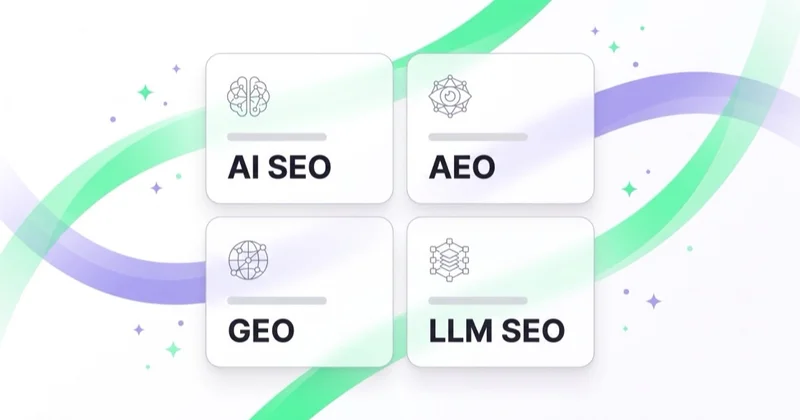
AI SEO, AEO, GEO and LLM SEO
| Term | Main focus | Practical meaning |
|---|---|---|
| SEO | Organic visibility and clicks | Make pages crawlable, indexable, relevant and useful |
| AEO | Answer engines and direct answers | Industry label for improving visibility in answer-led experiences |
| GEO | Generative search results | Industry label for work focused on generated answers and their sources |
| LLM SEO | Language-model products | Industry label often used for brand representation and citations in AI tools |
| AI SEO | Broad umbrella term | A practical way to group the areas above with established SEO |
These labels overlap and vendors define them differently. Google says that, from its perspective, optimizing for generative AI in Search is still SEO. A business can use the terms to organize work, but should be skeptical of a service that turns new terminology into unsupported guarantees.
For deeper related guides, see AEO, AI Overviews and GEO and Google AI Mode.
What changes with AI search?
Classic search often begins with a list of results. Generative search may answer part of the question on the results page, show links within or beside the response and invite follow-up questions. Google says AI Mode and AI Overviews can use query fan-out: the system issues several related searches across subtopics and sources to assemble a response.
Important changes:
- users ask longer and more specific questions;
- search systems may retrieve several sources before generating an answer;
- a source may be selected for one subtopic rather than the user's complete question;
- source visibility may happen without a click;
- brand descriptions may be generated from multiple public signals;
- each non-Google tool can have different crawler and user-agent controls;
- vague content is easier to ignore.
Google's July 2026 guidance goes further than simply repeating SEO basics. It prioritizes unique, non-commodity content: original experience, a defensible point of view, useful images or video and information that does more than repackage what is already online. It also warns against creating many near-duplicate pages for every possible fan-out query.
A content framework for people—not a citation formula
There is no template that guarantees selection in an AI answer. The right structure depends on the subject and the reader. The following elements are useful when they reduce uncertainty or make a decision easier.
1. Direct answer first
When a query has a concise factual answer, state it early and then explain the conditions, evidence and exceptions. Do not force an executive summary onto a story, case study or topic that requires context first.
2. TL;DR
Use a short summary on long, practical guides so readers can confirm that the page addresses their problem. Each bullet should be accurate without stripping away an important qualification.
3. Definitions and glossary
Define ambiguous terms once and use them consistently. For example:
- AI Overview - a Google Search feature that can show an AI-generated summary with supporting links for some queries.
- Answer engine - a system that responds with a direct answer rather than only a list of links.
- Entity - a recognizable person, brand, product, service, place or concept.
- Supporting link - a page linked from a generated answer so the user can inspect the source or learn more.
4. Comparison tables
Tables work well for repeated fields, trade-offs and exact comparisons. They are not inherently better for AI and should not replace a clearer paragraph.
5. Process sections
Educational content becomes more valuable when it helps the reader make or implement a decision. Add a process, worked example, diagnostic tree, calculator, template or original dataset when the topic warrants one.
6. FAQ
Add frequently asked questions only when they address real follow-up needs that the main structure does not already answer. Repeating headings as FAQ schema adds no unique value.
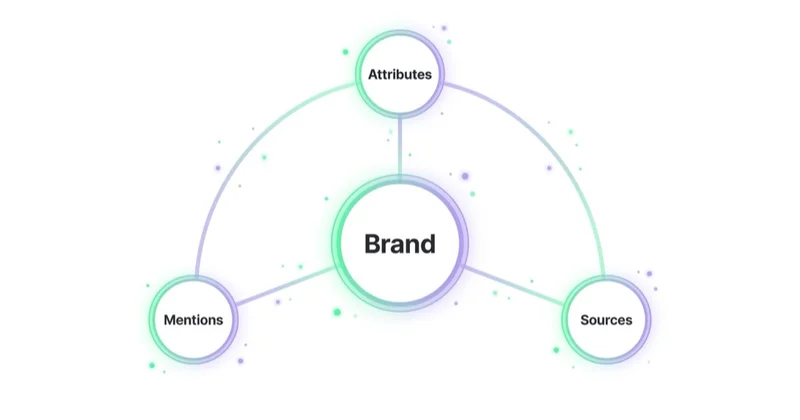
7. Sources
Link claims to primary documentation, original research or the underlying dataset wherever possible. Record the date and scope of time-sensitive facts in the prose. A source list cannot rescue unsupported claims in the body.
The content moat: evidence a generic model cannot invent
The strongest page is rarely the one with the most definitions. It is the one with useful evidence that competitors cannot reproduce without doing the work. Depending on the business, that might include:
- anonymized campaign or sales data with a transparent method;
- an expert's first-hand diagnosis and named limitations;
- original photographs, product tests or process screenshots;
- a case study that separates baseline, intervention and result;
- a decision framework tested in real projects;
- a calculator, dataset or template that helps the reader act;
- a clear correction policy for information that changes.
This improves the page for users and gives search systems a reason to retrieve it instead of another summary of the same public facts.
Technical AI SEO checklist
| Area | What to check |
|---|---|
| Google eligibility | the canonical page is indexed, can return a Search snippet and follows Search policies |
| Preview controls | nosnippet, data-nosnippet, max-snippet and noindex reflect the publisher's intended use |
| Rendering | important text and links are accessible to the crawler after any JavaScript processing |
| Internal links | topic clusters connect articles, service pages and case studies |
| Structured data | uses supported types, matches visible content and is validated; no invented “AI schema” |
| Platform crawlers | robots.txt has an intentional rule for each relevant user agent |
| CDN and firewall | legitimate bots are not blocked accidentally; user agent and published IP ranges are checked where appropriate |
| Page performance | pages load reliably on mobile and desktop |
| Business data | product feeds, Merchant Center and Business Profile are accurate where relevant |
| Duplication | near-identical pages do not compete for the same intent or waste crawl resources |
For Google AI features in Search, access is controlled through Googlebot and the normal Search preview controls. Blocking Google-Extended is a separate decision related to some other Google AI training and grounding uses; it is not the switch for AI Overviews or AI Mode in Search.
OpenAI documents three distinct agents that matter here:
- OAI-SearchBot supports inclusion in ChatGPT search results;
- GPTBot is used for content that may train foundation models;
- ChatGPT-User can visit a page in response to a user action and may not follow robots.txt in the same way as an automatic crawler.
Perplexity similarly documents PerplexityBot for its search index and Perplexity-User for user-requested page access. The policy question is not “allow all AI bots or block all AI bots”. A publisher can make separate choices about search discovery, model training and user-requested retrieval, then verify the implementation in server and firewall logs.
What Google says you do not need
Google's current guidance explicitly rejects several common “AI SEO hacks” for its Search products:
- no
llms.txtor other AI text file is required; Google Search currently ignores it; - no special Schema.org type is needed for AI Overviews or AI Mode;
- content does not need to be broken into tiny chunks;
- pages do not need to be rewritten in a special style for generative search;
- a separate page for every long-tail variation is unnecessary and can become scaled content abuse;
- inauthentic brand mentions do not create a durable advantage.
An llms.txt file may still be used by another service, but it should have a named consumer and maintenance owner. Adding it because it appears on a checklist is not a strategy.
Entity optimization
People and search systems both benefit from consistent facts about a business. This is sometimes described as “entity optimization”, but it should not become repetition of the brand name or mass creation of profiles.
Important entities:
- brand name;
- legal or operating company where relevant;
- authors and experts;
- services;
- products;
- locations or markets;
- case studies;
- industries served;
- tools and platforms;
- frameworks and methodologies.
For an agency, the useful public facts include its legal or trading name, markets served, named experts, services, methodologies and attributable case studies. Those facts should be consistent on the site and supported by evidence. A service is not “connected” to a brand merely because both terms appear repeatedly on the same page.
For example, an article about AI SEO can link to a marketing audit, an explanation of how an SEO audit works and a relevant case study. The links should help the reader verify the method or take a next step, not exist simply to manufacture a topical graph.
AI SEO for service pages
Service pages need to be more explicit in AI search because models may summarize a brand before a user visits the site.
A useful service page should answer:
- what the service is;
- who it is for;
- what problems it solves;
- when it is not a fit;
- how the process works;
- what data is needed;
- what proof supports the offer;
- who is responsible for the work and why they are qualified;
- which related articles explain the topic;
- what the next step is.
This matters for pages such as Google Ads, Meta Ads, TikTok Ads, marketing audit, Fractional CMO, marketing agency Poland and luxury marketing agency. Claims about process, outcomes or expertise should be specific enough to verify.
AI SEO for blog posts
Blog posts should not all chase “agency” keywords. Problem-led and educational articles can support buyers before they are ready to contact a vendor:
- "why are my Google Ads not converting";
- "how to measure lead quality";
- "what is conversion optimization";
- "AI SEO vs LLM SEO";
- "how to build a marketing dashboard";
- "how to choose paid media channels";
- "demand generation vs lead generation".
Problem-led posts reflect how buyers describe real situations. They also help sales conversations because the reader can understand the problem, possible causes and evidence required before contacting a vendor.
A practical rule is to give each page a clear primary purpose. A post about AI SEO should not also try to sell every SEO service and rank for every adjacent label. Create another page only when the user need is materially different—not for every wording variation.
Building an AI SEO content cluster
A complex subject is often easier to serve with a small set of genuinely distinct pages than one overloaded article. Each page should solve a different reader problem, and internal links should explain the relationship.
| Cluster layer | Example |
|---|---|
| Pillar definition | AI SEO: what it is and how to optimize |
| Technical support | crawler access, robots, snippets, structured data |
| Content support | answer blocks, FAQ, comparison tables, source sections |
| Commercial support | service pages, audits, consulting offers |
| Proof support | case studies, methodology, reporting examples |
| Measurement support | Search Console, analytics, answer sampling and source review |
This structure prevents one page from becoming too broad. It does not justify four nearly identical definitions of AI SEO, LLM SEO, GEO and AEO. If the search intent and answer are substantially the same, consolidate instead of multiplying pages.
Experience, expertise and trust
E-E-A-T is a framework used in Google's search quality documentation, not a single score that a site can “add”. Trust is the central idea. In practice, readers should be able to tell:
- who created or reviewed the content;
- what first-hand experience or expertise supports it;
- where material claims and numbers came from;
- which parts are analysis rather than established fact;
- when time-sensitive information was checked;
- how to contact the business or request a correction;
- whether commercial relationships affect a recommendation.
An author box alone is not proof. A named method, transparent dataset, correction history and case evidence are stronger than generic claims such as “our experts have years of experience”.
AI SEO for different business models
| Business model | AI SEO priority |
|---|---|
| B2B services | explain process, proof, qualification, objections and case studies |
| SaaS | document use cases, integrations, comparisons, onboarding and activation |
| E-commerce | optimize categories, product data, reviews, guides and buying questions |
| Local services | clarify location, service area, reviews, pricing ranges and booking process |
| Luxury brands | protect brand context, positioning, authenticity and selective distribution |
| Agencies and consultancies | publish methodology, examples, expert commentary and decision frameworks |
This is why AI SEO cannot be copied from one vertical into another. A SaaS tool needs feature and integration clarity. A service business needs trust and process clarity. An e-commerce store needs product and category clarity. A consulting brand needs proof and methodology.
How Space Ads approaches this
At Space Ads, we treat AI SEO as part of search strategy and measurement. We map the questions a buyer asks before contact—definitions, comparisons, costs, risks, implementation and vendor selection—then identify gaps, overlap and pages that repeat commodity information without adding evidence.
The technical review covers Search eligibility, preview controls, internal links, rendering, supported structured data and crawler policy. The editorial review looks for first-hand value, source quality, clear authorship, unsupported claims and a logical route from education to a commercial next step. Reporting combines platform data, analytics and a repeatable sample of answers. We do not promise citations; no publisher or agency controls source selection.
How to measure AI SEO
AI SEO measurement needs several signals because each answers a different question:
| Signal | What it shows |
|---|---|
| Search Console: Search performance | queries, pages, clicks, impressions and classic organic trend |
| Search Console: Generative AI performance | AI Overview and AI Mode impressions by page, country and device where the report is available |
| GA4 | landing-page behavior and conversions |
| AI referrals | traffic from tools that send referral data |
| Sampled answer checks | how selected tools answer a fixed set of representative questions |
| Source checks | which pages are linked or cited in the sampled answers |
| Brand description quality | whether AI describes the offer correctly |
| Assisted sales evidence | whether content supports sales questions |
Google began rolling out a dedicated Generative AI performance report in Search Console in 2026. It currently covers impressions from AI Overviews and AI Mode and is available only to a subset of properties during rollout. Its data also sits within the Web search data in the standard Performance report, so analysts must avoid adding both views together as if they were separate traffic sources.
There is no single universal “AI ranking”. Answers can change by tool, wording, location, user context, account state and source availability. A monitoring sample should record the exact prompt, market, tool, date, login state where relevant, answer, linked sources and brand description. It is a trend instrument, not a deterministic rank tracker.
Referral traffic is useful but incomplete: an answer can show the brand without a click, and some visits may not pass a distinctive referrer. Connect visibility measures to qualified visits, leads, assisted sales and revenue rather than reporting citation counts alone.
Common mistakes
| Mistake | Why it hurts | Better approach |
|---|---|---|
| Treating AI SEO as a replacement for SEO | Ignores crawl, index, content and links | Build on strong SEO fundamentals |
| Writing generic AI summaries | Adds no reason to choose the page | Add first-hand evidence, a method, original analysis or a useful tool |
| Blocking crawlers accidentally | Reduces access for some tools | Review robots, WAF and bot policies deliberately |
| Targeting too many intents on one URL | Creates weak topical focus | Map one main intent to one main URL |
| Hiding commercial paths | Traffic does not convert | Link educational pages to relevant service pages |
| Using unsupported claims | Reduces trust | Cite primary sources and state uncertainty |
| Treating an AI monitor as a rank tracker | Hides volatility and sampling limits | Record the testing protocol and read results as a trend |
Publishing llms.txt without a consumer |
Creates maintenance work with no Google Search benefit | Name the system that uses it or skip it |
| Adding FAQ and schema mechanically | Repeats content without helping the reader | Use supported markup and sections only when they serve a real need |
30-day AI SEO plan
Week 1: establish the baseline
Export Search Console and analytics data, check whether the Generative AI report is available, define business conversions and save a small, representative answer sample. Inventory key topics, authors, evidence, service pages and existing overlap.
Week 2: audit technical access
Review indexability, snippet eligibility, canonicals, rendering, internal links and supported structured data. Document separate policies for Googlebot, OAI-SearchBot, GPTBot, ChatGPT-User, PerplexityBot and other agents relevant to the business. Verify firewall behavior in logs.
Week 3: improve content structure
Improve the pages with the strongest business relevance. Replace generic summaries with first-hand evidence, clearer explanations, useful visuals and primary sources. Merge duplicate pages. Add summaries, tables or FAQ only where they help the reader.
Week 4: measure and iterate
Review the same sampled questions using the documented protocol, inspect Search Console and analytics, and evaluate conversions. Update pages where facts are stale, evidence is weak or the user's next step is unclear. Do not rewrite a sound page merely because one generated answer changed.
FAQ
What is AI SEO?
AI SEO is an industry term for applying SEO, content quality, crawler management and measurement to generative search and answer tools. It aims to improve accurate discovery and representation, but it is not a formal Google standard or a guarantee of citation.
Is AI SEO different from traditional SEO?
For Google, generative search optimization is still SEO: the features rely on core Search systems and indexed web content. Work outside Google may also require platform-specific crawler decisions and separate measurement, but it does not remove the need for technical SEO and useful content.
Does Google require special markup for AI Overviews?
No. Google says there is no special Schema.org markup or other AI-only markup required for AI Overviews or AI Mode. A page must be indexed and eligible for a Search snippet. Structured data can still support normal Search features when it uses a supported type and matches visible content.
Does Google use llms.txt for AI Overviews or AI Mode?
No. Google's July 2026 guidance says Google Search ignores llms.txt; the file neither improves nor harms Google Search visibility. Another service may choose to use it, so implement it only for a documented consumer and keep it accurate.
How does AI SEO relate to LLM SEO?
“LLM SEO” is usually used for work focused on brand representation and source links in language-model products. “AI SEO” is a broader umbrella label. Neither term has a universal definition, so a proposal should describe concrete deliverables, platforms and measurements rather than rely on the label.
Can AI SEO guarantee citations in ChatGPT or Perplexity?
No. Source selection changes with the tool, prompt, context, index and date. An agency can improve eligibility, evidence and technical access, but cannot control whether a system links to a page for a particular response.
What content format works best for AI SEO?
There is no single best format. Use the structure that helps the reader: a direct answer for a simple definition, a table for repeated comparisons, a process for implementation and visuals where they explain something prose cannot. Original evidence and a satisfying answer matter more than forcing every page into the same template.
How should a company measure AI SEO in 2026?
Use the standard Search performance report, Google's Generative AI performance report where available, analytics and conversions. Add a documented sample of answers and linked sources across relevant tools. Report the sampling limits and connect visibility to qualified demand; do not present a volatile prompt check as a universal rank.
Key takeaways
AI SEO is not a shortcut around SEO. For Google, the current playbook is clear: create valuable, non-commodity content; maintain a sound technical structure; keep product and business information accurate; and ignore unsupported hacks such as mandatory chunking, AI schema or llms.txt for Search.
Other answer tools require their own crawler and measurement decisions. The durable objective is not to manufacture citations. It is to publish evidence that genuinely helps the user, make access intentional and measure whether visibility contributes to the business.
Sources and further reading
- Google Search Central - Optimizing for generative AI features in Google Search
- Google Search Console - Generative AI performance report
- Google Search Central - AI features and your website
- Google Search Central - Creating helpful, reliable, people-first content
- Google Search Central - Robots meta tag, data-nosnippet and X-Robots-Tag
- OpenAI - Overview of OpenAI crawlers
- Perplexity - Perplexity Crawlers
Continue learning
Continue reading
Generative Engine Optimization: How Brands Get Mentioned in AI Search Results
Generative Engine Optimization helps brands become useful, verifiable sources for AI-generated search experiences. Learn what GEO can influence, what it cannot guarantee and how to measure visibility without mistaking a single answer for a ranking.
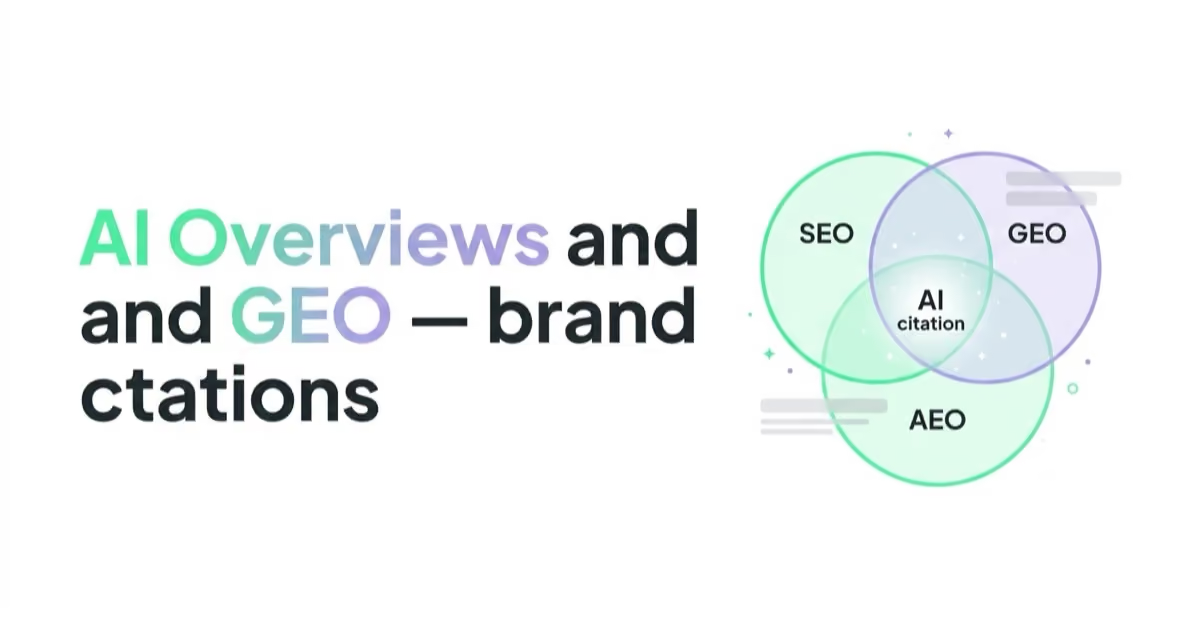
AI Overviews and GEO: How to Make AI Search More Likely to Cite Your Brand
A practical GEO and AEO guide for AI search: how to structure content so Google AI Overviews, ChatGPT, Perplexity and other answer engines are more likely to understand, retrieve and cite your brand.
LLM SEO: How to Make Your Brand Easier for AI Tools to Cite
LLM SEO helps language models understand, describe and cite a brand correctly. This guide covers entities, crawlability, answer-ready content, sources, prompt monitoring and commercial paths.