Google AI Max for Search is one of the clearest signs that Google Ads search campaigns are moving beyond strict keyword control. For years, search specialists built accounts around match types, negatives, RSA testing and landing page control. AI Max adds a broader automation layer: keywordless matching, text customisation, URL expansion, improved reporting and new controls inside Search campaigns.
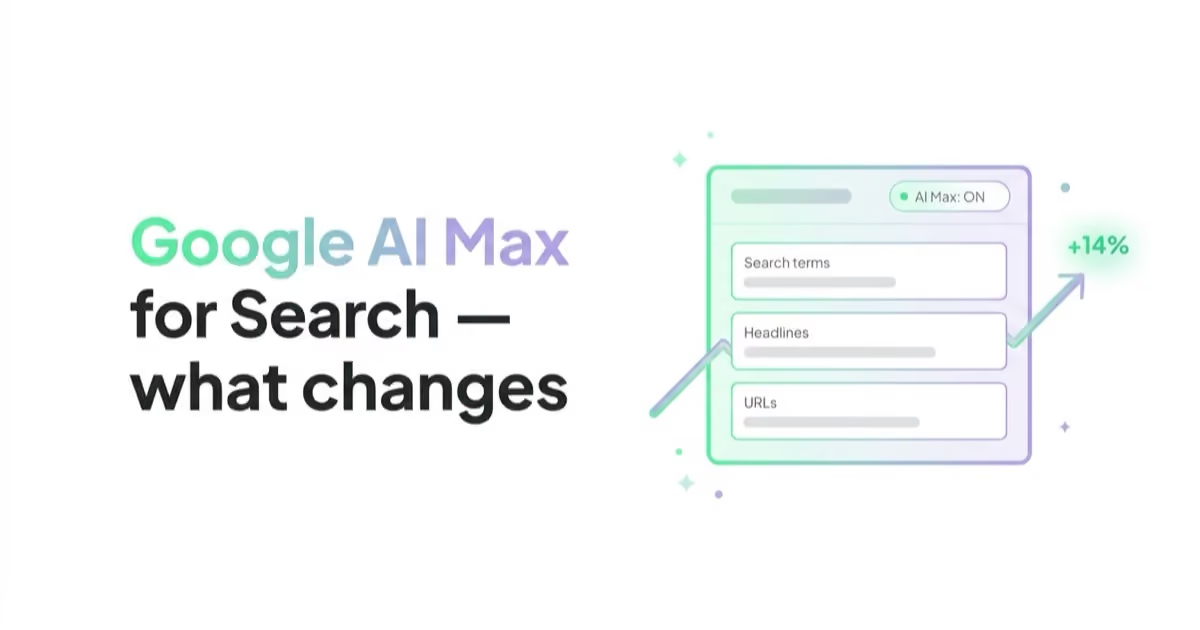
AI Max for Search is an optimisation layer for existing Google Ads Search campaigns. It is not simply a new campaign type. It uses Google AI to expand reach, match more queries, customise text and help advertisers capture intent that keyword lists may miss. It can improve coverage, but it also needs careful brand, URL, search-term and conversion-quality controls.
The strategic question is not "should every campaign enable AI Max?" The better question is "where can AI Max discover incremental, profitable search demand without cannibalising brand, wasting spend or sending traffic to weak landing pages?"
TL;DR
- Google AI Max for Search is an AI optimisation layer for Search campaigns, not a replacement for all Search strategy.
- Google describes it as using AI to help advertisers get more conversions and improve performance through Search campaigns.
- It can include broader matching, URL expansion and text customisation, depending on settings and account availability.
- AI Max should be tested with experiments where possible, not blindly enabled across the whole account.
- Brand controls, location controls, URL exclusions and query monitoring are essential.
- It is closely related to the broader shift away from Dynamic Search Ads and toward AI-powered Search automation.
- AI Max does not remove the need for clean conversion tracking, negative keywords, landing page quality or business judgement.
- The first audit question is simple: is AI Max finding new profitable demand, or just taking credit for demand already captured elsewhere?
What Is AI Max For Search?
AI Max for Search is a Google Ads feature set that brings more AI-driven matching and creative support into Search campaigns. Google's developer documentation describes it as an optimisation layer for existing Search campaigns that uses AI to help advertisers get more conversions and improve performance.
In practical PPC terms, AI Max can affect:
- which searches a campaign can match;
- which landing pages are used;
- how ad text can be customised;
- how Google identifies relevant intent beyond exact keywords;
- how reporting and controls are applied.
This moves Search closer to the logic already seen in Performance Max and broad match automation, but inside the Search campaign environment.
AI Max vs Classic Search Campaigns
| Area | Classic Search | AI Max for Search |
|---|---|---|
| Targeting logic | Keywords and match types | Keywords plus AI-expanded intent |
| Landing pages | Usually manually assigned final URLs | URL expansion may be used where enabled |
| Ad copy | RSA assets controlled by advertiser | Text customisation can adapt messaging |
| Control | Higher manual control | More automation with controls |
| Best use | Proven query coverage and precision | Discovering additional relevant demand |
| Risk | Missing new queries | Over-broad matching and cannibalisation |
AI Max is not "set and forget". It needs a test plan.
What AI Max Changes
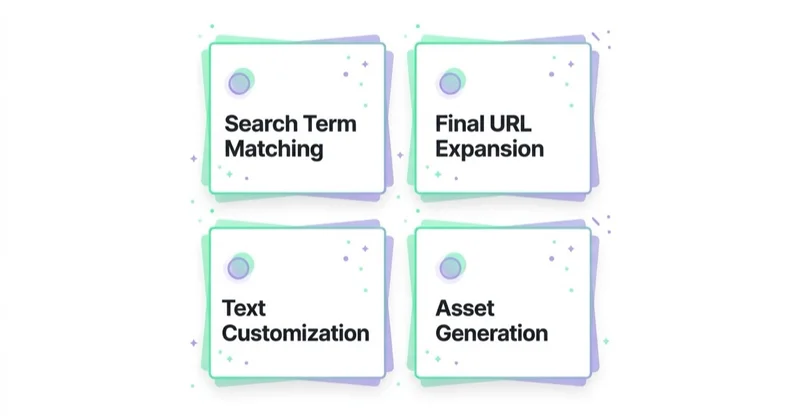
Search Term Matching
AI Max can help campaigns match to relevant queries that are not explicitly covered by keyword lists. This can be useful when users search with longer, more conversational or less predictable phrases.
The risk: broader matching can include weak or low-intent queries if conversion signals and controls are poor.
URL Expansion
URL expansion can send users to pages Google considers relevant. This can help when a site has many useful landing pages, but it can be risky when pages are outdated, thin, low-converting or not aligned with the offer.
Use URL exclusions for:
- blog posts that should not receive paid traffic;
- out-of-stock pages;
- support pages;
- low-margin categories;
- legal pages;
- irrelevant international pages.
Text Customisation
Text customisation can help align ad copy with detected intent. The risk is message drift. Ads should not make claims the landing page cannot support.
Reporting And Controls
AI Max is only useful if advertisers can see what it is doing. Search terms, asset reporting, landing page performance and conversion quality should be reviewed regularly.
AI Max And Dynamic Search Ads
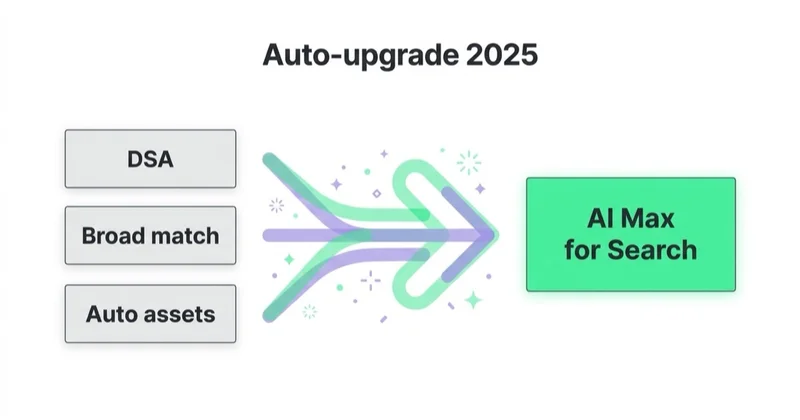
Dynamic Search Ads historically used website content to match relevant searches and generate ad headlines. AI Max is part of Google's broader move toward AI-powered search automation. Some industry discussion has focused on the future of DSA and AI Max migrations.
The operational point: any account still relying on DSA should be audited. DSA structures, URL coverage, page feeds and negatives need to be reviewed before moving into an AI Max environment.
Questions to ask:
- Which DSA campaigns are still active?
- Which URLs are allowed?
- Which search terms are profitable?
- Which pages should be excluded?
- Are DSA campaigns cannibalising standard Search?
- Should AI Max be tested in a controlled experiment instead?
When To Use AI Max
AI Max is worth testing when:
- standard Search campaigns already convert;
- conversion tracking is reliable;
- landing pages are strong;
- the account has enough search demand;
- broad match has shown some promise;
- the team can review search terms and URL performance;
- the goal is incremental demand discovery.
It is risky when:
- conversion tracking is weak;
- the website has many poor pages;
- brand/non-brand structure is messy;
- lead quality is not fed back into Google Ads;
- budgets are too small to learn;
- the account already has broad match waste;
- the advertiser cannot monitor search terms.
AI Max And Performance Max
AI Max and Performance Max solve different problems.
Performance Max runs across multiple Google surfaces. AI Max works inside Search campaigns. They can complement each other, but they can also overlap in demand capture.
For e-commerce, compare:
- AI Max Search,
- standard Search,
- Shopping,
- Performance Max,
- brand campaigns,
- category campaigns.
For lead generation, compare:
- lead quality,
- CRM stage,
- calls,
- qualified pipeline,
- spam rate,
- cost per qualified opportunity.
The worst setup is one where PMax, AI Max, broad Search and brand campaigns all claim success while total qualified pipeline does not grow.
30-Day AI Max Test Plan
Week 1: Audit Readiness
Check:
- conversion actions;
- enhanced conversions;
- Consent Mode;
- landing page quality;
- brand exclusions;
- URL exclusions;
- campaign structure;
- negative keywords;
- budget limits.
Week 2: Launch Experiment
Use a controlled experiment where possible. Start with one or two campaign groups rather than the whole account.
Week 3: Review Search Terms And URLs
Look for:
- irrelevant queries;
- brand leakage;
- competitor mismatch;
- low-quality informational traffic;
- unexpected landing pages;
- conversion rate by landing page.
Week 4: Evaluate Business Quality
Do not stop at conversions. Check:
- qualified leads;
- revenue;
- margin;
- order value;
- offline conversion quality;
- new vs returning customers;
- incremental search coverage.
Brand Safety And Control Checklist
Before scaling AI Max:
- separate brand and non-brand campaigns;
- add brand exclusions where needed;
- exclude irrelevant URLs;
- review automatically created assets;
- monitor search terms;
- check landing page reports;
- import offline conversions;
- use value-based bidding where appropriate;
- compare against a control period or experiment;
- document what changed.
How we approach this at Space Ads
AI Max really can widen Search: it catches queries your keyword list misses and assembles ad components on its own. Underneath, though, it's broad match wearing a confident name, so we run it as an experiment rather than a "more results" switch. In practice that's hard brand exclusions, an eye on which URLs it routes to, and the search-terms report read daily, since that's where you first spot AI Max drifting into queries unrelated to the offer. We scale it only once the terms come back clean, never on faith. The upside is real, but without that frame it's easy to buy cheap, broad traffic that lifts impressions and sells nothing. New automation gets tested with a hand on the exclusions, not with the eyes shut.
Common Mistakes
Enabling AI Max Everywhere
Automation should be tested. Enabling it across every campaign removes the ability to learn what changed.
Ignoring Brand Cannibalisation
If AI Max captures brand demand and reports strong performance, it may not be incremental.
Sending Traffic To Weak URLs
URL expansion is only as good as the website. Poor pages should be excluded.
Measuring Only Platform Conversions
Lead quality, margin and incremental revenue matter more than raw conversion count.
Treating AI Max As A Replacement For Strategy
AI can expand matching. It cannot decide the business model, margin structure or acceptable lead quality.
FAQ
What is Google AI Max for Search?
Google AI Max for Search is an AI optimisation layer for Search campaigns that can expand matching, support text customisation and improve reach through Google AI.
Is AI Max a new campaign type?
It is better understood as an optimisation layer or setting within Search campaigns, not a completely separate campaign category like Performance Max.
Does AI Max replace keywords?
No. Keywords still matter, but AI Max can expand beyond strict keyword coverage.
Should AI Max be enabled in every Search campaign?
No. It should be tested where tracking, landing pages and controls are strong enough to evaluate results.
Is AI Max the same as Performance Max?
No. Performance Max runs across multiple Google surfaces. AI Max applies to Search campaigns.
What is the biggest AI Max risk?
The biggest risk is losing control over query and landing page quality while mistaking attributed conversions for incremental business growth.
Key Takeaways
AI Max for Search is part of Google's shift toward AI-first paid search. It can help accounts find demand that keyword lists miss, but it also increases the need for measurement discipline.
The right approach is controlled testing: strong conversion tracking, URL exclusions, brand controls, search-term review and business-quality measurement. AI Max should earn scale by proving incremental value.
If you would rather roll out AI Max without losing control of results, you can hand it to a team — see how we run Google Ads campaigns.
Sources and further reading
- Google Ads Help: About AI Max for Search campaigns
- Google Ads API: Get started with AI Max for Search campaigns
- Google Ads & Commerce Blog: AI Max expands globally
- Search Engine Journal: Google launches AI Max for Search campaigns
Continue Learning
Continue reading
AI for Google Ads in 2026: Google's Native AI vs a Control Layer on Top
Google's AI and third-party AI tools solve different problems. This guide draws the line between platform automation that already controls bidding and creative assembly, and external control layers that audit, explain, propose changes and help teams govern execution.
What Is the Google Search Network and How to Use It?
The Google Search Network shows ads around active search intent. Learn how it works, where ads appear, how search partners behave and how to structure Search campaigns.

Gemini Ad Formats: When the Ad Is Generated, Not Written
Google is testing and announcing Gemini-powered ad experiences across AI Mode and Search. Learn what each format does, what remains uncertain and how to prepare data, content and measurement.