A TikTok Ads audit is a structured review of a TikTok for Business account that checks measurement quality (Pixel, Events API, EMQ), campaign structure under Smart+, the volume and quality of video creative, attribution settings and the real impact on sales. A good audit does not end with "ROAS dropped". It explains what is blocking performance and orders the recommendations by business impact and implementation effort.
TikTok follows a different logic than Google Ads or Meta Ads. Here, creative is the primary lever, and the delivery system (Smart+) increasingly automates targeting and bidding. So a TikTok Ads audit puts more weight on event measurement, conversion-signal quality (EMQ) and hook diversity than on manual audience settings.
TL;DR
- A TikTok Ads audit starts with measurement — without a correct Pixel, Events API and high EMQ, you cannot tell whether campaigns are weak or just badly tracked.
- Key areas: access and security, measurement (Pixel + Events API + EMQ), structure and objectives, Smart+, creative and hooks, Spark Ads, audiences, TikTok Shop / GMV Max, attribution, plus compliance and brand safety.
- Hard 2026 thresholds: EMQ ≥ 6 as a condition for moving to Smart+, a 2-second hook rate ≥ 25% at account level, completion rate around 5–10% for well-matched creative, and a minimum of 50 conversions / 7 days per ad group to exit the learning phase.
- Findings must be prioritised by impact and effort — an audit ends with a plan, not a report.
- TikTok and Pangle are two different worlds — mixing them in one campaign blurs the picture and breaks optimisation.
Glossary
- TikTok Ads Manager — the campaign management panel in TikTok for Business.
- TikTok Pixel — browser-side event tracking (the equivalent of the Meta Pixel).
- Events API (CAPI) — server-side measurement that complements the Pixel with events resistant to browser blocking.
- EMQ (Event Match Quality) — a 0–10 score for how well events are matched; the higher it is, the stronger the optimisation signal.
- Smart+ — TikTok's automated campaign type (the equivalent of Advantage+ / Performance Max), where the system manages targeting, bidding and creative.
- GMV Max — an automated mode for TikTok Shop sellers, optimising for order value.
- Spark Ads — a format that uses existing organic posts (your own or creators') as ads.
- Hook rate — the share of viewers who watched the first 2 seconds of a video (
video_watched_2s/ impressions). - Pangle — TikTok's partner-app network; a placement with a completely different profile than the TikTok feed.
When to run a TikTok Ads audit
An audit is especially needed when:
- results decline on a similar budget,
- the account was launched quickly, without a correct Pixel and Events API setup,
- EMQ is low yet you are considering a move to Smart+,
- creative has stopped delivering (rising CPM, falling hook rate),
- the agency or in-house team is changing,
- you plan to scale budget or enter a sales season,
- you launch TikTok Shop and want to know if the account is ready for GMV Max,
- TikTok, GA4 and the store's reporting diverge significantly.
Frequency depends on spend. A short health check is worth doing monthly; a full audit after any major strategic change.
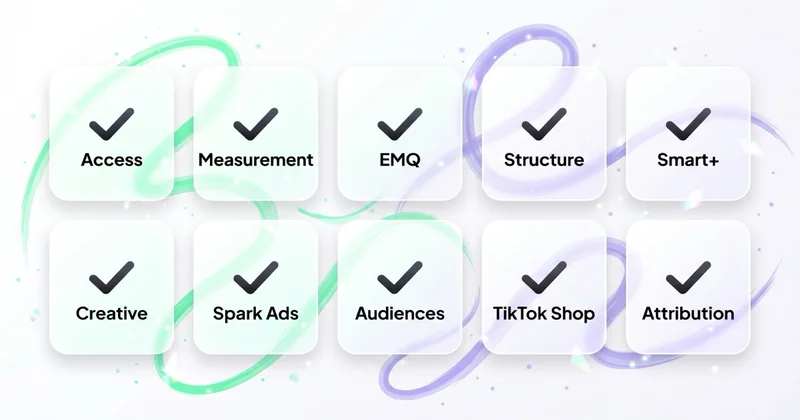
TikTok Ads audit areas
1. Access and account security
The starting point, often skipped. Check: the TikTok Business Center owner, user roles and permissions, ownership of the Pixel and product catalog, partner and agency access, domain verification, and the history of restrictions and rejections. The ad account should be a company asset, not an employee's or agency's personal account.
2. Measurement — Pixel, Events API and EMQ
The most important block of the audit. If the conversion signal is weak, all delivery automation optimises against bad data. Check:
- whether the TikTok Pixel is firing and events are complete,
- whether Events API (server-side) is implemented, with deduplication against the Pixel,
- the EMQ (Event Match Quality) for key events,
- whether hashed first-party data (email, phone) is passed to raise EMQ,
- whether conversion value (
value,currency) is passed correctly, - whether
CompletePayment/Purchaseis not confused withAddToCart, - consistency with GA4 and the store.
Practical threshold: EMQ ≥ 6 is the point at which Smart+ and automated strategies make sense. Below that, moving to automation almost always loses to a correct manual setup.
3. Campaign structure and objectives
Check whether campaign objectives match the real business goal, the number of campaigns and ad groups (is the budget fragmented?), test campaigns with no end date, ad groups too narrow to reach 50 conversions / 7 days, overlapping campaigns, and placement separation (see the Pangle point). An over-fragmented structure prevents exiting the learning phase — the system never gathers enough signal to optimise.
4. Smart+ and bidding strategy
Smart+ is TikTok's automated campaign mode. The audit should assess whether the account is ready for it: EMQ ≥ 6 with a stable Events API, a bidding strategy (Cost Cap, Maximum Delivery, Smart+ Lowest Cost, Minimum ROAS) matched to data volume and goal, no over-editing during the learning phase, a budget that can gather conversion signal, and manual campaigns not competing with Smart+ for the same audience. Smart+ without solid measurement is accelerating in the wrong direction. Signal first, automation second.
5. Creative, hooks and video format
On TikTok, creative is performance lever number one. The audit should cover concept diversity (not variants of the same ad), the cadence of fresh creative, hook rate (the first 2 seconds), completion rate, vertical 9:16 format, captions and sound-on, alignment with the platform's native language (TikTok penalises ads that feel "too much like ads"), creative fatigue (rising CPM, falling conversion frequency) and results per creative, not just per campaign. Working threshold: hook rate ≥ 25% with a steady flow of fresh concepts. In most audited accounts the problem is not targeting but too few diverse, native creatives.
6. Spark Ads and creator collaboration
Spark Ads use organic posts as ads — usually with a better hook and lower CPM than standard In-Feed Ads. Check whether the account uses Spark Ads at all, the correctness of creator post authorisations (TCM / Spark code), the balance between owned content and creator UGC, and whether expiring authorisations are switching ads off mid-campaign.
7. Audiences
Despite automation, check Custom Audiences and their freshness, customer lists (data quality and recency), exclusions (e.g. existing customers in prospecting campaigns), lookalikes, audience overlap, and the separation of prospecting and retargeting.
8. TikTok Shop and GMV Max
If the account sells through TikTok Shop, an audit without this part is incomplete. Check the catalog's freshness and completeness, prices, availability and images, the account's readiness for GMV Max (conversion signal, sales history), feed alignment with product ads, and errors in Seller Center.
9. Attribution and business outcome
TikTok is often a channel of inspiration — the conversion frequently closes later and in a different source. The audit should compare TikTok's attribution windows (click vs view), TikTok data vs GA4 vs the store vs CRM, the share of new customers, and margin, returns and LTV. ROAS in the TikTok panel, read in isolation from GA4 and the store, almost always overstates the channel's impact. Triangulating data is mandatory, not optional.
10. Compliance and brand safety
Check alignment with TikTok's advertising policies, the history of rejections, brand-safety settings and the TikTok ↔ Pangle separation. Mixing TikTok feed and the Pangle network in one campaign blurs results and breaks optimisation — they are two different worlds with different audience intent.
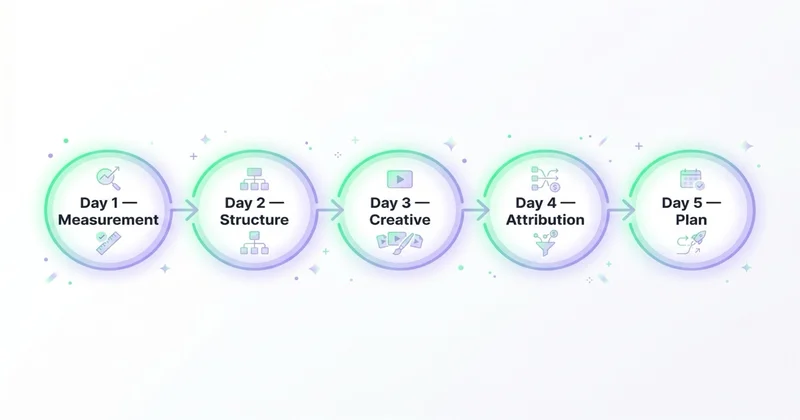
A 5-day TikTok Ads audit plan
- Day 1 — measurement. Verify the Pixel, Events API, deduplication and EMQ. Without this, later findings are unreliable.
- Day 2 — structure and delivery. Assess objectives, structure, Smart+ readiness and bidding strategy against data volume.
- Day 3 — creative. Analyse hook rate, completion rate, concept diversity and the cadence of fresh creative.
- Day 4 — attribution and business. Compare TikTok with GA4, the store and CRM. Judge profitability, not just panel ROAS.
- Day 5 — plan. Order the findings: critical errors, quick fixes, tests and strategic changes, each with a priority and an owner.
How to report the audit
Describe each finding the same way: problem → evidence in data → impact → recommendation → effort → priority → owner → deadline. The best audit ends with a task list for the coming weeks, not a general presentation.
If you would rather have an external team go through the account — with a ready action plan instead of just a list of notes — see our marketing audit of Google, Meta and TikTok accounts. It is the same structured process, packaged into a defined scope and timeline.
How we approach this at Space Ads
We open a TikTok audit with the creative, because on this platform the creative is the real targeting. The first read is the video funnel: how many people stay past the opening seconds and how many watch to the end — that says more about what's working than cost per conversion alone. A poor result behind a weak hook is a creative problem, not a settings one. Next comes measurement and readiness for automation: are the Pixel and Events API wired, and is event match quality good enough to run Smart+ sensibly. Structure is last, including pulling TikTok apart from the Pangle network, since lumped together they blur the numbers. The point of the audit is to show where the problem really sits, not to switch off ads that merely had a weak first frame.
Common mistakes
| Mistake | Consequence | Better approach |
|---|---|---|
| Moving to Smart+ at low EMQ | automation optimises against a bad signal | EMQ ≥ 6 first, then Smart+ |
| Few concepts, many variants | fast creative fatigue | diverse hooks, not copies |
| Mixing TikTok + Pangle | blurred results | separate campaigns per placement |
| Judging by the TikTok panel only | overstated channel impact | triangulate with GA4 and the store |
| Ad groups too narrow | no exit from the learning phase | consolidate, 50 conv/7d |
| No Events API | weak signal, low EMQ | implement server-side measurement |
FAQ
How does a TikTok Ads audit differ from a Google Ads or Meta Ads audit?
The logic is similar — start with measurement, then structure, creative, attribution and business — but the weighting differs. On TikTok, creative and conversion-signal quality (EMQ) matter more than manual targeting settings, because Smart+ takes over an increasing share of delivery decisions.
Is a TikTok Ads audit worth it on a small budget?
Yes, especially before scaling. The most common waste on small accounts is a missing Events API, low EMQ and ad groups too narrow to leave the learning phase. Fixing those fundamentals usually returns more than adding budget to a badly configured account.
What should be checked first?
Measurement: TikTok Pixel, Events API, deduplication, conversion values and EMQ. If the signal is weak, every later optimisation rests on distorted data.
Does an audit always end with rebuilding the account?
No. Sometimes improving measurement, adding Events API, tidying creative or separating Pangle is enough. A rebuild only makes sense when it follows from the diagnosis.
How often should a TikTok Ads audit be done?
A short health check monthly; a full audit after major changes: moving to Smart+, launching TikTok Shop, a team change, or before a season.
Conclusion
A TikTok Ads audit starts with data quality — Pixel, Events API and EMQ ≥ 6 are the foundation. Smart+ and GMV Max only work well on a solid conversion signal; without it, automation accelerates in the wrong direction. Creative is the number-one lever, so hook diversity and the cadence of fresh concepts matter more than the number of variants. Keep TikTok and Pangle separate, judge results through the business (GA4, store, CRM, margin) rather than the TikTok panel alone, and finish with a prioritised implementation plan.
Sources and further reading
- TikTok for Business — Pixel & Events API
- TikTok for Business — Smart+ Campaigns
- TikTok for Business — Event Match Quality
- TikTok for Business — GMV Max
Continue learning
Continue reading
TikTok Smart+: When to Hand Over the Campaign
TikTok Smart+ now supports full, partial and manual control across key campaign modules. Learn when automation has enough measurement, budget and creative signal to help—and how to test it without confusing attribution with business value.
How Much Does TikTok Advertising Cost? Budgets, Minimums and CPM in 2026
TikTok advertising has no fixed price, and its technical minimums do not define a useful test. Learn how to budget for media, creative and measurement, calculate qualified CPA and read Spark Ads or GMV Max without confusing attributed GMV with incremental profit.
TikTok GMV Max: What It Is, When to Use It and How to Measure It
TikTok GMV Max is an automated campaign type for TikTok Shop that optimizes toward gross merchandise value and target ROI. This guide explains Product and LIVE GMV Max, readiness requirements, creative inputs, automation risks, measurement and when manual control still matters.