
Spark Ads are a TikTok ad format that uses an existing organic TikTok post as the ad creative. The post can come from the brand account or from a creator account with authorization. The key difference from a standard non-Spark ad is that views, likes, comments, shares and follows generated during promotion are attributed to the organic post, so paid distribution strengthens the post rather than creating a separate ad asset with no social proof.
TL;DR
- Spark Ads promote organic TikTok posts. TikTok describes Spark Ads as a native ad format that uses organic posts and their features in advertising.
- They can use brand or creator content. A brand can use posts from its own account or posts made by creators with authorization.
- Engagement stays connected to the organic post. TikTok says views, comments, shares, likes and follows gained from boosting are attributed to the organic posts.
- They are useful for paid-organic amplification. Strong organic posts can be scaled with budget after proving audience fit.
- They are not magic. A weak hook, poor offer, low relevance or broken tracking can still make a Spark Ad perform badly.
- Creator usage needs process. Authorization, usage rights, deadlines, disclosure, brand safety and measurement should be agreed before spend starts.
- Measurement still matters. Use TikTok Pixel, Events API and clear campaign objectives when Spark Ads are expected to drive conversions.
What Spark Ads are
Spark Ads are TikTok ads built from organic TikTok posts. Instead of uploading a separate video file as a normal ad, the advertiser selects an existing post and promotes it through TikTok Ads Manager.
That organic post can be:
- a post published on the brand TikTok account;
- a post published by a creator or partner account with authorization;
- a post selected from a content workflow where the creator gives access for ad use.
This makes Spark Ads useful when the goal is to combine the native feel of TikTok content with the control and scale of paid media.
Why Spark Ads exist
TikTok is a content-first platform. Users are used to creator videos, comments, sounds, stitches, profiles and organic discovery. Standard ads can work, but they often feel more separate from the platform culture.
Spark Ads solve a different problem: how to scale content that already belongs to the TikTok ecosystem.
They can help because:
- the ad is connected to a real post;
- the viewer can visit the profile and interact with the post;
- social proof is visible and accumulates;
- creator content can be amplified without recreating it as a brand ad;
- organic and paid learning can support each other;
- strong posts can be scaled after they prove audience fit.
This does not mean every organic post should be boosted. Spark Ads work best when the original content already shows a useful signal: retention, comments, shares, profile visits, purchase-intent questions or strong creator fit.
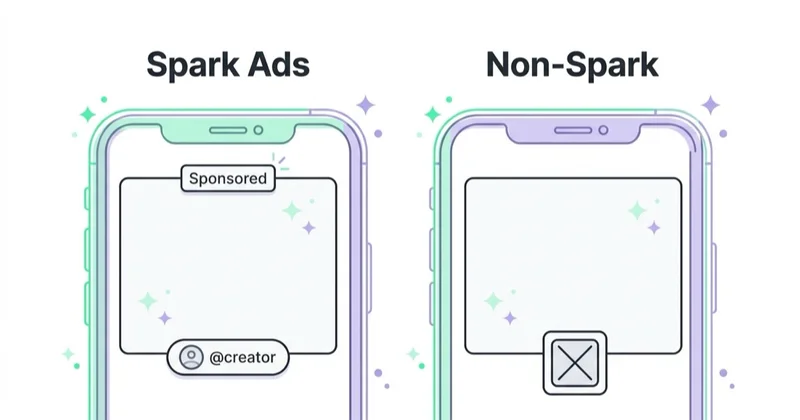
Spark Ads vs non-Spark Ads
| Area | Spark Ads | Non-Spark Ads |
|---|---|---|
| Creative source | Existing organic post | Uploaded ad creative |
| Social proof | Connected to the post | Starts as a separate ad asset |
| Profile interaction | Users can interact with the post owner profile | More limited ad-style interaction |
| Creator content | Built for creator authorization workflows | Usually requires separate asset handling |
| Caption and identity | Reflect the chosen organic post | Controlled as a standard ad asset |
| Best use | Amplifying proven content and creator posts | Testing controlled ad concepts, offers and variations |
| Main risk | Weak organic content scaled with spend | Ad creative feels less native or has no social proof |
TikTok documentation also notes that the display name and text for Spark Ads reflect the chosen organic post and cannot be edited during ad creation. That matters because Spark Ads should be prepared as TikTok posts first, not treated as editable ad units later.
When to use Spark Ads
Spark Ads are a strong fit when:
- an organic post already performs above account average;
- a creator post has high-quality comments or purchase intent;
- the brand wants to preserve social proof on the original post;
- the campaign needs a native feel rather than a polished ad look;
- the account wants to scale UGC, creator or founder-led content;
- paid media should support profile growth and community signals;
- the post has a clear hook, message and CTA alignment.
They are less appropriate when:
- the post is weak organically and there is no reason to believe paid traffic will fix it;
- the brand needs tight control over every frame and caption;
- the creator usage rights are unclear;
- comments need moderation but no one owns that process;
- the tracking setup cannot measure the intended outcome;
- the post topic is risky for policy, legal or brand safety reasons.
A practical rule: Spark Ads should usually scale content that already deserves distribution. They should not be used as a paid rescue plan for content that failed because the idea was weak.
How Spark Ads work with creator content
Creator Spark Ads require authorization. TikTok documentation states that Spark Ads can use posts made by other creators with authorization, and official FAQ content explains that Spark Ads can be created by pulling existing content via authorization code or account linkage.
A strong creator workflow should define:
- which post can be used;
- how long the authorization lasts;
- which markets and objectives are allowed;
- whether the brand can add destination links or CTA settings;
- who moderates comments;
- whether the creator can delete, hide or edit the post;
- whether the video can be reused outside TikTok;
- what happens if the creator content receives negative comments;
- how performance data is shared with the creator.
This should be agreed before the campaign launches. Spark Ads can look simple in Ads Manager, but creator rights and communication can become the real operational bottleneck.
How to choose posts for Spark Ads
Do not select posts only because they have many views. Views are useful, but they may come from the wrong audience.
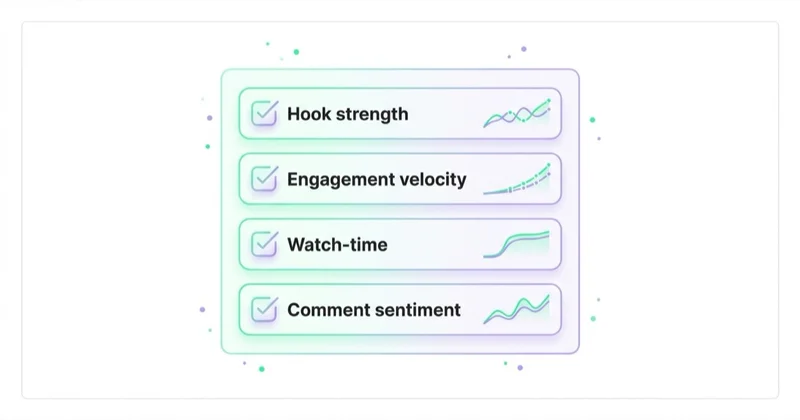
Better selection criteria:
| Signal | What it suggests |
|---|---|
| Strong first 2 seconds | The hook can stop the scroll |
| High average watch time | Viewers stay with the content |
| High completion rate | The video keeps attention until the end |
| Rewatches | The idea is useful, entertaining or looped well |
| Shares | Viewers believe others should see it |
| Comments with intent | The post creates questions, objections or buying signals |
| Profile visits | The content creates curiosity about the brand or creator |
| Saves | The video has practical or reference value |
| Matching audience | The people engaging resemble the target market |
For e-commerce, useful comment signals may include questions about price, sizing, shipping, ingredients, colour, availability or how the product works. For B2B or services, useful signals may include people asking for templates, examples, audits, pricing, process or next steps.
How to set up Spark Ads
The exact interface can change, but the operational workflow is stable.
1. Prepare the organic post
Before boosting, check:
- the hook is strong;
- the caption is accurate;
- the creator or brand profile is ready;
- comments do not create brand risk;
- music and usage rights are suitable for ad use;
- the landing page or profile CTA matches the message;
- the post has no policy issue.
Spark Ads inherit the organic post identity, so the post should be treated as part of the ad setup.
2. Confirm authorization
For brand-owned posts, connect the TikTok account or use the supported account workflow. For creator posts, request authorization through the appropriate TikTok workflow, authorization code or account linkage process.
Confirm the authorization duration before campaign launch. If authorization expires during a campaign, delivery can be disrupted.
3. Choose the objective
Spark Ads can support different goals depending on campaign setup and availability. Common use cases include:
- reach;
- video views;
- community interaction;
- traffic;
- conversions;
- app or shop-related objectives where available.
The objective should match the role of the post. A creator review that creates trust may be useful for conversions. A founder story may be better for awareness or profile visits. A product demo may work for traffic or sales if tracking and landing pages are ready.
4. Build the audience and budget plan
A Spark Ad does not remove the need for media planning. Decide:
- prospecting or remarketing;
- broad or interest-led audience;
- market and language;
- budget per post;
- minimum test duration;
- frequency limits where relevant;
- success threshold before scaling.
Avoid putting all spend behind one creator post. Spark Ads are still creative tests, and creative tests need a portfolio.
5. Measure and learn
Track both platform metrics and business metrics:
- thumb-stop or early retention proxy;
- video views and watch time;
- engagement rate;
- paid profile visits;
- paid follows;
- click-through rate;
- landing-page engagement;
- conversion rate;
- cost per lead or purchase;
- revenue, margin or qualified pipeline where available.
TikTok documentation lists Spark Ads metrics such as paid likes, paid shares, paid followers, paid profile visits and paid comments. Those are useful, but they should not replace conversion or business reporting when the campaign goal is revenue or leads.
Spark Ads and TikTok Pixel
Spark Ads can drive engagement and profile growth without a Pixel, but conversion campaigns need a measurement foundation.
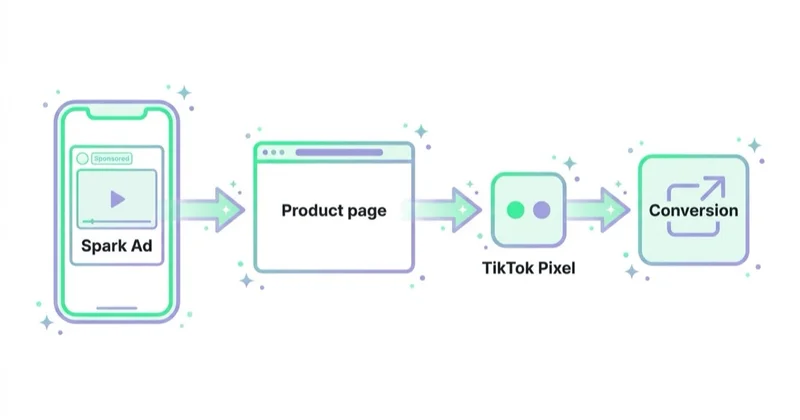
Before using Spark Ads for sales or leads, check:
- TikTok Pixel is installed;
- key events are configured;
- Events API is planned or implemented for stronger event reliability;
- event deduplication works where both browser and server events are sent;
- purchase or lead value is passed where relevant;
- consent behaviour is tested;
- reporting is compared with backend data.
A native-looking ad still needs accurate tracking. Otherwise it is hard to tell whether engagement turns into useful business outcomes.
Spark Ads for e-commerce
For e-commerce, Spark Ads are often useful when product discovery depends on demonstration, social proof or creator trust.
Good e-commerce formats:
- product demonstration;
- try-on or styling video;
- before and after;
- unboxing;
- comparison;
- creator review;
- objection handling;
- FAQ reply video;
- product use in a real routine.
The best candidates often come from posts where comments reveal buying intent. A video with many comments like "which size", "where can I buy", "does it ship to", "how long does it last" or "is this suitable for" can be more valuable than a broad entertainment video with no commercial intent.
Spark Ads beyond e-commerce
Spark Ads are not only for online stores.
For B2B, Spark Ads can amplify expert clips, founder opinions, event snippets, educational content or creator-led explanations. The goal may be awareness, remarketing audience growth, profile authority or traffic to a deeper resource.
For local services, Spark Ads can promote proof-based videos: transformations, process videos, client questions, staff introductions, premises walkthroughs or service explanations.
For education, Spark Ads can amplify course explanations, student outcomes, application tips or short tutorials.
The principle is the same: use organic content that already communicates trust or value, then scale it to the right audience.
How we approach this at Space Ads
Spark Ads are our default, because they fix the biggest problem with TikTok advertising: that it looks too much like advertising. The ad runs from a real post — ours or a creator's, with permission — so it keeps its comments, likes and followers, and social proof works for us instead of starting from zero. We use them two ways: putting budget behind organic videos already performing, and bringing in creator content (UGC), which on TikTok usually outperforms polished production. The formalities are easy to forget and worth guarding — the creator's authorisation code, the right account links — because without them even the best creative won't run as a Spark Ad.
Common mistakes
| Mistake | Why it hurts | Better approach |
|---|---|---|
| Boosting weak organic posts | Budget cannot fix a poor idea | Promote posts with strong retention or intent |
| Choosing by views only | Views may come from the wrong audience | Check comments, shares, profile visits and audience fit |
| No creator rights process | Campaigns can pause or create legal risk | Agree authorization, usage and duration upfront |
| Ignoring comments | Spark Ads keep the post alive | Moderate and use comments for follow-up content |
| No Pixel for conversion campaigns | Sales and leads are hard to measure | Set up Pixel, Events API and deduplication |
| One post per campaign | Results depend too much on one asset | Test multiple posts and creators |
| Treating Spark Ads as normal ads | The post identity and caption matter | Prepare the organic post like a campaign asset |
| Scaling too fast | Early metrics can be unstable | Use thresholds and gradual budget increases |
FAQ
What are Spark Ads on TikTok?
Spark Ads are a native TikTok ad format that uses organic TikTok posts as ad creative. The post can come from the brand account or from a creator account with authorization.
How are Spark Ads different from regular TikTok ads?
Spark Ads are connected to an organic post and its social interactions. Standard non-Spark ads are uploaded as separate ad creatives and do not carry the same organic post context.
Can a brand run Spark Ads from a creator post?
Yes, but the creator must authorize the post for ad use through the supported TikTok workflow, such as authorization code or account linkage.
Does engagement from Spark Ads stay on the original post?
TikTok says views, comments, shares, likes and follows gained from boosting the video during promotion are attributed to the organic posts.
Should every organic post be boosted?
No. Boost posts that already show strong audience signals or business intent. Weak posts should usually be improved or replaced rather than scaled with budget.
Are Spark Ads good for conversions?
They can be, especially when the post has a strong product or offer fit. Conversion campaigns still need TikTok Pixel, Events API where appropriate, clear landing pages and reliable measurement.
Are Spark Ads only for e-commerce?
No. They can also support B2B, local services, education, recruitment, creator campaigns and personal brands when the organic post helps build trust or explain value.
What should be checked before launching Spark Ads?
Check authorization, usage rights, caption, music rights, comments, brand safety, landing page, objective, tracking, Pixel events and budget thresholds.
Key takeaways
Spark Ads are one of the clearest ways to connect organic TikTok content with paid distribution. They work best when the content already feels native, earns attention and matches a business goal. The format is especially useful for creator partnerships, product demonstrations, founder-led content and paid amplification of organic winners.
The strongest workflow is simple: publish or source strong organic content, measure the real audience response, select winners, confirm rights and tracking, then scale with Spark Ads while monitoring both engagement and business outcomes.
Sources and further reading
- TikTok for Business Help Center - About Spark Ads
- TikTok for Business Help Center - About Spark Ads FAQs
- TikTok for Business Help Center - TikTok auction in-feed ads
- TikTok for Business Help Center - About paid and organic optimization for brand ads
- Space Ads - TikTok Ads service
Continue learning
Continue reading
TikTok Smart+: When to Hand Over the Campaign
TikTok Smart+ now supports full, partial and manual control across key campaign modules. Learn when automation has enough measurement, budget and creative signal to help—and how to test it without confusing attribution with business value.
How Much Does TikTok Advertising Cost? Budgets, Minimums and CPM in 2026
TikTok advertising has no fixed price, and its technical minimums do not define a useful test. Learn how to budget for media, creative and measurement, calculate qualified CPA and read Spark Ads or GMV Max without confusing attributed GMV with incremental profit.
TikTok GMV Max: What It Is, When to Use It and How to Measure It
TikTok GMV Max is an automated campaign type for TikTok Shop that optimizes toward gross merchandise value and target ROI. This guide explains Product and LIVE GMV Max, readiness requirements, creative inputs, automation risks, measurement and when manual control still matters.


































