TikTok GMV Max is an automated campaign type for TikTok Shop that optimizes toward GMV, or gross merchandise value: the total value of goods sold through the shop. The seller gives TikTok products, creative assets, budget and an efficiency target; TikTok's system then automates more of the audience selection, bidding, placement and creative delivery.
The simplest analogy is that GMV Max is to TikTok Shop what Performance Max is to Google Shopping and Advantage+ Shopping is to Meta: a goal-based automation layer built for commerce scale. That analogy is useful, but it also reveals the main risk. More automation means less manual control, so the quality of inputs matters more: catalogue hygiene, product economics, stock, creator content, Spark Ads, live-shopping readiness, tracking and the target ROI.
This guide explains what TikTok GMV Max is, how Product GMV Max and LIVE GMV Max differ, when it makes sense, what to prepare before launch, how to use it without treating it as a black box, and how to measure profitable GMV rather than just top-line sales.
TL;DR
- TikTok GMV Max is automated TikTok Shop advertising. It optimizes toward gross merchandise value and an efficiency target such as ROI.
- It is not a shortcut around weak foundations. Product data, stock, creative volume, tracking, fulfilment and margin decide whether automation has enough quality input.
- There are two main use cases. Product GMV Max supports catalogue and product-video sales; LIVE GMV Max supports live-shopping sales.
- Creative is the biggest lever. TikTok-native videos, creator content, affiliate posts and Spark Ads usually matter more than manual audience control.
- GMV is not profit. GMV does not automatically account for margin, discounts, platform fees, creator commissions, fulfilment, cancellations or returns.
- Automation reduces transparency. Expect less granular control than manual shopping campaigns and judge performance with business data, not only platform ROAS.
- Availability varies. TikTok Shop and GMV Max features roll out by market, account and product setup, so confirm current availability inside TikTok Seller Center or Ads Manager.
What is TikTok GMV Max?
TikTok GMV Max is a goal-based campaign type for sellers using TikTok Shop. Instead of manually controlling every audience, placement, bid and creative combination, the seller chooses products and campaign settings while the system tries to maximize sales value at the target efficiency.
GMV means gross merchandise value. It is the total value of goods sold, before a full business view of costs. That distinction matters. A campaign can increase GMV while still damaging contribution margin if the promoted products have low margin, high return rates, heavy discounts, expensive creator commissions or fulfilment problems.
Use GMV Max as an automation product for TikTok Shop scale, not as a complete profitability report.
How GMV Max works
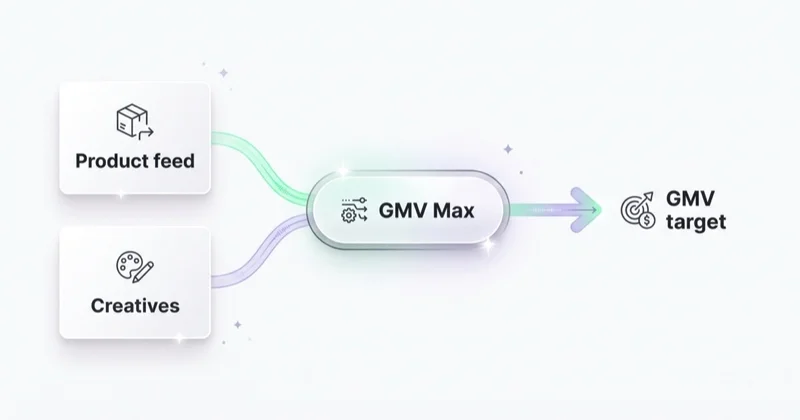
GMV Max depends on five inputs.
| Input | Why it matters |
|---|---|
| Products | TikTok Shop listings, titles, variants, images, prices, stock and approval status decide what the system can sell. |
| Creative | Videos, organic posts, creator/affiliate content and Spark Ads give the system material to test and scale. |
| Sales signals | Shop behavior, orders, product events and account history help the system learn which users and products convert. |
| Efficiency target | Target ROI or a maximize-GMV setting steers volume versus efficiency. |
| Operational reality | Margin, stock, delivery, returns, customer support and live-shopping capacity decide whether GMV becomes profit. |
The automation can decide which products and creative assets receive spend, where ads appear within available TikTok commerce surfaces, how aggressively to bid and which users are likely to buy. The operator's job shifts from manual micro-control to feed quality, creative supply, product selection, target-setting and business measurement.
This is why GMV Max often disappoints sellers who launch it with a thin catalogue, weak product pages, two tired videos and an unrealistic ROI target. Automation amplifies inputs. It does not fix the offer.
Product GMV Max vs LIVE GMV Max
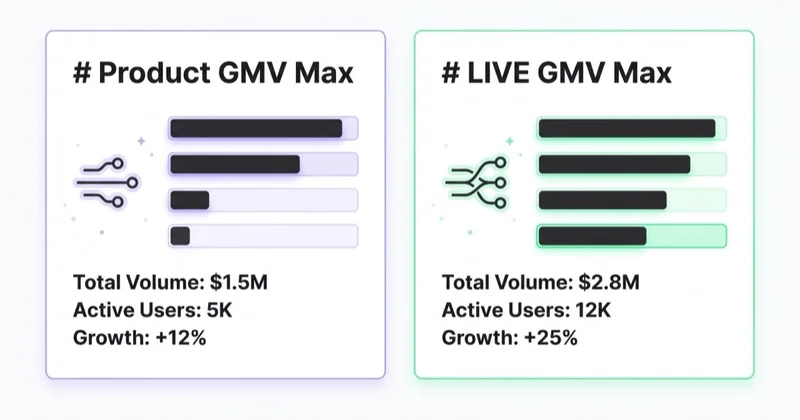
The two common use cases match the two TikTok Shop selling modes.
| Area | Product GMV Max | LIVE GMV Max |
|---|---|---|
| Main goal | Sell products from listings, videos and product content | Drive purchases during live-shopping sessions |
| Main assets | Product catalogue, videos, Spark Ads, creator and affiliate posts | Live stream, host, product script, offer, comments and live operations |
| Best fit | Always-on selling, bestseller scaling, product discovery | Launches, scheduled live commerce, strong host-led selling |
| Main lever | Catalogue quality plus native creative volume | Live quality, offer, host, traffic before and during the stream |
| Main risk | GMV grows without margin or incrementality | Live cost and effort exceed sales contribution |
Product GMV Max is usually the always-on engine when a seller has products, stock, listings and creative ready. LIVE GMV Max makes sense only when live commerce is an actual sales motion, not a one-off experiment. A good live campaign needs a host, product order, talking points, offer, moderation, comment handling, fulfilment readiness and post-live analysis.
When GMV Max makes sense
GMV Max is strongest when TikTok Shop is already operationally ready.
Good conditions:
- product listings are complete, approved and in stock;
- the products have enough margin to absorb media spend, discounts and commissions;
- there is existing sales signal or clear product-market pull;
- the brand has a steady supply of TikTok-native creative;
- creator or affiliate content is available and rights are clear;
- Spark Ads can amplify posts with real organic signal;
- fulfilment, customer service and returns can handle higher order volume;
- the target ROI is based on economics, not wishful thinking;
- the team accepts lower manual control in exchange for scale.
Poor conditions:
- the catalogue is small, messy or often out of stock;
- margin is too thin for paid acquisition;
- the seller has no fresh video pipeline;
- product listings are weak or unclear;
- the account needs strict control over audience, creator, geography or placement;
- the live-shopping operation is not ready;
- reporting must precisely separate paid, organic, affiliate and live sales;
- TikTok Shop or GMV Max is not available in the target market or account.
When those foundations are weak, start with TikTok Ads cost and budget planning, TikTok Shop setup, creative testing and manual campaigns before giving automation a scaling brief.
Readiness checklist before launch
Product and catalogue
- TikTok Shop is approved and connected to the ad account.
- Product titles, categories, variants, images, prices and stock are accurate.
- Products selected for GMV Max have enough stock to handle scale.
- Products with weak margin, high return risk or operational issues are excluded.
- Bestsellers and video-friendly products are prioritized.
- Delivery, returns and customer service information are clear.
For feed fundamentals, read what is a product feed and how to use it.
Creative
- There are several distinct creative concepts, not one video with tiny edits.
- Videos show the product in use, with a clear hook and reason to buy.
- Creator, affiliate and customer content is available where relevant.
- Spark Ads authorization is in place for posts the brand wants to promote.
- Creative rights define paid use, duration, territory and editing.
- A refresh plan exists before fatigue appears.
TikTok's Spark Ads format allows advertisers to use organic posts from their own account or authorized creator posts while keeping the post's engagement attached to the original content. That makes it especially useful when a post has already shown organic pull.
Measurement and economics
- Target ROI is calculated from margin, fees, discounts, commissions and fulfilment cost.
- Reporting separates GMV from net revenue and contribution margin.
- New versus returning customers can be assessed where data allows.
- Returns and cancellations are reviewed after the platform's initial attribution window.
- UTMs and analytics comparison are in place.
- Incrementality is considered before scaling spend aggressively.
Operations
- Inventory can support the expected sales volume.
- Customer support can handle comments, order questions and post-purchase issues.
- Live-shopping teams have scripts, hosts, offer rules and moderation if LIVE GMV Max is used.
- Product exclusions are ready if stock or margin changes.
- Organic, affiliate and paid activity are coordinated so the team can understand what caused demand.
GMV Max vs manual Video Shopping Ads
GMV Max and manual Video Shopping Ads solve different problems.
| Area | GMV Max | Manual Video Shopping Ads |
|---|---|---|
| Control | Lower; system automates more decisions | Higher; operator isolates audiences, creatives and tests |
| Setup | Faster when inputs are ready | More hands-on |
| Transparency | More limited detail | Easier to analyze specific hypotheses |
| Best use | Scaling proven catalogue, products and creative | Testing products, hooks, creators, audiences or offers |
| Risk | Black-box attribution and less diagnostic learning | Slower scale and more manual work |
The best model is often hybrid. Use manual campaigns, organic posts and creators to test hooks, products and content. Use GMV Max to scale the assets and products that show signal. This is similar to the relationship between Performance Max and standard Shopping: automation can scale, but controlled tests still create learning.
How to run GMV Max well
1. Choose products deliberately
Do not put the entire catalogue into automation without thinking. Prioritize products that have stock, margin, good visuals, low operational risk and a reason to buy on TikTok. Exclude products that look good in GMV but fail after returns, discounts or fulfilment.
2. Set a realistic target ROI
An aggressive target can starve delivery. A loose target can grow GMV while eroding profit. Start from product economics:
target ROI should reflect product margin, discounts, TikTok fees, creator or affiliate commissions, fulfilment, returns and acceptable payback.
Tighten the target after the system has enough signal, not before it has learned anything useful.
3. Feed creative variety
TikTok is creative-led. Give GMV Max different angles:
- product demonstration;
- creator try-on or review;
- problem and solution;
- comparison with an alternative;
- unboxing or first impression;
- before and after;
- objection handling;
- live clip;
- social proof;
- use-case or occasion content.
One strong concept can fatigue quickly. A steady creative pipeline is more valuable than constant campaign resets.
4. Avoid learning-phase panic
Automated campaigns need stable inputs. Constantly changing targets, budgets, products and creative can make the learning period noisy. Monitor for technical or operational problems, but avoid judging the campaign from one or two volatile days.
5. Watch stock and fulfilment
GMV Max can push volume toward products the system believes will sell. If stock runs out, delivery times slip or support gets overwhelmed, the paid-media result can create a customer-experience problem. Inventory and service readiness are part of media readiness.
6. Separate diagnosis from scale
If performance is weak, diagnose inputs before blaming automation:
- Is the product desirable in TikTok context?
- Is the listing clear?
- Are videos native and varied enough?
- Is the target ROI realistic?
- Is the product actually profitable after costs?
- Is the shop losing buyers through delivery, reviews, price or trust issues?
- Is GMV Max claiming sales that organic or affiliate activity would have generated anyway?
How to measure GMV Max
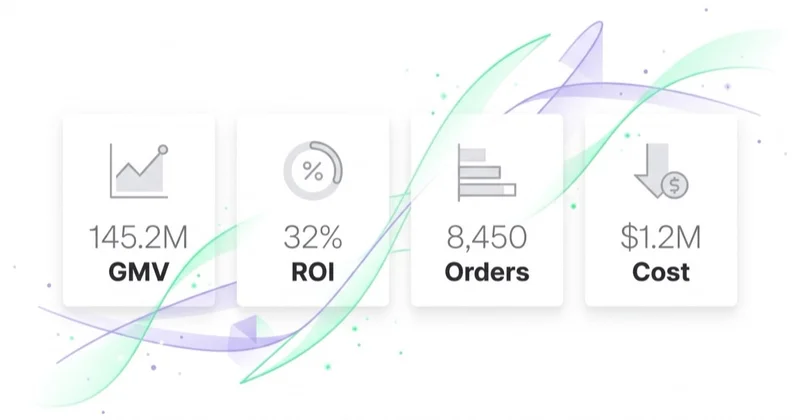
Use platform metrics for campaign operation, but use business metrics for budget decisions.
| Metric | What it shows | What it misses |
|---|---|---|
| GMV | Total sales value attributed to the campaign | Profit, returns, discounts and incrementality |
| ROI / ROAS | Sales value relative to ad spend | Margin, commissions, fulfilment and customer quality |
| Orders | Volume | Whether orders are profitable or incremental |
| New customers | Acquisition quality | Repeat value and long-term retention |
| Product-level GMV | Which products sell | Whether the winning products are actually good for the business |
| Contribution margin | Profit after variable costs | Usually needs ecommerce or finance data outside the platform |
| Incrementality | Additional sales caused by the campaign | Requires tests or careful comparison |
The central question is not "Did GMV Max increase GMV?" It is: Did it create profitable, incremental GMV that the business would not have captured anyway?
For smaller accounts, this may mean comparing total TikTok Shop sales, paid spend, organic sales, affiliate activity, new customers, returns and stock movement before and after campaign changes. For larger accounts, use holdouts, geo tests, product splits or structured incrementality testing where feasible.
Common automation risks
| Risk | What happens | How to reduce it |
|---|---|---|
| GMV without profit | Sales rise but contribution falls | Use margin, return and fee data in decisions |
| Weak creative supply | Automation cannot find enough winning combinations | Build a recurring creator and video pipeline |
| Messy catalogue | Spend goes to products with poor data or stock issues | Clean product data and exclude risky SKUs |
| Over-tight ROI target | Delivery becomes too restricted | Start realistic, then tighten with evidence |
| Over-loose ROI target | Scale becomes inefficient | Monitor contribution, not only volume |
| Attribution over-credit | GMV Max claims demand created elsewhere | Compare with organic, affiliate and total shop trends |
| Live underprepared | LIVE GMV Max drives traffic to a weak shopping event | Plan host, offer, script, moderation and fulfilment |
How Space Ads approaches GMV Max
At Space Ads, GMV Max is treated as a commerce automation layer, not a replacement for strategy. The starting point is readiness: product economics, TikTok Shop setup, catalogue quality, creative pipeline, tracking, operational capacity and the real target ROI after margin, fees and returns.
The practical work is usually:
- decide which products are suitable for automation;
- improve listings and catalogue quality before scaling;
- build a creative pipeline from brand videos, creators, affiliates and Spark Ads;
- set target ROI from business economics, not vanity ROAS;
- monitor stock, fulfilment and customer feedback as media spend grows;
- compare GMV Max performance with organic, affiliate, live and total TikTok Shop sales;
- keep manual tests where the business needs diagnostic learning or tighter control.
This connects naturally with TikTok Ads, performance marketing, social media marketing for fashion brands, fashion marketing and marketing audit. A GMV Max audit should answer whether the blocker is automation, creative, product data, shop trust, economics or measurement.
Common mistakes
- Launching before TikTok Shop is ready. Automation cannot compensate for incomplete listings, poor stock or weak fulfilment.
- Treating GMV as profit. GMV ignores the costs that decide whether scale is healthy.
- Using too little creative. One or two videos rarely give the system enough options.
- Setting target ROI from hope. ROI targets should come from margin and payback logic.
- Changing too much too quickly. Constant resets make learning harder.
- Ignoring creator rights. Strong creator posts cannot be promoted safely if paid usage was not agreed.
- Judging only inside TikTok. Cross-check with ecommerce, GA4, finance and total shop performance.
- Using GMV Max for every diagnostic question. Manual tests still matter when you need to understand a product, creator or offer.
FAQ
What is TikTok GMV Max?
TikTok GMV Max is an automated TikTok Shop campaign type that optimizes toward gross merchandise value and an efficiency target such as ROI. It uses product listings, creative assets, shop signals and campaign settings to automate more of the targeting, bidding, placement and creative delivery.
What does GMV mean on TikTok?
GMV means gross merchandise value: the total value of goods sold. It is useful for measuring sales volume, but it is not the same as profit. GMV does not automatically account for product margin, discounts, platform fees, creator commissions, fulfilment, cancellations or returns.
What is the difference between Product GMV Max and LIVE GMV Max?
Product GMV Max is used to sell products from listings, videos, creator posts and product content. LIVE GMV Max is used to drive sales during live-shopping sessions. Product GMV Max is usually the always-on catalogue engine; LIVE GMV Max only makes sense when live commerce is operationally prepared.
Is GMV Max better than manual Video Shopping Ads?
GMV Max is better for scaling when products, creative and shop data are ready. Manual Video Shopping Ads are better when the team needs more control or wants to isolate a test around a product, creator, audience or offer. Many sellers use both: manual campaigns for learning, GMV Max for scale.
What do I need before launching GMV Max?
You need an active TikTok Shop, accurate product listings, stock, a linked ad account, creative assets, creator or Spark Ads rights where relevant, tracking, a realistic target ROI and operations that can handle higher sales volume. If margin, fulfilment or product data are weak, fix those before scaling.
Is TikTok GMV Max available in every country?
No. TikTok Shop and GMV Max availability can vary by country, account, product category and platform rollout. Confirm availability directly inside TikTok Seller Center, TikTok Ads Manager or with a TikTok representative before building a plan around it.
How should GMV Max be measured?
Measure GMV and ROI in the platform, but make budget decisions with business data: contribution margin, fees, discounts, returns, customer quality, new versus returning customers and incrementality. The best question is whether GMV Max produced profitable additional sales, not only whether attributed GMV increased.
Can GMV Max work for fashion brands?
Yes, when the brand has TikTok-native creative, product listings that show fit and style clearly, stock, margin and a social-commerce operation. Fashion brands should pay special attention to sizing, returns, creator fit, usage rights and whether the promoted products are profitable after exchanges and returns.
Key takeaways
- TikTok GMV Max automates TikTok Shop advertising around GMV and target ROI.
- It works best when catalogue, creative, tracking, stock and product economics are already strong.
- Product GMV Max and LIVE GMV Max solve different commerce problems.
- Creative volume, creator rights and Spark Ads are major levers.
- GMV is not profit; measure margin, returns, fees, commissions and incrementality.
- Keep manual campaigns or tests when the business needs control and learning, not only scale.
Sources and further reading
- TikTok Ads Help - About Spark Ads
- TikTok Shop Seller Center - Seller and advertising resources
- TikTok for Business - Business help center
- Business Insider - Reporting on GMV Max automation and advertiser concerns
Continue learning
Continue reading

Auto Parts Ecommerce: Marketing Around the Fitment Problem
Auto parts marketing starts with fitment data. Learn how to connect the catalogue, vehicle selector, product feed, SEO and returns data so customers find parts that genuinely fit.

Local Inventory Ads: The Format Decided by Your Stockroom
Local inventory ads connect nearby demand with products available in physical stores. Learn how to prepare store data, pickup options, landing pages and offline measurement without promising stock the customer cannot buy.
TikTok Smart+: When to Hand Over the Campaign
TikTok Smart+ now supports full, partial and manual control across key campaign modules. Learn when automation has enough measurement, budget and creative signal to help—and how to test it without confusing attribution with business value.