TikTok Ads are paid campaigns managed in TikTok Ads Manager. They can support reach, traffic, lead generation, app promotion, website conversions, ecommerce sales, creator amplification and full-funnel demand generation. The channel is not just a cheaper version of Meta Ads. It is a discovery environment where the creative, the first seconds of the video, the quality of conversion data and the pace of testing often decide whether the campaign scales or stalls.
A strong TikTok Ads setup starts with a clear role for the channel. For some brands, TikTok is a direct-response sales engine. For others, it is a way to introduce a product, educate a market, collect leads, test creator content or feed remarketing audiences in other channels. The wrong starting point is to upload a polished horizontal ad from another platform and expect TikTok to make it work. The right starting point is to build ads that feel native to how people watch, search, compare and decide inside TikTok.
TL;DR
- TikTok Ads Manager uses a campaign, ad group and ad structure, so strategy must be translated into objectives, budgets, audiences, placements and creatives.
- Creative quality is the main growth lever. Strong hooks, natural pacing, clear demonstrations and fast testing matter more than small targeting tweaks.
- TikTok Ads can support awareness, traffic, leads, app installs, website conversions and ecommerce sales, but each objective needs a different measurement plan.
- Conversion campaigns need reliable event data from TikTok Pixel and, at larger scale, Events API with deduplication.
- Spark Ads help promote organic posts from a brand or creator while keeping the post identity and engagement attached to the original TikTok post.
- Smart+ campaigns automate more of the setup and optimisation, but they still need good inputs: clear goals, enough budget, strong creative and clean data.
- Ecommerce teams should connect catalog, product events, margin data and post-click behaviour before judging TikTok only by platform ROAS.
- Service, education, SaaS, B2B and local brands can also use TikTok Ads, but the path to conversion is usually longer and should be measured beyond last click.
What are TikTok Ads?
TikTok Ads are paid video and commerce placements bought through TikTok Ads Manager. They appear across TikTok surfaces and, depending on the setup and market, can also use additional placement options such as partner inventory. The system uses auction, objective selection, audience signals, creative signals and conversion data to decide which ad should be shown to which user.
The most common setup uses short vertical video, a concise caption, a call to action and a landing page, instant form, app store page, product page or TikTok Shop destination. Campaigns can be manual, more automated through Smart+ flows, based on search intent, supported by catalog data, or built around creator content promoted as Spark Ads.
TikTok Ads work best when the campaign matches the platform behaviour. People open TikTok to discover, learn, compare, be entertained and solve specific problems quickly. Advertising that respects that context usually performs better than advertising that only tries to interrupt it.
When TikTok Ads make sense
TikTok Ads can be useful when the offer can be explained visually, when the audience needs education before conversion, or when the brand has enough creative capacity to test multiple angles. The channel is especially strong when product value can be shown rather than only described.
Typical use cases include:
| Use case | Example | Main metric |
|---|---|---|
| Product discovery | Launching a new consumer product | Reach, video views, assisted conversions |
| Ecommerce acquisition | Selling products through a website or TikTok Shop | CPA, ROAS, contribution margin |
| Lead generation | Collecting enquiries for a service, course or consultation | CPL, lead quality, contact rate |
| Creator amplification | Promoting UGC or influencer posts with Spark Ads | Engagement, conversions, cost per qualified visit |
| App promotion | Driving installs and in-app actions | CPI, activation rate, retention |
| B2B education | Introducing a problem and moving users to remarketing | Quality sessions, CRM leads, assisted pipeline |
| Local demand | Showing proof, results or transformations | Bookings, calls, form submissions |
TikTok Ads are less suitable when there is no capacity to produce video, no clear landing page, no event tracking, or no patience for creative iteration. The platform can produce cheap reach, but cheap reach does not equal profitable growth.
How TikTok Ads Manager is structured
TikTok Ads Manager is organised into three main levels:
| Level | What it controls | Practical decision |
|---|---|---|
| Campaign | Objective, campaign type and high-level budget logic | Traffic, Lead Generation, Sales, App Promotion, Smart+ or Search |
| Ad group | Placement, audience, schedule, budget, bid strategy and optimisation event | Purchase, Complete Payment, Submit Form, Landing Page View or Click |
| Ad | Video, text, CTA, identity, destination and tracking | In-feed video, Spark Ad, creator post, product ad or instant form |
This structure matters because a weak decision at one level can limit the whole campaign. A good creative cannot solve a wrong optimisation event. A good audience cannot solve a poor landing page. A large budget cannot solve missing conversion data.
Before launch, define the campaign role in one sentence. For example: increase qualified product discovery among new buyers, generate demo requests from remarketing audiences, or test whether creator-style proof can reduce purchase CPA. That sentence should guide every setup choice.
Campaign objectives and how to choose them
The objective should match the business outcome, not just the cheapest report metric. Traffic campaigns can bring visitors, but they do not automatically find buyers. Lead campaigns can bring form submissions, but they still need qualification. Sales campaigns can optimise for purchases, but only when the event data is strong enough.
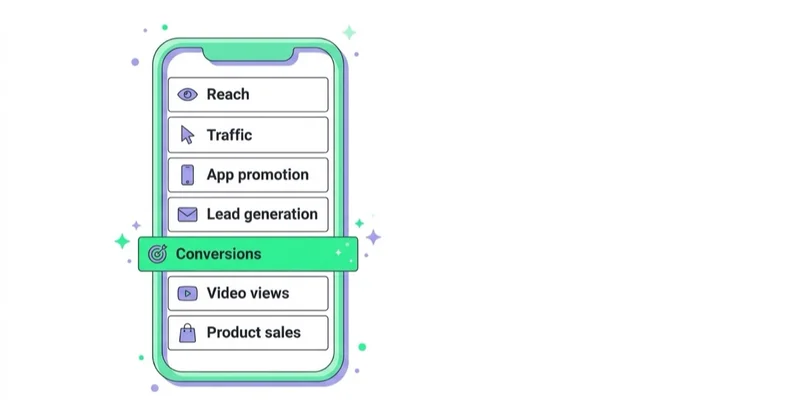
| Objective group | Best for | Watch out for |
|---|---|---|
| Awareness | Market entry, launch, broad reach, brand lift | Do not judge only by immediate sales |
| Traffic | Content promotion, landing page testing, warm audience building | Cheap clicks can be low intent |
| Lead Generation | Quotes, consultations, webinars, downloads, recruitment | Lead quality needs CRM feedback |
| Sales or web conversions | Purchases, sign-ups, bookings and other website actions | Pixel and Events API quality matter |
| App Promotion | Installs and in-app actions | Optimise beyond install when possible |
| Search Ads | Intent-based discovery inside TikTok search | Keyword coverage and creative relevance matter |
| Smart+ | Automated performance campaigns | Automation still needs creative variety and clean signals |
A practical rule: choose the deepest objective that can receive enough reliable data. If a campaign will not generate enough purchases, it may be better to start with a higher-volume event such as add to cart, lead, landing page view or qualified micro-conversion, then move deeper when data improves.
TikTok ad formats and campaign types
TikTok Ads include several formats and buying approaches. The exact availability can vary by market and account, so the Ads Manager interface is the final source of truth.
| Format or type | Role | When to use it |
|---|---|---|
| In-Feed Ads | Core vertical video ads in the feed | Most traffic, lead and conversion campaigns |
| Spark Ads | Paid promotion of existing TikTok posts | Creator content, organic winners, social proof |
| Search Ads | Ads shown in the context of TikTok search | Product research, education and intent capture |
| Smart+ Campaigns | More automated setup and optimisation | Scaling with strong creative and clean data |
| Catalog or product ads | Product-led ecommerce promotion | Larger catalogs, remarketing and product discovery |
| Instant Forms | Lead capture inside TikTok | Fast lead generation when landing pages are weak |
| Premium reach formats | High-impact brand placements | Major launches and larger media budgets |
The most important distinction is between non-Spark ads and Spark Ads. Non-Spark ads are created directly as ads. Spark Ads promote an organic post from a brand account or creator account after authorisation. Spark Ads can feel more native because they preserve the post identity, comments and social context.
Creative strategy: the main performance lever
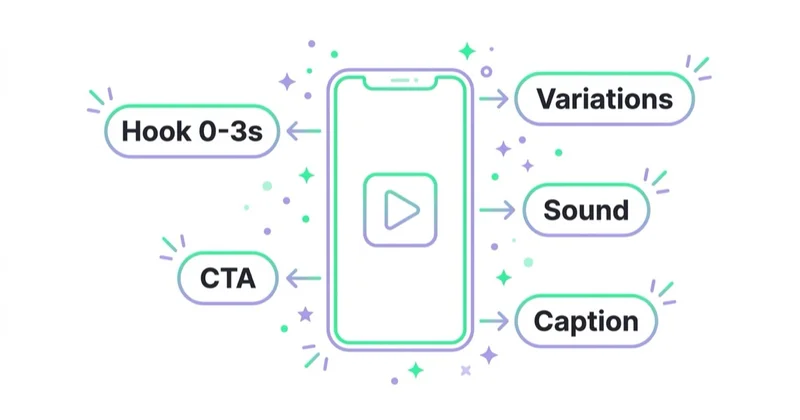
TikTok creative should be built around attention, relevance and proof. The first seconds need to answer why the viewer should keep watching. The middle needs to show the idea clearly. The ending needs a simple next step.
Useful creative angles include:
- problem and solution,
- before and after,
- product demonstration,
- creator review,
- myth versus fact,
- mistakes to avoid,
- checklist or quick tutorial,
- comparison with an alternative,
- founder or expert explanation,
- customer objection and answer,
- behind the scenes,
- reaction to a common question.
Do not test only tiny edits. A different caption, button or colour is rarely as useful as a different hook, offer, audience insight, proof type or story structure. A better first test is four to six genuinely different concepts. After a concept works, then variations can refine the winner.
A simple creative brief should include the audience problem, the hook, the proof, the offer, the visual idea, the CTA and the landing page promise. TikTok Creative Center can help research trends, top ads, keywords and creative patterns, but it should be used for insight, not copying.
Budget and bidding basics
TikTok sets minimum budget thresholds at campaign and ad group level. Official help materials currently describe daily budget minimums above 50 USD at campaign level and above 20 USD at ad group level, with lifetime budgets calculated from equivalent daily thresholds. Actual account thresholds can differ by currency, region and setup, so the final value should always be checked in Ads Manager.
Budget should be large enough to let the system learn. Splitting a small test across too many ad groups, audiences and creative variants usually creates inconclusive data. It is better to start with fewer, clearer tests and enough spend to compare meaningful concepts.
For budget management:
- avoid changing budget and targeting every few hours,
- evaluate by objective-specific outcomes, not CPM alone,
- keep a stable testing window,
- separate creative learning from audience learning where possible,
- scale winners gradually rather than restarting the learning process constantly,
- compare platform data with analytics, CRM, ecommerce and profit data.
Low CPM can be useful, but it is not the goal. The goal is profitable attention, qualified demand or measurable business growth.
Measurement: Pixel, Events API and attribution
Performance campaigns need reliable tracking before scaling. TikTok Pixel collects browser events such as page views, leads, add to cart and purchases. Events API sends events from the server or another backend system. Using both can improve measurement resilience, but duplicate events must be handled correctly.
When the same event is sent by Pixel and Events API, deduplication requires a shared event identifier. Without deduplication, reporting can overcount. Without enough event data, optimisation can become unstable.
A basic measurement checklist:
- install TikTok Pixel before launching conversion campaigns,
- define the primary conversion event,
- pass value and currency for revenue events,
- use product identifiers for ecommerce catalog matching,
- add Events API when performance spend becomes material,
- deduplicate browser and server events,
- use UTM parameters for analytics comparison,
- compare TikTok reporting with GA4, CRM and ecommerce platform data,
- review assisted conversions and incrementality where scale allows.
TikTok often creates demand before the final click. Last-click reports can undervalue that role, especially for high-consideration products, subscriptions, education, services and B2B. The measurement plan should separate immediate response, assisted demand and long-term audience growth.
Ecommerce: website sales and TikTok Shop
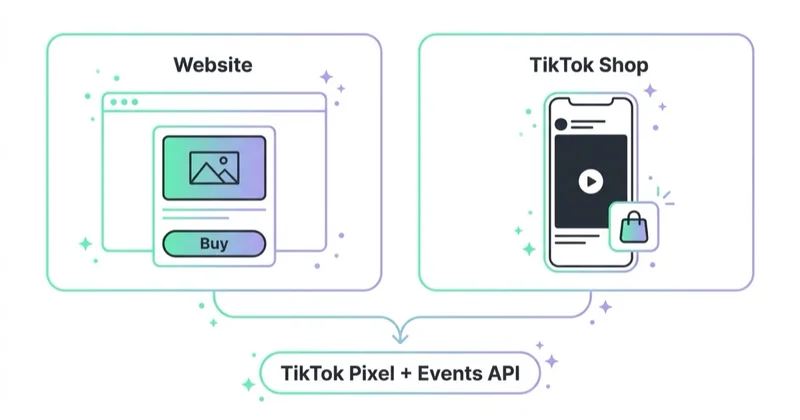
For ecommerce, TikTok Ads can support prospecting, retargeting, creator-led selling, catalog campaigns and TikTok Shop. The channel tends to perform best when products are visually demonstrable, easy to understand and aligned with mobile buying behaviour.
Important ecommerce foundations include:
- clean product feed or catalog,
- product IDs consistent across catalog and events,
- purchase event with value and currency,
- fast mobile product pages,
- checkout with limited friction,
- clear delivery, returns and payment information,
- creator-style videos that show real use,
- margin and return analysis, not only revenue ROAS.
TikTok Shop changes the journey because discovery, product content and checkout can happen closer together inside TikTok. Website ecommerce still needs strong landing pages and tracking. Many brands will use both: TikTok Shop for native commerce and the website for broader merchandising, retention, email capture and analytics control.
TikTok Ads outside ecommerce
TikTok Ads are not only for online stores. Service businesses, education providers, local companies, apps, SaaS and B2B teams can use TikTok when the message can be made visual and useful.
Examples:
- A local clinic can show process, outcomes, FAQs and trust signals.
- A software company can show the cost of a workflow problem and a short product demo.
- A training company can use short lessons and webinar signups.
- A recruitment team can promote roles with culture proof and employee videos.
- A professional service firm can explain mistakes, audits and decision criteria.
- An event organiser can use video proof, speaker clips and urgency.
The key difference is measurement. A B2B TikTok campaign may not close deals directly in one click. It can still drive qualified traffic, remarketing pools, content consumption, newsletter signups, demo requests and assisted pipeline. That should be planned before judging the campaign.
How to launch the first TikTok Ads campaign
Use this sequence for a clean first launch:
- Define the campaign role and success metric.
- Choose the objective that matches the outcome and available data volume.
- Install TikTok Pixel and verify events.
- Add Events API if conversion data quality is important from the start.
- Prepare a landing page, form, product page or TikTok Shop destination.
- Build four to six distinct creative concepts.
- Decide whether to use non-Spark ads, Spark Ads or both in separate tests.
- Set budget so each test can collect meaningful data.
- Add UTM parameters to all website links.
- Launch with a stable evaluation window.
- Cut weak concepts, iterate promising ones and scale proven winners.
- Feed learnings back into organic content, creator briefs and other paid channels.
This process is intentionally simple. Most early TikTok Ads problems come from unclear goals, weak measurement or too little creative variety, not from a missing advanced setting.
How we approach this at Space Ads
On TikTok the fastest way to burn budget is to run ads that look like ads. We don't port creative one-to-one from Meta; we shoot native material, with sound and a hook in the first second or two, because what stops the thumb is the moment, not the minute. Spark Ads are our default, so the ad reads like an ordinary video rather than a banner. Before scaling anything we make measurement solid: Pixel and Events API wired and deduplicated, with healthy event match quality, since automated bidding and Smart+ only work on clean data. And we judge campaigns by TikTok's own signals, hold in the first seconds and watch-through, rather than benchmarks carried over from Meta, because it's a different ecosystem with different behaviour.
Common mistakes
| Mistake | Why it hurts | Better approach |
|---|---|---|
| Reusing a polished ad from another channel | It feels out of place in the feed | Build native vertical concepts |
| Starting with one video | No creative learning | Test several different angles |
| Optimising for traffic when sales are expected | The system finds clickers, not buyers | Choose conversion goals when data supports it |
| Ignoring Pixel and Events API | Weak optimisation and unreliable reporting | Fix tracking before scaling |
| Over-segmenting audiences | Limited learning and fragmented spend | Start broader with stronger creative signals |
| Judging by CPM only | Cheap reach can hide poor demand quality | Use CPA, ROAS, lead quality and profit metrics |
| Editing campaigns too often | Learning becomes unstable | Use planned testing windows |
| Treating TikTok as ecommerce-only | Missed demand generation use cases | Match the funnel to the business model |
FAQ
Are TikTok Ads worth it?
TikTok Ads are worth testing when the business can create native video, measure outcomes and use the channel for discovery or conversion. They are not worth scaling when tracking is incomplete, the landing page is weak or the brand has only one generic creative.
How much do TikTok Ads cost?
Cost depends on market, objective, competition, creative quality, landing page quality and event data. TikTok publishes minimum budget thresholds, but real media cost should be judged by the business outcome: purchase cost, qualified lead cost, app activation, margin or incremental demand.
Can TikTok Ads work for B2B?
Yes, but usually as part of a wider funnel. B2B campaigns should focus on useful education, expert proof, remarketing, newsletter signups, webinar registrations, demo requests and assisted pipeline rather than expecting every conversion to happen after one click.
Do TikTok Ads need TikTok Pixel?
Traffic or awareness campaigns can run without conversion tracking, but website conversion campaigns need TikTok Pixel or another event connection. For more reliable performance measurement, Events API and deduplication should be considered.
What is the difference between Spark Ads and regular TikTok ads?
Regular TikTok ads are created as ads inside Ads Manager. Spark Ads promote existing organic posts from a brand or creator, with authorisation where needed. They can preserve the original post identity and social context.
How many creatives should be prepared for launch?
A practical starting point is four to six different concepts. These should not be small edits of the same video. They should test different hooks, problems, proof types, formats and offers.
Key takeaways
TikTok Ads work when campaign setup, creative and measurement support one clear goal. The platform can create demand quickly, but it rewards fast creative learning and strong signal quality more than over-engineered audience segmentation.
For ecommerce, TikTok Ads should connect product feed, purchase events, creator-style videos, TikTok Shop or website conversion data, and profitability analysis. For services, SaaS, education, B2B and local businesses, TikTok should usually be planned as a discovery, education, lead generation and remarketing channel.
The safest first step is not a complex campaign structure. It is a clear offer, a reliable measurement setup, a small set of genuinely different videos and a decision framework for what to scale, what to rewrite and what to stop.
Running TikTok Ads campaigns — from setup to scaling — is something you can hand to us.
Sources and further reading
- TikTok Ads Manager: How to set up an ad campaign
- TikTok Ads Manager: About TikTok Ads Manager
- TikTok Ads Manager: About budgets
- TikTok Ads Manager: About Smart+ Campaigns
- TikTok Ads Manager: About Spark Ads
- TikTok Ads Manager: Event deduplication
Continue learning
Continue reading
TikTok Creative Center: What It Is and How to Use It
TikTok Creative Center helps marketers research Top Ads, trends, keywords, sounds and creative patterns before producing TikTok videos or ads.
TikTok Smart+: When to Hand Over the Campaign
TikTok Smart+ now supports full, partial and manual control across key campaign modules. Learn when automation has enough measurement, budget and creative signal to help—and how to test it without confusing attribution with business value.
How Much Does TikTok Advertising Cost? Budgets, Minimums and CPM in 2026
TikTok advertising has no fixed price, and its technical minimums do not define a useful test. Learn how to budget for media, creative and measurement, calculate qualified CPA and read Spark Ads or GMV Max without confusing attributed GMV with incremental profit.