
Allegro Ads is one of the most important retail media channels for brands that want to sell in Poland. For many international e-commerce teams, Poland means "Google Shopping plus Meta plus maybe Amazon". That is an incomplete view. Allegro is the dominant marketplace layer in the Polish buying journey, and its ad system can influence product discovery directly inside a high-intent marketplace environment.
Allegro Ads lets sellers promote products inside Allegro through Sponsored Offers and, on selected marketplaces, display-style placements. For foreign brands, the channel matters most when products are already listed on Allegro, margins can absorb marketplace fees and CPCs, and there is a clear plan for Polish-language product content, fulfilment, pricing and product feed quality.
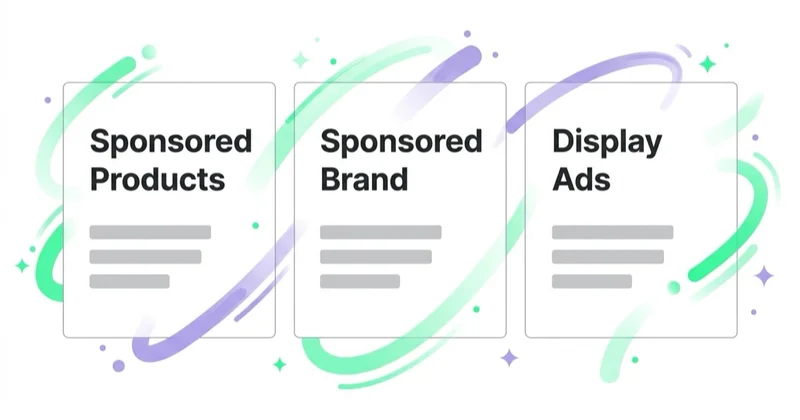
The important availability point is this: Allegro's named marketplaces currently include Poland, Czechia, Slovakia and Hungary. Allegro's own help materials state that Sponsored Offers are available on allegro.pl and in foreign marketplaces, while Display Ads are available only on allegro.pl. That distinction matters when planning CEE expansion, because the Polish market has the broadest ad-format coverage.
TL;DR
- Allegro Ads is the retail media advertising system used to promote offers inside Allegro, Poland's largest marketplace.
- The strongest commercial use case is bottom-funnel product promotion: products appear in search results and on offer pages when buyers are already comparing options.
- Sponsored Offers are the standard starting point. They are CPC-based and available on allegro.pl and foreign Allegro marketplaces.
- Display Ads are used more for reach and brand visibility. According to Allegro's help documentation, they are available only on allegro.pl.
- Allegro's current named marketplace expansion covers Poland, Czechia, Slovakia and Hungary. Poland should usually be treated as the primary market for Allegro Ads planning.
- Allegro Ads should not be managed in isolation from Google Shopping, Performance Max or price-comparison activity. The same SKU can be competing for the same demand across several surfaces.
- Reporting needs a marketplace view and a business view: Allegro Ads dashboard data is useful, but profitability should also include commission, delivery, returns, margin and repeat purchases.
- For international sellers, the operational work is often more important than the bidding work: localised listings, pricing, stock, delivery promise and product reviews shape the ceiling of ad performance.
What Is Allegro Ads?
Allegro Ads is Allegro's advertising ecosystem for sellers and brands that want to increase product visibility inside the marketplace. The core promise is simple: promoted offers can appear in high-attention areas of Allegro when users are searching, browsing categories or viewing product pages.
For performance teams, the closest analogy is not only Google Shopping. Allegro Ads sits between marketplace advertising, retail media and product-feed advertising:
- like Google Shopping, it depends heavily on product data, price, availability and offer quality;
- like Amazon Ads, it captures demand inside a marketplace where users are close to purchase;
- like retail media, it creates an additional paid layer on top of organic marketplace ranking;
- like product listing ads, it works SKU by SKU rather than only campaign by campaign.
The key difference is purchase context. A person searching on Google may still be comparing stores, reading reviews or looking for inspiration. A person searching inside Allegro is already in a marketplace environment where seller reputation, delivery options, price and marketplace trust are part of the decision.
Where Is Allegro Ads Available?
For international readers, this is the first strategic question.
Allegro as a marketplace brand is strongest in Poland and has expanded into Central Europe. Official Allegro materials describe successful launches of Allegro.cz in Czechia, Allegro.sk in Slovakia and Allegro.hu in Hungary. International seller materials also position Allegro as an entry route into Poland, Czechia, Slovakia and Hungary.
Ad-format availability is not identical in every market:
| Market | Marketplace | Practical Allegro Ads note |
|---|---|---|
| Poland | allegro.pl | Main market. Sponsored Offers and Display Ads are the most relevant formats. |
| Czechia | allegro.cz | Sponsored Offers can be used in foreign marketplaces, but format access may differ from Poland. |
| Slovakia | allegro.sk | Sponsored Offers can support product visibility, especially when listings and fulfilment are localised. |
| Hungary | allegro.hu | Newer expansion market. Treat campaign planning as marketplace growth plus retail media testing. |
| Slovenia / Croatia | Allegro Group presence through broader regional operations | Do not assume full Allegro Ads parity with allegro.pl. Verify marketplace and ad-format availability before planning. |
For most foreign brands, the practical starting point is Poland. It has the largest Allegro marketplace maturity, the strongest buyer habit and the most developed ad environment. Czechia, Slovakia and Hungary can be considered once listings, translations, logistics and pricing are ready.
Allegro Ads Formats in 2026
Sponsored Offers
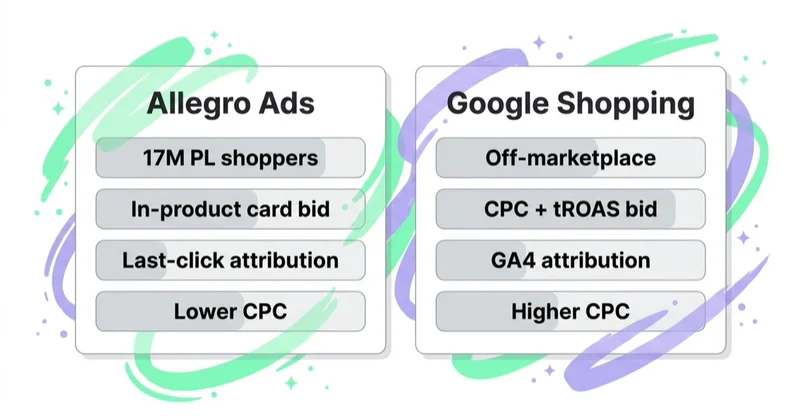
Sponsored Offers are the default performance format. They promote specific offers in marketplace search results and on offer pages. This is where most brands should start, because the format is close to purchase intent and can be evaluated SKU by SKU.
Sponsored Offers work best when:
- the offer already has a competitive price,
- product title and parameters are complete,
- delivery terms are strong,
- the seller account has enough trust signals,
- product reviews or seller reviews reduce purchase anxiety,
- the SKU has existing demand on Allegro,
- the category has enough search volume to support paid traffic.
The most common mistake is using Allegro Ads to fix weak marketplace fundamentals. Paid visibility can bring more people to an offer, but it cannot fully compensate for poor product content, bad shipping terms or an uncompetitive price.
Display Ads
Display Ads are visual placements used for brand visibility and demand shaping inside Allegro. Allegro's help documentation describes display placements on areas such as the home page, above search results and product pages. They are closer to retail media display than classic search advertising.
Display Ads are useful when:
- the brand needs to build recognition in Poland,
- a seasonal promotion needs reach,
- a product line is being launched,
- a category is visually driven,
- the campaign is coordinated with Meta, TikTok, YouTube or Google Display,
- the goal includes assisted sales, not only last-click performance.
The availability caveat is important: Allegro's help page states that Display Ads are available only on allegro.pl. International CEE planning should not assume the same display inventory in Czechia, Slovakia or Hungary.
Brand And Marketplace-Level Campaigns
Allegro's advertising ecosystem also includes brand-oriented and richer formats through marketplace media buying. These are usually more relevant once a brand has:
- enough SKU coverage,
- a clear category strategy,
- a Polish offer architecture,
- budgets beyond basic Sponsored Offers,
- a reason to build mental availability inside Allegro, not only harvest demand.
For smaller foreign sellers, the first 90 days should usually focus on listing quality, Sponsored Offers, category economics and reporting. Brand formats become more useful when there is already proof that Allegro can generate profitable sales.
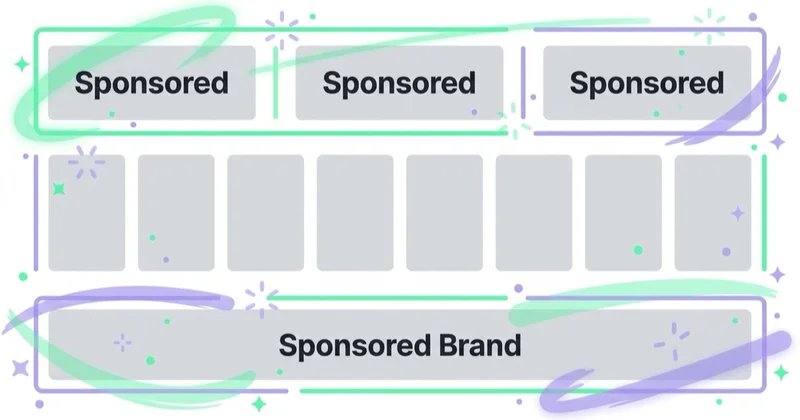
Allegro Ads vs Google Shopping
Allegro Ads and Google Shopping often compete for the same commercial demand, but they do it in different contexts.
| Area | Allegro Ads | Google Shopping / PMax |
|---|---|---|
| Buying context | Inside Allegro marketplace | Google Search, Shopping tab, Display, YouTube and other Google inventory |
| Main unit | Offer / SKU on Allegro | Product feed item linked to merchant website or marketplace setup |
| Trust layer | Allegro marketplace, seller profile, delivery options, reviews | Store trust, Merchant Center quality, landing page, brand trust |
| Pricing pressure | Very high because alternatives are one click away | High, but comparison depends on search surface |
| Reporting | Allegro Ads dashboard and marketplace sales data | Google Ads, Merchant Center, GA4 and backend data |
| Best use | Capturing marketplace demand | Capturing search demand and scaling beyond one marketplace |
The two channels should not be treated as enemies. For many products, the correct question is not "Allegro Ads or Google Shopping?" but "Which demand should go to the brand store, and which demand should be captured on Allegro?"
If a foreign brand has low recognition in Poland, Allegro can lower trust friction because buyers already trust the marketplace. If the brand has strong margins, a differentiated offer and a good website, Google Shopping can build more direct customer ownership. The budget split should follow margin, stock, category competitiveness and customer lifetime value.
How To Split Budget Between Allegro Ads And Google Shopping
A practical starting framework:
| Situation | Budget implication |
|---|---|
| Product is new to Poland and brand trust is low | Use Allegro Ads to test marketplace demand and reduce buyer friction. |
| Product has strong branded search demand | Protect Google Shopping and brand search while testing Allegro incrementality. |
| Product is highly commoditised | Compare net margin after marketplace commission, CPC and returns before scaling. |
| Product has unique features or bundles | Use Google Shopping and landing pages for education, Allegro for high-intent conversion. |
| Product performs well on Allegro organically | Sponsored Offers can defend visibility and scale demand. |
| Product has weak Allegro conversion rate | Fix listing, pricing and delivery before increasing ads. |
For agency work, the first audit should include overlap by SKU. If the same product is promoted in Google Shopping, Performance Max and Allegro Ads, the team needs to know whether spend is creating incremental sales or just moving the same order between channels.
Reporting And Attribution
Allegro Ads reporting is useful for campaign control, but it should not be the only source of truth. Marketplace dashboards are designed to show campaign-level outcomes inside the platform. Business decisions need a broader view.
Track at least:
- ad spend by campaign and SKU,
- click volume and CPC,
- sales value attributed in Allegro Ads,
- organic Allegro sales for the same SKUs,
- total SKU sales across Allegro and the brand website,
- marketplace commission,
- delivery subsidy,
- return rate,
- margin after all marketplace costs,
- new customer share if available from internal data,
- stockouts and availability issues.
The most useful metric is not only ROAS. It is contribution margin after advertising and marketplace costs. A campaign can show attractive attributed revenue and still be weak after commissions, discounts and returns.
The "CSS-Like" Thinking For Allegro
In Google Shopping, CSS partners and feed tactics can affect competitiveness, visibility and cost structure. Allegro does not have a direct equivalent that works the same way, but there is a similar strategic mindset: marketplace performance is not only a bid problem.
The levers are:
- product title structure,
- category and parameter completeness,
- offer grouping,
- price competitiveness,
- delivery promise,
- Smart! eligibility where relevant,
- seller quality,
- promotions,
- product reviews,
- image quality,
- stock depth,
- campaign segmentation by SKU economics.
In other words, Allegro Ads optimization is part media buying and part marketplace operations. A pure PPC team that ignores offer quality will hit a ceiling quickly.
Recommended 90-Day Launch Plan For Foreign Brands
Days 1-15: Marketplace Readiness
Prepare product listings, translations, product parameters, pricing, delivery terms, returns process, invoices and customer service. This stage decides whether ads will have enough conversion potential.
Days 16-30: Baseline And Product Selection
Identify SKUs with the best chance of profitable sales. Prioritise products with demand, margin, stock and operational simplicity. Avoid launching ads on the full catalogue without segmentation.
Days 31-45: Sponsored Offers Test
Launch Sponsored Offers for selected SKUs. Keep campaign structure simple enough to read results. Separate hero products, margin-sensitive products and experimental products.
Days 46-60: Search Query And SKU Economics Review
Review cost, sales, CPC, conversion, margin and organic movement. Pause products where paid visibility only exposes weak offer economics. Increase budget where paid and organic movement improve together.
Days 61-75: Google Shopping Overlap Audit
Compare Allegro Ads results with Google Shopping, Performance Max and brand-store sales. Identify whether Allegro is generating incremental marketplace demand or cannibalising direct sales.
Days 76-90: Scale Or Rebuild
Scale winning SKUs, rebuild weak listings, test new categories and decide whether display or brand-level marketplace media makes sense.
How we approach this at Space Ads
On a marketplace the ad auction is the smaller half of the game; the bigger half is the listing itself. Price against the identical offers sitting right beside you, reviews, delivery time and a clean listing move more units than the size of your bid. Allegro Ads amplifies an offer that's already competitive, but it won't rescue a product dearer than the one two clicks away, because here the customer compares everything on one screen. So before scaling budget we fix the listing first: price, photo, reviews, delivery terms. We read attribution carefully too, since the marketplace panel, GA4 and real sales rarely agree, and look at the effect at the business level rather than the conversions the system credits itself. A marketplace is one channel among others, not a separate world running on its own magic.
Common Mistakes
Launching Ads Before Localisation
Foreign brands often underestimate Polish marketplace expectations. Product names, parameters, delivery terms and customer service language matter. A translated title is not the same as a listing built for Polish buyers.
Looking Only At ROAS
Marketplace ROAS can be misleading if commission, delivery, discounts and returns are not included. Profitability should be calculated at SKU level.
Treating Allegro As A Smaller Amazon
Allegro has its own buyer habits, seller tools, logistics expectations and category dynamics. Amazon playbooks are useful, but they need adaptation.
Ignoring Organic Marketplace Ranking
Paid campaigns can affect visibility, but organic ranking, offer quality and price competitiveness are still critical. Allegro Ads works best when it amplifies offers that are already commercially strong.
Scaling Too Many SKUs Too Early
Large catalogues need segmentation. Not every SKU deserves paid support. Start with products that have the best mix of margin, demand and operational readiness.
FAQ
What is Allegro Ads?
Allegro Ads is Allegro's advertising system for promoting marketplace offers. It includes Sponsored Offers and display-style formats, with availability depending on marketplace and format.
Is Allegro Ads only for Polish companies?
No. International sellers can use Allegro as a route into Poland and selected CEE markets, provided they meet seller, listing, fulfilment and legal requirements. Operational readiness is essential.
In which countries is Allegro Ads available?
Allegro's main named marketplaces are Poland, Czechia, Slovakia and Hungary. Sponsored Offers are described by Allegro as available on allegro.pl and in foreign marketplaces. Display Ads are described as available only on allegro.pl. Availability should be checked before each market launch.
Is Allegro Ads similar to Amazon Ads?
There are similarities because both are marketplace advertising systems. The buying context is high intent, and product listing quality matters. However, Allegro has its own formats, seller rules, buyer expectations and CEE market dynamics.
Should Allegro Ads replace Google Shopping?
Usually no. Allegro Ads and Google Shopping should be planned together. Allegro can capture marketplace demand, while Google Shopping can drive users to the brand store or other shopping surfaces.
What should be audited before scaling Allegro Ads?
The audit should cover product pricing, margin, stock, listing quality, delivery promise, marketplace commission, return rate, Google Shopping overlap, organic Allegro sales and SKU-level profitability.
Key Takeaways
Allegro Ads should be a serious consideration for any international e-commerce brand entering Poland. It is not just another PPC channel. It is advertising inside a marketplace that already shapes how Polish consumers search, compare and buy.
The opportunity is strongest when Allegro Ads is connected with marketplace operations, Google Shopping strategy and SKU-level profitability. Sponsored Offers can capture high-intent demand, while Display Ads on allegro.pl can support brand visibility. But campaigns will only scale when listings, pricing, logistics and reporting are built properly.
For foreign companies, the practical path is clear: start with Poland, understand the Allegro ecosystem, validate product economics, then expand carefully into Czechia, Slovakia and Hungary where marketplace and format availability support the plan.
Sources and further reading
- Allegro Help: General information on Allegro Ads
- Allegro Help: How to start advertising with Allegro Ads
- Allegro: At a glance
- Allegro: Join Allegro - sell in Poland and internationally
- Allegro: Why choose Allegro for international markets
- Allegro Help: Allegro Ads budget and statistics
Continue Learning
Continue reading

How to Choose an Ecommerce PPC Agency (Margin, Feed and Blended Truth)
Choose an ecommerce PPC agency by examining product-data operations, contribution economics, customer acquisition, PMax controls, measurement, access and scope—not a headline ROAS alone.

Furniture Marketing: Shopping, Meta, Showrooms and Custom Orders
Furniture marketing needs two operating models: product-led ecommerce for stock furniture and consultation-led lead generation for custom work. This guide covers Google Shopping, product feeds, Meta lifestyle creative, delivery, returns, financing, showrooms and margin-aware measurement.

Jewelry Marketing: Shopping Feeds, Meta and High-AOV Retargeting
Jewelry marketing needs accurate product data, visual demand creation and margin-aware measurement. This guide covers Google Shopping feeds, Meta catalog strategy, gifting seasonality, fine vs fashion jewelry, product-truth claims, retargeting and high-AOV CRO.


































