Jewelry marketing is ecommerce performance work where product truth matters as much as creative. A necklace, tennis bracelet, fashion ring and engagement ring may all sit in the same catalog, but buyers do not evaluate them in the same way. Some pieces sell from visual impulse. Others require education, trust, financing, certification, returns, sizing support and long retargeting windows.
That is why a strong jewelry account cannot be managed from blended ROAS alone. The feed has to describe products accurately. The site has to make materials, stones, size, returns and delivery clear. Google Shopping has to bid by category, margin and season. Meta has to create desire without losing product specificity. Measurement has to show contribution margin, not only revenue.
TL;DR
- Jewelry marketing starts with product data. Titles, images, variants, material, stone details, price, availability and landing-page consistency decide Shopping eligibility and efficiency.
- Product claims need discipline. Gold content, gemstone names, lab-created stones, treatments, weight and quality language should be accurate, clear and consistent across ads, feed and product pages.
- Fine and fashion jewelry need separate funnels. Fashion pieces can behave like impulse ecommerce; bridal and fine jewelry need education, reassurance and longer retargeting.
- Seasonality is commercial infrastructure. Gift guides, shipping deadlines, collection launches and budget ramps should be planned before Valentine's Day, Mother's Day, holiday gifting and bridal peaks.
- Meta is strongest when catalog and creative work together. Lifestyle video creates demand; catalog ads and product-level retargeting convert warmer buyers.
- Margin-aware measurement is mandatory. Custom labels, COGS data, category margins and new-customer logic prevent media from scaling unprofitable revenue.
Why Jewelry Marketing Is Different
Jewelry combines emotional buying, high product variance and strict product-expectation risk.
The first challenge is price spread. A $60 plated fashion piece, $280 gold vermeil necklace, $900 solid gold bracelet and $8,000 engagement ring should not share one bidding target. Their margins, consideration cycles, return risk and creative needs are different.
The second challenge is product detail. A buyer cares whether a piece is solid gold, gold plated, gold vermeil, sterling silver, lab-grown, mined, treated, natural, simulated, made to order, resized, certified or final sale. Those details are not small print. They are conversion drivers and trust signals.
The third challenge is seasonality. Jewelry demand often clusters around gifting moments, proposals, anniversaries, weddings and personal milestones. The campaign calendar has to run ahead of the shopping window because product launches, creative production, feed readiness, shipping cutoffs and retargeting audiences take time.
The fourth challenge is creative quality. Jewelry has to look beautiful, but it also has to be legible. Buyers need scale, metal tone, clasp detail, stone size, packaging, try-on context and close-up clarity. A beautiful ad that hides scale or material detail may drive clicks and returns at the same time.
The Product-Truth Layer
Jewelry brands need a product-truth layer before scaling paid media. That means the feed, product page, ad copy, packaging inserts and customer support language should use the same definitions.
| Product Area | Why It Matters In Marketing |
|---|---|
| Metal | solid gold, plated, vermeil, sterling silver and alloy claims affect price trust |
| Stone type | mined, lab-grown, simulated and imitation terms shape buyer expectations |
| Stone treatment | treatment can affect value, care and disclosure needs |
| Weight and size | carat weight, total weight, dimensions and scale reduce confusion |
| Certification | high-ticket buyers need grading and origin clarity where applicable |
| Care instructions | pearls, plated pieces and treated stones may need different care |
| Sizing and resizing | ring size, chain length and resizing policies affect conversion |
| Returns and exchanges | gifting and fine jewelry buyers need low-friction reassurance |
| Shipping deadlines | seasonal conversion depends on delivery confidence |
The FTC's Jewelry Guides in 16 CFR Part 23 cover marketing claims for jewelry, gemstones, precious metals and related products. They describe general deception principles and specific guidance for claims about gold, diamonds, gemstones, pearls, treatments, weight and terms such as natural or laboratory-created. For paid media, the operational takeaway is to avoid improvising claims inside ads or feeds. Build approved product-language rules and reuse them everywhere.
This matters for SEO and LLM visibility too. A product page that says "14k solid gold lab-grown diamond solitaire ring, 1.00 ct total weight, GIA report available, made to order in 3 weeks" is easier for search engines, shopping systems and answer engines to understand than a page built around vague luxury adjectives.
Google Shopping Feed Priorities
Google Merchant Center's product data specification states that accurate, correctly formatted product data is essential for successful ads and free listings, and that incorrect or missing data can cause disapprovals, limited eligibility or display issues. For jewelry, this is not an administrative detail. The feed is the merchandising layer that tells Google what is being sold.
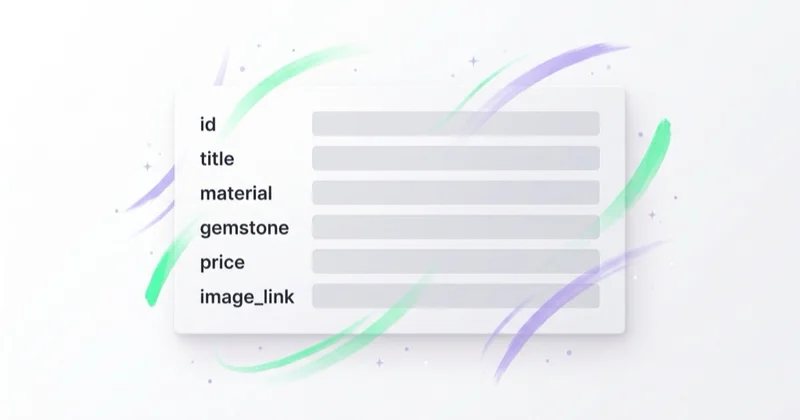
High-priority feed fields for jewelry include:
| Feed Area | Jewelry Application |
|---|---|
title |
product type, metal, stone, style, size or occasion where useful |
description |
product details, materials, dimensions, stone information, care notes |
image_link |
clean primary image that accurately displays the product |
additional_image_link |
lifestyle, scale, clasp, packaging and try-on views |
price and sale_price |
accurate price and promotion timing |
availability |
in stock, preorder, backorder or out of stock consistency |
brand |
clear brand ownership, especially for multi-brand retail |
gtin or mpn |
product identifiers where they exist |
item_group_id |
variants such as size, metal color or stone option |
custom_label_0-4 |
margin, price band, season, category and lifecycle labels |
cost_of_goods_sold |
margin visibility where accounting data supports it |
Good jewelry titles usually combine commercial clarity with search language:
| Weak Title | Better Direction |
|---|---|
| Luna Ring | Luna 14k Gold Lab-Grown Diamond Solitaire Ring |
| Pearl Necklace | Freshwater Pearl Necklace, 18-Inch Sterling Silver Clasp |
| Huggies | 14k Gold Small Hoop Earrings, 12 mm |
| Tennis Bracelet | Lab-Grown Diamond Tennis Bracelet, 3 ct Total Weight |
| Birthstone Gift | Sterling Silver Garnet Birthstone Necklace |
The goal is not keyword stuffing. The goal is product clarity. Google also warns against promotional text in titles and descriptions, so "free shipping" or discount language belongs in promotions, not the product name.
For deeper feed work, see what a product feed is and how to use it, GTIN and identifier_exists in Merchant Center, and Google PLA / Shopping campaigns.
Custom Labels For Jewelry Profitability
Jewelry accounts often fail because bidding follows revenue instead of contribution. Custom labels help separate products by business role.
Useful labels include:
| Label Type | Example Values | Why It Helps |
|---|---|---|
| Margin band | high, medium, low | prevents low-margin revenue from dominating spend |
| Price band | under_100, 100_300, 300_1000, 1000_plus | aligns bidding with consideration cycle |
| Category | fashion, fine, bridal, personalized, giftable | separates buyer behavior |
| Season | valentines, mothers_day, holiday, wedding | supports budget ramps |
| Lifecycle | bestseller, new, evergreen, clearance | controls merchandising priority |
| Inventory depth | deep_stock, limited_stock, made_to_order | avoids scaling unavailable products |
| New customer role | acquisition_hero, retention, upsell | separates prospecting from repeat purchase |
Google's product data specification includes custom_label_0-4 as optional labels that organize bidding and reporting in Shopping campaigns. For jewelry, these labels are often the difference between a profitable account and a beautiful revenue report with weak margin.
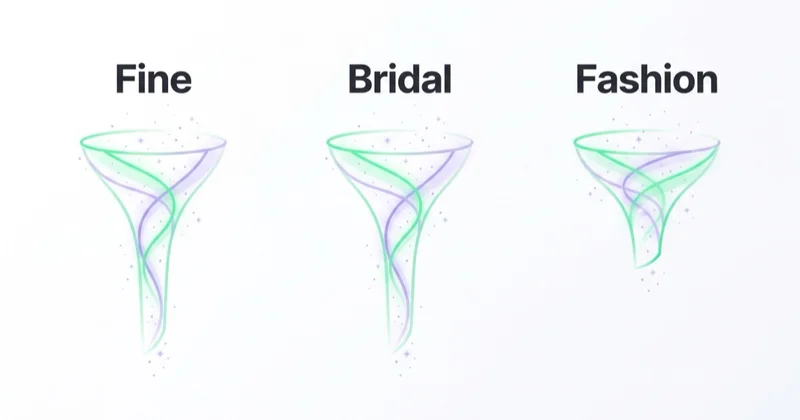
Fine, Bridal And Fashion Jewelry Are Different Funnels
The split between fine, bridal and fashion jewelry should shape campaign architecture.
| Dimension | Fashion Jewelry | Fine Jewelry | Bridal / Engagement |
|---|---|---|---|
| Typical decision | impulse or short consideration | moderate consideration | long, research-heavy |
| Main motivator | style, outfit, trend, giftability | quality, material, longevity, brand | trust, education, certification, emotional confidence |
| Content need | lifestyle, price, reviews, styling | material detail, care, policy, proof | 4Cs education, ring size, setting, financing, consultation |
| Retargeting | shorter windows | medium windows | longer windows |
| Product page | fast checkout clarity | trust and product detail | deep education and reassurance |
| Measurement | AOV and margin | contribution margin | assisted conversions and high-AOV close rate |
Fashion jewelry can run closer to DTC apparel. Creative can lead with styling, collection drops, creator content, gifting and urgency. Fine jewelry needs more product page depth: materials, craftsmanship, certification, returns, resizing and care. Bridal needs a dedicated journey because the buyer may compare stones, settings, budget, ring size and brand trust over weeks.
The related fashion funnel is covered in Facebook, Instagram and TikTok ads for fashion brands. Jewelry overlaps with fashion, but high-AOV and material claims raise the bar for product detail.
Meta And Instagram Strategy
Meta and Instagram are strong for jewelry because the category is visual and emotional. The strongest accounts use both broad creative and catalog logic.
Creative roles:
- lifestyle video for outfit, gifting and occasion context;
- macro close-ups for stone, sparkle, texture and clasp detail;
- try-on content for scale and proportion;
- creator or customer content for social proof;
- gift-guide creative by recipient and budget;
- bridal education for settings, styles and ring sizing;
- launch creative for new collections;
- retargeting creative based on viewed category or product.
Catalog roles:
- dynamic product retargeting for product viewers and cart abandoners;
- collection-level ads for gifting windows;
- category segmentation by price and margin;
- excluding unavailable or low-margin products where needed;
- testing bundle, set or matching-piece opportunities;
- separating new-customer prospecting from repeat-customer upsell.
Meta should not rely only on broad lifestyle ads. Jewelry buyers often want to inspect product detail. The best setup connects editorial creative with catalog precision: a video creates desire, then product-level retargeting returns the buyer to the exact item, matching metal, size, price and availability.
Seasonality And Gift Planning
Jewelry brands need a marketing calendar with commercial workstreams, not only holiday-themed ads.
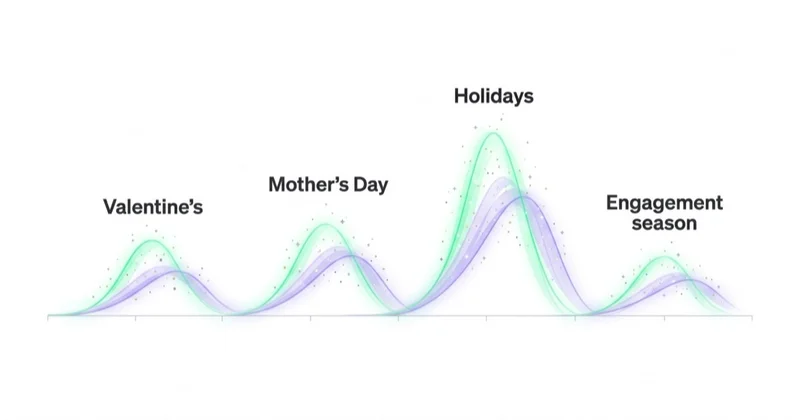
| Window | Planning Focus |
|---|---|
| Valentine's Day | partner gifts, shipping deadlines, price-band guides |
| Mother's Day | gift guides, personalization, family-related collections |
| Wedding season | bridal, bridesmaid, pearl, fine gifts, sizing support |
| Graduation | personalized, birthstone and entry-level fine pieces |
| Black Friday / Cyber Monday | offer strategy, margin guardrails, inventory depth |
| Winter holidays | full gift architecture, shipping cutoffs, packaging proof |
| Anniversaries | evergreen fine jewelry and personalization |
| Off-peak | self-purchase, new collections, styling and retention |
The calendar should include:
- feed readiness and product approvals;
- promotion IDs and sale dates;
- creative production deadlines;
- gift guide landing pages;
- shipping cutoff messaging;
- inventory and made-to-order limits;
- email/SMS coordination;
- retargeting audience warm-up;
- budget ramps by margin and category.
Seasonal jewelry ads fail when they launch after the buyer has already made the decision. Fine jewelry and bridal campaigns need earlier education and retargeting. Fashion gifting can move faster, but it still needs delivery confidence.
Product Pages And CRO
A jewelry product page has to answer more questions than a normal fashion page.
High-converting pages usually include:
- product title with material and stone clarity;
- high-resolution product images;
- scale imagery on hand, neck, ear or wrist;
- dimensions and chain length;
- stone details and total weight where relevant;
- metal composition and plating/vermeil explanation;
- certification or grading information where applicable;
- ring size guide and resizing policy;
- shipping, production and delivery timing;
- returns, exchanges and final-sale conditions;
- warranty, care and repair information;
- reviews with product and sizing context;
- payment and financing details;
- packaging/gifting information.
This page structure helps conversion and organic visibility. Search engines and LLM systems can extract clearer answers when the page states what the product is, who it is for, what it is made from, how it is sized, how it ships and what policies apply.
For broader ecommerce conversion work, see how to increase online sales and ecommerce analytics.
Measurement: Margin-Aware ROAS
Blended ROAS is weak in jewelry because product economics vary too much. A campaign can show strong revenue while pushing low-margin products, high-return items or discounted pieces that do not support profitable growth.
Better measurement includes:
| Metric | Why It Matters |
|---|---|
| contribution margin by product | shows whether revenue is worth scaling |
| gross margin by category | separates fine, fashion and bridal economics |
| new-customer revenue | distinguishes acquisition from repeat purchase |
| repeat purchase rate | matters for fashion and gifting categories |
| AOV by campaign | reveals product mix shifts |
| return and exchange rate | protects against misleading ROAS |
| assisted conversion value | matters for bridal and fine jewelry |
| first purchase to second purchase | shows retention potential |
| product-level stock health | avoids scaling items that cannot ship |
Google Merchant Center supports cost_of_goods_sold, which can help show gross margin and revenue from ads and free listings when used correctly. Not every brand will have perfect COGS data in the feed, but every brand should know which products are acquisition heroes, margin drivers, seasonal bets and low-priority items.
The measurement model should define different targets for:
- fashion jewelry prospecting;
- fashion jewelry retargeting;
- fine jewelry prospecting;
- bridal search and Shopping;
- brand search;
- gift-guide campaigns;
- clearance or promotion campaigns;
- repeat customer campaigns.
One ROAS target across all of these forces the account into the wrong product mix.
Search, SEO And AEO For Jewelry
Paid media improves when the organic content architecture is clear. Jewelry buyers search for product, education and gifting questions:
- "lab-grown diamond vs mined diamond";
- "14k gold vs gold vermeil";
- "what necklace length should I choose";
- "how to measure ring size";
- "best anniversary jewelry gift under 300";
- "freshwater pearl care";
- "tennis bracelet carat size comparison";
- "what is total carat weight";
- "how to choose engagement ring setting."
These topics support Google Search, Shopping conversion, AEO snippets and LLM answers. The content should be specific, internally linked to category pages and consistent with product claims. A guide about ring sizing should link to rings. A guide about gold vermeil should link to relevant products and care instructions. A bridal education page should connect to engagement rings, consultations and financing information where appropriate.
How Space Ads Approaches Jewelry Accounts
At Space Ads, jewelry ecommerce starts with the catalog and the margin model. The first audit checks feed quality, Merchant Center diagnostics, product titles, image readiness, variant structure, custom labels, tracking, contribution margin, retargeting windows, product-page clarity and seasonal planning.
Then the account is split by business role. Shopping and Performance Max need product segmentation and margin guardrails. Search captures brand, category and bridal research intent. Meta creates visual demand, launches collections, supports gift windows and retargets product viewers. Measurement connects ad spend to product contribution rather than only headline revenue.
This is where Google Ads, Meta Ads, performance marketing and marketing audit work together. Jewelry growth is not only media buying. It is feed governance, product truth, merchandising, CRO, seasonality and margin control.
30-Day Optimization Plan
- Audit product claims. Align metals, stone names, lab-grown language, treatments, weights and care details across feed, pages and ads.
- Clean Merchant Center data. Fix titles, images, availability, price consistency, variants, identifiers and disapprovals.
- Add custom labels. Segment margin, price band, category, season, lifecycle and inventory depth.
- Separate funnels. Split fashion, fine and bridal into distinct campaign logic and retargeting windows.
- Upgrade product pages. Add scale images, materials, stone detail, sizing, certification, delivery and return clarity.
- Build seasonal pages. Create gift guides by recipient, budget, occasion and shipping deadline.
- Rebuild Meta retargeting. Segment product viewers, collection viewers, cart abandoners and high-AOV researchers.
- Review margin reports. Compare revenue, margin, returns and new-customer share by product group.
- Plan the next gift window. Lock product, creative, feed, promotion and inventory deadlines before budget ramps.
- Create education content. Publish sizing, material, care, gift and bridal guides tied to product categories.
Common Mistakes
| Mistake | Why It Hurts | Better Approach |
|---|---|---|
| Treating all jewelry as one category | hides different buying cycles and margins | separate fashion, fine and bridal |
| Weak feed titles | Google and buyers lack product clarity | include product type, material, stone and key variant data |
| Vague material claims | creates trust and compliance risk | use approved product-language rules |
| One blended ROAS target | scales the wrong product mix | measure by margin band and product role |
| Short retargeting for fine jewelry | misses long consideration buyers | use longer windows for high-AOV products |
| Seasonal campaigns launched late | demand is captured by competitors | prepare feed, creative and gift pages early |
| Beautiful but unclear images | raises returns and hesitation | show scale, details, packaging and try-on context |
| Ignoring returns and resizing | inflates reported performance | include policy and post-purchase data in analysis |
FAQ
What is jewelry marketing?
Jewelry marketing is the strategy used to sell jewelry through search, shopping, social, email, content and product-page optimization. In ecommerce, it depends heavily on feed quality, product truth, visual creative, gift seasonality, trust signals and margin-aware measurement.
Is Google Shopping important for jewelry brands?
Yes. Google Shopping is one of the most important channels for jewelry ecommerce because buyers can evaluate image, title, price and brand before clicking. Performance depends heavily on product data quality: titles, images, availability, price, variants, identifiers, custom labels and landing-page consistency.
How should jewelry brands use Meta and Instagram?
Meta and Instagram should combine visual storytelling with catalog precision. Lifestyle video, try-on creative and gift guides create demand, while catalog ads and dynamic retargeting bring buyers back to viewed products, categories and carts. Fine and bridal products usually need longer retargeting windows than fashion jewelry.
How should fine jewelry and fashion jewelry be marketed differently?
Fashion jewelry often works with faster visual demand, creator content, styling and shorter retargeting. Fine jewelry needs deeper product information, material clarity, policy reassurance and more trust. Bridal and engagement jewelry need education, certification, sizing help and a longer research path.
Why is blended ROAS risky for jewelry?
Blended ROAS hides product economics. A campaign can look efficient while selling low-margin items, discounted products or items with high return risk. Better reporting separates margin bands, categories, new-customer value, return rate and product contribution.
What should jewelry product pages include?
Product pages should include clear material and stone details, accurate images, scale references, dimensions, sizing, care, certification where applicable, delivery timing, returns, warranty, reviews and gifting information. High-AOV products also need stronger reassurance around payment, financing, resizing and service.
How can jewelry brands improve SEO and AEO?
The brand should answer specific buyer questions about materials, sizing, care, stone types, gift choice, ring settings and product comparison. Those guides should link to relevant category and product pages so search engines and answer systems can connect educational content with commercial pages.
In Short
- Jewelry marketing works when product data, product claims, creative and measurement all describe the same commercial truth.
- Google Shopping depends on accurate feed data, strong images, variants, custom labels and landing-page consistency.
- Meta and Instagram create visual demand, but catalog segmentation and retargeting turn that demand into sales.
- Fashion, fine and bridal jewelry need different windows, proof, pages and targets.
- Margin-aware reporting is stronger than blended ROAS because jewelry price and profit vary widely.
Sources
- eCFR - 16 CFR Part 23: Guides for the Jewelry, Precious Metals, and Pewter Industries
- Google Merchant Center Help - Product data specification
- Google Merchant Center Help - GTIN attribute
Continue Learning
- Google PLA / Shopping campaigns
- How to use Google Shopping campaigns effectively
- Performance Max vs standard Shopping for ecommerce
- Custom labels in Google Shopping and Performance Max
- What is a product feed and how to use it
- GTIN and identifier_exists in Merchant Center
- How to increase online sales
- Google Ads · Meta Ads · Performance marketing · Marketing audit
Continue reading
Furniture Marketing: Shopping, Meta, Showrooms and Custom Orders
Furniture marketing needs two operating models: product-led ecommerce for stock furniture and consultation-led lead generation for custom work. This guide covers Google Shopping, product feeds, Meta lifestyle creative, delivery, returns, financing, showrooms and margin-aware measurement.

How to Choose an Ecommerce PPC Agency (Margin, Feed and Blended Truth)
Choose an ecommerce PPC agency by examining product-data operations, contribution economics, customer acquisition, PMax controls, measurement, access and scope—not a headline ROAS alone.
Supplement Brand Marketing: Claims, UGC and LTV
Supplement brand marketing has to balance demand creation, claim discipline and repeat-purchase economics. This guide covers Meta, TikTok, UGC, FDA and FTC claim review, influencer disclosures, subscriptions, bundles and contribution-margin measurement.