Pet store and pet ecommerce marketing is a repeat-purchase business before it is a first-order business. Food, litter, treats, supplements, grooming supplies and everyday accessories run on a cycle. The first order matters, but the larger value comes from reorders, autoship, cross-sell, retention and trust over the life of the pet.
That changes how campaigns should be judged. A first-order ROAS view can undervalue a customer who buys food every month and overvalue a discounted one-time cart that never returns. The better question is: which campaigns acquire customers who reorder, subscribe, buy profitable categories and stay with the store?
The category also has heavy marketplace pressure. Large retailers compete on price, delivery speed and autoship convenience. A smaller pet retailer needs a sharper system: cleaner product data, category-level margin control, better retention, local availability, expert curation and product claims that stay accurate.
TL;DR
- Pet ecommerce should be measured by LTV and contribution margin. First-order ROAS is too shallow for food, litter and recurring supplies.
- Google Shopping depends on feed quality. Brand, species, life stage, formula, size, flavor, GTIN, availability and images affect matching and conversion.
- Autoship changes acquisition math. A customer who starts a recurring food order is worth more than a one-time promotional buyer.
- Dynamic remarketing should follow the reorder cycle. Timing should reflect product depletion, not a generic retargeting window.
- Food, accessories and heavy goods need different bidding. Margin, shipping cost, repeat rate and basket role vary by category.
- Local stores can compete with immediacy. Google Business Profile, local inventory, pickup and local delivery create advantages marketplaces do not always match.
- Pet-food and supplement claims need discipline. Product copy should help selection without making unsupported health or disease claims.
Why pet retail marketing is different
Pet retail has four economic layers:
| Layer | Why it matters |
|---|---|
| Recurring consumables | food, litter and supplements create repeat purchase cycles |
| Category margin | accessories, toys, heavy food bags and specialty products have different economics |
| Marketplace pressure | price and delivery expectations are set by large retailers |
| Trust and curation | pet owners want confidence that the product fits the pet and use case |
The biggest mistake is treating the catalog as one blended ecommerce business. A low-margin 30 lb bag of food, a high-margin toy, a specialty aquarium filter and a local pickup order do not deserve the same bid, creative or success metric.
The second mistake is optimizing only for first purchase. In this category, the strongest customers may not look profitable until the second, third or fourth order. That is why LTV, reorder rate and autoship retention belong in performance reporting.
Product feed priorities for Google Shopping
Pet shoppers often search by exact product, brand, size and variant. That makes Google Shopping and Performance Max powerful, but only if Merchant Center data is clean.

High-priority fields:
| Feed area | Pet retail application |
|---|---|
title |
brand, species, life stage, formula, flavor, size or pack count |
description |
use case, ingredients, feeding guidance, compatibility, restrictions |
gtin / mpn |
manufacturer identifiers where they exist |
brand |
critical for branded food, litter, supplements and accessories |
image_link |
clear product packshot matching the variant |
additional_image_link |
label, sizing, use case, bundle or product in use |
price / sale_price |
current price and promotion timing |
availability |
stock, preorder or backorder status matching the site |
item_group_id |
variants by flavor, size, color or pack count |
shipping |
cost and speed, especially for heavy items |
custom_label_0-4 |
margin, category, autoship eligibility, lifecycle, season |
Good titles are specific:
| Weak title | Better direction |
|---|---|
| Puppy Food 12 lb | Brand X Chicken Puppy Dry Dog Food, 12 lb |
| Cat Litter | Unscented Clumping Cat Litter, 20 lb |
| Harness Medium | Reflective Dog Harness, Medium, Black |
| Aquarium Filter | External Aquarium Canister Filter, 200 L |
Google's product data specification states that accurate and correctly formatted product data is essential for successful ads and free listings, and that inaccurate or missing data can lead to disapprovals, limited eligibility or incorrect display. In pet retail, the usual problems are weak titles, missing GTINs, stale availability, wrong variants, generic images and shipping settings that do not reflect heavy products.
For deeper feed work, see what is a product feed and how to use it, GTIN and identifier_exists in Merchant Center, Google PLA / Shopping campaigns, and custom labels in Google Shopping and Performance Max.
Segment products by economics
Pet catalogs should be segmented by business role.
| Segment | Marketing role | Measurement risk |
|---|---|---|
| Food | recurring acquisition and retention | first-order margin may look weak |
| Litter / hygiene | repeat purchase, heavy shipping | delivery cost can distort ROAS |
| Treats | add-on and impulse | small carts without bundles |
| Toys | margin and creative potential | seasonal and trend volatility |
| Accessories | margin and cross-sell | size/fit returns |
| Aquarium / terrarium | specialist intent | compatibility and education needs |
| Supplements / specialty products | trust and compliance | unsupported health claims |
| Local pickup products | immediacy and availability | online reporting may miss store value |
This segmentation should appear in custom labels, campaign reporting, email flows and remarketing logic. A store can then decide where to accept lower first-order margin because the reorder path is strong, and where to demand immediate profitability.
Autoship, reorder and subscription
Autoship is the core profit lever in pet ecommerce. Food and litter run out. Pet owners do not want to rebuild the same cart every month. A well-designed reorder path increases convenience for the customer and revenue predictability for the retailer.
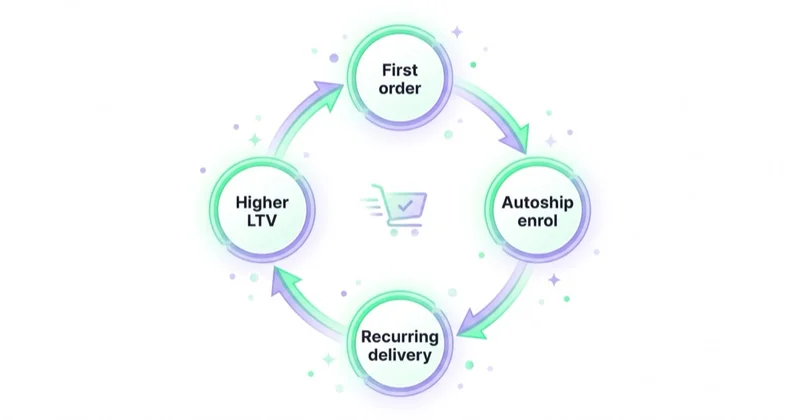
Autoship does not need to be rigid. Useful retention options include:
- recurring delivery with editable cadence;
- subscribe-and-save pricing where margin allows it;
- "buy again" and saved products;
- reorder reminders based on pack size and purchase date;
- larger pack suggestions;
- bundle and replenishment flows;
- reminders before expected depletion;
- easy pause, skip and change options.
Campaigns should distinguish between first-order buyers, autoship starters, repeat customers and lapsed customers. A first order that starts autoship can carry a different value than a one-time discounted purchase. That value should be reflected in bidding or at least in reporting.
Dynamic remarketing by species and cycle
Dynamic remarketing fits pet ecommerce because purchase timing is predictable. But generic retargeting is not enough.
Better audience logic:
| Audience | Message |
|---|---|
| product viewer, no purchase | availability, variant, delivery, reviews |
| cart abandoner | final price, shipping threshold, return to cart |
| food buyer | reorder reminder based on size and time since purchase |
| litter buyer | refill timing and heavier-pack economics |
| new puppy/kitten basket | starter kits, training, repeat food |
| aquarium buyer | compatible filters, food, treatment and maintenance |
| high-LTV customer | loyalty, early access, bundles |
| lapsed customer | reorder prompt or category-specific reason to return |
Meta catalog ads, Google remarketing and email/SMS should reinforce each other. The aim is not to chase a buyer with the same ad for 30 days. The aim is to show the right product or replenishment offer when the need is likely to return.
The mechanics are covered in dynamic remarketing: what it is and how it works.
Competing with marketplaces and big-box retailers
Smaller pet retailers rarely win by outspending large marketplaces on generic product terms. The advantage usually has to come from focus.
Potential differentiators:
- specialist curation by species, breed, life stage or use case;
- premium, natural or niche assortment;
- local pickup and immediate availability;
- in-store advice and community;
- better subscription support;
- bundles for new pet owners;
- content that helps selection;
- loyalty programs and replenishment reminders;
- products not treated as commodities by the store.
Search and Shopping can still capture product intent, but the landing page, email flow and retention program need to explain why buying from the store is easier, safer or more helpful than defaulting to a large marketplace.
Local pet stores: pickup and local inventory
A local pet store has an advantage online-only retailers cannot fully copy: immediacy. If a customer runs out of food, needs a specific litter today or wants advice before buying, pickup and local inventory matter.
Local store priorities:
- strong Google Business Profile with current hours, photos and reviews;
- store pickup and local delivery information;
- local inventory where the feed and operations support it;
- product availability visible on product pages;
- pickup today or pickup later where appropriate;
- local SEO pages for store, categories and brands;
- community content: adoption events, training, grooming partners, vet-adjacent referrals where compliant.
Google's local inventory ads and free local listings allow eligible retailers to show products and store information to nearby shoppers searching on Google. For pet stores, that can be valuable for heavy products, urgent replenishment and in-store discovery.
Pet-food and specialty product claims
Product claims need discipline. Pet owners search with health-related concerns, but retail marketing should not turn a product page into veterinary advice.
The FDA states that pet food, like other animal foods, must be safe, produced under sanitary conditions, contain no harmful substances and be truthfully labeled. It also notes that pet food labeling must include proper product identification, net quantity, manufacturer/distributor details and ingredient listing, and that the FDA reviews certain specific claims on pet food.
Practical marketing rules:
- use manufacturer-approved product language;
- avoid disease-treatment claims unless the product, jurisdiction and documentation support them;
- separate veterinary products, prescription items and regulated products from normal retail messaging;
- describe species, life stage, size, formula and intended use clearly;
- avoid implying that a product replaces veterinary advice;
- review supplement and specialty-product landing pages before scaling ads;
- give creators and affiliates approved language.
Google's Merchant Center misrepresentation policy also prohibits offers that misrepresent products or omit important information. In pet ecommerce, that means claims, availability, subscription terms, delivery costs and product identity should be clear before purchase.
Product pages and CRO
Pet product pages should answer practical questions quickly:
- What animal is this for?
- What life stage or size is it for?
- What variant is being sold?
- How much product is included?
- How long might it last?
- Is it eligible for autoship?
- Is it available for pickup?
- What does shipping cost?
- Are there restrictions or handling notes?
- What products naturally go with it?
For food and litter, show pack size, feeding or usage guidance, ingredients or composition where relevant, subscription options, delivery cost and reorder prompts. For accessories, show size guides, measurements, material, photos in use and returns information. For aquarium or terrarium products, show compatibility and technical details.
Product pages should align with the feed. If the feed title says "grain-free salmon adult cat food 6 lb," the landing page should show the same product, size, flavor, price and availability. Inconsistent product data creates customer confusion and Merchant Center risk.
Measurement: contribution margin and LTV
Pet ecommerce measurement should answer three questions:
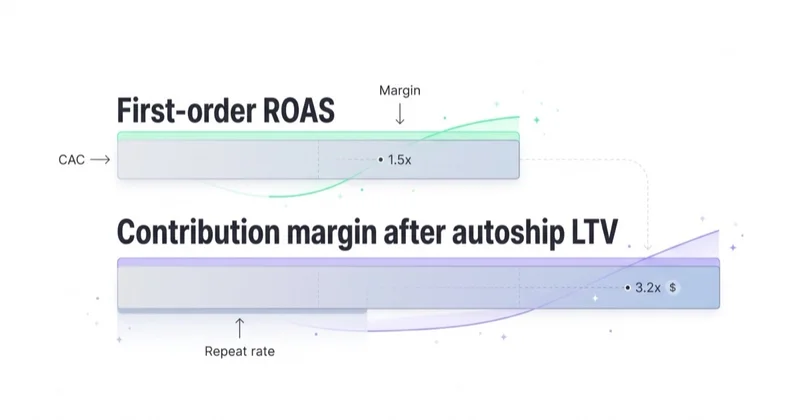
- Which campaigns acquire new customers?
- Which customers reorder or start autoship?
- Which categories create contribution after product cost, shipping, discounts and ad cost?
Important metrics:
| Metric | Why it matters |
|---|---|
| new-customer CAC | distinguishes growth from harvesting existing demand |
| contribution margin | includes product margin, shipping, discounts and ad cost |
| reorder rate | shows whether the first order turns into repeat behavior |
| autoship start rate | identifies recurring revenue creation |
| autoship retention | protects against low-quality subscription starts |
| 90/180/365-day LTV | captures food and supply replenishment |
| category margin | prevents low-margin food from hiding high-margin accessories |
| heavy-item shipping cost | avoids false profitability on bulky goods |
| new vs returning revenue | keeps retargeting and acquisition honest |
Where data quality allows it, conversion value should move closer to contribution margin than gross revenue. Where that is not possible, custom labels and post-purchase reporting can still keep bidding decisions closer to the business.
For broader ecommerce measurement, see what is ecommerce analytics and why it matters and how to audit an ecommerce store.
How Space Ads approaches pet ecommerce marketing
At Space Ads, pet retail work starts with catalog economics. We review feed quality, Merchant Center health, SKU-level margin, shipping cost, autoship eligibility, repeat purchase, category structure and local-store role before changing campaign scale.
The working model is:
- clean titles, variants, GTINs, images, price and availability;
- segment products by margin, category, shipping risk, subscription eligibility and lifecycle;
- build Shopping and Performance Max around product economics;
- use dynamic remarketing and email/SMS around actual reorder timing;
- separate new-customer acquisition from returning-customer revenue;
- support local stores with Google Business Profile and local inventory where operations allow it;
- keep pet-food, supplement and specialty claims within approved language.
That connects directly with Google Ads, Meta Ads, performance marketing, and ecommerce strategy in Shopify, Google Shopping and Performance Max for DTC.
Practical setup order
- Map categories by margin, shipping cost, repeat rate and autoship eligibility.
- Audit Merchant Center: titles, GTINs, images, variants, price, availability and disapprovals.
- Add custom labels for food, litter, accessories, heavy items, autoship and high-margin categories.
- Build Shopping/PMax reporting around contribution, not gross revenue alone.
- Create autoship and reorder flows by pack size and category.
- Use dynamic remarketing by species, category and time since purchase.
- Improve local profile, pickup and local inventory for physical stores.
- Review product claims, subscription terms and specialty-product pages before scaling.
Common mistakes
| Mistake | Better approach |
|---|---|
| Judging campaigns by first-order ROAS | measure contribution margin, reorder rate and LTV |
| Treating food and accessories equally | segment by margin, repeat rate and shipping cost |
| Weak feed titles | include brand, species, life stage, formula, size and flavor |
| Ignoring autoship | measure subscription starts and retention |
| Generic retargeting windows | time reminders to product depletion |
| Competing only on price | use curation, local service, expertise and retention |
| Unsupported health-style claims | use approved product language and policy review |
FAQ
What is pet ecommerce marketing?
Pet ecommerce marketing is the system used to sell pet food, litter, treats, accessories, supplements and supplies online or through a hybrid local store. It usually combines Google Shopping, product feeds, Performance Max, Meta catalog ads, dynamic remarketing, email/SMS, autoship and retention reporting.
What is the most important metric for pet stores?
Contribution margin and lifetime value are more useful than first-order ROAS. Food and litter customers may become profitable through repeat orders and autoship, while heavy or discounted first orders may look strong in revenue but weak after shipping and margin.
Why is Google Shopping important for pet stores?
Pet shoppers often search for exact products: brand, species, life stage, flavor, size or pack count. Shopping can match that intent well when the feed is accurate. Weak titles, missing GTINs, wrong variants and stale availability limit performance.
How does autoship affect pet store advertising?
Autoship turns a one-time buyer into recurring revenue when the product has a predictable replacement cycle. Campaigns can tolerate a different acquisition cost when an order starts a subscription, but the store has to measure subscription start rate and retention.
Does dynamic remarketing work for pet products?
Yes, especially for consumables. Food, litter and supplements run out on a schedule, so remarketing, email and SMS should return near the likely reorder window. The best setup uses product, category, species and time since purchase rather than one generic audience.
How can local pet stores compete online?
Local stores can use immediacy and trust: pickup, local inventory, advice, community, reviews and same-day availability. Google Business Profile, local inventory listings and product pages with pickup options help connect online search with store visits.
In Short
Pet store and pet ecommerce marketing works when the account is built around repeat purchase. Google Shopping captures product intent, the feed determines visibility, autoship increases customer value, dynamic remarketing supports reorders, and local inventory helps stores win urgent demand.
The best starting point is catalog economics: margin, shipping cost, repeat rate, subscription eligibility and product-claim discipline. Once those signals are clean, media can scale customers who return, not just carts that convert once.
Sources
- Google Merchant Center Help - Product data specification
- Google Merchant Center Help - Misrepresentation
- Google Merchant Center Help - Local inventory ads and free local listings
- FDA - Pet Food
- Google Business Profile Help - Tips to improve your local ranking on Google
Continue Learning
- How to use Google Shopping campaigns effectively
- Performance Max vs standard Shopping for ecommerce
- Custom labels in Google Shopping and Performance Max
- What is a product feed and how to use it
- Dynamic remarketing: what it is and how it works
- Merchant Center disapproved products: how to fix them
- Google Ads · Meta Ads · Performance marketing
Continue reading

Furniture Marketing: Shopping, Meta, Showrooms and Custom Orders
Furniture marketing needs two operating models: product-led ecommerce for stock furniture and consultation-led lead generation for custom work. This guide covers Google Shopping, product feeds, Meta lifestyle creative, delivery, returns, financing, showrooms and margin-aware measurement.

Jewelry Marketing: Shopping Feeds, Meta and High-AOV Retargeting
Jewelry marketing needs accurate product data, visual demand creation and margin-aware measurement. This guide covers Google Shopping feeds, Meta catalog strategy, gifting seasonality, fine vs fashion jewelry, product-truth claims, retargeting and high-AOV CRO.

Language School Marketing: Two Businesses, One Building
Language schools often combine consumer enrolment and corporate training. Market them as separate buying journeys, then connect campaigns to attendance, enrolment, group contribution and continuation.