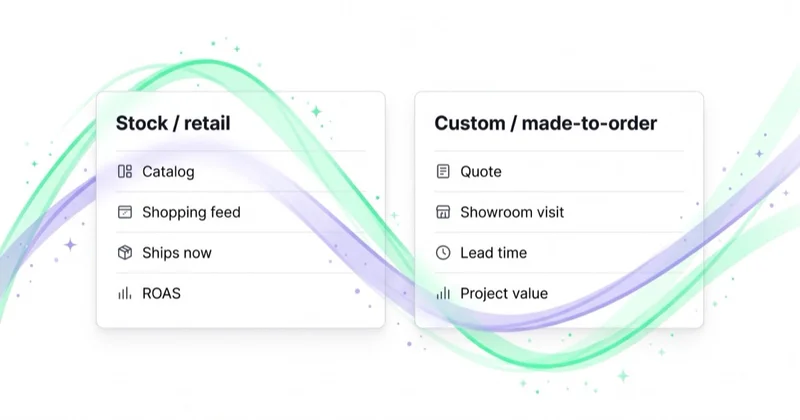
Furniture marketing sits between ecommerce, local retail and high-ticket lead generation. A sofa in stock, a dining table available for delivery, a built-in wardrobe, a custom kitchen and a showroom consultation all belong to the furniture category, but they do not sell through the same funnel.

Stock furniture behaves like high-AOV ecommerce, but the transaction is unusually dependent on fit and logistics. The system needs accurate product data, useful images and video, assembled dimensions, packaged shipping dimensions, delivery timing, access requirements, returns information and contribution-aware decisions. Custom furniture behaves more like a scoped home-improvement project: the buyer needs portfolio evidence, materials, process, lead time, budget fit, consultation and a quote.
The strongest furniture accounts separate those models instead of forcing one blended ROAS target across everything.
TL;DR
- Furniture marketing has two core models. Stock furniture needs ecommerce and Shopping discipline; custom furniture needs consultation, quoting and CRM discipline.
- Feed quality enables Google Shopping. Titles, product dimensions, material, color, variant grouping, price, availability, images and delivery data affect eligibility and matching; internal margin labels support commercial segmentation.
- Meta sells the room, not just the item. Lifestyle scenes, room styling, before/after content, video, catalog retargeting and creator-style proof support a long consideration cycle.
- Delivery and returns are conversion and margin levers. Large-item shipping, assembly, white-glove delivery and wrong-fit returns can change profitability dramatically.
- Showrooms change the funnel. Local Search, Google Business Profile, appointment booking and in-store design help can close shoppers who hesitate online.
- Financing changes both conversion and customer obligations. Monthly-payment language needs the real price, term, cost and required disclosures; do not assume it improves profitable demand.
- Measurement needs stage and cost depth. Retail should report fulfilled contribution after delivery and returns; custom should report suitable consultations, accepted quotes, collected revenue and realized project contribution.
Why furniture marketing is different
Furniture combines a high ticket, visual decision-making, physical fit, logistics and long consideration.
A shopper buying a rug or side table may behave like a normal ecommerce buyer. A shopper comparing sectionals may save products for weeks, measure a room, check delivery options, compare fabric swatches and wait for a sale. A buyer commissioning custom built-ins or a made-to-measure wardrobe is not buying a SKU; they are buying a process, materials, measurement, installation and trust.
Four factors make the category commercially sensitive:
- Fit risk. The buyer needs dimensions, scale imagery, room context, color accuracy and return clarity.
- Logistics risk. Large items require freight, scheduling, assembly, access checks, damage handling and sometimes white-glove service.
- Margin variance. Product margin, delivery cost, return risk, financing cost and clearance pricing can make blended ROAS misleading.
- Inventory depth. A collection can look well stocked while the commercially important finish, module or configuration is unavailable or too slow to deliver.
The account structure should make those realities visible.
Stock furniture vs custom furniture
| Model | Buying path | Best channels | Main metric |
|---|---|---|---|
| Stock retail / DTC | browse, compare, purchase, fulfill, keep | Google Shopping, Performance Max, Meta catalog, Search | fulfilled contribution, cancellation and return rate |
| Showroom retail | search, visit, consult, purchase | local Search, Google Business Profile, Meta, retargeting | appointments, showroom visits, offline sales |
| Custom / made-to-order | inquiry, consultation, quote, build, install | Search, Meta, portfolio SEO, CRM | suitable quote, collected value and realized contribution |
| Trade / commercial | designer, architect, office, hospitality | Search, LinkedIn, partnerships, direct sales | qualified pipeline, won contribution and repeat projects |
Many furniture businesses span more than one model. A retailer may have a custom program. A maker may sell some standard pieces. A showroom may close offline after online discovery. The marketing system should track each path separately.
Google Shopping and product feed priorities
For stock furniture, the product feed is not a technical export. It is the merchandising layer that tells Google what is being sold and helps shoppers understand whether the item fits their space.
Important feed fields for furniture:
| Feed area | Furniture application |
|---|---|
title |
product type, material, style, size, color, seating count |
description |
dimensions, materials, construction, care, assembly, use case |
image_link |
clear primary product image without promotional overlays |
additional_image_link |
room scene, detail, scale, fabric, finish, dimensions |
product_length, product_width, product_height |
assembled product measurements where supported |
shipping_length, shipping_width, shipping_height, shipping_weight |
packaged dimensions and weight for carrier-calculated delivery |
video_link |
optional product video; eligible serving and quality validation began June 30, 2026 |
price and sale_price |
accurate price and sale timing |
availability |
in stock, preorder, backorder or out of stock |
item_group_id |
variants by color, fabric, size or configuration |
shipping |
cost, speed and destination rules where required |
cost_of_goods_sold |
product-level cost where accounting supports it |
custom_label_0-4 |
margin band, category, price band, season, lifecycle |
Good furniture titles describe the item as a shopper would compare it:
| Weak title | Better direction |
|---|---|
| Luna Sofa | Luna 3-Seat Sofa, Beige Boucle, 84 Inch |
| Dining Table | Solid Oak Extendable Dining Table, 6-8 Seats |
| Storage Bed | King Storage Bed Frame, Walnut Finish, Upholstered Headboard |
| Office Chair | Ergonomic Mesh Office Chair, Black, Adjustable Arms |
The goal is clarity, not keyword stuffing. Google's product data specification requires landing-page and submitted values to agree. Product dimensions describe the assembled item; shipping dimensions describe the package used for carrier calculations. Confusing the two can create a poor customer decision and incorrect shipping logic.
Google's April 2026 specification update added optional product video links, with serving and policy or quality validation beginning June 30, 2026. It also introduced additional product-level shipping fields. These are useful for furniture only when the source data is maintained: a cinematic room video does not compensate for stale availability, an incorrect configuration or delivery costs that change at checkout.
For broader feed strategy, see what is a product feed and how to use it, Google PLA / Shopping campaigns, and custom labels for Google Shopping and Performance Max.
Delivery, returns and fit risk
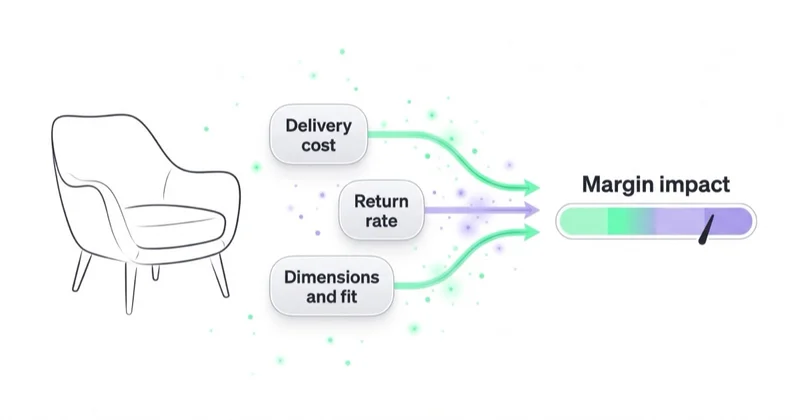
Furniture conversion depends heavily on logistics confidence. A shopper may like the product, but hesitate because of delivery cost, apartment access, assembly, return policy, damage risk or uncertainty about dimensions.
Product pages and ads should make the operational reality clear:
- delivery method: parcel, freight, threshold, room-of-choice, white-glove;
- delivery cost and timing by region;
- assembly options;
- access requirements for large items;
- return window, return shipping responsibility and condition requirements;
- damage reporting process;
- made-to-order or preorder lead time;
- swatches and samples where relevant;
- room scale imagery and dimensions.
This information affects both customer experience and economics. A product that generates high placed-order revenue but frequent cancellations, damage claims or costly returns can look successful in an ad platform while destroying contribution. Feed, site and checkout delivery promises should reconcile; when an exact Merchant Center shipping cost cannot be matched, Google advises merchants to overestimate rather than understate it.
The related topic is covered in returns and conversion adjustments in Google Ads ecommerce.
Meta and Instagram: visual demand creation
Furniture is a natural category for Meta because the decision is visual and aspirational. The strongest creative sells a room, a style and a use case, not only a product cutout.
Useful creative types:
- lifestyle rooms by style: modern, traditional, minimal, industrial, coastal;
- short videos showing scale, texture, opening mechanisms or transformation;
- before/after room upgrades;
- UGC-style home tours and customer rooms;
- catalog retargeting for product viewers;
- collection launches by room;
- swatch, finish and material explainers;
- showroom walkthroughs;
- custom project before/after content.
Audience windows should be based on actual consideration and consent, not a generic “furniture is long-cycle” rule. Separate recent product viewers, showroom planners and past customers only when the segment is large enough and the message remains useful. A visit to a custom-project page is not proof that paid social caused a later consultation.
Meta should not replace feed and product-page work. It amplifies the visual layer. If the product page lacks dimensions, shipping clarity or return policy, strong creative may only increase expensive hesitation.
Search campaigns for stock, showroom and custom intent
Search should be split by intent.
| Intent | Example queries | Best page |
|---|---|---|
| Product category | "oak dining table," "sectional sofa with chaise" | category or product listing |
| Local showroom | "furniture store near me," "sofa showroom [city]" | showroom page, GBP, appointment |
| Custom | "custom built-in wardrobes," "made to measure shelves" | portfolio and quote page |
| Commercial | "office furniture supplier," "hotel furniture manufacturer" | B2B/trade page |
| Financing / sale | "sofa financing," "furniture sale [city]" | offer page with accurate terms |
| Brand | store or brand name | official navigation, service and promotion pages; paid coverage where testing shows value |
Stock Search can support Shopping when category demand is strong or product names are specific. Local Search supports showrooms. Custom Search should avoid sending users to a generic ecommerce category, because the user is looking for a process and proof.
Negative keyword work matters in furniture too: used items, DIY plans, repair, free, jobs, wholesale if not relevant, rentals, dollhouse, templates and unrelated materials can waste budget.
Showrooms and local retail
A showroom lets shoppers see scale, feel materials, test comfort, compare finishes and discuss access or configuration. Marketing should describe those practical advantages without assuming every online shopper wants an appointment.
Important showroom assets:
- complete Google Business Profile;
- current hours and appointment options;
- photos of the showroom, room sets, parking and entrance;
- product categories available in store;
- local delivery information;
- review responses;
- consultation or design-service page;
- offline sale tracking where possible.
Google Business Profile supports local discovery and comparison. A genuine showroom should use its accurate real-world name, address, staffed hours, categories and current imagery. Do not create virtual-office or unstaffed profiles to manufacture local reach. Track appointment bookings and offline sales where lawful, while recognizing that modeled store visits and platform attribution are not the same as incremental showroom footfall.
Custom and made-to-order furniture
Custom furniture needs a lead funnel, not a product grid.
Strong custom pages usually include:
- portfolio by room or project type;
- process: consultation, measurement, design, quote, production, installation;
- materials, finishes, hardware and options;
- typical lead-time ranges;
- budget guidance or "from" pricing where commercially possible;
- service area;
- showroom or in-home consultation options;
- reviews and finished-project proof;
- form fields for project type, location, timing, rough budget and images/plans.
The form should collect enough information for a useful next step without demanding a full design brief before trust is established. Project type, service area, timing, indicative budget and optional plans can improve routing. Explain how uploaded floor plans, property photos and contact details will be used and retained; do not expose them in analytics URLs or advertising events.
This overlaps with home remodeling marketing and interior designer marketing, because the decision is consultative and visual.
Financing and promotion strategy
Furniture purchases often sit above the buyer's everyday purchase threshold. Financing, payment plans or buy-now-pay-later options can make the decision feel more approachable, especially for sofas, beds, dining sets and custom projects.
Possible commercial roles for financing include:
- reduce sticker shock on high-ticket pieces;
- support seasonal sale periods without discounting everything;
- help showroom consultants move from interest to commitment;
- create a separate reporting view for financed orders and margin.
The compliance role is equally important. “From $X per month” is incomplete if the term, interest, fees, deposit, eligibility or total payable materially changes the offer. Requirements vary by credit product and jurisdiction, so the lender and qualified legal or compliance owner should approve ads, landing pages and checkout. Financing should never hide the cash price or create false urgency, and its cost to the merchant belongs in contribution reporting.
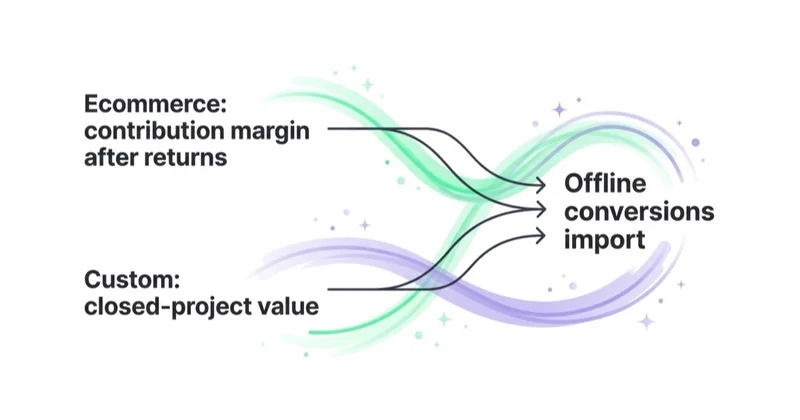
Measurement: contribution margin and closed projects
Furniture reporting should separate ecommerce outcomes from custom pipeline outcomes.
| Model | Better metrics |
|---|---|
| Stock ecommerce | placed, cancelled, fulfilled and returned orders; contribution after product, delivery, damage, payment, financing and media costs |
| Showroom retail | appointment, attended visit, offline sale, collected value and contribution |
| Custom furniture | suitable inquiry, consultation, quote, deposit, collected project value, change orders and realized contribution |
| Commercial / trade | qualified pipeline, won work, collected value, project contribution and repeat business |
Google Merchant Center supports cost_of_goods_sold when conversions include cart data. Google uses it for features such as estimated gross-profit reporting and automated discounts. This is optional for ordinary reporting and sensitive commercial data; it should be shared only after finance and data owners approve the use. COGS still does not include every cost required for contribution—freight subsidies, damage, returns, payment fees, financing, assembly and media can remain outside it.
For long-cycle or offline outcomes, define separate events such as attended showroom appointment, suitable custom consultation, deposit received and completed paid sale. As of June 15, 2026, current and future Google offline-conversion and enhanced-conversion-for-leads uploads should use the Data Manager API. Do not mark every intermediate stage as a primary conversion or count one order several times. Maintain a finance reconciliation and import only the minimum approved customer data.
A furniture contribution waterfall
Use one documented calculation across marketing, merchandising and finance:
kept revenue – discounts – product cost – outbound delivery subsidy – return/damage cost – assembly – payment/financing fees – variable service cost – media = realized contribution
The exact definition may differ by business, but it must stay consistent over the decision window. Custom projects require a separate job-cost view because materials, design time, installation, rework and change orders mature later than the initial deposit.
How Space Ads approaches furniture marketing
Our standard approach starts with the model split: ecommerce stock, showroom retail, custom projects and trade or commercial work. The audit maps product economics, stock depth, delivery and damage risk, showroom role, custom stages and source-data quality before changing campaign structure.
The working model is:
- clean the product feed and variant structure for stock furniture;
- segment products by margin, logistics risk, category and lifecycle;
- structure Shopping or Performance Max around approved inventory and commercial groups, then reconcile with contribution;
- use Meta to test room-level creative, showroom or product demand—not as guaranteed “discovery”;
- build separate Search and landing pages for custom and showroom intent;
- import offline and CRM outcomes for showroom sales and custom projects.
That connects directly with Google Ads, Meta Ads, performance marketing, and ecommerce measurement work in how to audit an ecommerce store.
Practical setup order
- Split the business model: stock ecommerce, showroom, custom, trade.
- Audit product feed titles, dimensions, images, variants, availability and shipping.
- Segment products by category, margin, delivery risk, return risk and lifecycle.
- Improve product pages with dimensions, scale images, delivery, returns and financing clarity.
- Build Search campaigns for category, showroom, custom and commercial intent.
- Test Meta with lifestyle rooms, catalog delivery, showroom and custom-project evidence under appropriate audience rules.
- Connect placed, fulfilled and returned orders, showroom sales and custom CRM stages to reporting.
- Review mature contribution and closed project economics alongside platform attribution and incremental evidence.
Common mistakes
| Mistake | Better approach |
|---|---|
| Mixing stock and custom under one target | separate ecommerce and quote funnels |
| Optimizing to revenue before logistics | measure contribution after delivery and returns |
| Weak product feed titles and dimensions | describe type, material, color, size and variants clearly |
| One generic retargeting window | use actual consideration data, consent and message relevance |
| Hiding delivery and returns details | surface operational clarity before checkout |
| Treating showrooms as offline only | track appointments, visits and offline sale value |
| Using only product cutouts in Meta | test room scenes, video, scale and styling context |
FAQ
What is furniture marketing?
Furniture marketing is the system used to sell stock furniture, generate showroom visits and create qualified leads for custom or made-to-order furniture. It usually combines Google Shopping, Search, Meta, product feeds, showroom pages, service pages, email, CRM and offline sales tracking.
What is the best channel for furniture ecommerce?
Google Shopping and Performance Max can connect eligible products, images, prices and search demand. Meta can test lifestyle creative and product or showroom messages. No channel is universally “best”: the mix depends on search demand, feed quality, stock, delivery coverage, contribution and credible incremental results.
How is custom furniture marketing different?
Custom furniture is a consultation and quote process. The page should show portfolio, materials, process, lead time, service area, budget fit and a form that qualifies the project. Success is a qualified quote and closed project, not a product-page purchase.
Why do delivery and returns matter so much in furniture ads?
Large-item logistics affect both confidence and profit. Clear delivery options can improve conversion, but high freight, assembly and return costs can erase margin. That is why furniture campaigns should be measured after logistics and returns, not only by revenue.
Should furniture brands use Meta Ads?
Meta can show rooms, textures, scale, styling, customer spaces and showroom evidence. Its value should be tested against fulfilled contribution or suitable consultations, not inferred from visual appeal. Product pages still need accurate dimensions, availability, delivery and return information.
How should a furniture store measure performance?
Stock ecommerce should measure fulfilled and kept orders plus realized contribution after logistics and media. Showrooms should distinguish bookings, attended visits and completed sales. Custom work should measure suitable inquiries, deposits, collected project value and job contribution after materials, design, installation and rework.
In Short
Furniture marketing works when ecommerce, showroom and custom paths are separated. Stock products need feed quality, Shopping structure, product-page clarity and margin-aware measurement. Custom furniture needs portfolio proof, consultation and CRM stages. Showrooms need local trust and offline tracking.
The biggest gains usually come from operational clarity: dimensions, materials, delivery, returns, financing, availability, margin and project status. Once those signals are clean, Google Shopping, Search and Meta can scale the furniture paths that actually produce profit.
Sources
- Google Merchant Center Help - 2026 product data specification update
- Google Merchant Center Help - Product and shipping dimensions
- Google Merchant Center Help - Account shipping settings
- Google Merchant Center Help - How Google uses COGS data
- Google Business Profile Help - Tips to improve your local ranking on Google
- Google Ads Help - Offline conversion imports and the 2026 Data Manager API migration
Continue Learning
Continue reading

Jewelry Marketing: Shopping Feeds, Meta and High-AOV Retargeting
Jewelry marketing needs accurate product data, visual demand creation and margin-aware measurement. This guide covers Google Shopping feeds, Meta catalog strategy, gifting seasonality, fine vs fashion jewelry, product-truth claims, retargeting and high-AOV CRO.

Supplement Brand Marketing: Claims, UGC and LTV
Supplement brand marketing has to balance demand creation, claim discipline and repeat-purchase economics. This guide covers Meta, TikTok, UGC, FDA and FTC claim review, influencer disclosures, subscriptions, bundles and contribution-margin measurement.

Weight Loss Clinic Marketing: GLP-1 Demand Without Risky Claims
Weight loss clinic marketing in the GLP-1 era has to generate qualified consultations without risky body claims, prescription-drug shortcuts or privacy leakage. This guide covers Meta, Google Search, telehealth funnels, HIPAA-conscious tracking and program LTV.