Upselling and cross-selling are techniques for increasing revenue from existing traffic, customers or sales conversations. Upselling means suggesting a better, larger, more advanced or more complete version of the same choice. Cross-selling means suggesting a complementary product, service or add-on.
Both techniques can improve average order value and customer value, but only when the recommendation is relevant. A helpful suggestion feels like guidance. A random or aggressive suggestion feels like pressure and can reduce trust.
In 2026, the strongest upsell and cross-sell systems combine product data, user intent, margin, availability, timing and measurement. They are not just "more products under the button". They are part of conversion rate optimisation and customer experience.
TL;DR
- Upselling suggests a better or higher-value version of what the user is already considering.
- Cross-selling suggests a complementary product or service.
- Relevance matters more than the number of recommendations.
- The best placements are product pages, comparison tables, cart, post-purchase flows, emails and sales conversations.
- Checkout should be protected from excessive friction.
- Post-purchase upsells can work well because the primary purchase is already complete.
- AI recommendations are not always necessary; manual rules can work better for small catalogues.
- Measure AOV, margin, attach rate, conversion rate, returns and incremental revenue.
- A recommendation that increases AOV but lowers total profit may be a bad recommendation.
- Good upsell and cross-sell should help the customer make a better decision, not just push a higher price.
- The safest question is: would this recommendation still be useful if there were no short-term revenue target?
What is upselling?
Upselling is the practice of offering a higher-value version of the same product, plan, package or service.
Examples:
- larger storage plan instead of a basic plan;
- premium subscription instead of standard subscription;
- higher-capacity product variant;
- extended warranty;
- professional service package instead of basic setup;
- larger bundle;
- better material or finish;
- annual plan instead of monthly plan.
The key is that the upgraded option should solve the same core need more completely.
Good upselling explains:
- what is different;
- who the higher option is for;
- why the extra cost is justified;
- what risk or limitation the upgrade solves;
- what happens if the basic option is enough.
What is cross-selling?
Cross-selling means recommending something that complements the main choice.
Examples:
- phone case with a phone;
- filter with a coffee machine;
- memory card with a camera;
- setup service with software;
- analytics add-on with a marketing service;
- installation with a physical product;
- training with a SaaS rollout;
- care product with footwear;
- replacement part or refill.
The best cross-sell feels obvious after the user sees it. It should reduce effort, complete a set or prevent a future problem.
Upselling vs cross-selling
| Area | Upselling | Cross-selling |
|---|---|---|
| Core idea | Better version of the same choice | Complementary addition |
| Main goal | Increase value of selected option | Add useful related items |
| Example | Pro plan instead of Basic | Training session added to Pro plan |
| Best moment | Comparison, configuration, pricing | Product page, cart, post-purchase, email |
| Main risk | Price jump feels unjustified | Add-on feels random |
| Success metric | Upgrade rate, margin, retention | Attach rate, AOV, incremental revenue |
Both techniques can work together, but they should not compete for attention at the same moment.
Decision framework
Before adding a recommendation, answer five questions:
- Need: does the recommendation solve a real problem connected to the main choice?
- Timing: is this the right moment, or will it interrupt the primary conversion?
- Proof: is the value difference or compatibility clear?
- Economics: does it improve margin, retention or LTV, not only order value?
- Experience: can the user decline easily without feeling pressured?
If the answer is weak, the recommendation should be changed, moved later in the journey or removed.
Where upselling works best
Upselling works when the customer can clearly compare the value difference.
Good placements:
- pricing table;
- product variant selector;
- plan comparison page;
- product page;
- configurator;
- sales proposal;
- checkout only for low-friction add-ons;
- onboarding flow;
- renewal flow.
Useful upsell explanations:
- "Best for teams of 5+";
- "Includes advanced reporting";
- "Adds installation and configuration";
- "More storage for long-term use";
- "Priority support included";
- "Lower monthly cost on annual billing".
The bigger the price difference, the more proof and context are needed.
Where cross-selling works best
Cross-selling works when the add-on is natural and useful.
Good placements:
- product page;
- cart;
- mini cart;
- product recommendation section;
- post-purchase page;
- order confirmation email;
- replenishment email;
- service proposal;
- customer success review.
Strong cross-sell patterns:
- frequently bought together;
- compatible accessories;
- complete the set;
- refills and consumables;
- installation or setup;
- protection or warranty;
- training or onboarding;
- next logical product after purchase.
The recommendation should answer a real need connected to the main item.
How to use upselling in ecommerce
Ecommerce upselling often happens before the user commits to the final product.
Examples:
- larger size or pack;
- premium version;
- subscription instead of one-time purchase;
- bundle instead of single item;
- extended warranty;
- faster delivery upgrade;
- gift wrap or premium packaging.
Good ecommerce upsell questions:
- Does the higher option solve a clear problem?
- Is the price difference easy to understand?
- Is the comparison visible?
- Does the upgrade protect margin?
- Does it increase returns or complaints?
- Does it slow checkout?
Upselling should not hide the basic option. If the customer feels pushed, the perceived trust of the store can fall.
How to use cross-selling in ecommerce
Ecommerce cross-selling should focus on compatibility and timing.
Examples:
- camera plus memory card;
- laptop plus protective sleeve;
- running shoes plus socks;
- skincare product plus cleanser;
- coffee machine plus descaling tablets;
- furniture plus assembly service;
- dress plus matching accessories.
Best practices:
- show only a few strong recommendations;
- avoid unrelated products;
- use product compatibility data;
- respect stock availability;
- consider margin;
- keep cart recommendations lightweight;
- avoid blocking checkout;
- test post-purchase recommendations.
For deeper ecommerce conversion work, see product recommendations and how to increase online sales.
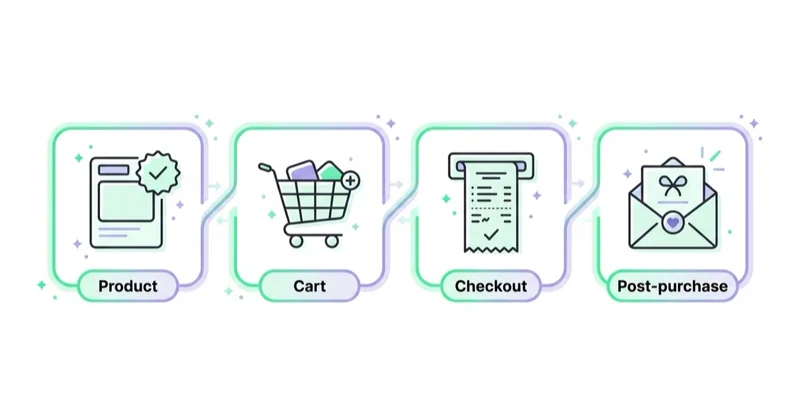
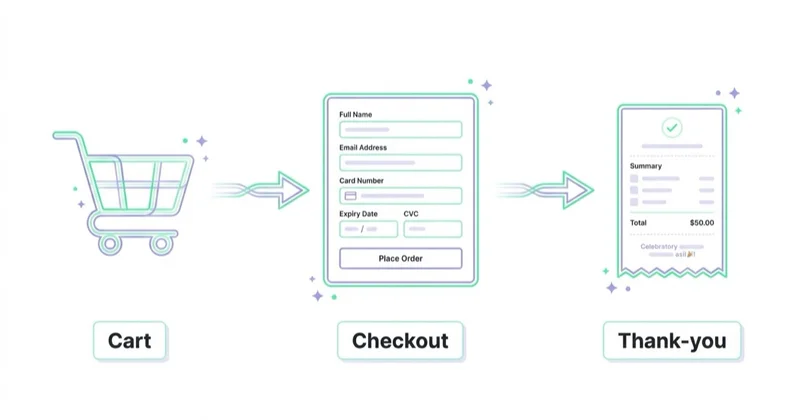
Checkout, cart and post-purchase timing
Timing changes the risk profile.
Product page:
- Good for discovery and comparison.
- Works well for compatible accessories and better variants.
- Low risk if recommendations do not cover core product information.
Cart:
- Good for small, clearly useful add-ons.
- Risk rises if the cart becomes cluttered.
- Recommendations should not hide totals, delivery or checkout CTA.
Checkout:
- High-risk placement.
- Use only low-friction, highly relevant add-ons.
- Avoid adding decisions that delay payment.
Post-purchase:
- Useful because the primary purchase is complete.
- Good for accessories, warranties, replenishment and related services.
- Needs careful handling so it does not feel like regret or pressure.
In many cases, a post-purchase upsell is safer than a checkout upsell because it does not interrupt payment completion.
Upselling and cross-selling outside ecommerce
These techniques are not only for online stores.
In B2B and services:
- higher service package;
- additional analytics;
- implementation support;
- training;
- strategy workshop;
- maintenance plan;
- CRM integration;
- reporting dashboard;
- quarterly optimisation review.
In SaaS:
- higher plan;
- annual billing;
- extra seats;
- advanced support;
- integrations;
- usage-based expansion;
- onboarding package.
In professional services:
- audit plus implementation;
- consultation plus training;
- design plus development;
- campaign setup plus ongoing optimisation.
The rule is the same: the add-on should follow from the customer's actual problem.
For B2B and SaaS, timing often depends on product maturity or customer success signals. A customer who has not adopted the basic product may not be ready for an upsell. A customer who is close to a usage limit, expanding a team or asking for advanced reporting may be ready for a higher plan or add-on.
Product data and recommendation logic
Recommendations can be created in several ways.
Manual curation:
- best for small catalogues;
- useful when compatibility matters;
- good for premium or specialist products;
- easier to control.
Rule-based recommendations:
- based on category, price, margin, brand, attributes or tags;
- useful for predictable relationships;
- easier to test and audit.
Behaviour-based recommendations:
- based on browsing, cart and purchase data;
- useful with enough traffic and transaction history;
- requires clean analytics and product data.
AI or algorithmic recommendations:
- useful for larger catalogues;
- can adapt to behaviour and patterns;
- requires strong data quality, availability controls and testing.
AI is not a shortcut around poor product data. If products are badly categorised or compatibility is unclear, automated recommendations can become irrelevant.
How to avoid being pushy
The difference between helpful and pushy is often context.
Helpful:
- "These filters fit this model."
- "Choose Pro if more than three users need reporting."
- "Add cleaning tablets for the first 3 months."
- "Save with the annual plan if the tool will be used long term."
Pushy:
- "Are you sure you want the worse option?"
- hiding the basic option;
- showing five pop-ups before checkout;
- adding items automatically;
- making the add-on hard to remove;
- using false urgency;
- making the checkout feel like a sales script.
Trust is more valuable than a short-term AOV lift.
When not to use upselling or cross-selling
Sometimes the best optimisation is not showing an offer.
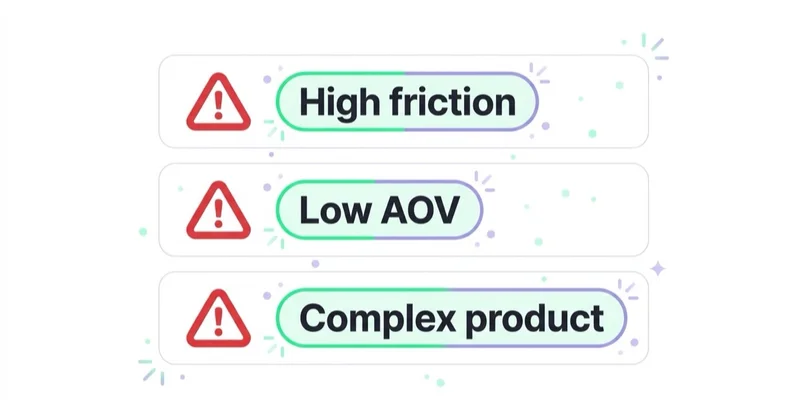
Avoid extra recommendations when:
- the user is trying to complete a sensitive payment or account action;
- the recommendation is not compatible with the selected product;
- the product is out of stock or has delivery issues;
- the add-on has high return or complaint risk;
- the customer already bought the recommended item;
- the page already has too much decision load;
- the upsell hides important product or pricing information;
- the sales team cannot deliver the promised higher package.
Restraint is part of conversion optimisation. Every additional offer has an opportunity cost: attention, trust, checkout clarity and support complexity.
How to measure upsell and cross-sell performance
Useful metrics:
- average order value;
- conversion rate;
- attach rate;
- upgrade rate;
- incremental revenue;
- gross margin;
- return rate;
- cancellation rate;
- checkout abandonment;
- post-purchase acceptance rate;
- repeat purchase rate;
- customer lifetime value;
- customer support complaints.
Do not stop at click-through rate. A recommendation can receive clicks and still reduce total profit if it lowers conversion, increases returns or adds operational complexity.
The best measurement uses a control group or A/B test:
- users with recommendation;
- users without recommendation;
- same traffic quality;
- same time period or controlled experiment;
- revenue and margin measured after returns where possible.
For conversion measurement foundations, see conversion tracking.
Examples by industry
Fashion and apparel
Cross-sell complete outfits, care products and accessories. Upsell higher-quality materials or premium collections. Size and returns data should guide recommendations.
Electronics
Cross-sell compatible cables, storage, cases, insurance and setup. Upsell higher storage, better performance or longer warranty. Compatibility is critical.
Beauty and skincare
Cross-sell routines and replenishment. Upsell larger sizes or premium formulations. Avoid recommending products that conflict with skin type or stated need.
SaaS
Upsell plans by usage, seats, integrations and support level. Cross-sell onboarding, training or advanced modules. Usage data should inform timing.
B2B services
Upsell from audit to implementation, or from setup to ongoing optimisation. Cross-sell reporting, analytics, training or strategic support only when it improves the outcome.
How we approach this at Space Ads
Upselling and cross-selling aren't just a sales trick to us; they're a lever on the whole of acquisition. The logic is plain: the higher the average order value, the more we can pay for the same click and still profit. A customer who adds a complementary product or steps up to a higher tier is simply worth more, which lets us bid harder and win auctions a competitor with a smaller basket can't reach. So basket improvement gets the same seriousness as campaign optimisation — both widen the room to scale. One condition, though: the suggestion has to be relevant, not pushy. Bolt something onto every order and you erode the experience, which over time costs more than it brings.
Common mistakes
Too many recommendations
More options can create decision fatigue. A few relevant recommendations are usually better than a long carousel.
Checkout friction
Aggressive offers during payment can increase abandonment. Protect the main conversion.
Irrelevant products
Bad recommendations reduce trust in the whole store or offer.
No margin control
AOV can rise while profit falls. Margin should be part of the analysis.
No availability checks
Recommending out-of-stock or incompatible items creates frustration.
Measuring clicks instead of incremental impact
Clicks do not prove growth. Measure revenue, profit and conversion impact.
FAQ
What is the difference between upselling and cross-selling?
Upselling suggests a better or higher-value version of the same choice. Cross-selling suggests a complementary product or service that fits the original choice.
Which is better: upselling or cross-selling?
It depends on the offer. Cross-selling is easier when there are natural add-ons. Upselling works when the higher option has a clear and credible value difference.
Where should cross-sell offers appear?
They often work on product pages, in carts, after purchase and in follow-up emails. Checkout should be used carefully because too many offers can distract from payment.
Are AI product recommendations necessary?
Not always. Small catalogues can perform well with manual or rule-based recommendations. AI recommendations become more useful when there is enough catalogue depth, traffic and clean product data.
How can upselling be done without annoying customers?
Explain the value difference honestly, keep the basic option visible and recommend upgrades only when they match the user's need.
What metrics matter most?
Track AOV, attach rate, upgrade rate, conversion rate, margin, return rate and incremental revenue. The goal is profitable growth, not just bigger baskets.
Can upselling work in B2B?
Yes. B2B upselling can include a broader service package, implementation support, reporting, training, integrations or ongoing optimisation. It should be tied to the client's business problem, not a generic package ladder.
Can cross-selling reduce conversion?
Yes. Irrelevant or aggressive cross-selling can add friction, distract from checkout or reduce trust. That is why recommendations should be tested against total conversion rate and margin, not only clicks.
Conclusion
Upselling and cross-selling work when they help customers make a better decision. Upselling should clarify why a higher option is worth it. Cross-selling should suggest something that genuinely completes or improves the original purchase.
The best systems are restrained, relevant and measurable. They use product data, timing and customer intent rather than pressure. If a recommendation increases average order value but reduces trust, conversion or margin, it is not a real optimisation.
Sources and further reading
- Shopify Help Center: Product recommendations
- Shopify App Store: Search & Discovery
- Baymard Institute: Ecommerce UX benchmark
- Google Analytics for Developers: Measure ecommerce
Continue learning
Continue reading
Are Product Recommendations Important?
Product recommendations can improve discovery, cross-selling, upselling and AOV when they are relevant, measured and privacy-aware.
How to Use Push Notifications
Push notifications can support sales, retention and service journeys when they are timely, permission-based, segmented, preference-aware and measured for incremental impact.

Conversion Optimization: A Complete Guide for E-commerce, B2B, SaaS and Services
Conversion optimization improves the percentage and quality of visitors who become customers, leads, users or booked appointments. This guide explains how to diagnose friction before scaling paid ads.