Online sales grow when the whole commercial system works together: the offer is clear, traffic matches intent, the website is fast, measurement is reliable, trust is visible and the user can move from first visit to purchase or enquiry without unnecessary friction.
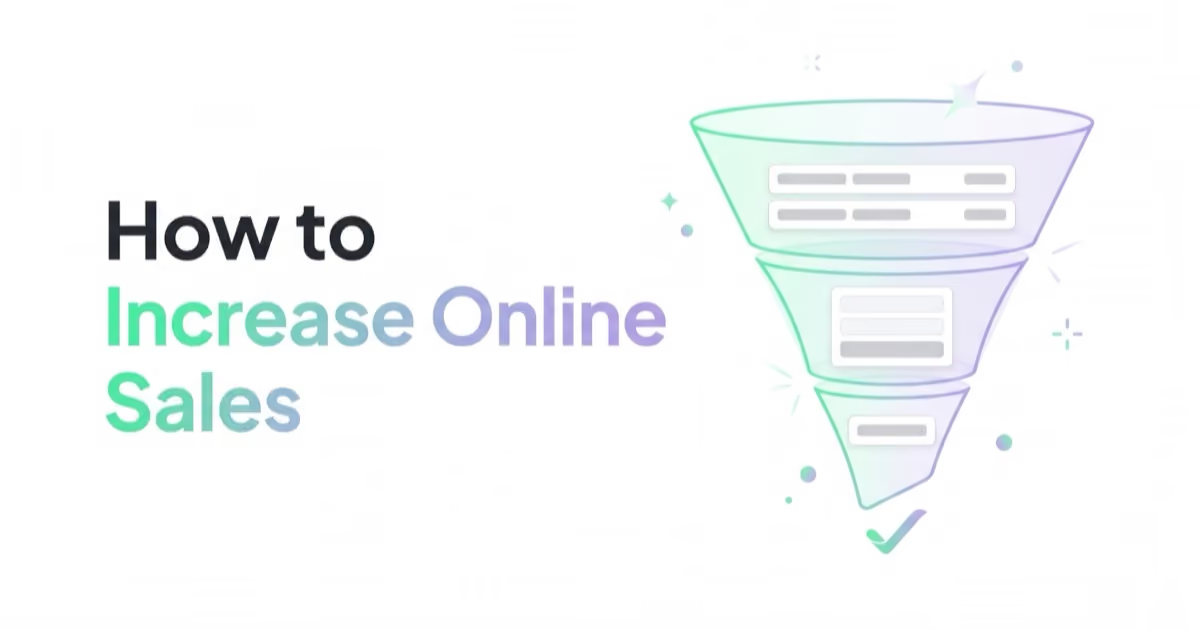
Increasing ad spend is rarely the full answer. More traffic can help only when the sales funnel already converts profitably. If users do not understand the offer, abandon the checkout, distrust the brand, struggle on mobile or cannot complete a form, paid acquisition simply exposes those problems faster.
This guide explains how to increase online sales across ecommerce, service businesses, B2B, digital products, subscriptions and lead generation. Ecommerce examples are included, but the underlying principles apply to any business that sells or generates demand online.
TL;DR
- Start with funnel diagnosis before scaling traffic.
- Online sales are not only ecommerce sales. The same principles apply to services, SaaS, courses, marketplaces, subscriptions and lead generation.
- The main growth levers are offer clarity, traffic quality, UX, speed, measurement, trust, retention, SEO, paid media and automation.
- CRO matters because small friction points can block otherwise qualified users.
- For ecommerce, product pages, basket, checkout, payment methods, delivery clarity, returns and reviews are especially important.
- Measurement should connect revenue, margin, conversion rate, CAC, AOV, LTV and returning customer share.
- SEO, AEO and LLM SEO require clear answers, structured sections, proof, source references and helpful internal linking.
- The best sequence is usually: fix tracking, understand drop-off, improve conversion, retain customers and then scale acquisition.
What does increasing online sales really mean?
Increasing online sales does not always mean increasing the number of orders at any cost.
A better definition is: increase profitable revenue from online channels while preserving margin, customer quality and long-term growth.
That distinction matters. A business can grow revenue and still lose money if:
- advertising cost rises faster than margin;
- discounts train customers to wait;
- low-quality leads overload the sales team;
- returns increase;
- support costs grow;
- repeat purchase rate falls;
- tracking overcredits the wrong channels.
The goal is not more traffic. The goal is more qualified demand, more conversions and better economics.
Key metrics to watch
Before changing campaigns, landing pages or offers, define the numbers that matter.
| Metric | What it shows |
|---|---|
| Conversion rate | Share of users who complete the desired action |
| Revenue | Total sales generated online |
| Gross margin | How much money remains after product or service delivery cost |
| CAC | Cost to acquire a customer |
| AOV | Average order value |
| LTV | Customer value over time |
| Repeat purchase rate | How often existing customers return |
| Lead-to-sale rate | Quality of leads, not only lead volume |
| Refund or return rate | Whether sales are sustainable |
| Assisted conversions | Channels that support the decision before the final click |
For ecommerce, track product views, add to cart, begin checkout, purchase, payment errors, delivery selection and returns.
For services and B2B, track qualified enquiries, booked calls, proposals, closed deals, sales cycle length and revenue by source.
Start with funnel diagnosis
The first step is not a list of random tactics. It is a structured diagnosis.
Review:
- which traffic sources generate users with buying intent;
- which landing pages bring qualified sessions;
- where users drop off;
- whether the first screen explains the offer;
- whether the user can complete the next step on mobile;
- whether forms, checkout and payment steps work correctly;
- whether analytics records the right actions;
- whether conversion data is imported into ad platforms;
- whether sales growth is profitable after margin and fulfilment costs.
This prevents the common mistake of spending more money to send users into a broken funnel.
Lever 1: clarify the offer
Users buy faster when they understand the offer quickly.
A strong online offer answers:
- What is being sold?
- Who is it for?
- What problem does it solve?
- Why is this brand a credible choice?
- What is included?
- What happens after purchase or enquiry?
- What are the risks, limitations or conditions?
- What proof supports the claim?
Weak offers often hide behind vague slogans. Better commercial pages use direct language, visible pricing logic where appropriate, clear scope, proof and a simple next step.
For service businesses, this may mean case studies, process, deliverables, timelines and examples of work.
For ecommerce, this means clear product benefits, specifications, variants, availability, delivery, returns and reviews.
Lever 2: match traffic to intent
Not all traffic has the same commercial value.
Users may be:
- learning about a problem;
- comparing options;
- checking price;
- looking for a specific brand;
- ready to buy;
- returning after previous contact;
- seeking support after purchase.
Each stage needs different content and a different call to action.
Examples:
| Intent stage | Better asset |
|---|---|
| Education | Guides, explainers, comparison criteria |
| Consideration | Category pages, case studies, reviews, comparison pages |
| Decision | Product pages, pricing pages, offer pages, demos |
| Recovery | Remarketing, cart emails, browse abandonment flows |
| Retention | Post-purchase emails, replenishment, loyalty, onboarding |
Paid media works better when the ad promise, keyword or audience signal matches the landing page. SEO works better when each page has a clear search intent rather than trying to rank one page for everything.
Lever 3: improve UX and remove friction
Conversion problems are often practical, not strategic.
Common blockers:
- unclear call to action;
- too many form fields;
- required account creation too early;
- hidden delivery costs;
- unclear return policy;
- weak mobile layout;
- slow product filters;
- distracting pop-ups;
- missing trust signals;
- payment errors;
- confusing variant selection;
- unclear next step after enquiry.
Good CRO is not about changing button colours at random. It is about identifying where users hesitate, fail, abandon or choose a competitor.
For a deeper CRO framework, see conversion rate optimization.
Lever 4: improve speed and Core Web Vitals
Page speed affects how quickly users can understand and act. It also affects ad quality, SEO experience and mobile conversion.
Core Web Vitals focus on:
- Largest Contentful Paint: how quickly main content loads;
- Interaction to Next Paint: how responsive the page feels;
- Cumulative Layout Shift: how stable the layout is while loading.
For sales pages, product pages and checkout, performance work should prioritise real user experience, not only lab scores.
High-impact improvements often include:
- reducing oversized images;
- lazy-loading non-critical assets;
- removing unused scripts;
- improving server response time;
- loading product media efficiently;
- avoiding layout shifts from banners or reviews;
- simplifying third-party tags;
- testing mobile performance on real devices.
Speed is rarely the only reason people buy, but slow and unstable pages create unnecessary loss.
Lever 5: fix measurement quality
Online sales cannot be improved confidently without reliable measurement.
A good measurement setup should include:
- GA4 events for the main funnel;
- ecommerce events where products are sold online;
- form and lead tracking;
- call or booking tracking where relevant;
- campaign UTM governance;
- consent management where required;
- Google Ads conversion import;
- Meta Conversions API or server-side tracking where justified;
- deduplication between browser and server events;
- revenue and margin reporting where possible.
For ecommerce, GA4 recommended events such as view item, add to cart, begin checkout and purchase help describe the shopping journey. For lead generation, the key is not only form submission volume but qualified lead quality.
For Meta measurement, see Meta Conversions API.
Lever 6: build trust and reduce perceived risk
A user who does not trust the business will not convert, even if the campaign targeting is accurate.

Trust signals can include:
- visible company details;
- contact options;
- reviews;
- testimonials;
- case studies;
- certifications;
- delivery and return policies;
- secure payment methods;
- guarantees;
- realistic product photos;
- clear privacy information;
- transparent pricing.
For services and B2B, trust often comes from expertise and proof: examples of results, sector knowledge, process clarity and realistic expectations.
For ecommerce, trust often comes from product reviews, delivery clarity, returns, payment options and accessible support.
Lever 7: improve product, service and category pages
Commercial pages should make the decision easier.
A strong product page usually includes:
- specific title;
- benefit-led introduction;
- clear images or video;
- variants;
- availability;
- delivery information;
- return information;
- specifications;
- FAQs;
- reviews;
- related products;
- structured data;
- visible add-to-cart action.
A strong service page usually includes:
- problem definition;
- service scope;
- who the service is for;
- process;
- deliverables;
- proof;
- pricing model or qualification logic;
- FAQs;
- next step;
- internal links to supporting content.
For product-led websites, Merchant Center and structured data should support page-level information. See Google Merchant Center.
Lever 8: use retention and lifecycle marketing
Many businesses focus too much on first-time acquisition and too little on existing customers.
Retention can increase sales by improving repeat purchase, upsell, cross-sell and customer lifetime value.
Useful flows include:
- welcome sequence;
- abandoned cart recovery;
- browse abandonment;
- post-purchase education;
- replenishment reminders;
- review requests;
- win-back campaigns;
- loyalty communication;
- product recommendations;
- onboarding for digital products or SaaS.
Retention work also improves paid media economics. If LTV rises, the business can afford more acquisition cost without destroying margin.
Lever 9: use remarketing carefully
Remarketing helps bring users back after a first visit, but it should be segmented.
Better remarketing audiences:
- product viewers;
- cart abandoners;
- checkout abandoners;
- users who viewed pricing;
- engaged content readers;
- past purchasers;
- high-value customers;
- lapsed customers.
Each audience needs a different message. A user who abandoned checkout may need delivery reassurance. A B2B visitor who read three articles may need a case study. A past customer may need a replenishment reminder.
For Google-based return traffic, see Google remarketing. For product catalogues, see dynamic remarketing.
Lever 10: strengthen SEO, AEO and LLM visibility
Organic growth works best when the website answers real questions with structure and expertise.

Pages should include:
- a clear answer near the top;
- definitions where needed;
- step-by-step sections;
- examples;
- comparison tables;
- FAQs;
- authorial or business expertise;
- up-to-date source references;
- internal links;
- relevant structured data;
- original insights from projects, audits or customer experience.
This supports classic SEO, answer engine optimization and LLM discoverability. The goal is to make the page useful to a person and easy for machines to parse without making it formulaic.
For ecommerce SEO, category pages, product pages, filters, product variants, structured data and internal linking deserve special attention.
Ecommerce: what usually moves sales fastest
In ecommerce, the biggest impact often comes from product pages, cart and checkout.
Review:
- whether the product title is specific;
- whether images show the exact variant;
- whether delivery cost is visible early enough;
- whether payment methods match customer expectations;
- whether checkout works on mobile;
- whether guest checkout is possible where appropriate;
- whether stock status is accurate;
- whether return policy is easy to find;
- whether reviews answer objections;
- whether unavailable products have a useful alternative;
- whether abandoned cart flows are active.
Baymard's ecommerce UX research consistently shows that checkout usability remains a major area for improvement across many retail sites. The practical lesson is not to copy one benchmark blindly, but to treat checkout as a revenue-critical product, not an administrative page.
Services and B2B: what usually moves sales fastest
For services, agencies, consultants and B2B companies, the conversion event is often not a purchase. It may be a call, form, demo, quote or diagnostic session.
The strongest levers are usually:
- clear positioning;
- credible proof;
- specific service scope;
- strong landing pages for each service;
- frictionless forms;
- fast response time;
- qualified lead scoring;
- case studies;
- remarketing to engaged visitors;
- content that answers buying questions;
- sales follow-up quality.
In B2B, more leads are not always better. A smaller number of high-intent qualified enquiries can outperform a larger number of weak leads.
Recommended order of work
1. Verify measurement
Confirm that revenue, leads, purchases, forms, calls, UTMs and platform conversions are tracked correctly.
2. Analyse the funnel
Find where users drop off and which sources generate profitable customers.
3. Improve the offer
Clarify positioning, scope, pricing logic, proof and risk reduction.
4. Fix the most important pages
Prioritise pages with meaningful traffic and commercial intent.
5. Improve speed and UX
Focus on mobile, forms, product pages, cart, checkout and key CTAs.
6. Add retention
Use email, remarketing, onboarding and post-purchase communication.
7. Scale acquisition
Increase SEO, paid media, partnerships and content distribution only after the core funnel works.
How we approach this at Space Ads
We split "increase online sales" into two levers: bring in more (or cheaper) traffic, or earn more from the traffic already arriving, through higher conversion and a fuller basket. Before adding budget to ads, we work out which lever is cheaper. Often half a percentage point on conversion, or a dozen percent on the average basket, beats buying more clicks, and it lifts every channel at once because it improves the economics of each. So the starting question isn't "spend more", it's where the cheapest growth sits: in winning traffic or in closing it. Advertising scales whatever already works; if the shop closes badly, we fix closing first, or we're just scaling the loss.
Common mistakes
| Mistake | Why it hurts sales | Better approach |
|---|---|---|
| Scaling traffic too early | More users hit the same blockers | Fix funnel and measurement first |
| Optimising only ads | Page friction remains | Connect media, CRO and offer work |
| Tracking only last click | Supporting channels look weak | Review assisted journeys and incrementality |
| Chasing conversion rate alone | Margin can fall | Track profitable conversion |
| Hiding delivery or pricing | Trust drops late in the funnel | Show important cost information earlier |
| Overusing discounts | Customers wait for promotions | Improve value, bundles and retention |
| Ignoring mobile | Many users cannot complete the journey | Test real mobile flows |
| Treating content as generic SEO text | Low authority and weak answers | Add proof, examples, FAQs and sources |
FAQ
What is the fastest way to increase online sales?
The fastest route is usually to fix the largest funnel blocker: unclear offer, weak landing page, broken tracking, poor mobile UX, checkout friction, missing trust or poor remarketing. The exact answer depends on data.
Is increasing ad spend enough?
Not usually. More budget works only when the funnel converts profitably. If conversion rate, offer clarity or tracking is weak, bigger budgets can waste money faster.
What is more important: SEO or paid ads?
Both can matter. Paid ads generate traffic and learning faster. SEO builds compounding visibility. The strongest growth usually comes from combining SEO, paid media, CRO, measurement and retention.
How should online sales growth be measured?
Measure revenue, margin, conversion rate, CAC, AOV, LTV, repeat purchase rate, qualified lead rate and channel contribution. Revenue alone can be misleading.
How can a service business increase online sales?
A service business should improve positioning, proof, service pages, lead forms, case studies, response speed, remarketing and content that answers buying questions.
How can an online store increase sales?
An online store should improve product pages, checkout, delivery clarity, payment options, reviews, product data, Merchant Center, remarketing and retention flows.
Does SEO help with online sales?
Yes, when SEO targets the full buying journey: educational queries, comparison queries, category demand, product demand, brand demand and post-purchase questions.
Conclusion
Online sales grow when the whole system is aligned: offer, traffic, UX, measurement, trust, retention and acquisition. The best improvements are usually practical. Make the offer clearer, remove friction, measure the right events, show proof, improve page speed and follow up with users who already showed intent.
For ecommerce, the product page, cart and checkout deserve constant attention. For services and B2B, clarity, proof and lead quality matter more than raw form volume. In every model, profitable sales growth comes from fixing the funnel before scaling traffic.
Sources and further reading
- Google Analytics: Measure ecommerce
- Google Analytics: Recommended events
- web.dev: Core Web Vitals
- Google Search Central: Ecommerce SEO best practices
- Baymard Institute: Checkout usability research
Continue learning
Continue reading
What Is Conversion Rate and How to Increase It?
Conversion rate shows what share of users complete a desired action, but the number only matters with the right context. Learn how to calculate, segment and improve it.
Free Shipping Strategy for Online Stores (Threshold, Margin, When)
Free shipping can improve the offer, but only when the additional contribution it generates exceeds the delivery subsidy. Learn how to choose a model, calculate a threshold and test the impact on profit rather than AOV alone.
Conversion Optimization: A Complete Guide for E-commerce, B2B, SaaS and Services
Conversion optimization improves the percentage and quality of visitors who become customers, leads, users or booked appointments. This guide explains how to diagnose friction before scaling paid ads.