Conversion rate optimization, usually shortened to CRO, is the process of increasing the percentage of users who complete a valuable action on a website, landing page, store, app or funnel.
That action may be a purchase, form submission, demo request, phone call, registration, trial activation, quote request, newsletter sign-up or another conversion that matters to the business. CRO is not only about changing button colors. It is about reducing the distance between user intent and a successful outcome.
The commercial value is simple: when a website converts better, the same qualified traffic can generate more revenue, more qualified leads or more customer value. Paid media can become more efficient, SEO traffic becomes more valuable and marketing teams may scale with less waste.
However, a higher conversion rate is not automatically a better business result. Discounts can lift orders while reducing margin; a shorter form can create more leads while lowering sales quality; an aggressive popup can grow sign-ups while suppressing purchases. Good CRO improves the outcome that matters without causing a larger loss elsewhere.
TL;DR
- CRO improves the percentage of visitors who complete valuable actions.
- A conversion can be a purchase, lead, call, booking, trial, account creation or micro-action that supports the main goal.
- CRO should start with measurement, not design opinions.
- The biggest CRO levers are offer clarity, page speed, mobile UX, trust, copy, forms, checkout, proof and message match.
- A/B testing is useful when there is enough traffic, but CRO also includes qualitative research, analytics, usability testing and heuristic review.
- Ecommerce CRO focuses on product pages, category pages, search, filters, cart, checkout, payment, delivery and retention.
- For lead generation and B2B, CRO must measure lead quality, not only the number of form submissions.
- A winning test should improve a primary business metric while protecting guardrails such as margin, refunds, cancellations or lead quality.
What is a conversion?
A conversion is a user action that has business value. It can be macro or micro.
Macro conversions are the main outcomes:
- completed purchase;
- submitted lead form;
- booked consultation;
- phone call;
- software trial;
- subscription;
- quote request;
- account registration;
- app install;
- donation.
Micro conversions are supporting actions:
- product view;
- add to cart;
- checkout start;
- pricing-page visit;
- PDF download;
- video view;
- newsletter sign-up;
- store locator click;
- contact button click;
- comparison page visit.
Micro conversions help diagnose funnel problems, but they should not replace the main business goal. A campaign that optimizes only for cheap micro conversions can look successful while generating low revenue or poor leads.
What is conversion rate?
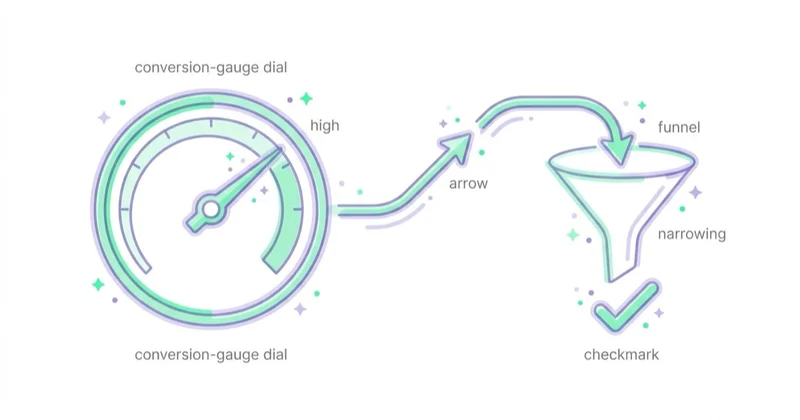
Conversion rate is the percentage of users, sessions, visits or clicks that complete a defined conversion. The precise definition depends on the measurement system and business question.
Basic formula:
Conversion rate = conversions ÷ eligible users, sessions or clicks × 100%.
The denominator matters. A purchase rate calculated from users will differ from a purchase rate calculated from sessions or ad clicks. GA4's session key event rate, for example, is the percentage of sessions in which a key event occurred — not simply the number of event occurrences divided by sessions. One user may purchase more than once, and one session may trigger an event repeatedly.
A landing-page lead rate is also not comparable with a website-wide purchase rate. Record the event, denominator, population, time window and attribution rule used in every report. Without that context, “conversion rate” is an ambiguous number.
Useful CRO metrics include:
- conversion rate by page, device and channel;
- revenue per visitor;
- lead-to-qualified-lead rate;
- cart-to-checkout rate;
- checkout completion rate;
- form completion rate;
- average order value;
- repeat purchase rate;
- customer acquisition cost;
- return on ad spend with margin context;
- customer lifetime value.
Conversion rate is a diagnostic, not the final objective
Use a metric hierarchy rather than treating conversion rate as the only target:
- Business outcome: contribution margin, new-customer revenue, qualified pipeline, activated subscriptions or another value metric.
- Primary conversion: purchase, qualified enquiry, booking or activation.
- Funnel diagnostics: product view, add to cart, checkout start, form start and completion.
- Guardrails: average order value, margin, refunds, cancellations, chargebacks, sales acceptance, page performance and customer support contacts.
This hierarchy prevents local optimisation. A variant that increases checkout completion but attracts more returns may be worse for the business. A form that generates fewer but substantially better opportunities may be the stronger version.
Why CRO matters
It improves the economics of traffic
If a site receives 100,000 qualified visits and converts 1% of them, it produces 1,000 conversions. If the conversion rate rises to 1.2%, the same traffic produces 1,200 conversions — 200 additional conversions, assuming traffic quality and the measurement definition stay constant. Whether that creates more profit still depends on order value, margin, fulfilment, refunds and the cost of the change.
It protects paid media budgets
Paid traffic is expensive in competitive markets. If the landing page is slow, unclear or untrustworthy, the media budget pays for users who had enough intent to click but not enough confidence to act.
Good CRO improves the return on Google Ads, Meta Ads, TikTok Ads, Demand Gen, email, affiliate, influencer and display campaigns.
It increases the value of SEO and content
SEO and content often attract users at different stages of intent. CRO helps turn that attention into meaningful next steps: subscribing, comparing, trying, contacting, buying or returning.
For broader acquisition context, see what digital marketing is and why it matters.
It reveals what users actually need
CRO research often exposes gaps in the offer, not only the interface. Users may need clearer pricing, shipping details, proof, risk reduction, service process, delivery time, compatibility information or a better product comparison.
The CRO process
1. Define the conversion
Start by defining the primary conversion and the supporting micro conversions. The goal should connect to business value.
For ecommerce, that may be purchase revenue and margin. For B2B, it may be qualified opportunities, not raw form fills. For SaaS, it may be trial activation or paid subscription, not only sign-ups.
2. Audit tracking and data quality
Before changing the site, check whether analytics can be trusted.
Review:
- GA4 events;
- ecommerce event parameters;
- Google Ads conversion actions;
- Meta and TikTok event tracking;
- duplicate events;
- consent behavior;
- form submissions;
- call tracking;
- CRM stages;
- revenue and currency values;
- test transactions;
- server-side or enhanced conversion setup where relevant.
For GA4 ecommerce, use the recommended event model where it fits the journey and validate identifiers and parameters such as transaction_id, items, value and currency. Test refunds as well as purchases. A purchase event that fires on a confirmation-page refresh or lacks a unique transaction ID can overstate revenue.
Measurement should also respect the applicable consent and privacy requirements. Do not introduce session recording, form analytics or advertising identifiers without reviewing what is collected, how it is disclosed and whether consent is required in the relevant market.
Bad tracking creates bad CRO priorities. If purchase values are wrong or form events fire twice, optimization decisions become unreliable.
3. Diagnose friction
Use multiple data sources:
- analytics reports;
- funnel exploration;
- search terms;
- heatmaps;
- scroll maps;
- session recordings;
- form analytics;
- user surveys;
- customer interviews;
- support tickets;
- sales objections;
- usability tests;
- page speed data;
- competitive review.
The goal is to understand why users hesitate, drop, misunderstand or fail. No single source proves the cause. Analytics shows where behaviour changes; interviews and usability studies help explain why; experiments estimate whether a proposed change caused an improvement.
4. Build hypotheses
A useful CRO hypothesis links evidence, change, expected behaviour and business effect.
Example:
Because customer feedback and checkout data show unexpected delivery terms are a frequent concern, displaying delivery cost and timing on the product page should increase checkout completion by resolving that uncertainty before the cart, without reducing average order value.
Another example:
If the lead form explains what happens after submission, more qualified users will complete it because the next step feels less vague.
5. Prioritize
Not every idea deserves implementation. Prioritise by:
- expected impact;
- confidence from data;
- traffic volume;
- business value;
- implementation effort;
- risk;
- learning potential.
Keep the scoring transparent, but do not mistake a framework score for evidence. A highly rated idea can still fail. Reserve capacity for severe defects and compliance risks even when their measurable traffic impact is small.
High-impact fixes with strong evidence should move first. Cosmetic tests with weak reasoning should wait.
6. Test or implement
A/B testing is valuable when there is enough eligible traffic and conversion volume. Before launch, define the primary metric, guardrails, minimum detectable effect, allocation, target population and stopping rule. Run the test across relevant business cycles rather than stopping as soon as a dashboard shows significance.
During analysis, check that traffic was allocated as intended. A sample ratio mismatch — for example, a nominal 50/50 test receiving a materially different split — can indicate a technical or assignment problem and make the result untrustworthy. Also review device, browser, geography, customer type and traffic source where the hypothesis suggests meaningful differences. Segment findings should be treated cautiously when they were not specified in advance.
Without enough data, tests can produce false confidence or run so long that the environment changes around them. In lower-traffic situations, combine qualitative research, usability testing, technical fixes and carefully monitored sequential changes. Be explicit that a before-and-after comparison cannot isolate causality as reliably as a controlled experiment.
Some changes do not need an A/B test. Broken forms, inaccessible controls, invisible error messages, duplicate purchase events and incorrect prices should be fixed and quality-assured. The case for immediate implementation should be based on correctness, accessibility, security or clear user harm — not merely confidence that a preferred design “must win”.
7. Learn and document
CRO should build organisational knowledge. Document the evidence, hypothesis, screenshots, implementation, quality checks, dates, audience, results and decision. Record inconclusive and losing tests as carefully as winners so teams do not repeat them or publish only favourable outcomes.
How to find the first CRO priority
Do not begin with a list of generic “best practices”. Start where user friction, business value and evidence overlap.
Build a simple opportunity map:
| Funnel stage | Diagnostic question | Evidence | Commercial check |
|---|---|---|---|
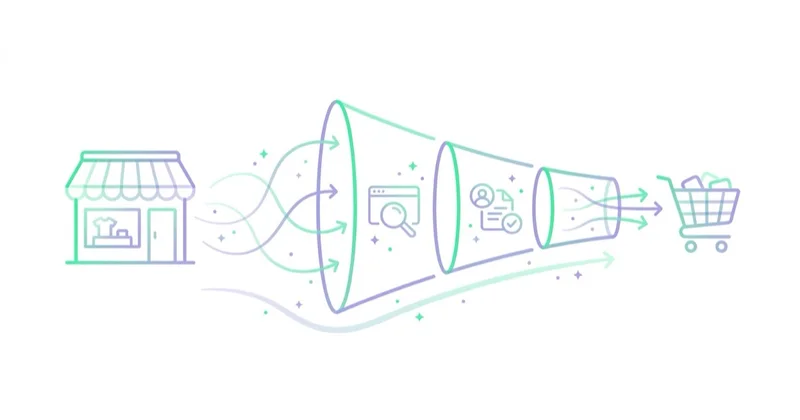
| Acquisition to landing | Does the page fulfil the promise that earned the click? | Search terms, ads, engagement, interviews | Traffic quality and acquisition cost |
| Product or service evaluation | Can users understand fit, value, price and risk? | Usability tests, page behaviour, sales objections | Margin, qualification and product mix |
| Cart or form | Is unnecessary effort blocking committed users? | Form analytics, errors, recordings, support data | Order value or lead quality |
| Checkout or booking | Are cost, timing, trust or technical failures causing exit? | Funnel steps, payment failures, feedback | Payment cost, refunds and fulfilment |
| Post-conversion | Does the promise survive after the conversion? | Activation, cancellations, returns, retention | Lifetime value and service capacity |
Then estimate the affected audience and value. A severe issue on a low-traffic page may matter less commercially than a smaller, well-evidenced friction point at the busiest decision step — unless the issue creates legal, accessibility or reputational risk.
High-impact CRO levers
Offer clarity
Users should quickly understand what is offered, who it is for, what problem it solves and why it is worth choosing. A beautiful page with unclear value will not convert reliably.
Strong offer clarity includes:
- specific headline;
- clear outcome;
- audience fit;
- visible proof;
- transparent next step;
- objections answered near the decision point.
Message match
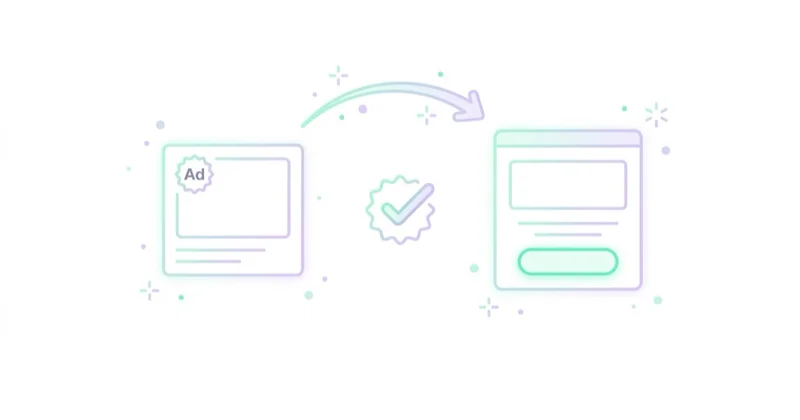
The landing page should match the ad, keyword, email or social post that brought the user there. If an ad promises a specific service and the page opens with a generic company introduction, intent is wasted.
Page speed and interaction quality
Slow or unstable pages create friction, especially on mobile. Core Web Vitals — Largest Contentful Paint, Interaction to Next Paint and Cumulative Layout Shift — are useful field measures of loading, responsiveness and visual stability. They are not conversion guarantees, so combine them with real-user performance by template, device and market.
Speed work is not only technical SEO. It is conversion work.
Mobile UX
Mobile users need readable text, tappable controls, stable layouts, fast forms, clear sticky actions, simple navigation and checkout steps that do not fight the screen size.
Many CRO programs fail because desktop pages are reviewed in meetings while most users convert, hesitate or leave on mobile.
Trust and proof
Users need reasons to believe the claim.
Useful proof includes:
- customer reviews;
- case studies;
- before-after examples;
- certifications;
- press mentions;
- client logos;
- return policy;
- delivery information;
- payment security;
- transparent company details;
- author expertise on educational content.
Proof should be near the decision point, not hidden on a separate page.
Forms
Forms should ask only for data needed at that stage. Every extra field adds friction, especially on mobile.
Improve forms by:
- removing unnecessary fields;
- using clear labels;
- explaining why sensitive information is requested;
- showing inline errors;
- keeping validation helpful;
- making phone and email fields easy to complete;
- explaining what happens after submission.
For B2B, fewer fields are not always better. Sometimes qualification fields improve sales quality. The point is to match the form to the value of the offer and the user's readiness.
Checkout
Checkout CRO focuses on reducing uncertainty and effort.
Key areas include:
- guest checkout;
- delivery cost visibility;
- delivery time;
- payment methods;
- promo code behavior;
- address autocomplete;
- error handling;
- cart editability;
- progress clarity;
- return policy;
- security reassurance;
- order summary visibility.
Baymard's large-scale checkout research is a useful source of usability patterns and possible friction points. Treat benchmarks as research input, not proof that a specific change will improve your store. Your customers, countries, payment methods, fulfilment model and technology still need direct validation.
Accessibility
Accessible journeys help more people understand and complete the task. Check keyboard operation, focus states, labels, error identification, colour contrast, zoom, screen-reader announcements and adequate target sizes. Accessibility defects are not good candidates for “leave the inaccessible version live until it wins”; fix conformance and usability problems, then test optional design choices around them.
CRO for ecommerce
Ecommerce CRO covers the full path from product discovery to repeat purchase.
Important areas:
- category structure;
- filters and sorting;
- onsite search;
- product title and images;
- product descriptions;
- variant selection;
- pricing and discounts;
- stock and delivery messages;
- reviews and user-generated content;
- cart;
- checkout;
- payment options;
- abandoned cart recovery;
- post-purchase communication;
- retention and replenishment.
The product page should answer practical questions before the user reaches the cart: size, compatibility, materials, delivery, returns, warranty, availability, bundles and alternatives.
For cart-specific work, see abandoned carts and how to recover them.
CRO for lead generation and B2B
In lead generation, CRO should not maximize form volume at any cost. It should improve the number of qualified leads.
Key CRO questions:
- Does the page explain who the offer is for?
- Is the service outcome clear?
- Are proof and process visible?
- Is pricing or scope ambiguity blocking action?
- Does the form match the value of the offer?
- Is the next step clear after submission?
- Are low-fit leads being filtered or educated?
- Is CRM feedback connected to campaign reporting?
The strongest lead generation pages often combine clarity, proof, risk reduction and a low-friction next step.
CRO and paid advertising
Paid media and CRO should work together. Campaign optimization can bring the right users, but the page must convert them.
CRO affects:
- landing page quality;
- conversion rate;
- cost per acquisition;
- ROAS;
- lead quality;
- Smart Bidding signals;
- remarketing audience quality;
- creative learning;
- ability to scale budgets.
If campaigns are optimised to a weak or easily triggered conversion event, platforms may learn to find more of that behaviour rather than more customers. Import qualified or revenue-bearing outcomes where appropriate, deduplicate events and give bidding systems enough stable data. For better signal quality, review enhanced conversions in Google Ads.
How we approach this at Space Ads
At Space Ads, we treat acquisition and the post-click journey as one commercial system. Increasing media spend before resolving a serious landing-page, form or checkout problem usually amplifies the waste. Conversely, improving a page while sending it poorly matched traffic can produce the wrong diagnosis.
Our starting point is a shared baseline: the conversion definition, source-to-page message match, funnel data, customer and sales evidence, technical performance and business economics. We prioritise the points where meaningful traffic, evidenced friction and commercial value overlap. Depending on volume and risk, the next step may be a controlled experiment, a usability study or a direct correction followed by monitoring.
We judge the outcome beyond the page. For ecommerce that can mean contribution, order value, refunds and new-customer performance. For lead generation it can mean sales acceptance, opportunity value and eventual revenue. This prevents a local “win” from quietly making the wider funnel worse.
Common CRO mistakes
- Starting with button color instead of user friction.
- Testing without enough traffic or conversion volume.
- Ignoring mobile behavior.
- Treating more leads as better leads.
- Running popups that increase email captures but reduce purchases.
- Copying competitor pages without understanding context.
- Fixing landing pages while the offer remains unclear.
- Measuring ecommerce revenue without margin.
- Changing many elements at once and learning nothing.
- Ignoring qualitative data from customers, sales and support.
- Declaring a winner too early.
- Ignoring sample ratio mismatch, tracking changes or campaign shifts during a test.
- Celebrating conversion rate while margin, refunds, cancellations or lead quality deteriorate.
- Optimizing one page while the next funnel step remains broken.
CRO checklist
Use this checklist before launching a test or redesign.
- The primary conversion is clearly defined.
- Micro conversions support diagnosis, not vanity reporting.
- Analytics events fire once and carry correct values.
- The page has a clear headline and next step.
- The offer is understandable above the fold.
- Mobile UX is reviewed on real devices.
- Page speed and interaction delays are checked.
- Trust signals appear near decision points.
- Forms are clear, short enough and error-friendly.
- Checkout shows delivery, payment and return information early.
- Customer objections are answered in copy or FAQ.
- The test hypothesis is written before implementation.
- The primary metric, guardrails, audience and stopping rule are defined.
- Traffic allocation and event integrity will be quality-checked.
- The result will be segmented only where there is a credible reason.
- The decision will be documented whether the test wins, loses or remains inconclusive.
FAQ
What does CRO stand for?
CRO stands for conversion rate optimization. It is the process of improving the percentage of users who complete valuable actions on a website, landing page, app or funnel.
Does CRO only apply to ecommerce?
No. CRO applies to ecommerce, B2B websites, SaaS, lead generation, landing pages, apps, booking flows, nonprofit donation pages and local service websites.
Is A/B testing required for CRO?
No. A/B testing is useful when traffic and conversion volume are high enough. CRO can also use analytics, user research, heatmaps, session recordings, usability testing, heuristic review and direct fixes for obvious problems.
What is a good conversion rate?
There is no universal good conversion rate. It depends on the event, denominator, traffic intent, industry, device, price, sales cycle, brand and market. Compare like with like, use external benchmarks only as context and judge the result through profit or qualified customer value. Our detailed guide to ecommerce conversion-rate benchmarks by industry explains how to build a defensible comparison.
What should be optimized first?
Start with measurement, then high-friction and high-value steps. For ecommerce, that often means product pages, cart and checkout. For lead generation, it may be landing page clarity, proof, form quality and post-submit follow-up.
Can CRO increase sales without increasing traffic?
Yes. If more of the same qualified audience purchases — or lead quality, order value or checkout completion improves — sales can increase without more traffic. CRO can also reduce sales when a change harms traffic quality, margin or later funnel stages, which is why guardrails matter.
Conclusion
CRO is the disciplined work of removing barriers between user intent and business value. It begins with reliable measurement, continues with diagnosis and hypotheses, and improves through testing, implementation and learning.
The best CRO programs are not cosmetic. They improve offer clarity, trust, speed, mobile usability, forms, checkout and message match. That makes every acquisition channel stronger: paid media, SEO, content, email, social and remarketing.
Conversion optimisation starts with correct measurement and diagnosis — just like an ad-account audit. If traffic comes from paid campaigns, consider a marketing audit (Google, Meta, TikTok) before running tests.
Where this runs continuously rather than as a one-off exercise, that is what our conversion rate optimization programme does.
Sources and further reading
- Google Ads Help: About conversion measurement
- Google Analytics Help: Ecommerce in Google Analytics
- Google Analytics for Developers: Measure ecommerce
- Google Analytics Help: Traffic acquisition metrics
- web.dev: Web Vitals
- web.dev: Interaction to Next Paint
- Baymard Institute: Cart abandonment rate statistics
- Microsoft Research: Diagnosing sample ratio mismatch in online controlled experiments
Continue learning
Continue reading
Conversion Optimization: A Complete Guide for E-commerce, B2B, SaaS and Services
Conversion optimization improves the percentage and quality of visitors who become customers, leads, users or booked appointments. This guide explains how to diagnose friction before scaling paid ads.
What Is Conversion Rate and How to Increase It?
Conversion rate shows what share of users complete a desired action, but the number only matters with the right context. Learn how to calculate, segment and improve it.
How to Use Pop-Ups Without Hurting UX or SEO
Pop-ups can improve conversion when they are relevant, accessible, easy to close and measured against real business impact.