Product recommendations are suggestions shown to users based on context, product similarity, popularity, behaviour, purchase history, basket contents or manual merchandising rules. Their purpose is not to push random add-ons. Their purpose is to help users discover relevant options, compare alternatives and choose products that fit their intent.

Product recommendations can improve discovery, cross-selling, upselling, average order value and customer experience. They can also damage trust when they are irrelevant, intrusive, incompatible or placed at the wrong moment.
In 2026, recommendations are increasingly AI-assisted, but the fundamentals have not changed. Relevance, placement, data quality, merchandising rules, privacy and measurement matter more than the label "AI-powered".
TL;DR
- Product recommendations are important when they help users choose, compare or complete a purchase.
- Relevance matters more than the number of recommendation widgets.
- Common recommendation types include similar products, frequently bought together, complementary products, bestsellers, personalized products and manual merchandising.
- Strong placements include product pages, cart, category pages, search results, post-purchase email and empty states.
- AI is useful at scale, but smaller catalogs can start with rules and manual bundles.
- Measure incremental impact through A/B tests or holdout groups, not only revenue after exposure.
- Privacy and consent matter when recommendations use behavior or purchase history.
- Recommendations can support internal linking and discovery, but they should not replace strong category, search and product page UX.
What are product recommendations?
Product recommendations are product suggestions shown to users during a shopping or browsing journey.
They can be based on:
- the current product;
- current category;
- search query;
- products in the basket;
- user behavior;
- previous purchases;
- customer segment;
- popular items;
- margin rules;
- inventory status;
- manual merchandising;
- machine learning models.
The best recommendations feel useful. The worst recommendations feel like clutter.
Why are product recommendations important?
Recommendations help solve several commercial and UX problems:
- users do not know the full catalog;
- similar products are hard to compare;
- complementary items are easy to forget;
- users may choose an incompatible product;
- bestselling items deserve visibility;
- long-tail products need discovery;
- returning customers need relevant shortcuts;
- stores need to increase order value without relying only on discounts;
- product pages need useful next paths when the current item is not right.
For broader ecommerce growth, read How to Increase Online Sales.
Main types of product recommendations
| Type | How it works | Example |
|---|---|---|
| Similar products | Uses product attributes or visual similarity | Similar color, style, size, function or price |
| Frequently bought together | Uses order history | Laptop plus sleeve plus mouse |
| Complementary products | Uses compatibility logic | Coffee machine plus filters |
| Bestsellers | Uses popularity | Top products in a category |
| Recently viewed | Uses session behavior | Products the user has already opened |
| Personalized recommendations | Uses user behavior or history | Suggested products after browsing or purchase |
| Manual recommendations | Set by the team | Seasonal bundles, campaign products |
| Buy again | Uses purchase history | Replenishment products |
| Next best product | Predicts likely next purchase | Subscription, consumable or accessory |
Not every store needs every type. The right recommendation depends on catalog, traffic, data and user intent.
Recommendation systems: simple explanation
Advanced recommendation systems often work in stages.
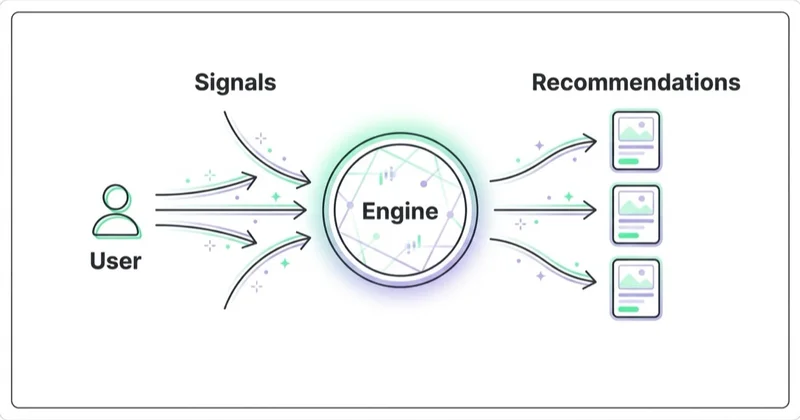
A simplified architecture:
- Candidate generation: choose a smaller group of possible products from the catalog.
- Scoring: rank those products by likely relevance.
- Re-ranking: apply business and user constraints such as availability, diversity, freshness, margin or exclusions.
For ecommerce teams, the most important point is practical: recommendations need both user signals and product data. If product attributes are poor, stock is outdated or variants are messy, the recommendations will be weaker.
For data quality context, read What Is a Product Feed and How to Use It?.
Contextual vs behavioural recommendations
Contextual recommendations
Contextual recommendations use the current page, search query, category or basket.
Examples:
- similar products on a product page;
- compatible accessories in cart;
- bestsellers in the current category;
- product alternatives in search results;
- products that complete a set.
They are often a good first step because they do not require deep personalisation.
Behavioural recommendations
Behavioural recommendations use user activity.
Examples:
- recently viewed products;
- recommendations based on purchase history;
- personalised homepage products;
- email recommendations based on browsing;
- replenishment suggestions after purchase.
They can be powerful, but they require better data, consent handling and privacy governance.
Where to show recommendations
Product page
Useful sections:
- similar products;
- alternatives in other price ranges;
- compatible accessories;
- bundle suggestions;
- products from the same collection;
- frequently bought together;
- "complete the look" or "complete the setup" modules.
Do not overload the page. The main job of a product page is to help the user decide whether to buy the product currently viewed. Recommendations should support that decision or provide a useful next path.
For product copy context, read How to Write a Product Description That Sells and What It Must Include.
Cart
Cart recommendations should be careful and practical.
Good options:
- low-friction add-ons;
- missing accessories;
- consumables;
- delivery threshold suggestions;
- protection or care products;
- items needed to complete a set.
Avoid aggressive upselling that distracts from checkout. Baymard's ecommerce UX research has repeatedly warned that irrelevant cross-sells in the cart can create clutter and weaken trust. The closer a user is to payment, the more disciplined recommendations should be.
Category pages
Recommendations can support:
- bestsellers;
- trending items;
- recently viewed;
- popular filters;
- new arrivals;
- editor picks;
- seasonal picks.
They should not push the product grid down so far that users cannot browse easily. The category page's main job is still product discovery and comparison.
For category strategy, read Are Category Descriptions Useful for Ecommerce SEO?.
Search results
Recommendations can help when:
- search returns no results;
- a query is too broad;
- products are similar;
- spelling is imperfect;
- the user needs category suggestions;
- the exact item is unavailable.
Search recommendations should support discovery, not hide the user's actual results.
Email and lifecycle campaigns
Recommendations can support:
- post-purchase cross-sell;
- replenishment;
- abandoned cart;
- browse abandonment;
- win-back;
- new arrival alerts;
- price drop or back-in-stock messages.
The recommendation should match the email reason. A post-purchase email should not show random bestsellers when a complementary product or next step is more useful.
For recovery flows, read Abandoned Carts: What They Are and How to Recover Them.
Product recommendations beyond ecommerce
The same logic can apply outside traditional stores.

Examples:
- SaaS: recommend the next feature, template or integration.
- Content sites: recommend related articles, guides or reports.
- Online courses: recommend the next lesson or advanced course.
- Services: recommend related service pages or diagnostic tools.
- Marketplaces: recommend providers, packages or alternatives.
- Apps: recommend actions, settings or next steps.
The object changes, but the principle is the same: help the user find the next relevant option.
Personalisation, AI and data quality
AI-powered recommendations can improve relevance at scale, especially with large catalogs and enough behavioural data.
But AI is not magic.
It needs:
- clean product catalog;
- stable product IDs;
- good attributes;
- user events;
- stock data;
- pricing data;
- category structure;
- business rules;
- privacy-compliant consent;
- regular evaluation.
AI can produce bad recommendations if the data is poor or if the objective rewards the wrong outcome. For example, an engine that maximises click probability may over-promote cheap curiosity items instead of profitable products.
Business rules matter
Recommendation systems should include business constraints.
Examples:
- do not recommend out-of-stock products;
- do not recommend incompatible products;
- exclude low-margin products from certain placements;
- prioritise high-stock items during clearance;
- avoid recommending products the user just purchased;
- avoid sensitive recommendations where privacy risk is high;
- keep enough variety so the user does not see the same product everywhere;
- prevent competitor marketplace leakage where relevant;
- avoid recommending products with high return rates in prominent placements unless there is a reason.
Automation should support merchandising strategy, not replace it entirely.
Privacy and consent
Recommendations based only on the current page or basket are different from recommendations based on long-term behaviour, customer profiles or purchase history.
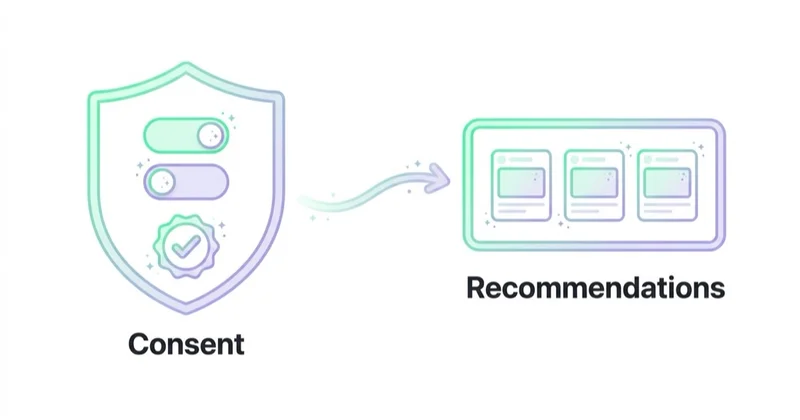
Privacy-aware implementation should consider:
- cookie and consent banner behaviour;
- analytics and marketing consent;
- privacy policy language;
- data minimisation;
- opt-out and unsubscribe logic;
- sensitive product categories;
- user account data governance;
- retention period for behavioural data.
Contextual recommendations can be a safer first step because they use the current page or basket. Behavioural personalisation can be more powerful, but it needs stronger governance.
SEO, AEO and internal linking
Product recommendations are not usually the main SEO lever, but they can support discovery and internal linking when implemented carefully.
They can help:
- connect related products;
- expose long-tail products;
- link complementary items;
- support category relationships;
- help users reach alternatives;
- improve crawl paths when links are server-rendered or otherwise crawlable.
Risks:
- important links rendered only client-side and missed by crawlers;
- too many low-value links on every product page;
- random products replacing intentional internal linking;
- duplicate or irrelevant recommendations across templates;
- recommendations pushing primary content down.
For AI search and answer engines, recommendations should not be the only source of context. Product pages still need clear descriptions, specifications, structured data and helpful copy.
Measuring product recommendations
Basic metrics:
- recommendation CTR;
- add-to-cart from recommendations;
- conversion rate after recommendation click;
- average order value;
- attach rate;
- revenue per session;
- products per order;
- return rate;
- cancellation rate;
- email click-through rate;
- recommendation coverage;
- recommendation error rate.
Better metrics:
- incremental revenue;
- incremental margin;
- incremental AOV;
- effect on checkout completion;
- effect on customer satisfaction;
- effect on repeat purchase;
- holdout group difference.
Do not attribute every purchase after exposure to the recommendation module. Many users would have bought anyway. A/B testing, holdout groups or careful before-after analysis are needed to estimate real impact.
For measurement context, read What Is Ecommerce Analytics and Why Is It So Important?.
How to start by store size
Small catalog
Start with:
- manual similar products;
- bestsellers by category;
- hand-built bundles;
- accessories on product pages;
- simple cart add-ons;
- post-purchase email cross-sell.
The goal is relevance, not automation.
Medium catalog
Add:
- attribute-based similar products;
- recently viewed products;
- frequently bought together;
- category-level merchandising rules;
- stock and margin exclusions;
- A/B tests by placement.
Large catalog
Consider:
- machine learning recommendations;
- personalization by segment;
- product embeddings or visual similarity;
- real-time inventory rules;
- lifecycle recommendation flows;
- recommendation governance with merchandising and analytics teams.
How we approach this at Space Ads
Product recommendations and remarketing run on the same fuel: customer behaviour — what someone viewed, added, bought. We don't keep them in separate worlds. The on-site recommendation engine and the ad that later follows the customer should know the same things, so a viewed product comes back consistently in the shop and in the ad rather than showing two different items. Well-tuned recommendations lift basket value and aid discovery, and as a bonus they hand cleaner signals to the feed and audiences. We grade them on incremental effect, though — did sales actually rise — not on clicks into the "recommended" strip. A clickable carousel that moves nothing in the result is just decoration.
Common mistakes
| Mistake | Why it hurts | Better approach |
|---|---|---|
| Too many widgets | Users ignore or distrust the page | Use fewer, clearer placements |
| Irrelevant cart cross-sells | Checkout friction increases | Recommend only useful add-ons |
| Out-of-stock recommendations | Bad UX and wasted clicks | Exclude unavailable products |
| No compatibility rules | Users buy wrong accessories | Use product relationships and attributes |
| Optimising only for clicks | Low-quality curiosity clicks increase | Measure add-to-cart, margin and conversion |
| No holdout test | Impact is overstated | Use A/B tests or control groups |
| Behavioural data without consent planning | Privacy risk | Separate contextual and behavioural logic |
| Client-side-only links | SEO value may be limited | Make important links crawlable |
FAQ
Are product recommendations important?
Yes, when they help users find relevant products, compare alternatives or complete an order. They are not important when they are generic, irrelevant or distracting.
Where should product recommendations appear?
Common placements include product pages, cart, category pages, search results, homepage, post-purchase emails, abandoned cart emails and no-results search pages. The right placement depends on intent.
Do product recommendations increase average order value?
They can increase AOV when they are relevant and measured properly. The effect should be tested because not every recommendation creates incremental value.
Are AI product recommendations necessary?
Not always. Small stores can start with manual bundles, bestsellers and simple similar-product rules. AI becomes more useful when the catalog, traffic and behavioural data are large enough.
What is the difference between cross-selling and upselling?
Cross-selling recommends complementary products. Upselling recommends a higher-value, larger or more advanced version of the product or package.
Can product recommendations help SEO?
They can support internal linking and discovery when implemented as crawlable, relevant links. They should not replace strong product descriptions, category structure or intentional internal linking.
How should product recommendations be measured?
Measure clicks, add-to-cart, conversion rate, AOV, attach rate, return rate and incremental margin. Use A/B tests or holdout groups where possible.
Key takeaways
Product recommendations are valuable when they make the shopping journey easier. They should help users compare, complete a set, discover relevant alternatives or return to products they already considered.
The strongest recommendation systems combine product data, user context, merchandising rules, privacy governance and measurement. The weakest ones add clutter. Relevance is the strategy.
Sources and further reading
- Baymard Institute - 6 Ways to Improve the Relevance of Cross-Sells in the Cart
- Google Search Central - Structured data for ecommerce sites
- Google Merchant Center Help - Product data specification
- Google Search Central - Creating helpful, reliable, people-first content
Continue learning
- How to Use Upselling and Cross-Selling
- What Is a Product Feed and How to Use It?
- How to Write a Product Description That Sells and What It Must Include
- What Is Conversion Rate Optimization (CRO) and How Does It Increase Sales?
- What Is Ecommerce Analytics and Why Is It So Important?
- How to Audit an Ecommerce Store
Continue reading

How to Use Upselling and Cross-Selling
Upselling and cross-selling can increase revenue when recommendations are relevant, well-timed, margin-aware and measured for incremental impact.
How to Use Push Notifications
Push notifications can support sales, retention and service journeys when they are timely, permission-based, segmented, preference-aware and measured for incremental impact.

Conversion Optimization: A Complete Guide for E-commerce, B2B, SaaS and Services
Conversion optimization improves the percentage and quality of visitors who become customers, leads, users or booked appointments. This guide explains how to diagnose friction before scaling paid ads.