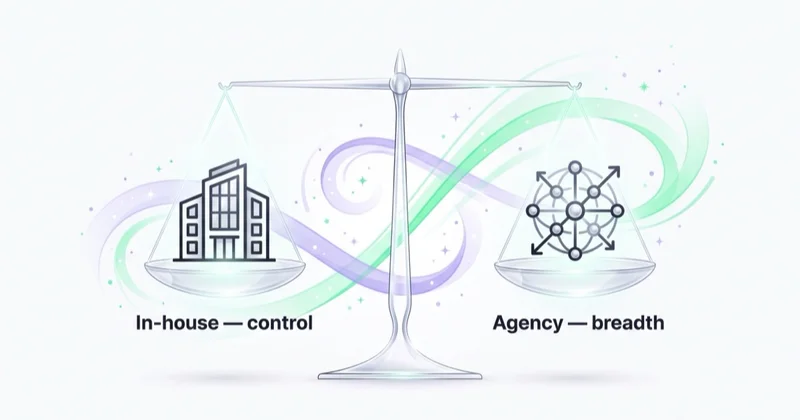
Choosing between a PPC agency and an in-house team is not a question of which one is "better." It is a build-versus-buy decision. In-house gives control, speed and deep business context. An agency gives specialist depth, process, cross-account experience and resilience without hiring a full team.
The right model depends on paid media spend, channel complexity, internal capability, data maturity, creative needs, hiring market and how quickly the business needs to learn. A simple Google Search account can often be managed in-house. A multi-channel account using Google, Meta, TikTok, Shopping, Performance Max, CRM data, product feeds and landing-page testing usually needs more than one person's spare capacity.
This guide gives a practical decision framework for PPC agency vs in-house: what each model does well, what it costs, when to hire, when to build internally, and how to structure a hybrid without losing account or data ownership.
TL;DR
- In-house gives control and business context. It works best when paid media is strategic, stable and large enough to justify hiring and management.
- An agency gives breadth and resilience. It works best when the account needs specialist depth across platforms, measurement, creative, feed work and optimization.
- Cost is not salary versus fee. Compare total capability: salary, recruitment, management, tools, training, cover, creative, analytics and opportunity cost.
- Modern PPC is not only campaign settings. Smart Bidding, Performance Max, Meta automation and TikTok creative demand clean conversion data and strong inputs.
- A hybrid model often wins. Keep business strategy, product knowledge and account ownership internal; use an agency for execution, diagnosis and specialist depth.
- You should own the accounts and data either way. Google Ads, Meta, pixels, GA4, Merchant Center, CRM audiences and history should belong to the business.
- Do not hire an agency to solve a product or sales problem. If the offer, site, margin, tracking or sales process is broken, start with diagnosis.
The core decision: build or buy capability
In-house PPC means building the capability inside the company. Agency PPC means buying that capability as a service. The decision should be based on the capability the business needs, not on a simple comparison between an agency fee and one salary.
| Question | In-house tends to fit | Agency tends to fit |
|---|---|---|
| How complex is the account? | one or two stable channels | several platforms, feeds, analytics, creative and CRO |
| How important is internal speed? | daily product or pricing changes | structured weekly/monthly optimization is enough |
| How much specialist depth is needed? | one strong generalist can handle it | multiple specialists are needed |
| How mature is measurement? | internal team owns analytics well | tracking, CRM or value signals need specialist repair |
| How much creative is required? | internal brand/content team can supply assets | paid media needs testing cadence and channel-native creative |
| How stable is budget? | high, recurring and predictable | variable, experimental or scaling |
| What is the risk of one person leaving? | low because team depth exists | high because capability is concentrated |
The wrong choice usually happens when a company underestimates complexity. PPC is no longer only keywords and bids. Automation has shifted the work toward conversion data, creative quality, feed quality, landing pages, value signals and interpretation.
What in-house PPC does well
In-house PPC can be strong when the business has enough scale and leadership to support it.
Advantages:
- Deep business knowledge. Internal teams understand margin, stock, sales quality, product priorities and company politics faster.
- Immediate coordination. Pricing, product launches, inventory, sales feedback and creative approvals can move quickly.
- Dedicated focus. A good in-house specialist is not splitting attention across clients.
- Closer CRM and sales feedback. Lead quality, revenue, return data and offline conversion quality can be easier to access.
- Long-term learning. Knowledge stays inside the organization if the team is stable.
In-house is especially attractive when paid media is a permanent core function, the spend is high enough to justify a team, and the company has a marketing leader who can manage specialists properly.
Where in-house PPC often struggles
In-house struggles when the company hires one person and expects one person to cover everything.
Common gaps:
- one specialist expected to master Google Search, Shopping, Performance Max, Meta, TikTok, analytics and creative;
- no senior peer review or second opinion;
- slow learning because the person sees only one account;
- limited time for platform changes, experiments and training;
- no backup during holidays, illness or resignation;
- creative and landing-page bottlenecks outside the PPC role;
- reporting shaped by internal pressure rather than independent diagnosis.
The risk is not that in-house is weak. The risk is underbuilding it. A serious internal PPC function usually needs more than one operator: paid media, analytics, creative, feed or ecommerce support, and marketing leadership.
What a PPC agency does well
A good PPC agency brings a broader operating system.
Advantages:
- Cross-account pattern recognition. Agencies see more markets, budgets, problems and platform changes.
- Specialist depth. Google Ads, Meta, TikTok, analytics, feeds, creative and reporting can be handled by different people.
- Process and cadence. Audits, QA, testing, reporting and escalation should be repeatable.
- Resilience. A team is less fragile than one hire.
- Faster diagnosis. The agency can often identify waste, tracking gaps and structure problems quickly.
- Flexible capacity. It is easier to add specialist input than hire full-time roles for every need.
An agency is most useful when spend is already meaningful, the account is complex, results have plateaued, channels are expanding, or the business cannot give PPC consistent senior attention internally.
Where agencies can fail
Hiring an agency is not automatically safer.
Risks:
- junior execution hidden behind senior sales;
- one-size-fits-all campaign structures;
- reporting focused on platform wins rather than business outcomes;
- weak understanding of margin, lead quality or customer value;
- poor communication or slow response;
- unclear ownership of accounts, pixels or audiences;
- incentives that favor spending more rather than spending better;
- lack of transparency around who does the work.
This is why agency selection matters. Before signing, use a structured checklist such as questions to ask a marketing agency. The quality gap between a strong and weak agency is large.
Cost: compare total capability, not salary versus fee
The cheapest-looking option is not always cheaper.
For in-house, include:
- salary and benefits;
- recruitment time and fees;
- onboarding and management;
- training and conferences;
- tools and reporting software;
- creative production support;
- analytics or tagging support;
- coverage during absence;
- risk if the hire leaves;
- opportunity cost if the person is learning slowly on one account.
For an agency, include:
- monthly retainer or fee;
- media spend paid directly to platforms;
- one-off setup, audit or tracking work;
- creative, landing page or analytics scope if separate;
- contract length and offboarding terms;
- whether the agency fee increases with spend;
- whether media, tools or production have markups.
The better lens is capability per dollar, not salary versus fee. A company may need a full internal team eventually. But before that point, an agency can provide access to a broader skill set faster than hiring.
The automation factor
Modern PPC platforms have more automation, not less complexity.
Google Smart Bidding uses auction-time signals and requires reliable conversion tracking. Performance Max can serve across multiple Google inventory sources and depends heavily on product feed quality, creative assets, conversion goals and exclusions. Meta's automated systems need strong creative, catalog quality, event signals and value data. TikTok relies heavily on native creative, pixel or Events API quality and fast testing cycles.
This changes the in-house versus agency question. The specialist no longer only adjusts bids. The work includes:
- conversion tracking and value quality;
- product feed structure;
- creative testing volume;
- landing page diagnosis;
- CRM or offline conversion feedback;
- customer value and margin signals;
- incrementality and reporting discipline;
- platform policy and account quality.
If the internal team can cover those inputs, in-house can work well. If not, an agency or hybrid model reduces risk.
When to hire a PPC agency
Signals that an agency may be the better next move:
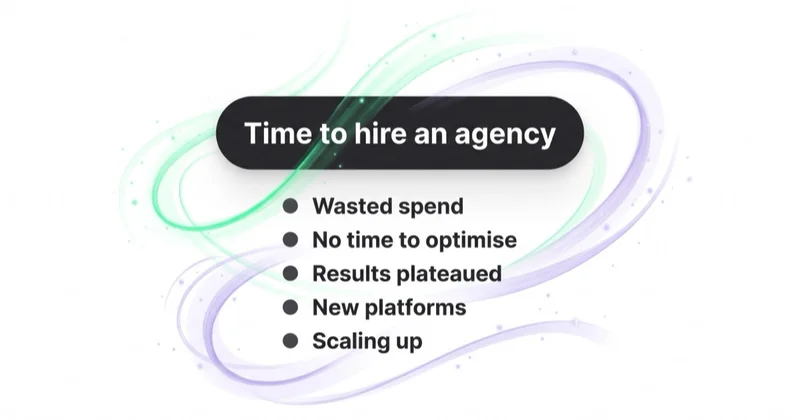
- paid spend is meaningful but no one owns it properly;
- results have plateaued and the team has no new diagnosis;
- the company is expanding from one channel into several;
- conversion tracking, CRM feedback or value data is unreliable;
- e-commerce depends on Shopping, feeds, returns or margin;
- lead generation needs quality feedback, not just form volume;
- creative testing is too slow;
- the account has grown beyond one person's capacity;
- a launch or expansion has high opportunity cost;
- leadership needs an independent audit before scaling.
An agency is not only for execution. A marketing audit can be the right first step when the company is unsure whether the issue is structure, tracking, creative, landing page, feed, offer or budget.
When to keep PPC in-house
In-house may be the right choice when:
- paid media is strategically central and recurring;
- budget is large and stable enough to justify a team;
- the business needs very fast day-to-day coordination;
- internal data and CRM access are critical;
- there is a senior marketer who can manage PPC quality;
- the company already has creative, analytics and ecommerce support;
- the account is simple enough for one specialist to manage well;
- knowledge retention is more valuable than outside breadth.
In-house does not mean "one generalist forever." It means the business is ready to own the capability properly.
When not to hire an agency yet
Sometimes the honest answer is: do not hire an agency yet.
Avoid hiring before fixing:
- no clear business goal;
- no acceptable CPA, CAC, ROAS or margin target;
- broken conversion tracking;
- weak landing page or checkout;
- unclear offer or pricing;
- sales team unable to handle leads;
- no budget for testing;
- leadership unwilling to change creative, page, feed or process;
- account ownership unclear.
An agency can diagnose these issues, but it cannot make paid media profitable if the economics, site or sales process cannot support acquisition.
The hybrid model
The hybrid model is often the strongest answer.
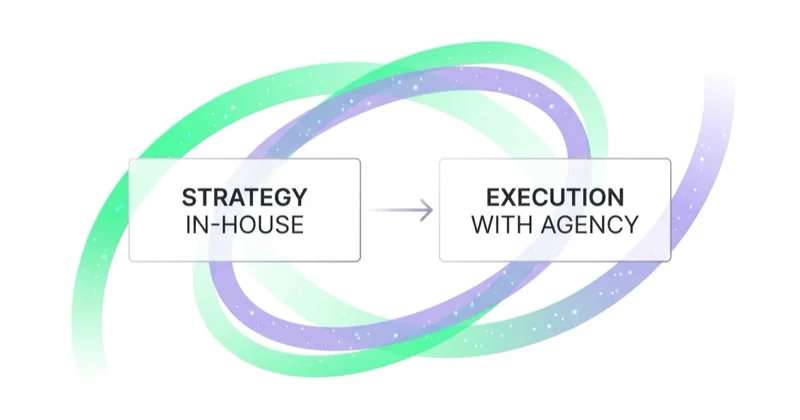
Common setup:
- internal team owns business goals, product priorities, approvals and data;
- agency owns campaign execution, optimization, specialist diagnosis and reporting;
- internal creative or brand team works with agency creative feedback;
- analytics ownership stays internal or jointly governed;
- accounts and data remain owned by the business;
- decision rights are defined clearly.
This gives the company control and context while giving the agency room to bring specialist depth. It works only when ownership is explicit: who decides budgets, who changes tracking, who approves creative, who owns reporting, and what happens if results underperform.
Account and data ownership
Whether you choose agency or in-house, keep ownership of the assets.
The business should own:
- Google Ads account;
- Meta Business portfolio and ad accounts;
- TikTok Ads account;
- pixels, tags and Events API / CAPI setup;
- GA4 and analytics properties;
- Google Merchant Center and product feed;
- landing pages;
- CRM audiences and offline conversion data;
- creative files and usage rights;
- reporting history.
The agency should be granted access, not ownership. This protects history, audiences, learning and offboarding. It also allows a future in-house team to inherit the account without starting over.
Decision scorecard
Use a simple scoring model:
| Criterion | Weight | Agency score | In-house score |
|---|---|---|---|
| Channel complexity | 20% | high if multi-channel | high if simple and stable |
| Data and analytics maturity | 20% | high if specialist repair needed | high if already strong internally |
| Creative and testing needs | 15% | high if volume is missing | high if internal creative team is strong |
| Business context requirement | 15% | medium | high |
| Speed of hiring | 10% | high | low to medium |
| Long-term capability ownership | 10% | medium | high |
| Resilience and cover | 10% | high | depends on team depth |
If agency wins on complexity, analytics and resilience, start there or use a hybrid. If in-house wins on context, scale and capability ownership, build the team. Revisit the decision as spend, channels and team maturity change.
How Space Ads approaches this decision
At Space Ads, we do not treat agency versus in-house as a moral choice. The right model is the one that gives the business better decisions, cleaner data and profitable growth.
When we evaluate an account, we look at ownership, conversion tracking, account structure, channel mix, creative cadence, product feed, CRM feedback, landing pages, margin and reporting. Sometimes the recommendation is full execution under performance marketing. Sometimes it is a marketing audit, consulting for an internal team, or a hybrid where the client keeps strategy and we provide specialist depth across Google Ads, Meta Ads and TikTok Ads.
The goal is not to replace internal knowledge. The goal is to connect it with disciplined paid-media execution.
FAQ
Should I hire a PPC agency or build an in-house team?
Hire a PPC agency if the account is complex, multi-channel, under-optimized, short on specialist depth or limited by tracking, creative, feed or analytics problems. Build in-house if paid media is a stable core function, budget justifies the team, and the company can manage specialists well. Many businesses use a hybrid.
Is an in-house PPC team cheaper than an agency?
Not always. In-house cost includes salary, recruitment, benefits, tools, training, management, creative support, analytics support and key-person risk. Agency cost includes fees and scope, but provides broader capability without hiring every role. Compare capability and outcomes, not salary versus fee alone.
When should I hire a PPC agency?
Hire when spend is meaningful, results have plateaued, the account is expanding into new platforms, tracking is unreliable, creative testing is too slow, the setup has outgrown one person, or leadership needs an independent diagnosis before scaling.
What is a hybrid PPC model?
A hybrid model keeps business strategy, product knowledge and account ownership inside the company while using an agency for execution, optimization, analytics, creative testing or platform expertise. It can combine in-house control with agency depth if decision rights are clear.
How do I keep control if I hire a PPC agency?
Own your ad accounts, pixels, GA4, Merchant Center, CRM audiences and data. Grant the agency access instead of letting it run everything inside agency-owned accounts. Agree reporting, decision rights, escalation rules and offboarding terms before work starts.
When should I not hire a PPC agency yet?
Do not hire for execution until you have a clear business goal, basic economics, enough test budget, a working landing page and conversion tracking. If those are missing, start with an audit or consulting project rather than a long execution retainer.
Key takeaways
- PPC agency vs in-house is a capability decision, not a universal answer.
- In-house gives control and context; agency gives breadth, process and resilience.
- Modern PPC requires clean data, creative, feed quality and landing-page input, not only campaign settings.
- The hybrid model often gives the best mix of ownership and specialist depth.
- Keep account and data ownership inside the business whichever model you choose.
Sources and further reading
- Google Ads Help - About Smart Bidding
- Google Ads Help - About Performance Max campaigns
- Google Ads Help - Manager accounts and access
- Meta Business Help - Business Manager and agency access
Continue learning
Continue reading
What Does a PPC Agency Do? Services, Deliverables and What to Expect
A PPC agency manages paid media as a commercial system: measurement, strategy, campaign build, creative testing, budgets, optimization, landing-page input and reporting. This guide explains what a PPC agency does, what it should deliver, what it usually does not own and how to evaluate one.
ChatGPT Ad Formats and Character Limits: What Actually Fits
A ChatGPT ad appears below the response and carries six elements, with specific limits: title 3–50 characters, body up to 100. The "24 / 48 character" figures in trade coverage do not match the documentation, so this guide gives the full limits table, shows how to fit a useful message, and covers the image, product ads and end-to-end consistency with the landing page.
OpenAI Ads Manager: How to Set Up Your First ChatGPT Ads Campaign
OpenAI Ads Manager has three campaign levels, but launch also requires advertiser verification, billing, landing-page checks, measurement and deliberate choices for settings that cannot be changed later. This guide covers the setup sequence, budgets, context hints, oCPC, targeting, review and Ads API workflows.