The best questions to ask a marketing agency before hiring are not designed to catch the agency out. They are designed to reveal how the agency thinks, measures, communicates and protects the assets your business will depend on.
A polished pitch can hide weak process. A strong case study can hide the fact that a junior team will run the account. A low fee can hide poor analysis, hidden media markups or no work on tracking. The right questions expose the operating system behind the sales deck: who does the work, how results are measured, who owns the data, what happens when performance is weak and how the agency makes decisions with your budget.
This guide gives a practical evaluation framework: the questions to ask a marketing agency, what good answers sound like, what red flags mean, and how to score agencies before signing.
TL;DR
- Start with the business problem, not the channel. A good agency asks about margin, LTV, sales cycle, lead quality, seasonality, data and constraints before recommending a media plan.
- Ask how success will be measured. The answer should distinguish business outcomes from platform metrics and explain attribution limits.
- Ask who actually does the work. The senior person who sells the project may not be the specialist running campaigns, content, analytics or creative.
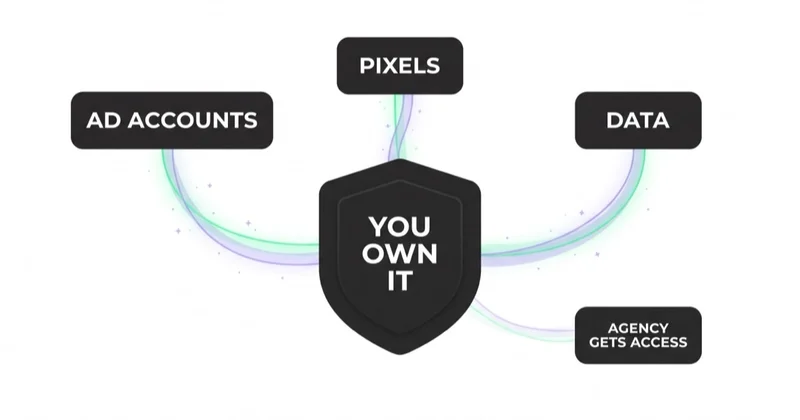
- Insist on account and data ownership. Your business should own ad accounts, analytics, pixels, tags, audiences, creative files, landing pages and historical data.
- Ask how pricing works. Separate media spend from management fees, production, tools, markups and performance bonuses.
- Ask about the first 90 days. A credible agency can explain diagnosis, tracking, priorities, testing and reporting milestones.
- Treat guarantees as a warning sign. Promised rankings, ROAS or lead volumes without assumptions usually signal weak accountability, not confidence.
- Use a scorecard. Comparing agencies against the same criteria reduces the influence of presentation style and sales pressure.
Why these questions matter
Hiring a marketing agency is a decision about budget, data, customer acquisition and operational trust. A strong agency can speed up learning, reduce waste and build a more reliable growth system. A weak agency can spend months optimizing the wrong conversion, reporting vanity metrics and leaving the business without usable account history when the relationship ends.
The risk is amplified because marketing work is often difficult to judge from the outside. It is easy to show dashboards, impressions, clicks and creative examples. It is harder to prove that the work is improving qualified demand, profit, pipeline, sales quality or category growth.
The goal of the evaluation is to learn four things:
| Area | What you need to know |
|---|---|
| Strategic fit | Does the agency understand the business model, buyer journey and economic constraints? |
| Operating quality | Does the agency have a repeatable process for diagnosis, testing, reporting and decision-making? |
| Accountability | Does the agency define success in business terms and explain what happens when results are weak? |
| Risk control | Will the business keep ownership of accounts, data, assets and learnings if the relationship ends? |
If an agency can answer these clearly, the conversation becomes useful. If it cannot, the pitch is carrying too much weight.
Start with your own brief
Before interviewing agencies, prepare a short internal brief. This prevents the conversation from becoming "Which services do you sell?" and keeps it focused on the business outcome.
Clarify:
- the main goal: revenue, qualified leads, profitability, new customer acquisition, market entry, retention or brand demand;
- the acceptable economics: CAC, CPA, CPL, ROAS, MER, contribution margin or payback period;
- the sales cycle and what a qualified lead or profitable order means;
- current channels, spend, conversion rate and main constraints;
- what data is available: GA4, CRM, ecommerce revenue, offline conversions, returns, product margin, call tracking, Search Console, ad accounts;
- internal resources: creative, developers, content, product feed, sales feedback, approvals and leadership time;
- what has been tried before and why it did or did not work.
Good agencies will use this context to ask better questions. Weak agencies will ignore it and sell the same package anyway.
Questions about strategy
These questions reveal whether the agency is diagnosing your growth constraint or simply selling a channel.
| Question | Strong answer | Red flag |
|---|---|---|
| What do you think is the main growth constraint from what you have seen? | Identifies assumptions, asks for data and separates traffic, conversion, offer, tracking and sales issues. | Jumps straight to "more ads," "more content" or "more budget." |
| Which channels would you prioritize first, and why? | Connects channel role to buyer intent, economics and stage of business. | Recommends every channel or only the agency's favorite channel. |
| Which activities would you not do yet? | Shows prioritization and explains opportunity cost. | Refuses to rule anything out because everything is "important." |
| How do you distinguish captured demand from created demand? | Explains brand, non-brand, prospecting, remarketing, organic, direct and assisted demand. | Treats every last-click conversion as created by the channel reporting it. |
| What would need to change outside media buying? | Mentions landing pages, offer clarity, pricing, sales process, feed quality, content, analytics or creative. | Acts as if campaign settings alone can fix every business problem. |
A useful agency is comfortable saying "this depends" and then explaining what it depends on. That is different from vagueness. Good strategy names the constraint, the evidence needed and the sequence of work.
Questions about measurement and attribution
Measurement is where many agency relationships fail. The agency optimizes for one thing, the leadership team expects another, and the reporting never reconciles the gap.
Ask:
- Which KPI will decide whether the partnership is working?
- Which metrics are primary, and which are diagnostic only?
- How will you separate platform-reported performance from business results?
- How will lead quality, sales pipeline, revenue, margin, returns or cancellations be fed back into decisions?
- How will brand and non-brand campaigns be reported?
- How will remarketing, direct traffic and organic search be interpreted?
- What attribution limits should we expect?
- What happens if platform ROAS looks good but total business profitability does not?
- What tracking must be fixed before optimization begins?
Good answers are specific. For ecommerce, the agency should talk about revenue quality, margin, returns, feed health, new versus returning customers and blended performance. For B2B, it should talk about qualified leads, sales acceptance, CRM stages, pipeline, close rate and offline conversion feedback. For local services, it should discuss call quality, booking rate, location intent and missed-call handling.
Be careful with agencies that report only what the ad platform says. Platform data is useful for optimization, but it is not the same as business truth.
Questions about account and data ownership
Account ownership is not a small administrative detail. It decides whether your business keeps its campaign history, conversion data, audiences, pixels, assets and learnings when the relationship ends.
Ask:
- Who will own the Google Ads, Meta, TikTok, LinkedIn, Merchant Center, GA4, Search Console, tag manager, pixels and product feeds?
- Will the agency work inside our accounts with granted access, or create accounts under its own ownership?
- Who will have admin rights?
- Can access be removed if the contract ends?
- What happens to audiences, conversion events, creative files, landing pages, dashboards and documentation?
- Will campaign naming, tracking conventions and documentation be understandable to a future team?
- Are there any tools, dashboards or scripts that stop working after termination?
For Google Ads, agencies can use manager accounts to manage several client accounts from one dashboard while client accounts remain separate. That is a normal access model. The business does not need to lose control of its own ad account just because an agency manages it.
The safest default is simple: the business owns the accounts and data; the agency receives the access needed to work; offboarding is documented before work starts.
Questions about the team
The people in the sales meeting may not be the people responsible for delivery. Ask until the delivery model is clear.
Ask:
- Who will be the strategist, account lead and day-to-day specialist?
- What is each person's role?
- How many accounts does the day-to-day specialist manage?
- How often will senior review happen?
- What work is done in-house and what is subcontracted?
- What experience does the team have with a similar business model, not only a similar industry?
- Who handles analytics, creative, content, feed work, CRO and landing page recommendations?
- What happens when the main specialist is unavailable?
Relevant industry experience is useful, but business-model experience is often more important. A team that understands margin, stock, lead quality, sales cycles and data feedback can outperform a team that simply lists recognizable logos.
Questions about process and the first 90 days
A credible agency should be able to describe the first 90 days without pretending that every result will be solved in month one.
| Period | What should happen | What you should receive |
|---|---|---|
| Days 0-14 | Access, discovery, tracking review, account audit, analytics audit, website and funnel review | Risk list, missing access list, quick wins, measurement gaps |
| Days 15-30 | Tracking fixes, account cleanup, KPI definition, test plan, reporting setup | Baseline dashboard, prioritized roadmap, first implementation tasks |
| Days 31-60 | Campaign, creative, landing page, feed, SEO or content tests depending on scope | Early data, learning summary, decisions to scale, cut or iterate |
| Days 61-90 | Evaluate direction, refine budget allocation, improve conversion quality, plan next cycle | Performance review, next-quarter plan, unresolved risks |
The details will vary by scope. PPC can generate data faster than SEO. SEO, AEO and content often need more time. B2B sales cycles may not show closed revenue immediately. Still, the first 90 days should show professional control: clear diagnosis, better measurement, visible decisions and fewer unknowns.
Questions about reporting and communication
A report should not be a screenshot collection. It should explain what changed, why it changed, what was learned, what decision follows and where the client needs to act.
Ask:
- How often will reporting happen?
- What will the report include besides channel metrics?
- Will reports separate brand and non-brand, prospecting and remarketing, new and returning customers, or qualified and unqualified leads?
- Will we have live dashboard access?
- How will bad news be communicated?
- Who owns action items after each meeting?
- How will recommendations be documented?
- What is the expected response time for urgent issues and normal questions?
Good communication does not require constant meetings. It requires predictable cadence, useful analysis, fast escalation and clear ownership of decisions.
Questions about pricing and contract terms
Agency pricing can be fair in several models: flat retainer, percentage of media spend, project fee, performance bonus or a hybrid. The issue is not the model itself. The issue is whether incentives and costs are transparent.
Ask:
- What exactly is included in the fee?
- What is excluded?
- How much of the budget goes to media versus management?
- Are there markups on media, tools, influencers, production, landing pages or creative?
- Does the fee increase automatically when media spend increases?
- How are one-off projects priced?
- What is the minimum contract length?
- What is the notice period?
- What does offboarding include?
- Are there exclusivity, non-compete or asset ownership clauses?
A low fee can be expensive if it buys little senior time and no analytics work. A higher fee can be efficient if it includes strategy, measurement, creative testing, technical input and senior review. Compare capability and incentive alignment, not only monthly price.
Questions about AI, SEO and content claims
Marketing agencies increasingly sell AI, AEO, GEO and LLM SEO services. Some of this work is valuable. Some of it is rebranded SEO with inflated claims.
Ask:
- How do your AI, AEO or GEO recommendations align with official search engine guidance?
- What is the difference between SEO, AEO and LLM visibility in your process?
- What content formats are built for users, and which are built for search or answer engines?
- How do you avoid publishing generic AI content that weakens trust?
- How do you use expert input, sources and updates?
- How do you measure content when it assists conversion through another channel?
- Do you guarantee AI citations, rankings or traffic?
Google's own guidance on hiring SEO providers warns against guaranteed rankings and secretive methods. That principle applies even more strongly to AI search claims. A serious agency can explain what it controls: content quality, crawlability, structure, entity clarity, sources, internal links, authority signals and measurement. It will not pretend to control every answer engine.
Questions about case studies and proof
Case studies matter, but only if they explain context.
Ask:
- What was the starting point?
- What was the scope of your responsibility?
- What changed in the account, website, offer, creative, tracking or sales process?
- Which metric improved, and over what period?
- Were results platform-reported or reconciled to revenue or CRM?
- What was the budget range?
- What constraints did the client have?
- Can you share a reference or anonymized example with enough detail to evaluate the work?
Be careful with isolated percentage lifts. A 200% increase from a tiny baseline may be less meaningful than a 12% improvement in a mature account with strong margin control. Good proof explains the operating problem and the mechanism of improvement.
Agency scorecard
Use the same scorecard for every agency. Adjust weights to your situation, but keep the scoring consistent.
| Criterion | Weight | Strong signal |
|---|---|---|
| Business understanding | 20% | Asks about margin, LTV, sales cycle, lead quality, stock, seasonality and constraints |
| Measurement quality | 20% | Defines KPIs, data sources, attribution limits and tracking fixes |
| Team and process | 15% | Clear roles, senior review, first 90-day plan and quality control |
| Relevant proof | 15% | Case studies match business model or problem, not only industry labels |
| Ownership and transparency | 15% | Client owns accounts, data and assets; media and fees are separate |
| Recommendation quality | 10% | Prioritized plan with trade-offs, risks and activities not recommended yet |
| Contract terms | 5% | Reasonable notice, clear offboarding and no unnecessary lock-in |
Score each area from 1 to 5. Then write one sentence explaining the score. The sentence matters more than the number because it forces the evaluation team to name the evidence.
Red flags
| Red flag | Why it matters | Better standard |
|---|---|---|
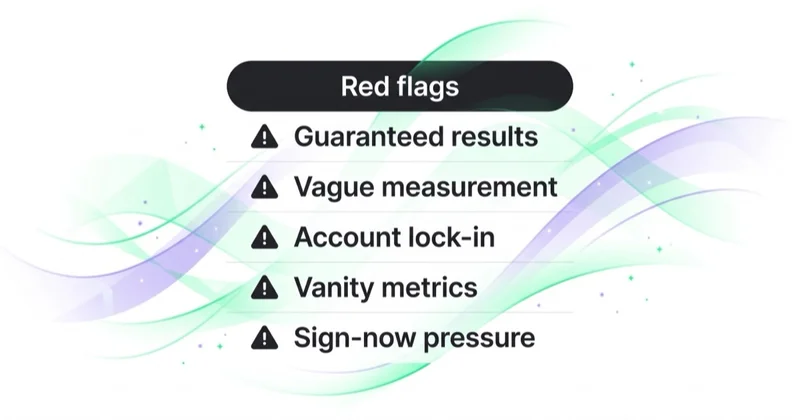
| Guaranteed ROAS, rankings or lead volume | Real performance depends on demand, offer, auction, site, data and sales process | Forecasts with assumptions, ranges and test plans |
| Vague measurement | The agency can report activity without proving business impact | Clear KPI definitions and data sources |
| Agency-owned accounts | You risk losing history, audiences, pixels and learnings | Client-owned accounts with agency access |
| Vanity-metric reporting | Impressions, clicks and likes can hide poor conversion quality | Leads, revenue, margin, qualified pipeline and customer value |
| Hidden markups | The business cannot see how much budget reaches media | Separate media, management, production and tool costs |
| Unknown delivery team | Senior sales may hide junior execution | Named roles, senior review and capacity clarity |
| Ready-made plan before diagnosis | The agency is selling a package, not solving the constraint | Audit, hypotheses and prioritized roadmap |
| Pressure to sign quickly | Urgency replaces substance | Time to review access, terms, scope and risks |
| Secret methods | You remain responsible for tactics you do not understand | Transparent recommendations and documented changes |
A red flag does not always mean the agency is disqualified. It means the explanation must be strong. If the explanation is evasive, the risk is real.
When not to hire an agency yet
Sometimes the best decision is to delay the retainer and fix the foundations first.
Do not rush into agency management if:
- no one can define the acceptable cost of acquisition;
- conversion tracking is broken and no one is willing to fix it;
- the landing page or checkout cannot convert qualified traffic;
- the sales team cannot process or qualify leads;
- the product, price or offer is not clear;
- leadership will not approve creative, page, feed or analytics changes;
- the budget covers media spend but not the learning required to improve it;
- internal ownership of decisions is missing.
In these cases, a marketing audit or shorter diagnostic project can be safer than a long contract. The output should be a decision: hire, delay, fix foundations, build in-house, or choose a narrower specialist.
How Space Ads approaches agency evaluation
At Space Ads, we prefer these questions early because they create a better partnership. The first conversation should not be about selling a channel. It should clarify the business model, target customer, margin, measurement quality, funnel constraints, account ownership and the speed at which the company needs results.
Our default operating principles are straightforward:
- the client should own accounts, pixels, analytics and data;
- reporting should connect platform data with business outcomes;
- media spend, management fees and additional production costs should be transparent;
- strategy should explain what will not be done yet, not only what could be done;
- weak performance should trigger diagnosis, not excuses;
- paid media, content, CRO and analytics should work from the same definition of valuable demand.
This is the same logic behind our performance marketing, Google Ads, fractional CMO, marketing agency and marketing audit work. If a prospect asks hard questions about measurement, ownership and decision-making, the collaboration usually starts in a healthier place.
Common mistakes when hiring an agency
- Choosing only by price. The cheapest retainer can be expensive if it buys little analysis, weak tracking and no senior attention.
- Judging only by the pitch. A good presentation does not prove daily delivery quality.
- Skipping account ownership. The risk appears later, when switching agencies becomes painful.
- Accepting vague KPIs. Without a shared definition of success, every report becomes negotiable.
- Buying channels instead of solving constraints. Google Ads, SEO, Meta, TikTok or content work only when they fit demand, economics and execution capacity.
- Signing a long lock-in before diagnosis. A diagnostic phase reduces the cost of a wrong partner.
- Believing guarantees. Guaranteed rankings, ROAS or lead volume without assumptions usually means oversimplification.
- Ignoring offboarding. A clean exit process is part of a professional relationship, not a sign of mistrust.
FAQ
What questions should I ask a marketing agency before hiring?
Ask how the agency measures success, how attribution will be handled, who will actually do the work, which accounts and data you will own, how reporting works, how pricing is structured, what happens if performance is weak and what the first 90 days will look like. Also ask which activities they would not recommend yet, because that reveals prioritization.
What are red flags when choosing a marketing agency?
Major red flags include guaranteed rankings or ROAS, vague measurement, agency-owned accounts, hidden media markups, unknown delivery teams, reports based only on vanity metrics, pressure to sign quickly and secret methods. The risk is not just poor performance; it is losing time, data and decision clarity.
Should I own my ad accounts if I hire an agency?
Yes. Your business should own its ad accounts, analytics, pixels, tags, product feeds, audiences and historical data. The agency should receive access to manage them. If campaigns run only inside the agency's own accounts, leaving can mean losing history, audiences and learning.
How do I know if a marketing agency is good?
A good agency asks specific questions about your business economics, measurement, sales cycle, data quality and constraints before recommending channels. It explains trade-offs, shows relevant proof, names the delivery team, reports business outcomes and is transparent about account ownership and pricing. It is also willing to say what should not be done yet.
How should I compare marketing agency proposals?
Use a scorecard. Compare business understanding, measurement quality, team and process, relevant proof, account ownership, recommendation quality and contract terms. Score each agency against the same criteria, then write the evidence behind each score. This reduces the influence of presentation style and sales pressure.
What should happen in the first 90 days with a marketing agency?
The first 90 days should usually cover access, discovery, tracking review, audits, KPI definition, reporting setup, priority fixes, first tests and a performance review. Not every channel will show full results in 90 days, especially SEO or long-cycle B2B, but the process should become clearer and the main risks should be documented.
How do marketing agencies charge?
Common models include flat retainers, percentage of media spend, project fees, performance bonuses and hybrids. Each can work if incentives are clear. Ask what is included, what costs extra, whether media spend is separated from fees, whether markups exist and whether the fee changes as spend grows.
Should I choose a full-service agency or a specialist agency?
Choose based on the constraint. Full-service agencies can coordinate broader work across channels, but may be less deep in every discipline. Specialist agencies can be stronger in one area, such as PPC, SEO or creative, but require more coordination. If the company lacks strategic leadership, a fractional CMO vs agency comparison may be useful before choosing the structure.
Key takeaways
- The right questions reveal operating quality, not just sales quality.
- Strong agencies ask about economics, data, constraints and decision-making before channels.
- Account and data ownership should stay with the business.
- Measurement should connect marketing activity with revenue, lead quality, margin or pipeline.
- Pricing should separate media, fees, tools, production and markups.
- A scorecard and diagnostic phase reduce the risk of choosing the wrong agency.
Sources and further reading
- U.S. Federal Trade Commission - Advertising and marketing basics
- Google Ads Help - Manager accounts (MCC) and access
- Google Search Central - Do you need an SEO? Tips for hiring an SEO
- Google Search Central - SEO Starter Guide
Continue learning
Continue reading
How to Choose a Performance Marketing Agency
Choose a performance marketing agency with a defined brief, evidence-based scorecard and clear commercial safeguards. This guide covers team evaluation, measurement, account access, fees, contracts and handover.
How to Tell If Your Marketing Agency Is Doing a Good Job
Evaluate an existing marketing agency with an agreed scorecard covering business impact, measurement quality, decisions, delivery, access, communication and commercial governance—not dashboard aesthetics.
Marketing Consultant vs Consultancy vs Agency: Which One Do You Need?
Use this when the business knows marketing is under-led but the buying category is fuzzy. The guide translates consultant, consultancy, agency and fractional CMO into practical differences around advice, ownership and execution so the next hire matches the real gap.