A marketing consultant is an individual expert you hire for advice and direction; a marketing consultancy is a firm of them; and a marketing agency is a team that executes the work — runs the ads, builds the campaigns, manages the channels. The difference that actually matters, though, isn't the label. It's where each sits on a spectrum from advice to ownership to execution: a consultant advises and hands it back, an agency executes a brief it's given, and a fractional CMO sits in between by owning the strategy and — in the operator-advisory model — running the accounts too. This guide untangles the terms and shows which one fits which problem.
TL;DR
- Marketing consultant = an individual who advises on strategy and direction, then hands it back to you to execute.
- Marketing consultancy = a firm of consultants; same advice-led model, more people and process.
- Marketing agency = a team that executes — runs the channels, builds the work — within the strategy it's given.
- The real axis is advice → ownership → execution. Consultants advise; agencies execute; the gap is owning the strategy and seeing it through.
- A fractional CMO closes that gap — it owns the direction and, in the operator-advisory form, runs the accounts, so advice doesn't die at the handover.
- Choose by what's missing: a plan (consultant), hands to run a channel (agency), or someone to own the outcome end to end (fractional CMO).
The terms, defined
The words get used loosely, so here's the clean version:
| Term | What it is | What you get | What you don't |
|---|---|---|---|
| Marketing consultant | An individual expert | Advice, diagnosis, a plan, direction | They rarely execute it for you |
| Marketing consultancy | A firm of consultants | The same, with more capacity and process | Usually still advice-led, not hands-on delivery |
| Marketing agency | An execution team | Channels run, campaigns built, work delivered | They don't own your overall strategy |
| Fractional CMO | A part-time senior leader | Strategy owned + (operator-advisory) accounts run | A full-time executive's total bandwidth |
| Freelancer | An individual specialist | One task or channel, done | Strategy, breadth, ownership |
The axis that actually matters
Forget the labels for a second. Every option above is really a position on one line:
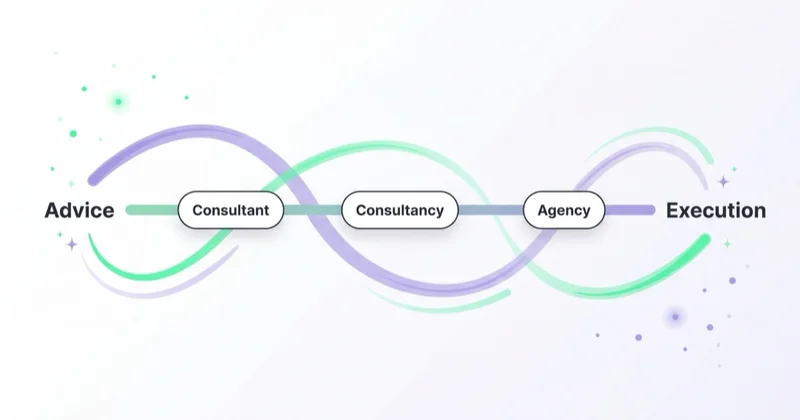
Advice → Ownership → Execution.
- A consultant lives at the advice end. They diagnose and recommend, then leave the doing to you. The value is the thinking; the risk is that a brilliant plan with no one to execute it changes nothing.
- An agency lives at the execution end. They do the work — well — within the brief they're handed. The value is delivery; the risk is that they optimise within a strategy nobody senior is actually owning.
- The middle — ownership — is where most companies have a gap and don't realise it. Someone has to own whether the strategy is right and whether it's being executed against. That's the seat a consultant vacates when they leave and an agency was never hired to fill.
Naming which end you're missing is the whole decision. A plan you can't execute and execution with no plan fail the same way: the advice and the doing aren't connected by ownership.
What a marketing consultant actually does
A marketing consultant is hired for judgement, not hands. Typically they: audit what's happening, diagnose why results are what they are, recommend a strategy or fix, and sometimes help you hire or brief whoever executes it. The good ones are worth their fee in a single reframed assumption. The structural limit is delivery: a consultant's recommendations are only as good as the team that picks them up — and if that team doesn't exist or isn't aligned, the report becomes shelfware.
That's not a knock on consultants; it's a reason to be honest about what you're buying. If you have a capable execution layer that just needs direction, a consultant (or consultancy) is efficient. If you don't, you're buying a plan with no one to run it.
Consultant vs agency: the core comparison
This is the comparison most people are really asking about. A consultant tells you what to do and why; an agency does it. They're not competitors — they're different halves of the same job. Problems arise when you hire one expecting the other: a consultant won't run your campaigns, and an agency won't tell you your whole channel strategy is wrong (it'll execute the brief you gave it).
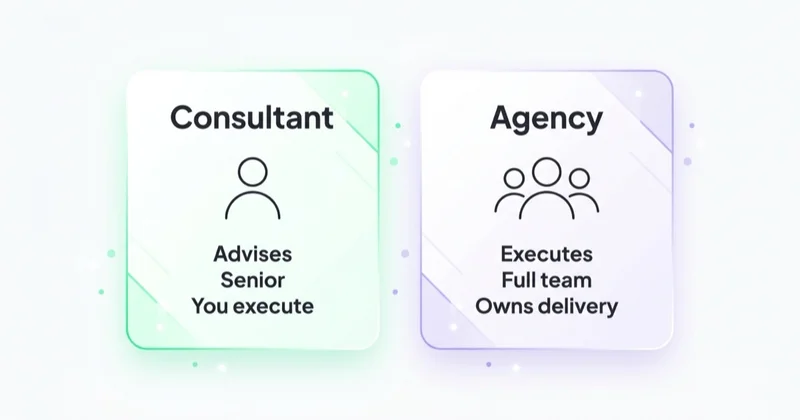
The practical test: is your bottleneck knowing what to do, or getting it done? Advice gap → consultant/consultancy. Execution gap → agency. Both at once → you need the ownership layer between them.
Where a fractional CMO fits
A fractional CMO is the ownership layer. Unlike a consultant, it doesn't hand the strategy back and leave; unlike an agency, it owns the strategy rather than just executing a brief. In the operator-advisory model, the same partner sets the direction and runs the accounts — collapsing advice, ownership and execution into one accountable engagement, with no gap at the handover.
That's the difference worth paying for when your problem is the middle of the spectrum: not "I need a plan" or "I need hands," but "I need someone to own the outcome end to end." For the full treatment, see our guide to what a fractional CMO is and the operator-advisory engagement itself.
How to choose
- Hire a marketing consultant / consultancy when you have a capable execution layer and the gap is direction — you need the plan, not the hands.
- Hire a marketing agency when the strategy is set and the gap is execution — you need a channel run well.
- Hire a freelancer when the need is one specific task or channel, time-boxed.
- Hire a fractional CMO when the gap is ownership — you need someone to own the strategy and see it executed, faster and cheaper than a full-time CMO.
Match the hire to the missing piece. The most expensive mistake is buying advice when you needed execution, or execution when nobody owns the strategy.
How we approach this at Space Ads
Across the 25+ accounts we audit daily, the most common and costly pattern is a disconnected middle: a consultant's strategy that no one executed against, or an agency executing hard against a strategy no one senior owns. We reconcile platform-reported numbers against business data because that gap usually shows up where advice becomes account structure, measurement, creative priorities and budget allocation. Closing it is less about hiring a better consultant or a better agency than about putting ownership in one place. That's the case for operator-advisory, and what our fractional CMO engagement is built around.
FAQ
What's the difference between a marketing consultant and a marketing agency?
A marketing consultant advises — they diagnose, recommend a strategy, and hand it back for you to execute. A marketing agency executes — it runs the channels and builds the work within the brief it's given. They're complementary halves of the same job: the consultant decides what to do, the agency does it. The gap between them is ownership of whether the strategy is right and whether it's actually being delivered.
Is a marketing consultancy the same as an agency?
No. A consultancy is a firm of consultants — advice-led, focused on strategy and direction — while an agency is an execution team that delivers the work. Some firms blur the line by offering both, but the core distinction holds: a consultancy's product is thinking; an agency's product is delivery.
Do I need a marketing consultant or a fractional CMO?
A consultant if you need a plan and already have a capable team to execute it. A fractional CMO if you need someone to own the strategy and see it through — including running the accounts, in the operator-advisory model — rather than handing a report back. The fractional CMO is the consultant who doesn't leave at the handover.
What does a marketing consultant cost vs an agency?
They're priced for different jobs, so comparing them directly is a category error. Consultants charge for advice (day rates or project fees); agencies charge for execution (retainers or percentage of spend). The right question isn't which is cheaper, but which gap you're filling — direction or delivery.
Can one firm be a consultant and an agency?
Yes, and that hybrid is essentially what a fractional CMO (operator-advisory) is: it provides the strategic direction of a consultant and the execution of an agency, owned by the same people. The benefit is no handover gap; the thing to check is that the firm is genuinely senior on strategy, not an agency using "consulting" as a label.
In short
- Consultant = advice; consultancy = a firm of advisors; agency = execution.
- The label matters less than the position on the advice → ownership → execution axis.
- The common gap is the middle — ownership of whether the strategy is right and being executed.
- A fractional CMO fills that gap; operator-advisory collapses advice, ownership and execution into one.
- Choose by what's missing: a plan, hands, or end-to-end ownership.
Sources and further reading
- Space Ads — What is a fractional CMO — and when not to hire one
- Space Ads — Fractional CMO vs agency vs full-time CMO
- Space Ads — Fractional CMO engagement (operator-advisory)
Continue learning
Continue reading
Fractional CMO vs Marketing Agency vs Full-Time CMO: How to Choose
The real decision is not a job title; it is what kind of marketing leadership gap you have. This guide compares the three options by ownership, cost, speed, risk and execution depth so you can decide whether to buy strategy, hands-on channel delivery or a permanent executive role.
What Is a Fractional CMO — and When You Should NOT Hire One
A fractional CMO can close a senior leadership gap without a permanent executive hire — but only when the mandate, authority and delivery capacity are clear. Use this guide to decide whether you need fractional leadership, an interim CMO, an agency, a consultant or an in-house hire.
How Much Does a Fractional CMO Cost? (Real Ranges and Pricing Models)
Pricing only makes sense once the scope and incentive model are visible. This guide gives realistic monthly ranges, explains why retainers, day rates and percentage-of-spend fees push different behaviours, and shows what a useful first engagement should include.