Choosing between a fractional CMO, a marketing agency and a full-time CMO is rarely a straight either/or — most growing companies end up combining two of the three. The short version: hire an agency when the strategy is set and you need a channel executed well; hire a full-time CMO when your spend and team are large and stable enough to justify a permanent six-figure executive; and bring in a fractional CMO when you need senior direction now, without a four-year bet — ideally one who also runs the accounts rather than just advising. This guide is the decision framework, the cost math, and the situations where each one actually wins.
TL;DR
- It's usually "which two," not "which one." A fractional CMO sets direction; an agency or in-house team executes; a full-time CMO eventually replaces the fractional one. Most growth-stage companies run a combination.
- Cost is the clearest divider. A full-time CMO runs ~$150k–$570k/year loaded; an agency is a retainer or % of spend; a fractional CMO is ~$3k–$20k/month — senior judgement without the salary line.
- Agencies execute a channel; they don't own the strategy. If your positioning, budget split and measurement are already right, you need execution, not a CMO.
- A full-time CMO only makes sense once the spend and team justify it — and even then it's a ~4-year bet that takes months to land.
- A fractional CMO is the fastest, most reversible way to get senior direction — strongest when it's operator-advisory (sets the strategy and runs the accounts).
- Decide by bottleneck: direction → fractional; channel execution → agency; scale + permanence → full-time. Match the hire to the gap, not the title to the trend.
The real question
The framing "fractional CMO vs agency vs full-time" makes it sound like you pick one and rule out the others. In practice, that's not how growing companies operate — and treating it as a three-way cage match leads to the wrong hire.
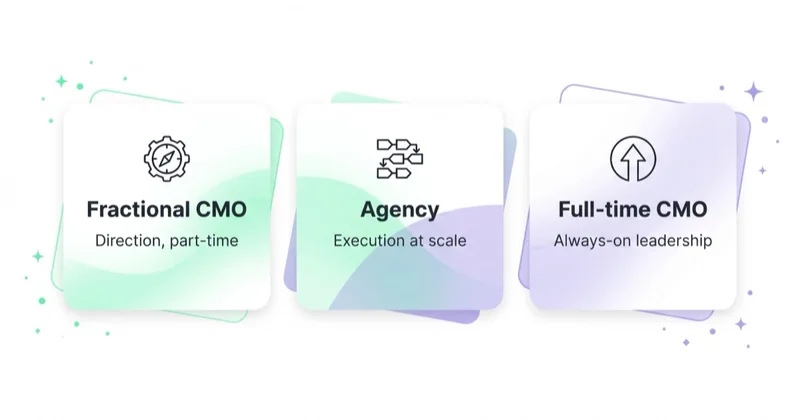
Here's the truer picture. These three solve different problems: a fractional CMO solves direction (where to play, how to allocate, what "working" means); an agency solves channel execution (running Google or Meta well); a full-time CMO solves permanent, full-bandwidth leadership at scale. You can have a gap in one, two, or all three — and the right answer is to fill the gaps you actually have.
Most companies in the awkward middle — past founder-led marketing, not yet at full-exec scale — have a direction gap and an execution gap at the same time. That's why the most common real-world setup isn't "one of three." It's a fractional CMO setting direction plus an agency or in-house team executing under it — until spend and complexity grow enough to justify a full-time CMO, at which point the fractional one has often built the function the full-timer inherits.
So the question to answer first isn't "which of the three?" It's "which gaps do I have?"
What each one actually is
Briefly, because the distinction drives everything (the full "what is a fractional CMO" treatment is in our pillar guide):
- Full-time CMO — a permanent executive who owns the entire marketing function: strategy, team, budget, board reporting. Maximum bandwidth and ownership; maximum cost and commitment.
- Marketing agency — an outside team that executes a channel (or a few) within a brief you set. Broad channel expertise, elastic capacity, but it doesn't own your strategy or your budget split across channels.
- Fractional CMO — a senior marketing leader part-time, owning the strategy and (in the operator-advisory model) running the accounts too. Executive judgement, fast and reversible, at a fraction of the cost.
The cost math
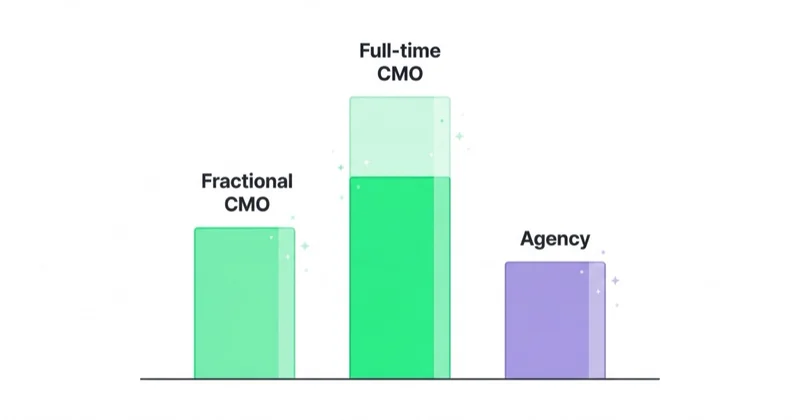
Cost is where the decision gets concrete, and it's the comparison most articles wave at without numbers. Annualised, roughly:
| Option | Typical annual cost | What you get | Commitment |
|---|---|---|---|
| Full-time CMO | ~$150k–$570k (loaded: salary, equity, overhead) | Full-bandwidth permanent leadership + a team to build | High — hiring process + ~4-year bet |
| Marketing agency | Retainer (often low-to-mid five figures/yr per channel) or 10–20% of ad spend | Channel execution, tools, benchmarks | Medium — contract, often 6–12 months |
| Fractional CMO | ~$36k–$240k ($3k–$20k/month by depth) | Senior direction; operator-advisory adds execution | Low — monthly, often starts with a fixed-scope diagnostic |
Two things the table makes obvious. First, the fractional CMO isn't "cheap leadership" — at the deep end it approaches a junior full-time salary — it's right-sized leadership: you buy the share of an executive you actually need. Second, the percentage-of-spend agency model has a hidden cost: it rises with your budget whether or not the extra spend is efficient, and it quietly rewards your agency for spending more of your money. A fractional CMO on a flat retainer has no such incentive — which is one reason the direction layer and the execution layer are often better held by different commercial models.
Decide by situation
Skip the generic advice and match the situation to the move:
| Where you are | The gap | The move |
|---|---|---|
| Founder still runs marketing; small, single-channel spend | Execution capacity | A specialist or a lean agency. Not a CMO yet. |
| Strategy is clear; you need a channel run well | Channel execution | An agency or a specialist hire. |
| Spend is meaningful; no one owns the cross-channel strategy | Direction | A fractional CMO — ideally operator-advisory. |
| Growth plateaued; dashboard and P&L disagree | Direction + measurement | A fractional CMO to rebuild the system. |
| Multiple channels, growing team, marketing is core to the model | Permanent leadership | A full-time CMO (a fractional one can bridge and hire for it). |
| Need senior judgement now, can't wait to hire | Speed | A fractional or interim CMO — live in days, not months. |
The throughline: hire against the bottleneck, not against the trend. "Fractional CMO" is having a moment, which is exactly when companies hire one to fix a problem it doesn't solve — a capacity or execution gap dressed up as a strategy gap.
When each one wins
The agency wins when your direction is sound and your need is depth in a channel — a feed rebuilt, creative volume, bidding operated daily. It's the most efficient way to buy execution and benchmarks without hiring, and it flexes with seasons and drops. Its limit is the brief: an agency optimises within the strategy it's handed; it won't tell you the strategy is wrong.
The full-time CMO wins when marketing is central to the business, spend and team are large and stable, and you need someone permanent owning the function and sitting at the leadership table full-time. The cost and the hiring timeline only make sense at that scale — and CMO tenure data (around four years on average) is a reminder to treat even the permanent hire as a finite bet.
The fractional CMO wins in the middle — when you need executive direction faster, cheaper and more reversibly than a full-time hire allows, and you want it without a 12-month agency lock-in. It wins hardest in the operator-advisory form: a leader who sets the strategy and runs the accounts, so the plan is executed by the person accountable for it rather than handed to someone else.
The hybrid reality (what most companies actually do)
The cleanest setups we see aren't pure. They're combinations, sequenced to the stage:
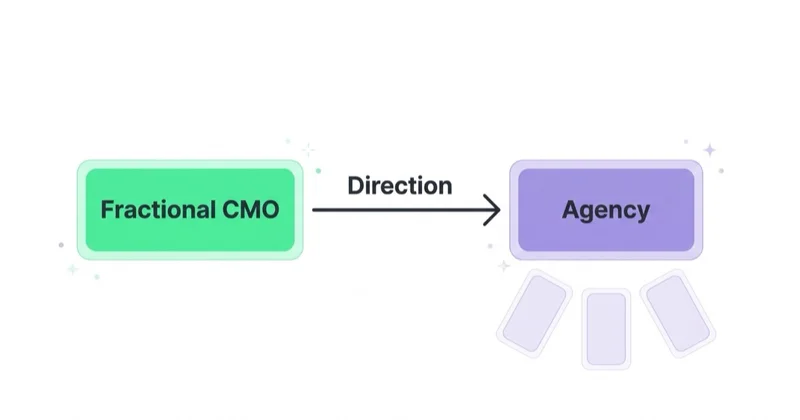
- Fractional CMO + agency/in-house executors — the CMO owns direction and measurement; the agency or team runs the channels under it. This covers the direction-and-execution double gap most growth-stage companies have.
- Fractional CMO → full-time CMO — the fractional leader builds the function, sets the measurement, and often helps hire the permanent CMO who inherits a working system instead of a blank page.
- Operator-advisory fractional CMO (no separate agency) — when the same partner sets the strategy and runs the accounts, you collapse the direction and execution layers into one accountable engagement. Fewer handoffs, one owner of the outcome.
Choosing "one of three" is the mistake. Sequencing the right combination for your stage is the decision.
How we approach this at Space Ads
We run daily audits across 25+ client accounts and analyse roughly 14 million data points a month through Space Ads OS — and the recurring failure isn't a bad choice between these three. It's a missing layer: an agency executing with no one owning whether the strategy is right, or a full-time hire managing a team while the account-level economics drift.
That gap sits exactly between "strategy" and "execution," which is why our model holds both. We reconcile platform-reported numbers against GA4, ecommerce or CRM data, and the business's actual commercial constraints, then keep the account work aligned with the strategy instead of handing the plan to another team and hoping it survives. Public work such as Philipp Plein, GP Batteries and Embassy London shows the same principle across different categories: one operating owner for direction, channel decisions, measurement and reporting. If that combination is what you're weighing, that's what our fractional CMO engagement is built around.
Common mistakes
- Choosing one when you need two. The direction gap and the execution gap are different; filling one leaves the other open.
- Deciding on cost alone. The cheapest option that doesn't fix your actual bottleneck is the most expensive one.
- Hiring a full-time CMO too early. A permanent six-figure executive before the spend and team justify it is a slow, expensive way to learn you needed a fractional one.
- Expecting an agency to set strategy. It executes a brief; it won't own whether the brief is right.
- Defaulting to the trend. "Fractional CMO" is popular right now — which is exactly when it gets hired for problems it doesn't solve.
FAQ
What's the difference between a fractional CMO and a marketing agency?
A fractional CMO owns the marketing strategy — positioning, budget allocation across channels, measurement — and decides what the agency should even be doing. A marketing agency executes a channel within the brief it's given. They're often complementary: the fractional CMO sets direction, the agency executes under it. The strongest model combines both in one engagement (operator-advisory), where the same partner sets the strategy and runs the accounts.
Fractional CMO vs full-time CMO — which should I hire?
Hire a full-time CMO when marketing is central to the business and your spend and team are large and stable enough to justify a permanent six-figure executive who owns the whole function. Hire a fractional CMO when you need senior direction now — faster, cheaper and more reversibly than a full-time hire — or as a bridge that builds the function (and often helps recruit) before a permanent CMO takes over.
Can you use a fractional CMO and an agency at the same time?
Yes — it's one of the most common and effective setups. The fractional CMO owns strategy, budget allocation and measurement; the agency executes the channels under that direction. The combination covers the two gaps most growth-stage companies have at once: senior direction and channel execution. In the operator-advisory model, a single partner covers both, removing the handoff.
Is a fractional CMO cheaper than an agency?
Not necessarily — they're priced for different jobs. A fractional CMO (~$3k–$20k/month) buys senior strategic direction; an agency retainer or percentage-of-spend buys channel execution. Comparing them on price alone is a category error. The relevant question is which gap you're filling: direction, execution, or both.
When is a full-time CMO worth the cost?
When marketing is core to the business model, spend and team are substantial and stable, and you need permanent, full-bandwidth leadership at the table — not part-time direction. Below that threshold, the loaded cost (~$150k–$570k a year) and the months-long hiring process rarely pay off versus a fractional or interim arrangement, especially given that CMO tenure averages around four years.
In short
- It's usually "which two," not "which one" — direction, execution and permanent leadership are different gaps.
- Cost divides them clearly: full-time ~$150k–$570k/yr, agency retainer/%-of-spend, fractional ~$3k–$20k/month.
- Agency = channel execution; full-time CMO = permanent leadership at scale; fractional CMO = senior direction, fast and reversible.
- The most common real setup is a fractional CMO plus executors — or operator-advisory, which collapses both into one owner.
- Decide by your bottleneck, not by the trend.
Sources and further reading
- Spencer Stuart — CMO Tenure Study 2025
- Space Ads — What is a fractional CMO — and when not to hire one
- Space Ads — Fractional CMO engagement (operator-advisory)
Continue learning
Continue reading
Marketing Consultant vs Consultancy vs Agency: Which One Do You Need?
Use this when the business knows marketing is under-led but the buying category is fuzzy. The guide translates consultant, consultancy, agency and fractional CMO into practical differences around advice, ownership and execution so the next hire matches the real gap.
How Much Does a Fractional CMO Cost? (Real Ranges and Pricing Models)
Pricing only makes sense once the scope and incentive model are visible. This guide gives realistic monthly ranges, explains why retainers, day rates and percentage-of-spend fees push different behaviours, and shows what a useful first engagement should include.
What Is a Fractional CMO — and When You Should NOT Hire One
A fractional CMO can close a senior leadership gap without a permanent executive hire — but only when the mandate, authority and delivery capacity are clear. Use this guide to decide whether you need fractional leadership, an interim CMO, an agency, a consultant or an in-house hire.