A PPC agency manages paid advertising so a business can turn media spend into qualified leads, sales, revenue or pipeline instead of just clicks. The work includes measurement, strategy, account structure, campaign management, creative testing, budget allocation, landing-page input, reporting and continuous optimization across platforms such as Google Ads, Meta, TikTok, Microsoft Ads, YouTube, Shopping, Performance Max and retail media.
The important point is that a good PPC agency does not only "run ads." Modern PPC is shaped by automation, conversion data, creative quality, product feeds, landing pages, CRM feedback and business economics. A campaign can have clean settings and still fail if it optimizes toward weak conversions, sends traffic to a poor page or scales products with bad margin.
This guide explains what a PPC agency does, what deliverables to expect, what it usually does not own, how pricing works, and how to evaluate whether an agency is actually creating business value.
TL;DR
- A PPC agency manages paid media end to end. That includes audit, strategy, tracking, campaign build, optimization, creative testing, reporting and budget decisions.
- Measurement comes first. Google Ads and other platforms optimize around conversion signals, so bad tracking can make automation scale the wrong behavior.
- Modern PPC is not only bids and keywords. Creative, feed quality, landing pages, conversion value, CRM data and incrementality now matter as much as account settings.
- A good agency reports business outcomes. Leads, revenue, CAC, ROAS, margin, qualified pipeline and customer quality matter more than impressions or clicks.
- Scope must be explicit. PPC agencies often advise on landing pages, feeds and analytics, but they may not own full SEO, PR, brand strategy or production unless included.
- You should own the accounts and data. The business should own ad accounts, pixels, GA4, tags, audiences and history; the agency should have access.
- A PPC agency is not always the right answer. If the offer, tracking, site, sales process or economics are broken, start with diagnosis before scaling media.
What is a PPC agency?
A PPC agency is a specialist team that plans, runs and improves paid advertising campaigns. PPC stands for pay-per-click, but the term now covers more than literal click-based buying. Paid media campaigns may optimize for impressions, views, leads, purchases, revenue, product sales, app events or customer value.
Typical platforms include:
- Google Search, Shopping, Performance Max, Demand Gen and YouTube;
- Microsoft Advertising;
- Meta Ads across Facebook and Instagram;
- TikTok Ads and TikTok Shop campaigns;
- LinkedIn Ads for B2B;
- Amazon Ads, marketplace ads and retail media;
- remarketing, catalogue ads and lead generation campaigns.
For the broader channel definition, read what is PPC?. For the build-versus-buy decision, read PPC agency vs in-house.
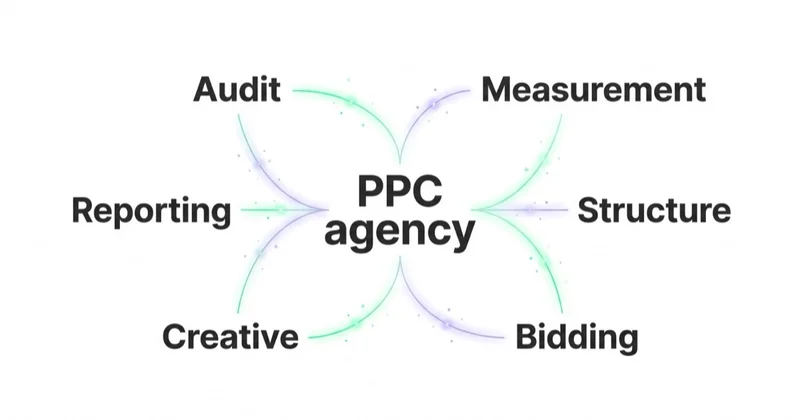
What a PPC agency actually does
1. Audit and diagnosis
Good PPC management starts with diagnosis. Before changing bids or launching new campaigns, the agency should understand:
- business model and unit economics;
- target CPA, CAC, ROAS, MER, pipeline or payback period;
- current campaign structure and historical performance;
- conversion tracking and data quality;
- brand versus non-brand traffic;
- search terms, audiences, placements and creative;
- landing pages, product pages and checkout;
- product feed quality for ecommerce;
- CRM or offline sales feedback for lead generation;
- budget allocation and wasted spend.
The audit should produce priorities, not just a list of observations. A useful marketing audit explains what to fix first, what to test, what to stop and what data is missing.
2. Measurement and conversion tracking
Measurement is one of the highest-value parts of PPC work. Platforms can optimize only toward the signals they receive. If every form fill, accidental call or low-quality lead is treated as a valuable conversion, automated bidding will learn to find more of those easy actions.
A PPC agency may work on:
- conversion actions and event definitions;
- Google Ads conversion tracking;
- GA4 and Google Tag Manager;
- Meta Pixel and Conversions API;
- TikTok Pixel and Events API;
- ecommerce revenue and product IDs;
- call tracking;
- offline conversion imports or CRM feedback;
- enhanced conversions where appropriate;
- deduplication between browser and server events;
- UTMs and analytics naming;
- consent and privacy implementation with the client's technical team.
Google Ads describes conversion measurement as a way to learn which keywords, ads, ad groups and campaigns drive valuable activity, understand ROI and use Smart Bidding toward business goals. That is why tracking quality is not a technical footnote; it is the foundation of performance.
3. Strategy and channel planning
A PPC agency should decide where paid media can actually create value. The plan should answer:
- which channels match buyer intent;
- which campaigns capture existing demand and which create new demand;
- how brand, non-brand, prospecting and remarketing will be separated;
- how budgets will be allocated;
- what a realistic test budget is;
- what landing pages or offers are needed;
- how success will be measured;
- where paid media should not be used yet.
The strongest strategies do not start with "we will run Google, Meta and TikTok." They start with the commercial constraint: not enough qualified demand, high acquisition cost, poor conversion rate, weak tracking, low repeat purchase, product feed issues, seasonal pressure or lack of creative.
4. Campaign build and account structure
The agency builds or restructures campaigns so the account can learn cleanly and spend intentionally.
This may include:
- campaign type selection;
- search campaign structure;
- brand and non-brand separation;
- keyword and negative keyword work;
- Shopping and Performance Max setup;
- product feed segmentation;
- audience and remarketing setup;
- Meta or TikTok campaign architecture;
- location, language, device and schedule settings;
- budget and bidding setup;
- ad copy, assets and extensions;
- landing page mapping;
- naming conventions and documentation.
The structure should fit the goal. A lead generation account with a long sales cycle needs different segmentation from a fashion ecommerce account with hundreds of SKUs and return-risk by product.
5. Creative and ad testing
Creative is now a major PPC lever, especially on Meta, TikTok, YouTube, Demand Gen and Performance Max. An agency may create assets directly, brief a creative team, edit variants or manage a testing process.
The work can include:
- ad copy and search messaging;
- static, video and UGC-style concepts;
- creator or Spark Ads amplification;
- product angle testing;
- offer and CTA tests;
- landing-page headline tests;
- feed-driven creative;
- creative performance analysis by hook, format, audience and product.
For fashion, beauty, ecommerce and DTC, the agency's ability to turn product truth into platform-native creative can matter more than minor bidding changes. For B2B or services, the creative lever may be sharper positioning, proof, problem framing or stronger lead magnets.
6. Ongoing optimization
PPC is not a one-time setup. Auctions, competitors, product availability, search behavior, creative fatigue and platform systems change constantly.
Ongoing work may include:
- search term reviews;
- negative keyword updates;
- budget reallocation;
- bid strategy adjustments;
- creative refreshes;
- product feed improvements;
- campaign experiments;
- landing-page recommendations;
- audience exclusions and remarketing refinement;
- lead quality analysis;
- value-based bidding improvements;
- performance anomaly checks;
- scaling and pruning decisions.
Optimization should not mean random weekly changes. It should mean a disciplined cycle: hypothesis, change, learning period, result, decision.
7. Reporting and communication
Reporting should explain business impact, not only platform activity.
A useful PPC report includes:
- spend by channel, campaign and role;
- primary KPI performance;
- revenue, leads, qualified leads or pipeline where available;
- CPA, CAC, ROAS, MER or margin context;
- brand versus non-brand performance;
- new versus returning customer indicators where possible;
- creative and search-term learnings;
- what changed during the period;
- what will change next;
- what decisions are needed from the client.
Good agencies surface problems early. If tracking is broken, lead quality is poor, stock is limiting scale, the landing page is weak or the target CPA is unrealistic, that should be visible in reporting.
PPC agency deliverables
Common deliverables include:
| Deliverable | What it should contain |
|---|---|
| Account audit | Waste, tracking issues, structure problems, budget allocation, quick wins and risks |
| Measurement plan | Conversion definitions, data sources, events, values, CRM feedback and reporting logic |
| Strategy roadmap | Channel roles, campaign priorities, test plan, budget logic and success metrics |
| Campaign build | Campaigns, ads, keywords, audiences, feeds, conversion goals and QA |
| Creative testing plan | Concepts, angles, formats, refresh cadence and learnings |
| Reporting dashboard | Business KPIs, platform metrics, budget, notes and action items |
| Optimization log | Changes made, why they were made and what happened next |
| Review cadence | Weekly, biweekly or monthly meetings tied to decisions, not just updates |
The exact scope depends on the contract. The important thing is that deliverables are specific enough to evaluate.
What a PPC agency does not usually do
PPC agencies often advise beyond ads, but they may not own every related discipline.
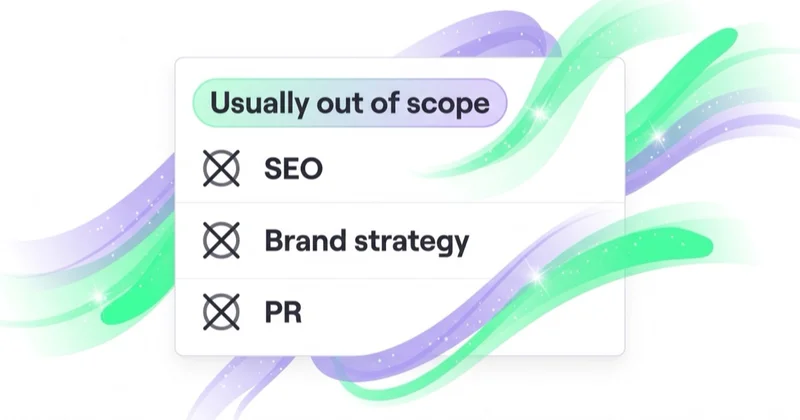
Clarify whether the agency is responsible for:
- full website design and development;
- conversion rate optimization implementation;
- creative production and video shoots;
- SEO and content strategy;
- PR and influencer relations;
- CRM, email and lifecycle marketing;
- sales team process;
- product pricing and margin strategy;
- inventory, fulfilment and customer support.
A PPC agency can diagnose that a landing page is weak. It may not be contracted to rebuild it. It can identify that lead quality is poor. It may not own the sales team's follow-up process. Scope clarity prevents frustration.
If the business needs broader marketing leadership, compare fractional CMO vs agency vs full-time CMO.
What to expect in the first 90 days
| Period | Typical focus | What good looks like |
|---|---|---|
| Days 1-14 | Access, discovery, tracking review, audit | Missing data identified, risks documented, quick fixes prioritized |
| Days 15-30 | Measurement fixes, account cleanup, roadmap, first tests | Cleaner tracking, clear KPIs, campaign priorities and reporting baseline |
| Days 31-60 | Launch or restructure, creative and landing-page tests, search term cleanup | Early learning, fewer waste patterns, clearer budget allocation |
| Days 61-90 | Evaluate results, refine strategy, scale or cut tests | Decisions based on qualified outcomes, not only platform screenshots |
Not every account will show full commercial impact in 90 days. A B2B account with a six-month sales cycle needs more time to prove revenue. An ecommerce account with clean tracking may show product-level learning faster. The first 90 days should at least create clarity: what is working, what is broken, what cannot be judged yet and what the next decision should be.
How PPC agencies charge
Common pricing models:
| Model | Pros | Risks |
|---|---|---|
| Flat retainer | Predictable cost and stable scope | Scope can become too broad if not defined |
| Percentage of media spend | Simple and scales with account size | Can incentivize spending more rather than spending better |
| Project fee | Good for audits, tracking fixes or builds | Does not cover ongoing optimization |
| Performance fee | Aligns to outcomes if measurement is strong | Can distort incentives if the outcome is poorly defined |
| Hybrid | Flexible for complex accounts | Needs clear rules and transparent calculation |
The agency fee is separate from media spend paid to platforms. Ask what is included, what costs extra, whether tools or creative have markups and how the fee changes when spend changes. The questions in questions to ask a marketing agency are useful before signing.
Account and data ownership
The business should normally own:
- Google Ads, Meta, TikTok, LinkedIn and Microsoft Ads accounts;
- GA4, Google Tag Manager and Search Console;
- pixels, conversion APIs and event history;
- Merchant Center and product feeds;
- audiences and customer lists;
- creative assets and landing pages, where produced under contract;
- dashboards, documentation and campaign history.
Agencies can manage Google Ads accounts through manager accounts. Google describes manager accounts as a way for agencies and professionals to view and manage multiple client accounts from one place. That model does not require the client to lose account access or history.
The clean standard is: the client owns the assets, the agency receives access, and offboarding is agreed before the relationship starts.
What a good PPC agency does differently
A strong PPC agency:
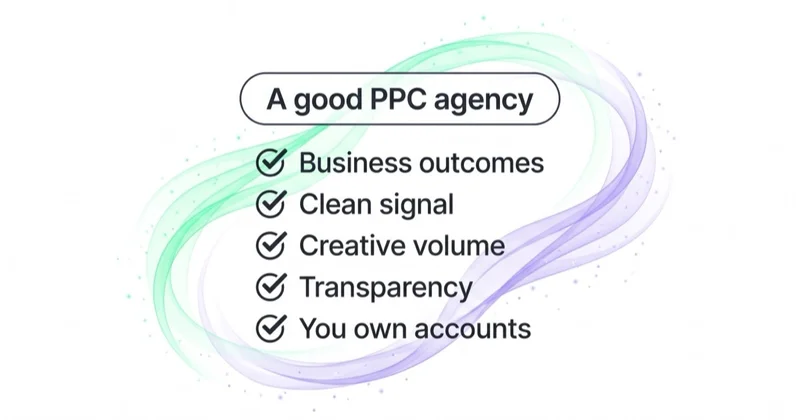
- asks about margin, LTV, sales cycle, returns and lead quality before scaling;
- treats conversion tracking as a performance lever;
- separates brand from non-brand and prospecting from remarketing;
- reports qualified outcomes, not only platform conversions;
- connects paid search, paid social, landing pages, feeds and analytics;
- explains trade-offs instead of promising guaranteed ROAS;
- documents changes and decisions;
- knows when paid media is not the main problem;
- protects account and data ownership.
The weaker version "runs ads" without connecting them to the business. It may still generate clicks, leads or platform ROAS, but the client cannot tell whether the work is improving profitable growth.
How Space Ads approaches PPC agency work
At Space Ads, PPC is managed as part of performance marketing, not as isolated campaign administration. The starting point is always the business outcome: what counts as a valuable conversion, what the economics allow, what the tracking can prove and what constraints outside the ad account are limiting results.
That means the work often begins with:
- verifying conversion tracking and value signals;
- separating useful demand from vanity metrics;
- reviewing campaign structure, feeds, creative and landing pages;
- connecting paid media data with GA4, ecommerce, CRM or sales feedback;
- prioritizing tests by expected business impact;
- reporting the difference between platform performance and commercial performance.
For some accounts, the fastest win is campaign restructuring. For others, it is fixing tracking, landing pages, creative, product feed, lead qualification or budget allocation. The point is to find the constraint before increasing spend. That is the logic behind our Google Ads, performance marketing, TikTok Ads, Meta Ads and marketing audit work.
Common misconceptions
- "A PPC agency is only campaign setup." Setup matters, but most value comes from ongoing measurement, optimization and decision-making.
- "PPC is just Google Ads." PPC now includes paid search, paid social, Shopping, video, marketplace ads and retail media.
- "The agency can fix everything with ads." Paid media cannot repair a weak offer, broken tracking, poor site or bad sales process by itself.
- "Low CPC means good performance." Cheap clicks are useless if they do not become qualified leads or profitable customers.
- "The platform report is the full truth." Platform data must be reconciled with analytics, CRM, ecommerce and finance data.
- "The agency should own the accounts." The business should usually own accounts and data, with the agency granted access.
FAQ
What does a PPC agency do?
A PPC agency plans, runs and optimizes paid advertising campaigns. It audits accounts, sets up tracking, builds campaign structure, manages budgets and bidding, tests creative, reviews search terms and audiences, advises on landing pages, reports performance and makes ongoing decisions to improve qualified leads, sales, revenue or pipeline.
Is a PPC agency the same as a Google Ads agency?
Not always. A Google Ads agency focuses on Google Ads. A PPC agency may manage Google Ads plus Meta, TikTok, Microsoft Ads, LinkedIn, YouTube, Shopping, marketplaces and other paid channels. Some agencies are deep specialists in one platform; others manage a broader paid-media system.
How is a PPC agency different from a freelancer?
A freelancer can be effective for a smaller or simpler account. A PPC agency usually provides broader capability: strategy, measurement, creative, analytics, feed work, peer review, reporting and backup capacity. The right choice depends on account complexity, budget, internal skills and how much specialist depth is needed.
How much does a PPC agency cost?
Costs vary by scope, spend, complexity and pricing model. Common models include a flat monthly retainer, percentage of ad spend, project fee, performance fee or hybrid. The management fee is separate from media spend. Compare total capability, not only the headline monthly fee.
Do PPC agencies create ads?
Many do, but the scope varies. A PPC agency may write search ads, produce basic creative variants, brief designers, edit videos, manage UGC-style tests or advise the internal creative team. Full brand campaigns, photo shoots or video production may be separate unless included in the contract.
Does a PPC agency handle SEO?
Usually not as the core scope. PPC is paid media, while SEO is organic visibility. Some agencies offer both, but they require different skills. A good PPC agency should understand where paid and organic interact; for the broader decision, see PPC vs SEO.
Should I own my ad accounts when using a PPC agency?
Yes. The business should own ad accounts, analytics, pixels, tags, audiences and historical data. The agency should work through granted access. This protects learning, account history and continuity if the relationship ends.
When should I hire a PPC agency?
Hire a PPC agency when paid media is meaningful enough to need specialist attention, results have plateaued, tracking is unreliable, channels are expanding, creative testing is too slow, or internal capacity cannot manage the complexity. If the business goal, tracking, site or offer is unclear, start with an audit before a long retainer.
Key takeaways
- A PPC agency manages paid media as a commercial system, not only campaign settings.
- Measurement, conversion quality and business economics are the foundation.
- Modern PPC depends on creative, data, feeds, landing pages and automation inputs.
- Deliverables should include audit, measurement plan, roadmap, campaign build, optimization and reporting.
- Account and data ownership should stay with the business.
- The best agencies diagnose the constraint before spending more budget.
Sources and further reading
- Google Ads Help - Your guide to Google Ads
- Google Ads Help - About conversion measurement
- Google Ads Help - Manager accounts (MCC)
- Google Ads Help - About consent mode
Continue learning
Continue reading
PPC Agency vs In-House: Which Model Fits Your Stage?
PPC agency vs in-house is a build-versus-buy decision. This guide compares control, cost, expertise, data ownership, platform complexity, hiring risk and hybrid models so you can choose the right setup for paid media.
ChatGPT Ad Formats and Character Limits: What Actually Fits
A ChatGPT ad appears below the response and carries six elements, with specific limits: title 3–50 characters, body up to 100. The "24 / 48 character" figures in trade coverage do not match the documentation, so this guide gives the full limits table, shows how to fit a useful message, and covers the image, product ads and end-to-end consistency with the landing page.
OpenAI Ads Manager: How to Set Up Your First ChatGPT Ads Campaign
OpenAI Ads Manager has three campaign levels, but launch also requires advertiser verification, billing, landing-page checks, measurement and deliberate choices for settings that cannot be changed later. This guide covers the setup sequence, budgets, context hints, oCPC, targeting, review and Ads API workflows.