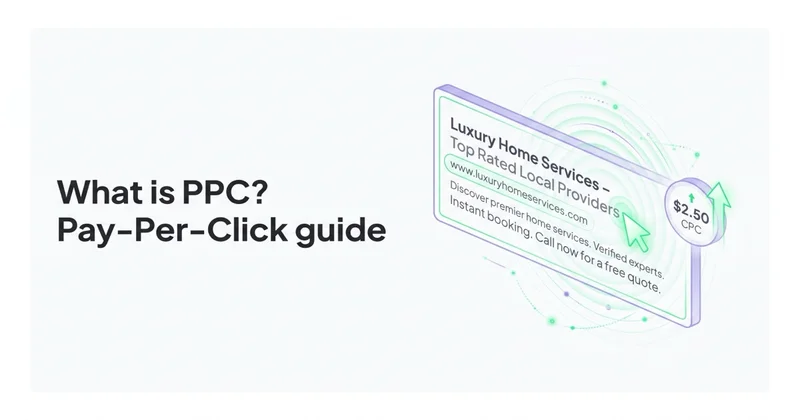
PPC, or pay-per-click advertising, is a paid media model where an advertiser pays when someone clicks an ad. In practice, modern PPC usually means performance advertising across Google Ads, Microsoft Advertising, Meta Ads, TikTok Ads, LinkedIn Ads, Amazon Ads and other auction-based platforms. The goal is not to buy clicks. The goal is to buy profitable attention that turns into sales, leads, revenue or another measurable business outcome.
TL;DR
- PPC means pay per click, but the industry uses the term broadly. Many social and video campaigns are billed by impressions, yet still sit inside a PPC/performance marketing strategy.
- The platform should match the intent. Google Search captures existing demand; Meta, TikTok, YouTube and Demand Gen often create or activate demand.
- Tracking comes before budget. Conversion tags, GA4, UTMs, server-side events and value tracking decide what the algorithms learn.
- Automation is now standard. Smart Bidding, Performance Max, Demand Gen and Advantage+ need clean data, strong assets and clear business constraints.
- Clicks are not success. CPC, CTR and traffic only matter when connected to CPA, ROAS, lead quality, margin, LTV and payback.
- E-commerce PPC depends on feed quality. Product titles, IDs, availability, margins, returns and conversion values can matter as much as ad copy.
- B2B PPC needs lead-quality feedback. Optimizing only for cheap form fills usually creates weak pipeline.
- A PPC budget should be designed around learning. The first budget must be large enough to test intent, creative, landing pages and conversion quality.
What PPC means
PPC stands for pay per click. The classic definition is simple: an advertiser pays when a user clicks an ad. Google Ads still explains online advertising this way for many campaign contexts: the advertiser can set how much they are willing to pay for a click, and may pay less than the maximum bid.
However, the modern use of "PPC" is broader. Agencies and marketers often use PPC to describe auction-based paid digital advertising even when the billing model is CPM, CPV, CPA or value-based Smart Bidding.
That broader usage includes:
- Google Search Ads;
- Google Shopping;
- Performance Max;
- Demand Gen;
- YouTube Ads;
- Microsoft Advertising;
- Meta Ads;
- TikTok Ads;
- LinkedIn Ads;
- Amazon Ads;
- Pinterest Ads;
- Reddit Ads;
- Apple Search Ads.
The shared principle is that spend is measurable and tied to an objective. The advertiser can see impressions, clicks, conversions, cost and value, then optimize based on performance.
PPC billing models
PPC is commonly used as an umbrella term, but the actual billing model can differ by platform and campaign type.
| Billing model | What it means | Common use |
|---|---|---|
| CPC | Cost per click | Search, Shopping, some display and social contexts |
| CPM | Cost per thousand impressions | Paid social, display, awareness, reach |
| CPV | Cost per video view or interaction | YouTube and video campaigns |
| CPA target | Bidding toward a target acquisition cost | Lead generation, sales, app actions |
| ROAS target | Bidding toward a target return on ad spend | Ecommerce and value-based campaigns |
| Maximize conversions/value | Automated bidding toward volume or value | Google Ads and other automated systems |
This matters because a campaign can still be part of PPC strategy even when the platform charges by impression. The commercial question remains the same: what did the spend produce, and was it worth the cost?
PPC vs paid search vs SEO vs paid social
| Term | Meaning | Example |
|---|---|---|
| PPC | Broad performance advertising model, often click-based | Google Ads, Microsoft Ads, paid social campaigns |
| Paid search | Ads shown on search engines for queries | Google Search Ads, Microsoft Search Ads |
| SEO | Organic visibility earned through content, technical and authority work | Ranking a guide without paying per click |
| Paid social | Ads shown inside social platforms | Meta Ads, TikTok Ads, LinkedIn Ads |
| Programmatic/display | Auction-based media across sites and apps | Display, DV360, retargeting banners |
The right channel depends on intent. A person searching "emergency plumber near me" has different intent from someone scrolling TikTok or reading an industry report. A PPC strategy should respect those differences instead of forcing every platform into the same funnel role.
How to choose a PPC channel
Choose the channel by intent, proof format and economics.
| Situation | Strong starting channel | Why |
|---|---|---|
| Users already search for the product or service | Google Search or Microsoft Search | Captures existing demand |
| Product is visual and needs discovery | Meta Ads, TikTok Ads, YouTube, Demand Gen | Creative can create demand |
| Product feed is strong and catalogue matters | Shopping, Performance Max, Meta Catalog Ads | Uses product data at scale |
| B2B audience is defined by job role or company type | LinkedIn Ads, Search, remarketing | Better targeting and intent layering |
| Local urgent service | Search Ads, Maps/local inventory where relevant | High intent and location fit |
| Long consideration cycle | Search, content remarketing, LinkedIn, email | Supports repeated touchpoints |
| Existing traffic but low conversion | CRO, remarketing and landing page work first | Traffic is not the only constraint |
The first channel should not be chosen because it is popular. It should be chosen because it matches how buyers discover, compare and decide.
How PPC auctions work
Most PPC platforms use real-time auctions. When an ad opportunity appears, the platform decides which eligible ads can compete and which ad should be shown.
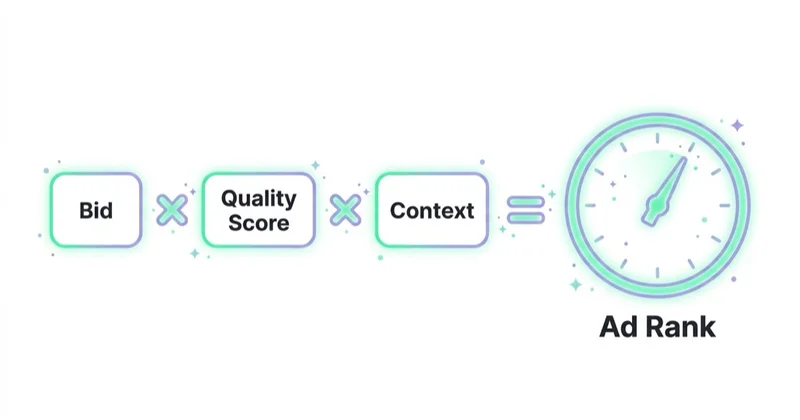
The auction usually considers:
- bid or budget strategy;
- expected action rate;
- ad quality or relevance;
- landing-page experience;
- user context;
- device, location and timing;
- creative asset quality;
- conversion probability;
- advertiser objective;
- policy and eligibility constraints.
The highest bid does not automatically win. Platforms want to show ads that are likely to create value for the user, platform and advertiser. That is why better relevance, better landing pages and stronger conversion data can reduce wasted spend.
Google, Meta and TikTok do not expose every detail of their auction systems. Treat simplified formulas as mental models, not exact operating instructions.
Main PPC channels
Google Ads
Google Ads is usually the first PPC channel for businesses with existing search demand. It covers Search, Shopping, Display, YouTube, Demand Gen, App campaigns and Performance Max. Google describes Performance Max as a goal-based campaign type that can access Google Ads inventory from a single campaign.
Best fit:
- high-intent search queries;
- local services;
- e-commerce products;
- B2B categories with search demand;
- remarketing;
- YouTube and upper-funnel demand generation.
Main risk:
- expensive clicks without conversion tracking;
- poor landing pages;
- weak product feed;
- Performance Max running without business guardrails.
Microsoft Advertising
Microsoft Advertising can be valuable when the audience overlaps with Bing, Edge, Windows, Outlook, LinkedIn profile data or business users. It is often less competitive than Google in some categories, but volume is usually smaller.
Best fit:
- B2B and professional services;
- finance, SaaS and enterprise categories;
- incremental search coverage;
- lower-competition keyword testing.
Meta Ads
Meta Ads includes Facebook, Instagram, Messenger and related placements. It is usually not "pay per click" in the strict billing sense, but it is commonly managed as part of a PPC program.
Best fit:
- demand creation;
- visual products;
- e-commerce prospecting and retargeting;
- lead generation;
- creative testing;
- broad audience discovery.
Main risk:
- weak creative;
- poor Conversions API setup;
- over-crediting platform ROAS;
- optimizing for cheap leads instead of qualified outcomes.
TikTok Ads
TikTok Ads works best when the creative matches native platform behavior. It is less forgiving of generic brand assets and often depends on strong short-form video, creator-style content and fast creative iteration.
Best fit:
- visual consumer products;
- creator-led campaigns;
- Spark Ads;
- product discovery;
- reach and consideration;
- younger or trend-sensitive audiences.
LinkedIn Ads
LinkedIn is usually expensive on a click basis, but it can work when the audience value is high and the targeting is precise.
Best fit:
- B2B SaaS;
- enterprise services;
- webinars;
- white papers;
- account-based marketing;
- senior decision-maker targeting.
Main risk:
- judging the channel only by last-click conversions;
- sending expensive clicks to weak landing pages;
- optimizing for lead volume instead of lead quality.
PPC metrics that matter
| Metric | What it shows | Main risk |
|---|---|---|
| Impressions | How often ads were shown | Reach without relevance |
| CTR | How often impressions become clicks | Clickbait can inflate it |
| CPC | Average cost per click | Cheap clicks can be low quality |
| Conversion rate | Clicks that become conversions | Bad tracking can distort it |
| CPA | Cost per acquisition | Not enough without lead quality or margin |
| ROAS | Revenue divided by ad spend | Can ignore margin, returns and incrementality |
| MER | Total revenue divided by total media spend | Better blended view, but less granular |
| LTV:CAC | Customer value relative to acquisition cost | Needs reliable retention data |
| Lead-to-sale rate | Lead quality after the form | Often missing in ad platforms |
PPC should be measured at two levels:
- Platform level: what the ad system reports.
- Business level: what actually happened in revenue, margin, CRM, refunds, repeat purchases and pipeline.
When those two views disagree, business data should win.
PPC budget planning
A PPC budget should be large enough to create useful learning, but small enough to control risk.
Start by estimating:
- average CPC or CPM in the target channel;
- expected conversion rate;
- target CPA, CAC or ROAS;
- average order value or lead value;
- sales cycle length;
- minimum conversion volume needed for decisions;
- creative and landing page production cost;
- margin, refund rate and repeat purchase assumptions.
For example, if a lead costs $150 and at least 20 leads are needed to judge quality, a $500 test is unlikely to prove much. The result may be noise. On the other hand, spending aggressively before tracking and landing pages are ready only produces expensive uncertainty.
The first PPC budget should often be framed as a learning budget. It should answer specific questions: which intent converts, which message attracts qualified users, which landing page works, which creative angle produces useful demand and which audience should be excluded.
For broader planning, see marketing budget strategy.
PPC setup checklist
Before launch:
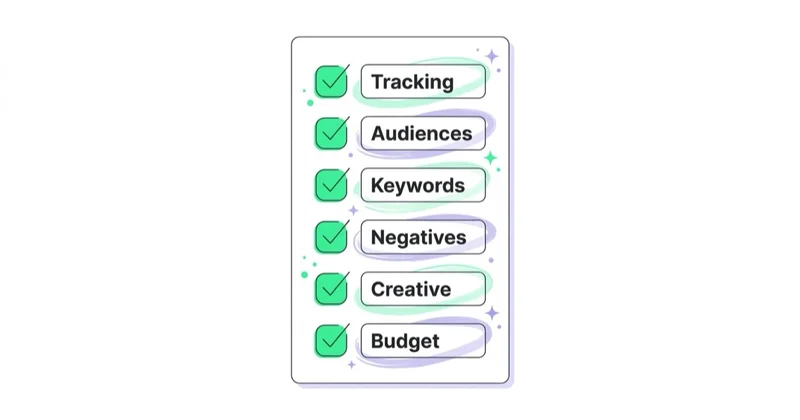
- Define the business goal.
- Calculate acceptable CPA, CAC or ROAS.
- Configure conversion tracking.
- Add conversion values where possible.
- Set up GA4 and UTM conventions.
- Prepare landing pages.
- Check Core Web Vitals and mobile UX for key pages.
- Build audience or customer lists where allowed.
- Prepare creative assets.
- Define what will be tested first.
Skipping this foundation creates the most common PPC failure: campaigns that generate data the business cannot trust.
Conversion tracking for PPC
PPC performance depends on the quality of the conversion signal.
A practical tracking setup should define:
- macro conversions, such as purchase, qualified lead, booking or subscription;
- micro conversions, such as add to cart, checkout start, pricing page view or form start;
- conversion values;
- deduplication rules;
- consent behaviour;
- UTM conventions;
- GA4 events and key events;
- platform-specific tags, pixels or APIs;
- CRM or offline conversion imports for lead generation;
- quality checks after website changes.
The goal is not to track everything as a primary conversion. The goal is to send platforms the best available signal for the outcome the business actually wants. For the measurement framework, see conversion measurement.
How to launch a PPC campaign
1. Start with intent
Use high-intent search if demand already exists. Use paid social, YouTube, Demand Gen or TikTok if the category needs education, visual proof or demand creation.
2. Match objective to the real outcome
Avoid optimizing for traffic when the business needs sales or qualified leads. Platforms learn from the selected objective. Optimizing for low-quality actions usually produces more low-quality actions.
3. Keep the first structure simple
A new account does not need dozens of campaigns. Start with clear separation by intent, funnel stage, geography, language, product economics or lead quality only when that separation changes decisions.
4. Give automation enough signal
Smart Bidding and automated campaigns need stable tracking and enough conversion data. If the account has low volume, start with simpler structures and avoid changing settings daily.
5. Review on a learning window
Daily panic edits usually hurt performance. Review search terms, spend, conversion quality, creative fatigue, landing-page performance and budget allocation on a consistent cadence.
Landing pages and PPC
A PPC campaign can have strong targeting and still fail if the landing page does not match the promise.
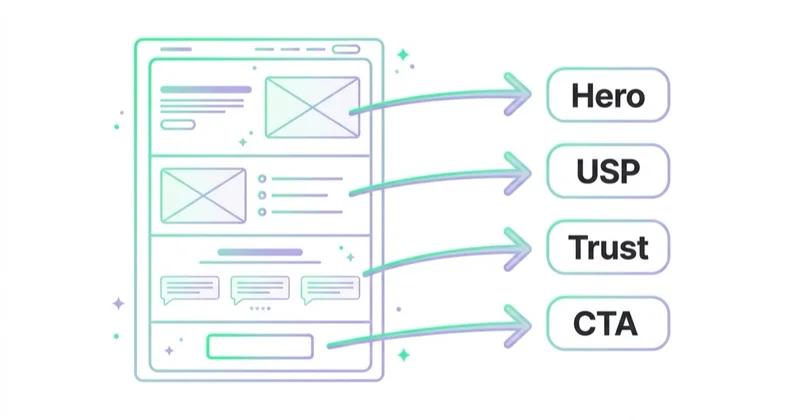
Good PPC landing pages usually include:
- a headline that matches the ad intent;
- clear explanation of the offer;
- one primary CTA;
- proof, reviews, case studies or product evidence;
- mobile speed and readability;
- low-friction forms or checkout;
- transparent pricing, delivery or process information where relevant;
- trust signals near the decision point;
- analytics events for key steps.
For Search campaigns, page relevance affects both user conversion and quality diagnostics. For paid social, the landing page must continue the creative story rather than feel like a disconnected sales page. For B2B, the page should reduce risk and explain the next step. For ecommerce, it should support product choice, availability, delivery, returns and checkout.
For conversion improvements, see conversion rate optimization.
PPC for e-commerce
E-commerce PPC is strongest when product data and business economics are clean.
Critical inputs:
- product feed titles and descriptions;
- item IDs aligned across feed, Pixel/CAPI and GA4;
- availability and price accuracy;
- product margins;
- shipping costs;
- return rates;
- customer lifetime value;
- new vs returning customer split;
- promotion calendar;
- landing-page and checkout UX.
Important campaign types:
- Google Shopping;
- Performance Max;
- branded Search;
- category Search;
- Meta Catalog Ads;
- Advantage+ Shopping / Sales;
- TikTok catalog or Spark Ads where relevant;
- remarketing and retention campaigns.
ROAS alone can be misleading. A campaign can look strong while selling low-margin products, cannibalizing brand demand or acquiring customers who return products frequently. E-commerce PPC should be judged against contribution margin, MER, new-customer acquisition and repeat purchase behavior.
PPC for B2B and lead generation
B2B PPC has a different problem. The conversion is often a lead, not revenue.
Good B2B PPC requires:
- clear definition of a qualified lead;
- CRM integration;
- offline conversion imports where possible;
- lead source and campaign tracking;
- landing pages matched to buying stage;
- negative keywords for irrelevant intent;
- sales feedback loop;
- reporting by pipeline and revenue, not only form submissions.
Cheap leads can be expensive if they never become opportunities. It is usually better to pay more for qualified demand than to optimize toward low-cost forms.
PPC audit checklist
Use this checklist when an account is spending but results are unclear:
- Are the primary conversions meaningful?
- Are conversion values, revenue or lead quality imported correctly?
- Are campaigns separated by intent or business decision, not arbitrary structure?
- Are search terms reviewed and negatives maintained?
- Are landing pages aligned with ads and keywords?
- Are creative assets refreshed before fatigue damages performance?
- Are automated campaigns receiving clean signals?
- Is spend concentrated where there is enough data to learn?
- Are brand, remarketing and prospecting separated in reporting?
- Are ecommerce campaigns judged by margin and new-customer value, not only ROAS?
- Are B2B campaigns judged by qualified pipeline, not only form volume?
- Are platform reports reconciled with GA4, backend orders or CRM?
The audit should identify whether the issue is traffic quality, offer strength, tracking, landing page conversion, budget allocation, creative fatigue or sales follow-up. PPC problems rarely come from one setting alone.
How we approach this at Space Ads
The very name "pay per click" nudges you toward the wrong goal: optimising the price of a click. We optimise the profit from one. A cheap click aimed at the wrong intent or a weak page is expensive; a dear click that closes profitably is cheap. So rather than chase the lowest CPC, we bid for value and watch what happens after the click — does it convert, at what margin, does the customer return. A low click cost that never becomes a sale is one of the panel's most deceptive numbers: it looks great and means nothing. Done well, PPC isn't hunting cheap clicks; it's buying the ones that actually pay, even when each looks pricier on its own.
Common mistakes
| Mistake | Why it hurts | Better approach |
|---|---|---|
| Launching before tracking | Algorithms learn from incomplete data | Configure conversions first |
| Optimizing for clicks | Traffic does not equal revenue | Optimize for business outcomes |
| Using the same landing page for every intent | Message mismatch lowers conversion | Match page to keyword, audience and funnel |
| Ignoring margin | ROAS can hide unprofitable sales | Use contribution margin and LTV |
| Changing settings every day | Automation cannot stabilize | Use defined review windows |
| Treating Performance Max as magic | Automation still needs inputs | Improve feed, assets, values and exclusions |
| No negative keywords in Search | Budget leaks into irrelevant queries | Review search terms consistently |
| No CRM feedback for leads | Platforms optimize for any lead | Import qualified stages and revenue |
| Judging social by last click only | Demand creation is undercounted | Use blended metrics and incrementality checks |
| Running every channel at once | Budget spreads too thin to learn | Start with the highest-confidence channel and expand after signal quality improves |
| Ignoring creative testing | Social and video campaigns fatigue quickly | Build a repeatable creative testing process |
FAQ
What is PPC in simple terms?
PPC is paid digital advertising where the advertiser pays when someone clicks an ad. In modern marketing, the term often covers broader performance advertising across search, social, video and marketplace platforms.
Is PPC the same as Google Ads?
No. Google Ads is one PPC platform. PPC can also include Microsoft Advertising, Meta Ads, TikTok Ads, LinkedIn Ads, Amazon Ads and other auction-based ad systems.
Is PPC better than SEO?
Neither is universally better. PPC can generate traffic and data quickly, while SEO compounds over time. Mature acquisition strategies often use both because they solve different problems.
How much should a PPC campaign cost?
There is no universal budget. The right budget depends on click costs, conversion rate, margin, sales cycle, customer value and how much data is needed to make a decision.
How long does PPC take to work?
Search campaigns can generate data quickly when demand exists. Automated, social, video and B2B campaigns often need more time because the platform has to learn audiences, creative and conversion quality.
Does PPC work for small businesses?
Yes, if the offer, location, landing page and tracking are clear. Small budgets should usually start with the highest-intent opportunities instead of trying to cover every channel.
What is the biggest PPC mistake?
The biggest mistake is launching without reliable conversion tracking. Without trustworthy data, optimization becomes guesswork and automation learns from the wrong signals.
Which PPC channel should be used first?
Use the channel that best matches buyer intent. If people already search for the offer, Search Ads are often the cleanest starting point. If demand must be created visually, paid social, YouTube or Demand Gen may be more suitable.
What should be checked before increasing PPC spend?
Check conversion tracking, landing page performance, search terms, creative fatigue, lead quality, margin and budget allocation. Scaling spend before these checks usually scales the same problems.
Conclusion
PPC is not about buying traffic cheaply. It is about using paid media to reach the right demand, measure outcomes and improve profitability over time. The modern PPC advantage comes from clean tracking, strong landing pages, better creative, useful first-party data and business-level measurement.
If you already run PPC and want to know where the money leaks, a marketing audit of Google, Meta and TikTok accounts turns it into a prioritised plan.
Sources and further reading
- Google Ads Help — Benefits of online advertising and Google Ads
- Google Ads Help — Choose the right campaign type
- Google Ads Help — 8 steps to prepare your campaign for success
- Google Ads API — Campaigns overview
- Space Ads — Meta Andromeda guide
Continue learning
- Why Brand Awareness Matters and How to Build a Successful Campaign
- Google Marketing Platform's DV360: Everything You Need to Know
- How to fix googleads.g.doubleclick.net sources and tpc.googlesyndication.com in Google Analytics
- Search advertising in Google Ads
- Performance Max campaigns
- Conversion measurement
- Marketing budget strategy
Continue reading
Google Ads vs Facebook Ads: Which Is Better for Your Business in 2026?
Google Ads vs Facebook Ads is not a question of one universally better platform. Google is strongest when demand already exists; Facebook and Instagram ads are strongest when the product needs discovery, creative proof and repeated exposure.
Scaling Meta Ads Without Killing ROAS
Scaling Meta ads is a commercial decision, not a promise to preserve the same ROAS at a higher spend. Learn how to set a profitable ceiling, diagnose constraints and increase budget through controlled tests.
Meta Advantage+ vs Manual Campaigns: When to Trust the Automation
Meta Advantage+ can automate audience expansion, placements and budget allocation, while manual settings preserve selected controls. This guide explains what each label actually means and how to test the right configuration for a business goal.