TikTok Creative Center is the official TikTok research hub for creative inspiration, trends, Top Ads, keywords, sounds and market signals. It helps marketers understand what types of videos, hooks, formats, sounds and messages are already gaining attention on TikTok. It should be used as a research tool before creative production, not as a shortcut for copying competitors.
TL;DR
- TikTok Creative Center supports creative research. It helps teams explore Top Ads, trends, keywords, sounds and inspiration before producing videos.
- Top Ads show high-performing creatives. TikTok says the dashboard can be filtered by region, industry, campaign objective and more.
- Trends help with market context. TikTok Trends can show hashtags, songs, creators and videos by region and industry.
- Keyword Insights help script planning. TikTok says Keyword Insights highlights top keywords and phrases from TikTok ads, with filters by region and industry.
- Music rules matter. Businesses should use the Commercial Music Library for commercial TikTok activities, including organic content, video ads and branded content.
- Creative Center is not a guarantee. A trend or ad example can inspire a test, but performance still depends on audience fit, offer, production quality, landing page and measurement.
- The best workflow is pattern extraction. Do not copy videos. Extract hooks, structures, angles and proof patterns, then adapt them to the brand.
What TikTok Creative Center is
TikTok Creative Center is a public TikTok for Business resource for researching what is happening creatively on the platform. It is useful for advertisers, social media managers, creators, agencies, founders and content teams that need to plan TikTok videos with more evidence and less guesswork.
It can help answer questions such as:
- Which ad formats are common in a category?
- What hooks appear repeatedly in high-performing ads?
- Which sounds or hashtags are trending in a region?
- What words and claims are popular in ad scripts?
- Which videos create engagement moments early in the ad?
- How do competitors explain similar products or services?
- Which creative ideas are worth testing first?
Creative Center should not replace strategy. It should make strategy more informed.
What you can find inside Creative Center
The exact interface may change, but the main use cases are stable.
| Area | What it helps with |
|---|---|
| Top Ads | Reviewing high-performing ad creatives by region, industry, objective and other filters |
| Trends | Exploring trending hashtags, songs, creators and videos by region and industry |
| Keyword Insights | Finding popular and top-converting words and phrases from TikTok ads |
| Commercial Music Library | Finding pre-cleared music for commercial TikTok content |
| Creative inspiration | Building a swipe file of hooks, structures, pacing and formats |
| Brief creation | Turning examples into concrete creator and production instructions |
This makes Creative Center valuable before a campaign launch and during ongoing creative iteration.
How to use Top Ads
TikTok says Top Ads Dashboard is a collection of high-performing creatives that can be filtered by region, industry, campaign objective and more. It also allows sorting by metrics such as reach, click-through rate, 2-second view rate and 6-second view rate, with more desktop options such as conversion rate and likes.
A practical Top Ads workflow:
- Choose the target country or region.
- Select the closest industry.
- Filter by campaign objective when possible.
- Search for product, service or category keywords.
- Sort by metrics that match the goal, not only by reach.
- Open promising ads and review the second-by-second performance graph.
- Save examples into a swipe file or collection.
- Extract patterns instead of copying the ad.
Useful patterns to extract:
- first frame;
- spoken hook;
- on-screen text;
- video length;
- pacing;
- product reveal moment;
- proof moment;
- CTA timing;
- comment-driving angle;
- use of creators or founder presence;
- offer structure;
- landing-page promise.
The goal is to understand why the ad worked, not to recreate it frame by frame.
How to use Trends
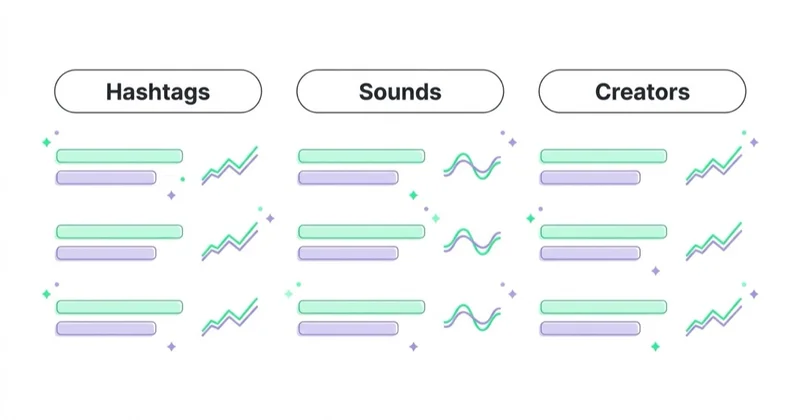
TikTok Trends can show trending hashtags, songs, creators and videos by region and industry. TikTok documentation says hashtag analytics can include trendline, related videos, audience insights, regional popularity and related hashtags. For songs, the tool can show trendline, related videos, audience insights, regional popularity and similar music.
A useful trend workflow:
- start with the target market, not a global trend list;
- filter by industry where possible;
- separate rising trends from already saturated trends;
- check whether the trend fits the brand voice;
- decide whether the trend supports awareness, engagement or conversion;
- confirm music rights before using sounds commercially;
- create two or three brand-specific variations, not one copy.
Trends are especially useful for organic content and creator briefs. For paid ads, trend fit should be balanced with legal, brand and performance constraints.
How to use Keyword Insights
TikTok says Keyword Insights highlights top keywords and phrases from TikTok ads. It can be filtered by region, industry and more, and can help with ad scripts, copy, value proposition language and popular phrases in a category. TikTok also notes that Keyword Insights is available on desktop and the data is collected from TikTok ads, not organic-only posts.
A practical Keyword Insights workflow:
- Select region and industry.
- Search for product, problem or category terms.
- Review recurring phrases and value propositions.
- Group keywords by intent: problem, benefit, proof, offer, comparison, urgency, identity.
- Turn keyword groups into hook ideas.
- Write several script openings from the strongest groups.
- Test those hooks in organic or paid creative.
Keyword Insights should inform language, but the brand still needs a clear point of view. If every ad uses the same category phrase, the creative will sound generic.
Commercial Music Library and sound safety
Music is one of the easiest places to make a mistake on TikTok.
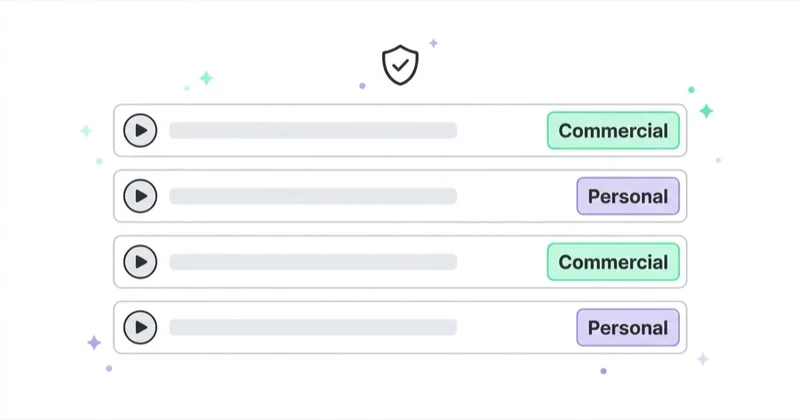
TikTok says businesses cannot use the general music library for commercial usage and should instead use the Commercial Music Library for commercial TikTok activities, including organic content, video ads and branded content. TikTok describes the Commercial Music Library as a pre-cleared global music library with 1 million songs.
Practical rules:
- use Commercial Music Library sounds for brand, ad and commercial content;
- do not assume a trending sound is cleared for business use;
- check usage rights before sending a brief to a creator or editor;
- document the sound used in each ad concept;
- consult legal support when using original sounds or licensed music outside the CML;
- use trend research as inspiration, but keep music compliance separate.
A trend that cannot be used safely in commercial content should not be the foundation of a paid campaign.
How to turn Creative Center research into a creative brief
Creative Center research becomes useful only when it changes production.
A strong TikTok brief should include:
| Brief element | What to define |
|---|---|
| Audience | Who should stop scrolling and why |
| Problem | The pain, desire or question the video addresses |
| Hook | First 1-2 seconds, including spoken or visual opening |
| Format | Tutorial, demo, review, myth, comparison, story, reply, list |
| Proof | Review, result, product use, expert point, case, social proof |
| CTA | Follow, comment, visit, buy, sign up, book, download |
| Constraints | Music rights, brand safety, claims, legal, platform policy |
| Variations | At least 3-5 different angles, not only different edits |
| Measurement | What makes the test successful |
The brief should not say only "make it like this viral video". It should explain which pattern is worth borrowing and how it changes for the brand.
Creative Center workflow for paid ads
A performance-oriented workflow can look like this:
Step 1: Research the category
Use Top Ads and Keyword Insights to understand the category language, common hooks, objections and visual patterns.
Step 2: Build creative hypotheses
Turn patterns into testable hypotheses. Example:
- problem hook versus result hook;
- founder voice versus creator voice;
- product demo versus customer story;
- price objection versus quality proof;
- educational angle versus trend angle.
Step 3: Produce multiple concepts
Create several distinct concepts. A concept is not a new crop or background. It is a different reason for the audience to care.
Step 4: Test organically or with small paid budgets
If the brand has an active organic account, test some concepts organically first. If speed matters, use paid testing with clear budgets and measurement rules.
Step 5: Scale winners with Spark Ads or paid campaigns
Use Spark Ads when a strong organic or creator post deserves amplification. Use non-Spark ads when the team needs more control over ad identity, variations, landing-page paths or message testing.
Step 6: Feed learnings back into production
The output of a test should be more than a winning ad ID. It should improve the next batch of hooks, scripts, creator briefs and landing-page promises.
Creative Center for organic TikTok
For organic content, Creative Center is useful for finding cultural timing and format ideas. The goal is not to imitate ads. The goal is to understand what people are already watching in a category.
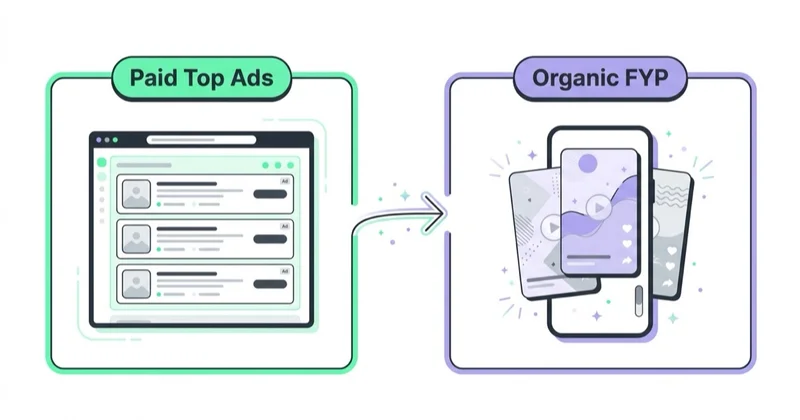
Useful organic outputs:
- weekly trend shortlist;
- creator reference list;
- hook bank;
- hashtag and search phrase list;
- series ideas;
- FAQ video topics;
- comment prompt ideas;
- sounds approved for the account type;
- examples of pacing and editing style.
Organic TikTok needs consistency. Creative Center can provide ideas, but the account still needs clear pillars and a profile promise.
Creative Center for e-commerce
For e-commerce, Creative Center can help identify how products are demonstrated and why people respond.
Useful things to look for:
- first product reveal;
- before-after structure;
- problem-solution framing;
- use case demonstration;
- review or UGC proof;
- offer timing;
- pricing and shipping mentions;
- product close-ups;
- creator credibility;
- comment patterns around buying intent.
This research should be connected to product margin, stock, landing pages, TikTok Pixel data and customer feedback. A trending format is not enough if the product page, offer or tracking is weak.
Creative Center beyond e-commerce
For B2B, services, education and local businesses, Creative Center can still be useful, but the research should focus less on product virality and more on explanation, trust and attention.
Examples:
- B2B: expert hooks, problem explanations, myths, tool comparisons;
- local services: process videos, before-after, staff credibility, client questions;
- education: application advice, course previews, student outcomes, career tips;
- SaaS: feature demos, pain-point hooks, workflow comparisons, customer stories;
- recruitment: team culture, day-in-the-life, office or role explainers.
The best Creative Center question is not "what is viral". It is "what pattern can make this message easier to notice and trust".
How we approach this at Space Ads
Creative Center is free creative intelligence: you can see which ads are working in an industry and which formats, sounds and hooks are climbing. We open it before shooting anything, so instead of guessing which hook will land we go into a test with informed bets, built on patterns already proven elsewhere. It won't replace testing on our own data, since what works for a competitor doesn't always work for us, but it sharply raises the hit rate of whatever we put into the test. Fewer creatives missing from the start means less budget burned on learning. We use it as a source of ideas and a read on trends, never as a template to copy: a borrowed ad with no idea of its own rarely wins.
Common mistakes
| Mistake | Why it hurts | Better approach |
|---|---|---|
| Copying ads directly | Creates weak differentiation and legal or brand risk | Extract patterns and adapt them |
| Filtering by the wrong market | Trends vary by region and language | Start with the target market |
| Sorting only by reach | Broad reach may not mean business value | Match metric to objective |
| Ignoring music rights | Commercial use can require CML or separate licensing | Check sound permissions before production |
| Treating trends as strategy | Trend fit can be shallow | Connect trends with audience and offer |
| No test plan | Research never becomes performance learning | Define concepts, budgets and success metrics |
| Over-indexing on e-commerce | Other models need trust and education patterns | Adapt research to the buying context |
| Building one video only | One asset cannot validate a pattern | Test multiple angles and formats |
FAQ
What is TikTok Creative Center?
TikTok Creative Center is an official TikTok for Business research hub for creative inspiration, Top Ads, trends, keywords, sounds and market signals.
Is TikTok Creative Center free?
Creative Center is publicly accessible, but some features or deeper views may require login. TikTok Top Ads documentation notes that users who are not logged in see only five ads.
What is Top Ads?
Top Ads is a dashboard of high-performing ad creatives that can be filtered by region, industry, campaign objective and other dimensions. It helps identify creative patterns that are already working in a category.
What is Keyword Insights?
Keyword Insights is a Creative Center tool that highlights top keywords and phrases from TikTok ads. It can help with ad scripts, copy and value proposition language.
Can Creative Center replace creative strategy?
No. It is a research tool. Strategy still needs audience definition, offer clarity, brand positioning, testing structure and measurement.
Can businesses use any trending song from TikTok?
No. TikTok says businesses cannot use the general music library for commercial usage and should use the Commercial Music Library for commercial TikTok activities.
Should competitors be copied from Top Ads?
No. Use competitor and category examples to identify patterns, not to copy. The goal is to adapt hooks, structures and proof types to the brand.
How often should Creative Center research be done?
For active TikTok accounts, a light weekly research rhythm is useful. For paid campaigns, deeper research should happen before each major creative batch or campaign sprint.
Key takeaways
TikTok Creative Center is useful because creative performance on TikTok depends heavily on format, hook, pacing, context and platform culture. It helps teams see what is already gaining attention before they spend time and budget on production.
The strongest use is not copying. It is pattern extraction: identify what works, translate it into brand-specific hypotheses, produce several concepts, test them, then feed the results back into the next creative batch.
Sources and further reading
- TikTok Creative Center - Official Creative Center
- TikTok for Business Help Center - How to use the Top Ads Dashboard
- TikTok for Business Help Center - How to use Trends
- TikTok for Business Help Center - How to use Keyword Insights
- TikTok for Business Help Center - About the Commercial Music Library
- Space Ads - TikTok Ads service
Continue learning
Continue reading
TikTok Ads: How to Start and Run Campaigns
TikTok Ads are paid campaigns in TikTok Ads Manager that can drive reach, leads, website conversions, app installs, ecommerce sales and creator amplification. Learn how to plan, launch and measure them.
TikTok Smart+: When to Hand Over the Campaign
TikTok Smart+ now supports full, partial and manual control across key campaign modules. Learn when automation has enough measurement, budget and creative signal to help—and how to test it without confusing attribution with business value.
How Much Does TikTok Advertising Cost? Budgets, Minimums and CPM in 2026
TikTok advertising has no fixed price, and its technical minimums do not define a useful test. Learn how to budget for media, creative and measurement, calculate qualified CPA and read Spark Ads or GMV Max without confusing attributed GMV with incremental profit.