Keywords are the words and phrases people use when they search, compare, ask questions, describe problems or look for products and services. In marketing, keywords help connect user intent with content, ads, landing pages, products and offers.
Keywords are not only an SEO topic. They matter in Google Ads, content strategy, ecommerce search, YouTube, marketplaces, app stores, social listening, customer research and AI search visibility. They show how people describe demand in their own language.
The best keyword strategy in 2026 is not a list of phrases repeated across a page. It is a system for understanding intent, grouping topics, building useful content and matching the right message to the right stage of the journey.
TL;DR
- Keywords are words and phrases people use to search for information, products, services or solutions.
- Good keyword research starts with intent, not search volume.
- Short keywords are broad and competitive; long-tail keywords are usually more specific and closer to real questions.
- SEO keywords help structure content around topics and user needs.
- Google Ads keywords help match ads to relevant searches through broad, phrase and exact match.
- Search engines can understand related terms, so exact repetition is less important than topical coverage and usefulness.
- Keyword stuffing is bad for users and against Google's spam policies.
- English-language markets require localisation: US, UK, AU and global users may search with different vocabulary.
- Topic clusters, FAQs, examples and clear answers help both SEO and LLM-friendly content.
- Keywords should be reviewed with Search Console, Google Ads search terms, conversions and revenue quality.
What are keywords?
Keywords are search terms or phrases that describe what a user wants. They can be short, broad and ambiguous, or long, specific and action-oriented.
Examples:
- google ads;
- keyword research;
- best CRM for small business;
- how to improve landing page conversion rate;
- ecommerce SEO agency UK;
- Google Ads audit checklist;
- TikTok ads cost Australia;
- what is demand generation.
The keyword is the visible expression of intent. Behind it is a real user need: learning, comparing, buying, troubleshooting, validating or navigating.
Why keywords still matter
Keywords still matter because users still express needs through language. Search engines and ad platforms have become better at understanding meaning, but they still need content, landing pages, ads and product data that clearly explain what the business offers.
Keywords help marketers:
- understand demand;
- prioritise content topics;
- group pages into topic clusters;
- plan Google Ads campaigns;
- identify buying intent;
- write better landing pages;
- build FAQ sections;
- create internal links;
- compare market language across countries;
- diagnose gaps in content or campaigns.
The mistake is treating keywords as mechanical text fragments. The strategic value is in the intent and context behind them.
Keywords vs search queries
The terms keyword and search query are often used together, but they are not exactly the same.
| Term | Meaning | Example |
|---|---|---|
| Keyword | Phrase selected by a marketer, SEO specialist or advertiser | google ads audit |
| Search query | Actual words typed or spoken by a user | how much does a google ads audit cost |
| Topic | Broader subject area that includes many related keywords | Google Ads optimisation |
| Intent | What the user wants to achieve | Compare audit services before buying |
In SEO, the goal is usually to cover a topic in a useful way so the page can match many related queries. In Google Ads, the advertiser chooses keywords and match types that decide which user searches can trigger ads.
Types of keywords
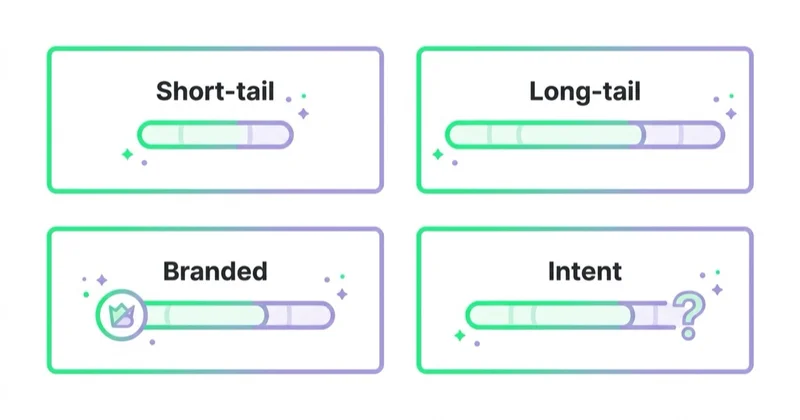
Head keywords
Head keywords are short, broad and usually competitive.
Examples:
- SEO;
- Google Ads;
- CRM;
- marketing;
- ecommerce.
They can have high search volume, but intent is often unclear. Someone searching "CRM" may want a definition, software comparison, login page, pricing, implementation help or a list of vendors.
Long-tail keywords
Long-tail keywords are longer and more specific.
Examples:
- best CRM for B2B lead generation;
- how to track micro conversions in GA4;
- Google Ads audit checklist for ecommerce;
- landing page conversion rate optimisation agency;
- how to choose keyword match types in Google Ads.
They often have lower volume individually, but stronger intent and clearer content requirements.
Branded keywords
Branded keywords include a brand, product or company name.
Examples:
- HubSpot pricing;
- Shopify product recommendations;
- Space Ads Google Ads audit;
- Meta Ads Manager.
Branded keywords can reflect navigation, comparison, support or purchase intent.
Non-branded keywords
Non-branded keywords describe a need without naming a brand.
Examples:
- PPC agency UK;
- ecommerce analytics audit;
- best email marketing platform;
- how to improve quality score.
These are often important for acquisition because they reach users before brand preference is fixed.
Commercial and transactional keywords
These keywords suggest buying or supplier evaluation.
Examples:
- Google Ads agency pricing;
- PPC consultant near me;
- buy email automation software;
- best ecommerce CRO agency;
- request SEO audit.
They are useful for landing pages, comparison pages, ads and bottom-funnel content.
Informational keywords
These keywords indicate learning or problem exploration.
Examples:
- what is consent mode v2;
- how does customer match work;
- what are micro conversions;
- how to increase TikTok reach;
- what is a sales funnel.
They are useful for blog posts, guides, videos, glossaries and FAQ content.
Search intent: the most important keyword layer
Search intent is the reason behind the query.
Common intent types:
- informational: the user wants to learn;
- navigational: the user wants a specific site or brand;
- commercial: the user compares options;
- transactional: the user is ready to act;
- local: the user needs something in a location;
- support: the user needs help solving a problem.
Two keywords can look similar but require different pages.
Example:
| Keyword | Likely intent | Best content type |
|---|---|---|
| what is Google Ads | Learn the basics | Educational guide |
| Google Ads agency | Compare providers | Service page |
| Google Ads audit checklist | Practical evaluation | Checklist or audit guide |
| Google Ads login | Navigation | Not a content target for an agency |
| Google Ads consultant pricing | Commercial comparison | Pricing or service explainer |
Keyword research without intent mapping often leads to content that ranks poorly or brings the wrong traffic.
Keywords for SEO
SEO keywords help shape page topics, headings, examples, FAQs and internal links. They should not be forced into every paragraph.
A good SEO keyword process:
- Choose a primary topic.
- Identify the main intent.
- Research related questions and subtopics.
- Group keywords into a content cluster.
- Decide which page should target which intent.
- Write a useful page that satisfies the query.
- Add internal links to related resources.
- Review performance in Search Console.
For example, a topic cluster around Google Ads could include:
- Google Ads basics;
- Google Ads audit;
- keyword match types;
- Quality Score;
- Google Ads Editor;
- enhanced conversions;
- Customer Match;
- Performance Max;
- Demand Gen campaigns.
Each page should have a clear role. One page should not try to rank for every possible keyword in the cluster.
For broader technical checks, see SEO audit.
Keywords for Google Ads
In Google Ads, keywords are words or phrases selected to help match ads with user searches. Match type controls how closely a search needs to relate to the keyword.
The core match types are:
- broad match;
- phrase match;
- exact match.
Google Ads matching has evolved from simple syntax toward meaning and intent. Broad match can use signals such as landing pages, other keywords and account context. That makes conversion tracking, ad relevance and landing page quality more important than ever.
A practical Google Ads keyword process:
- Start with the offer and conversion goal.
- Group keywords by intent.
- Separate brand, competitor, generic and high-intent terms.
- Choose match types based on budget, data and control needs.
- Add negative keywords.
- Write ads that match the query intent.
- Send traffic to relevant landing pages.
- Review search terms and conversion quality.
For more detail, see keyword match types in Google Ads and Google Ads audit.
Keywords for English-language markets
English keyword research should not assume that all markets search the same way.
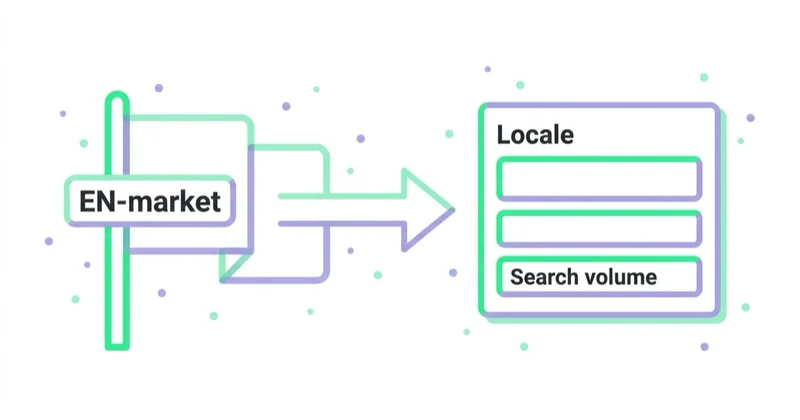
Differences can include:
- spelling: optimisation vs optimization;
- terminology: PPC agency vs paid search agency;
- geography: UK, US, Australia, Canada, Ireland;
- buyer language: ecommerce, e-commerce, online store;
- legal and industry terms;
- local modifiers: near me, London, New York, Sydney;
- currency and pricing expectations;
- platform popularity by market.
Examples:
- UK users may search "Google Ads agency UK" or "paid search agency London".
- US users may use "PPC management services" or "Google Ads consultant".
- Australian users may include "Australia", "Sydney", "Melbourne" or local business terms.
- Global B2B users may search by problem, such as "reduce wasted ad spend" or "improve lead quality".
For English content, include natural variations when they help users. Do not create awkward keyword repetition just to cover every spelling. A page can mention both "optimisation" and "optimization" where market context makes it useful.
Keywords and AI search / LLM visibility
LLM-friendly content is not about hiding keywords for machines. It is about making information explicit, structured and easy to cite or summarise.
Useful patterns:
- clear definitions near the top;
- concise TL;DR section;
- tables comparing terms;
- step-by-step processes;
- practical examples;
- FAQ section;
- sources and further reading;
- internal links to related topics;
- updated facts and caveats;
- clear separation between strategy, implementation and measurement.
Keyword clusters still matter because they show the range of questions a page should answer. However, the page should read like expert content for humans, not like a keyword list.
Topic clusters instead of isolated keywords
A topic cluster groups related content around a broader subject. This helps users and search engines understand depth.
Example cluster: Conversion optimisation
- What is CRO?
- What is a conversion?
- Micro conversions vs macro conversions.
- How to use pop-ups.
- CTA best practices.
- Product recommendations.
- Abandoned carts.
- How to increase online sales.
The cluster should include internal links, consistent terminology and clear page roles. This is stronger than publishing disconnected posts that target similar keywords and compete with each other.
For an example of a structured keyword tool, see keyword matrix.
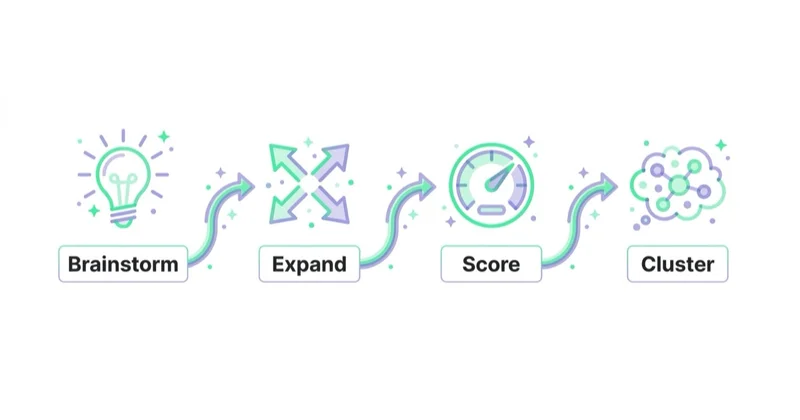
Keyword research workflow
Use this practical workflow.
1. Start with business goals
Do not start with volume. Start with what the business needs:
- sales;
- leads;
- qualified traffic;
- brand visibility;
- category education;
- local demand;
- retention;
- support deflection.
Different goals require different keywords.
2. Build seed keywords
Seed keywords come from:
- products;
- services;
- customer questions;
- sales calls;
- internal site search;
- competitor pages;
- Google Ads search terms;
- Search Console data;
- reviews;
- support tickets;
- CRM notes.
Customer language is often better than internal terminology.
3. Expand with tools
Useful sources:
- Google Keyword Planner;
- Google Search Console;
- Google Ads search terms;
- Google Trends;
- AlsoAsked or People Also Ask research;
- paid SEO tools;
- marketplace search suggestions;
- YouTube search suggestions;
- customer interviews.
No tool should decide strategy alone. Tools estimate demand; business context decides priority.
4. Group by intent
Group keywords into:
- informational;
- commercial;
- transactional;
- branded;
- local;
- support;
- comparison;
- problem-led.
This step prevents one page from trying to serve incompatible intents.
5. Choose page type
Match keyword groups to page formats:
- guide;
- glossary;
- service page;
- product page;
- comparison page;
- landing page;
- category page;
- FAQ;
- case study;
- checklist.
The correct page type is often more important than the exact phrase in the heading.
6. Measure outcomes
Review:
- impressions;
- clicks;
- rankings;
- click-through rate;
- engaged sessions;
- conversions;
- lead quality;
- assisted revenue;
- search terms;
- content gaps;
- internal link performance.
Traffic without business value should not dominate the strategy.
Keyword metrics that matter
| Metric | What it helps with | Limitation |
|---|---|---|
| Search volume | Demand estimate | Can hide intent quality |
| Keyword difficulty | Competitive pressure | Tool estimates vary |
| CPC | Commercial value signal | High CPC is not always profitable |
| Conversion rate | Business relevance | Needs enough data |
| Click-through rate | SERP or ad relevance | Affected by layout and competitors |
| Impressions | Visibility potential | Does not prove quality |
| Revenue or lead quality | Real value | Requires tracking and CRM data |
The strongest keyword decisions combine demand, intent, competition and business value.
How we approach this at Space Ads
Keywords are a map of intent and commercial value for us, not a list of phrases. We group them by what the searcher really wants and how close they are to buying, handling "how X works" quite differently from "X price shop" — that's what decides where to bid harder and where mere presence is enough. More and more we think in the questions people ask rather than single words, because search is sliding toward conversation and AI answers, where the "keyword" is often a whole sentence. So we cover the intent, not just the exact phrase, making sure the brand turns up in answers to real customer questions — in the search box and wherever a model replies. The list is a starting point; the need behind it is the point.
Common keyword mistakes
Chasing only high-volume keywords
High-volume keywords can be too broad, too competitive or too early in the journey. Lower-volume keywords can bring more qualified users.
Ignoring intent
A definition query, comparison query and purchase query need different content.
Keyword stuffing
Repeating the same phrase unnaturally hurts readability and can violate search spam guidelines. Write naturally and cover the topic properly.
Creating duplicate pages
Too many similar pages can compete with each other. Build one strong page per intent where possible.
Using one keyword list for every market
US, UK, AU and global users can use different terms. Localise vocabulary and examples.
Forgetting negative keywords
In paid search, irrelevant queries waste budget. Negative keywords are part of keyword strategy, not an afterthought.
No feedback loop
Keyword research should be updated with actual performance data from Search Console, Google Ads, analytics and CRM.
FAQ
What are keywords in marketing?
Keywords are words and phrases that users search or use to describe needs, problems, products and services. Marketers use them to plan content, ads, landing pages and messaging.
Are keywords still important for SEO?
Yes, but not as mechanical repetition. Keywords help understand user intent and topic coverage. Search engines can understand related language, so useful content matters more than exact keyword density.
What is keyword intent?
Keyword intent is the reason behind a search. It can be informational, commercial, transactional, navigational, local or support-related.
What is a long-tail keyword?
A long-tail keyword is a longer, more specific search phrase. It usually has clearer intent and can be easier to satisfy with focused content.
How are keywords used in Google Ads?
Advertisers choose keywords and match types so ads can appear for relevant searches. Broad, phrase and exact match control how closely the search needs to relate to the keyword.
Should the same keyword be repeated many times?
No. The keyword should appear naturally where useful, but the page should focus on answering the user's question. Excessive repetition is bad for readability and can be treated as keyword stuffing.
Conclusion
Keywords are not dead. Mechanical keyword SEO is. Modern keyword strategy is about understanding how people express demand, grouping that demand by intent and creating pages, ads and offers that genuinely answer the need.
For English-language markets, keyword work should also account for vocabulary, spelling, geography and buyer language across the US, UK, Australia and other regions. The best results come from combining keyword tools with customer research, analytics and business value. A keyword is only useful when it leads to a better decision, better content or better campaign performance.
Sources and further reading
- Google Search Central: SEO Starter Guide
- Google Ads Help: Use Keyword Planner
- Google Ads Help: Keyword matching
- Google Search Central: Creating helpful, reliable, people-first content
Continue learning
Continue reading
What Is a Keyword Matrix and How to Use It?
A keyword matrix turns keyword research into an execution map for SEO, PPC, content and AI search: intent, clusters, target URLs, business value, status and ownership. This guide explains how to use it to prevent cannibalization, plan pages, align paid search with organic demand and prioritise work by revenue or lead impact.
What Is the Google Search Network and How to Use It?
The Google Search Network shows ads around active search intent. Learn how it works, where ads appear, how search partners behave and how to structure Search campaigns.
Is Google Trends Worth Using and What Are the Alternatives?
Google Trends shows relative search interest, not exact search volume. Learn when to use it, how to interpret the 0-100 scale and which alternatives work better for volume, SEO and sales.