Meta tags in SEO are HTML elements and related metadata that help search engines, browsers and social platforms understand how a URL should be interpreted or displayed. The two most discussed elements are the page title, often called "meta title" in everyday SEO language, and the meta description. They can influence how a result appears in search, but they do not guarantee exactly what Google will show.
Good metadata will not rescue weak content. It can, however, make important pages easier to understand, improve click clarity, reduce duplicate-indexing problems and support better previews in social platforms and messaging apps. The goal is not to trick the search engine. The goal is to describe the page accurately, match search intent and make the result useful enough for the right user to click.
TL;DR
- "Meta title" usually means the HTML title element. Technically, it is not a meta tag, but the term is widely used in SEO.
- The title can influence the title link in Google Search. Google may also use headings, prominent on-page text, anchor text and other signals.
- Meta description can influence the snippet. Google may use it when it is a good match, but it can also generate a different snippet from page content.
- Canonical, robots, hreflang and Open Graph matter too. SEO metadata is broader than title and description.
- There is no guaranteed perfect character length. Write concise, clear, front-loaded titles and descriptions that work even if truncated.
- Meta keywords should not be a priority for Google SEO. They are not part of modern Google optimization work.
- Every important indexable page should have unique, accurate metadata aligned with the page content and search intent.
What meta tags are in SEO
In SEO, the term "meta tags" is often used broadly for metadata in the HTML head section. Some elements are true meta tags, such as meta description and robots. Others, such as the title element, canonical link tag and hreflang annotations, are not technically meta tags but are usually discussed in the same workflow.
Important SEO metadata includes:
- title element;
- meta description;
- robots meta tag;
- canonical link element;
- hreflang annotations;
- Open Graph tags;
- Twitter Card tags;
- structured data;
- viewport tag for mobile rendering.
Each element has a different role. The title and description help search appearance. Canonical helps consolidate duplicate or very similar URLs. Robots controls indexation and snippet behavior. Hreflang helps with language and regional alternatives. Open Graph helps social sharing previews.
Meta title vs title element
"Meta title" is a common SEO phrase, but the technically correct term is title element. In HTML, it looks like a title tag in the head section, not a meta tag.
The title element can be used by:
- browsers in tabs and bookmarks;
- search engines as one source for title links;
- social platforms when no better social metadata is provided;
- SEO tools when auditing pages.
Google's SEO Starter Guide explains that title links in Search can be influenced by writing good titles, and that the title link may use the title element as one source. It also notes that Google can use other sources such as headings on the page.
The practical lesson: write a good title element, but do not assume it is a guaranteed command.
What meta description does
Meta description is a short page summary placed in the head section. It can be used as the search snippet, but it is not guaranteed.
Google's documentation explains that snippets are usually sourced from page content and may occasionally come from the meta description tag when it provides a more accurate description. This is why descriptions should be written for humans and aligned with the actual page.
A good meta description should:
- summarize the page accurately;
- include the main topic naturally;
- explain the value of clicking;
- avoid keyword stuffing;
- avoid misleading promises;
- be unique for important pages;
- match the search intent.
Meta description is not a simple ranking lever. Its value is mainly presentation, relevance and click clarity.
How to write a good SEO title
A good title should be unique, clear and accurate. It should tell users and search engines what the page is about.
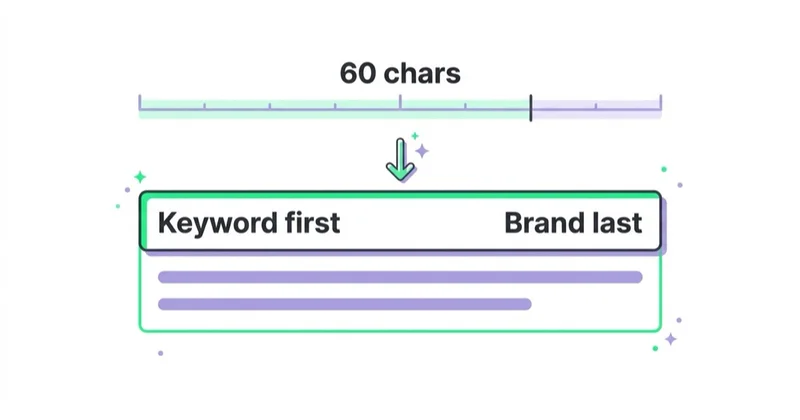
Use this structure as a starting point:
Main topic + specific value or qualifier + brand when useful
Examples:
- "SEO Audit Checklist: Technical, Content and Priority Fixes | Space Ads"
- "UTM Parameters in GA4: How to Tag Campaigns Correctly | Space Ads"
- "Google Ads Audit: What to Check Before Scaling Spend | Space Ads"
- "Product Page SEO: How to Improve Ecommerce Visibility | Space Ads"
Best practices:
- place the main topic near the beginning;
- keep the title concise;
- match the H1 and page intent;
- use the brand when it adds trust or context;
- avoid repeating the same keyword unnaturally;
- avoid vague titles such as "Home" or "Services";
- do not promise something the page does not deliver.
For broad content planning, read What Are Keywords and How to Use Them in Marketing?.
How to write a good meta description
A strong meta description explains why the page is worth opening.
Use this structure:
What the page contains + who it helps + what problem it solves or what the user will learn
Examples:
- "Learn how to run an SEO audit across crawlability, indexation, content, internal links, structured data and implementation priorities."
- "A practical GA4 guide for ecommerce teams: events, revenue tracking, key events, UTMs and common reporting mistakes."
- "See how responsive display ads work in Google Ads, what assets to prepare and how Demand Gen changes the display strategy."
Good descriptions are:
- specific;
- readable;
- aligned with the page;
- written in natural language;
- useful even if shortened;
- not overloaded with keywords.
Avoid:
- repeating the title word for word;
- generic brand slogans;
- lists of keywords;
- clickbait;
- outdated claims;
- duplicate descriptions across many pages.
Character length: what matters in 2026
Many SEO guides still mention fixed limits such as 50-60 characters for titles and 150-160 characters for descriptions. These ranges can be useful as rough writing discipline, but they are not guarantees.
Search result display depends on pixels, device, query, language and Google's generated result. Google can shorten, rewrite or replace the title link and snippet. The better rule is:
- put the most important information early;
- make the title understandable before truncation;
- write the description as a concise summary, not a paragraph;
- avoid relying on the final words for critical meaning.
Do not obsess over one exact character count. A clear 64-character title can outperform a weak 55-character title. A concise description that matches intent is better than one engineered only to fit a limit.
Canonical tags
Canonical tags tell Google which URL is the preferred version when duplicate or very similar pages exist.
Canonicalization matters for:
- URL parameters;
- filtered category pages;
- duplicate product variants;
- tracking parameters;
- HTTP vs HTTPS versions;
- www vs non-www;
- syndicated or republished content;
- near-duplicate landing pages.
Google's canonical documentation explains that site owners can indicate a preferred canonical URL, but Google may still choose a different canonical if signals conflict. Canonical is a strong hint, not absolute control.
Common mistakes:
- canonical points to the wrong URL;
- canonical points to a blocked or redirected page;
- canonical and hreflang conflict;
- every filtered page canonicalizes to a broad category even when some filters should rank;
- self-canonicals are missing on important pages;
- canonical is used to hide pages that should actually be noindexed.
Robots meta tag
The robots meta tag can control indexation and serving behavior. Common directives include:
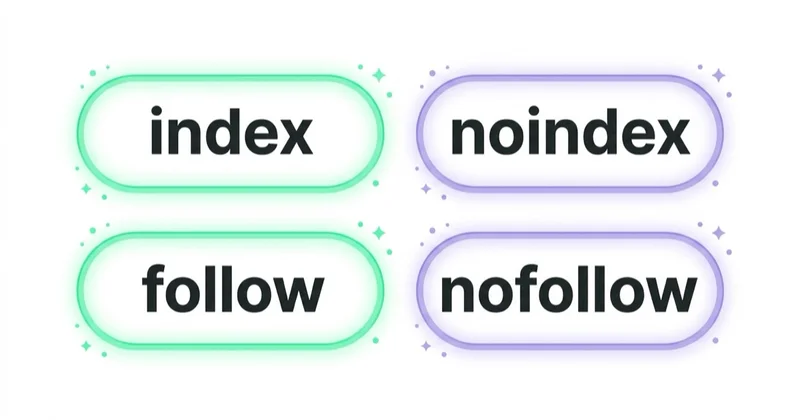
- index;
- noindex;
- follow;
- nofollow;
- max-snippet;
- max-image-preview;
- noarchive.
Use robots rules carefully. An accidental noindex on an important page can remove it from search results after crawling. A robots.txt block can also prevent Google from seeing the noindex directive, which creates confusion.
Robots metadata should be audited before and after migrations, redesigns, staging launches and CMS template changes.
Hreflang
Hreflang helps Google understand language and regional alternatives of similar pages. It is relevant for sites with multiple language or country versions, such as English for the UK, US or Australia, or Polish and English versions of the same content.
Good hreflang implementation should:
- point to equivalent pages;
- use valid language and region codes;
- be reciprocal;
- include self-references;
- work with canonicals, not against them;
- include x-default where appropriate.
For this website, PL and EN blog counterparts should be connected consistently through the content model and page templates. The content itself should not be treated as a literal translation when the English market requires deeper coverage, but technical alternates still need to be clean.
Open Graph and social metadata
Open Graph tags control how a link appears when shared on platforms such as Facebook, LinkedIn, Slack, Messenger and other environments that generate previews.
Important fields:
- og:title;
- og:description;
- og:image;
- og:url;
- og:type.
Twitter Card metadata can also influence previews on X and other tools that use similar fields.
Open Graph does not directly replace SEO metadata, but it affects click-through outside Google. A strong article can look weak if the shared preview has no image, a truncated title or a generic description.
Metadata by page type
Blog articles
Blog metadata should answer the user's question and clarify the scope.
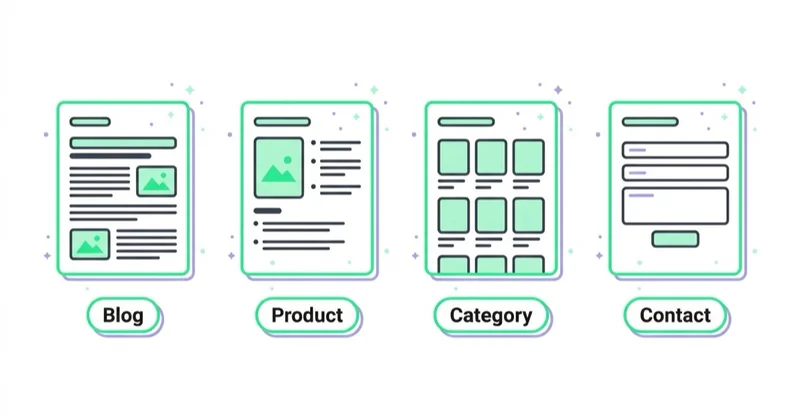
Example pattern:
Question or topic + practical angle + brand
Description should summarize what the reader will learn, not just repeat the title.
For content planning, read What to Write Blog Posts About?.
Service pages
Service page titles should name the service and, when useful, the audience or market.
Examples:
- "Google Ads Management for Ecommerce Brands | Space Ads"
- "SEO Audit for B2B Websites | Space Ads"
Descriptions should explain the service, outcome and next step.
Ecommerce categories
Category metadata should describe the product set and help the user choose.
Include:
- category name;
- important product type;
- relevant modifier;
- delivery, brand or use-case context when useful.
Avoid generating thousands of low-quality, duplicate descriptions from templates only.
Product pages
Product metadata should include the product name and useful differentiator. For merchant visibility, product structured data and feed consistency are also important.
For product SEO and commerce data, read What Is Google Merchant Center and How to Manage It?.
Landing pages
Landing page metadata should match the campaign promise. If the page is organic, it needs stronger informational structure. If it is paid-only, it still needs a clear title and description for quality control, sharing and accessibility.
Read What Is a Landing Page and How to Build One?.
AEO and LLM SEO considerations
Metadata is not enough for AI visibility, but it helps reinforce clarity.
For answer engines and LLM-driven retrieval, the page should also include:
- clear definitions;
- question-led headings;
- concise answers near the top;
- structured sections;
- FAQ;
- source links;
- updated facts;
- internal links to related concepts;
- consistent titles and headings.
Do not write metadata only for algorithms. It should accurately frame the page for humans first. LLM systems and search engines both benefit from unambiguous, well-structured content.
Metadata audit checklist
For each important page, check:
- title exists;
- title is unique;
- title matches the H1 and page intent;
- description exists;
- description is unique for important pages;
- metadata is not keyword-stuffed;
- canonical points to the preferred URL;
- robots directive is correct;
- hreflang is correct if the page has language versions;
- Open Graph title, description and image are present;
- structured data is valid where relevant;
- page is indexable if it should rank;
- Google Search Console shows expected indexing status.
How we approach this at Space Ads
For us the meta title and description are ad copy for the organic results, not a place to stuff keywords. We write them for the click — a clear benefit or an answer to a question, not a string of phrases — because a higher CTR from the same position can bring more traffic than climbing a rank with a dull line. Increasingly these same elements shape how AI answers summarise and cite a page, so they have to be specific and self-contained. Titles get treated as something to test: in Search Console we hunt for queries with plenty of impressions but a low CTR, which is almost always the title falling short rather than the content. We fix the snippet before touching anything else, because it's the cheapest change you can watch land in the traffic.
Common mistakes
| Mistake | Why it hurts | Better approach |
|---|---|---|
| Same title on many pages | URLs become harder to distinguish | Write unique titles for important pages |
| Keyword lists in titles | Looks spammy and unclear | Use natural, intent-led titles |
| Meta description as slogan | Gives no reason to click | Summarize the actual page value |
| Rigid character-count obsession | Can weaken clarity | Front-load meaning and write naturally |
| Wrong canonical | Consolidates the wrong URL | Audit canonical targets |
| Accidental noindex | Removes important pages | Check robots before release |
| Missing Open Graph image | Weak social previews | Add page-specific social images |
| Hreflang to non-equivalent pages | Confuses localization | Link true language/regional equivalents |
FAQ
Is meta title a ranking factor?
The title element is important because it helps describe the page and can influence the title link shown in search. It should be treated as an important SEO element, but not as a shortcut that compensates for weak content.
Does meta description affect rankings?
Meta description is not a simple ranking booster. Its main role is helping describe the page and potentially influencing the snippet and click clarity when Google uses it.
Why does Google rewrite titles and descriptions?
Google may generate title links and snippets from multiple sources if it believes another version better matches the query or page content. Headings, visible text, anchor text and page content can all influence what is shown.
How long should a meta title be?
There is no guaranteed character count. Keep it concise, put the main topic early and make sure it remains understandable if shortened.
How long should meta description be?
Write a concise one- or two-sentence summary. Avoid relying on exact character limits, because snippets vary by query, device and Google systems.
Are meta keywords useful for SEO?
Not for modern Google SEO work. They should not be a priority. Time is better spent on titles, descriptions, content quality, internal links, canonicalization and structured data.
Does every page need a meta description?
Every important indexable page should have a useful description. For low-value utility pages, the priority is lower, and some pages may be better noindexed.
Should brand name be included in every title?
Often yes for trust and consistency, especially for branded sites. But if space is tight, the page topic and user intent should come first.
Conclusion
Meta tags and related SEO metadata are not magic ranking levers, but they are part of a healthy search system. The title helps frame the page. The description can support snippets. Canonical and robots tags influence indexation. Hreflang helps international targeting. Open Graph improves link previews outside search.
The best metadata is accurate, unique and aligned with the page. It helps users decide whether the page is relevant and helps search systems understand the URL in context. For SEO, AEO and LLM visibility, metadata works best when it supports strong content rather than trying to replace it.
Sources and further reading
- Google Search Central - SEO Starter Guide
- Google Search Central - Influencing title links in Search
- Google Search Central - Canonicalization
- Google Search Central - Robots meta tag
- Google Search Central - Localized versions and hreflang
- Open Graph protocol
Continue learning
Continue reading

Core Web Vitals: How to Fix LCP, INP and CLS
Core Web Vitals are assessed from real-user data at the 75th percentile, while lab tools help diagnose causes. Learn what LCP, INP and CLS measure and how to prioritise fixes by metric, template and user impact.

Schema Markup: Which Structured Data Types Actually Do Something
Useful schema markup starts with the page and a supported outcome, not a universal checklist. Learn when WebSite, Organization, Product, Article, breadcrumbs and LocalBusiness are worth implementing — and when markup only adds maintenance.

llms.txt: What the File Does and What It Cannot Do
llms.txt is an index for language models — not a crawler control and not a ranking factor. This is what the format specifies, who reads it today, and how to keep it from going stale.