AI UGC ads are one of the fastest-moving creative trends in paid social. Instead of hiring a creator for every script, brands can use AI avatars, synthetic presenters, dubbing tools and video-generation workflows to create UGC-style ads at scale. The appeal is obvious: more concepts, more hooks, more variations and lower production friction.
AI UGC works best for script testing, product explainers, localisation, simple offer videos and early creative exploration. It works poorly when trust, lived experience, product proof, regulated claims or authentic endorsement are central. The safest workflow is hybrid: AI for volume and speed, humans for strategy, compliance, review and final judgement.
For performance teams, the question is not whether AI UGC looks impressive in a demo. The question is whether it can produce ads that people believe, platforms approve and campaigns can scale profitably.
TL;DR
- AI UGC ads use AI-generated or AI-assisted creators, avatars, voices, scripts or edits to produce ads that resemble user-generated content.
- The main benefit is creative velocity: more hooks, angles and language variants can be produced faster.
- Tools such as TikTok Symphony, HeyGen and AI video editors make avatar and dubbing workflows more accessible.
- AI UGC should not be used to fake real customer experience, fake testimonials or regulated proof.
- Disclosure and transparency matter, especially in the EU where AI Act transparency obligations for certain AI interactions and synthetic content apply from 2 August 2026.
- Human creator ads still matter because authenticity, personal experience and trust are difficult to synthesize convincingly.
- The best testing framework compares AI UGC against human UGC, static ads, product videos and founder-led content.
- Performance should be judged by conversion quality, comments, refund signals and brand impact, not only cheap CPM or CTR.
What Is AI UGC?
UGC stands for user-generated content. In advertising, it usually means creator-style content that feels native to TikTok, Instagram Reels, YouTube Shorts or similar platforms.
AI UGC is not always fully synthetic. It can include:
- AI avatars presenting a script;
- AI dubbing of real creator videos;
- AI captioning and editing;
- AI-generated hooks;
- AI-assisted scripts;
- synthetic product scenes;
- AI voiceovers;
- avatar localisation for different markets.
There are three broad categories:
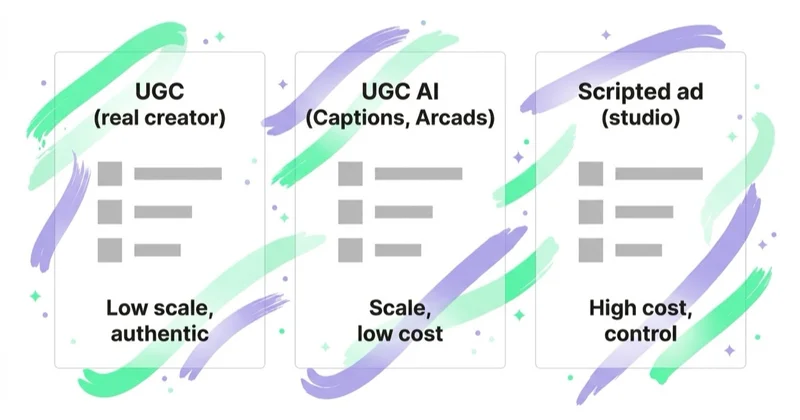
| Type | Example | Risk level |
|---|---|---|
| AI-assisted UGC | Real creator video edited, captioned or translated with AI | Lower |
| AI avatar UGC | Synthetic presenter reads a script | Medium |
| Fully synthetic testimonial-style UGC | Fake customer-like person claims product experience | High |
The last category is where trust and compliance risks become serious.
Why AI UGC Is Growing
Paid social algorithms need creative variation. Meta Andromeda, Advantage+ campaign structures and TikTok's content graph reward accounts that can test many distinct creative angles. A team that can only produce two videos per month will struggle against a team testing 20 angles.
AI UGC helps with:
- faster script testing;
- lower production bottlenecks;
- localisation into multiple languages;
- testing many hooks;
- refreshing fatigued ads;
- producing simple explainers;
- scaling creator-style formats for long-tail products.
For campaign context, see Meta Andromeda, Meta Advantage+ and TikTok Ads.
Tools And Workflows
TikTok Symphony
TikTok Symphony is TikTok's suite of generative AI creative tools. TikTok has introduced Symphony Digital Avatars and AI Dubbing to help brands and creators produce TikTok-first content and localise videos.
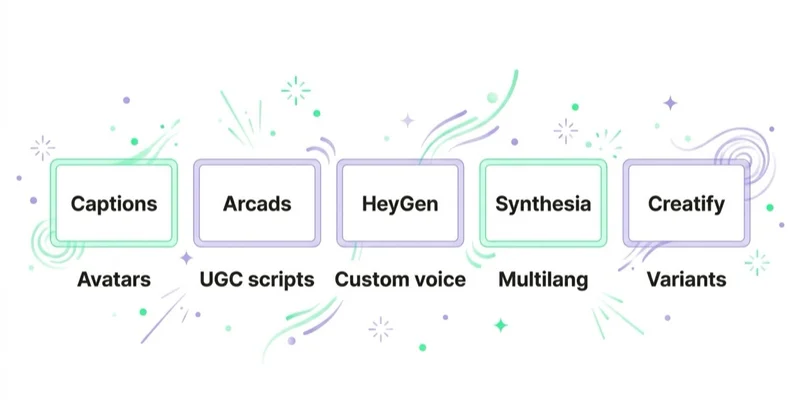
This is especially relevant for international advertisers because the same core message can be adapted across languages without producing every market from scratch.
HeyGen
HeyGen offers AI avatars, presenter-style videos and localisation workflows. It is useful for product explainers, onboarding videos, simple social ads and multilingual variations.
The watch-out is authenticity. An AI avatar can explain a product, but it should not pretend to be a real customer unless that is clearly and lawfully disclosed.
Captions, Arcads And Similar Tools
Tools in this category help with scripting, editing, captioning, avatar-led ads and social-first video generation. They are useful for speeding up production, but each asset still needs brand and compliance review.
AI Video Generators
AI video tools can create scenes, b-roll and concepts that support UGC-style ads. For broader video generation strategy, see AI video generators for ads.
When AI UGC Works
AI UGC can work well for:
- explaining simple product benefits;
- testing hooks before hiring creators;
- localising scripts into new markets;
- refreshing ad variants;
- founder-style explainers when based on real brand input;
- SaaS or app walkthroughs;
- low-risk e-commerce products;
- internal previsualisation.
Example workflow:
- Write 10 hooks from customer objections.
- Generate AI avatar videos for each hook.
- Test them with small budgets.
- Identify winning angles.
- Produce human creator versions of winners.
- Scale with a mix of human and AI-assisted variants.
This uses AI as a research and variation engine, not as a replacement for trust.
When AI UGC Fails
AI UGC fails when the creative needs real experience.
High-risk cases:
- testimonials;
- health, finance or legal claims;
- before/after results;
- children's products;
- political or public-interest topics;
- sensitive personal problems;
- regulated categories;
- products where physical use must be demonstrated precisely.
A synthetic person saying "this cured my problem" is not a harmless shortcut. It can be misleading, non-compliant and damaging to brand trust.
Disclosure And AI Act Considerations
The EU AI Act introduces transparency obligations for certain AI interactions and AI-generated or manipulated content. The European Commission has stated that from 2 August 2026, people in the EU will have to be informed when they are interacting with AI systems or exposed to certain AI-generated or manipulated content.
For advertisers, the practical approach is:
- disclose synthetic or AI-generated people where required;
- avoid fake endorsements;
- keep proof for any claims;
- use contracts for likeness rights;
- follow platform AI-content rules;
- review legal requirements by market;
- avoid using AI to imitate real creators without permission.
Even outside the EU, disclosure is a trust issue. If a user feels tricked, the ad can lose more value than it gained.
How To Test AI UGC
Use a fair testing structure:
| Variant | Purpose |
|---|---|
| Human creator UGC | Trust and authenticity baseline |
| AI avatar UGC | Production speed and script clarity |
| AI-assisted edit of real creator | Localisation and scaling |
| Product-only video | Product clarity baseline |
| Static ad | Control for simple offer communication |
Track:
- hook rate,
- hold rate,
- CTR,
- CVR,
- CPA,
- conversion value,
- comments sentiment,
- refund rate,
- lead quality,
- brand safety feedback.
AI UGC may win top-of-funnel metrics but lose conversion quality. That is why performance should be measured beyond thumb-stop rate.
AI UGC Prompt Framework
Create a short UGC-style ad script for [product].
Audience: [specific buyer].
Main problem: [pain point].
Offer: [clear value proposition].
Tone: [natural / expert / founder / playful].
Proof allowed: [only verified claims].
Restrictions: no fake testimonial, no medical claims, disclose AI avatar if used.
Structure: hook, problem, product explanation, objection handling, CTA.
Length: 20-30 seconds.
The prompt should include compliance boundaries. If the model is not told what not to say, it may overclaim.
Common Mistakes
Faking Customers
Synthetic testimonials can create legal and trust problems. Use AI presenters for explanation, not fake lived experience.
Testing Only Cheap Metrics
Low CPM does not mean profitable creative. Measure downstream quality.
Overusing The Same Avatar
If every ad looks like the same synthetic presenter, fatigue comes quickly.
Ignoring Comments
Users often notice AI. Negative comments can hurt conversion even when CTR looks strong.
Skipping Legal Review
AI likeness, disclosure, claims and platform rules should be reviewed before scale.
How we approach this at Space Ads
At Space Ads, we treat AI UGC as a creative testing layer, not a replacement for trust, proof or human creators. We start with the commercial question: which objection, hook, product benefit or market needs faster learning? AI avatars and scripted videos can help us test angles, localise simple explainers and refresh variants, but every asset still needs claim control, platform review, disclosure checks and comment monitoring. We compare AI UGC against human creator content, product-only videos, static ads and founder-led assets, then judge it by conversion quality, lead quality, refund signals and brand feedback, not only CPM, CTR or hook rate. If a message depends on lived experience, medical or financial proof, before/after evidence or sensitive personal claims, AI should support the workflow rather than impersonate the customer.
FAQ
What are AI UGC ads?
AI UGC ads are creator-style ads made with AI tools, avatars, scripts, dubbing, editing or generated video assets.
Can AI UGC replace human creators?
It can replace some early testing and simple explainers, but it should not fully replace human creators where trust and real experience matter.
Are AI avatars allowed in ads?
They can be allowed, but requirements depend on market, platform, content and disclosure rules. Synthetic people should not be used to mislead users.
Does the EU AI Act require disclosure?
The EU AI Act includes transparency obligations for certain AI interactions and synthetic or manipulated content. From 2 August 2026, relevant disclosure obligations become especially important in the EU.
How should AI UGC be tested?
Test it against human creator ads, product videos and static ads. Measure both media metrics and business quality.
Key Takeaways
AI UGC is useful when it increases creative learning without damaging trust. It is strongest for scripts, hooks, localisation and simple explainers. It is weakest when it pretends to be real customer experience.
The best workflow is hybrid: AI creates speed, humans protect strategy, authenticity, compliance and brand judgement.
We deploy and test UGC creative — including AI-generated — within Facebook and Instagram ads.
Sources and further reading
- TikTok Newsroom: Symphony Digital Avatars
- TikTok Help: Avatar videos with Symphony Creative Studio
- HeyGen AI Avatars
- European Commission: AI Act transparency obligations consultation
- EU Artificial Intelligence Act
Continue Learning
Continue reading

UGC Ads: How to Brief, Source and Run Creator Content That Performs
Creator-led ads can make a product easier to understand, but paid content must not masquerade as an independent customer opinion. Learn how to source, brief, contract, disclose and test creator content responsibly.
How Much Do LinkedIn Ads Cost?
LinkedIn Ads have no fixed CPC or CPM. Cost is set by the audience auction, objective, bidding and relevance. Use this framework to model an affordable CPL, opportunity cost and test budget.
Pinterest Performance+: What You Gain and What You Give Up
Pinterest Performance+ simplifies setup, bidding, targeting and creative, but some controls change materially — especially in catalogue Sales campaigns. Learn what is automated, what remains yours and how to test it fairly.