Meta Andromeda is Meta's ads retrieval system: the infrastructure layer that narrows a very large pool of eligible ads before those ads move into ranking and auction. Meta first described Andromeda publicly in December 2024, then expanded the wider ads recommendation story with GEM in November 2025 and Adaptive Ranking Model in March 2026. For advertisers, the practical consequence is clear: campaign performance now depends less on manual interest-stacking and more on creative diversity, conversion signal quality, account simplification, and disciplined measurement.
TL;DR
- Meta Andromeda is not a campaign type. It is part of Meta's ad delivery infrastructure, so there is no switch to turn it on or off in Ads Manager.
- Andromeda handles retrieval. It helps decide which ads are considered before later ranking and auction stages.
- GEM and Adaptive Ranking Model sit in the broader ranking stack. They point to the same strategic direction: larger AI recommendation models, more automation, and more reliance on high-quality signals.
- Manual targeting still exists, but its role is narrower. In many accounts, broad or Advantage+ audience structures now give Meta more room to find conversion patterns than heavily fragmented interest sets.
- Creative is a larger operational lever. The system needs genuinely different concepts, formats, hooks, offers, and landing-page contexts rather than many near-duplicate ads.
- Conversions API is now baseline infrastructure. Pixel-only measurement gives the algorithm less stable signal, especially after iOS privacy changes, browser restrictions, consent requirements, and ad-blocking.
- E-commerce accounts need product-feed hygiene. Andromeda does not fix weak catalogs, missing values, duplicated events, poor product margins, or broken landing pages.
- The safest 2026 playbook is simple: clean tracking, fewer campaigns, broader learning pools, stronger creative production, clear holdout logic, and business-level reporting beyond ROAS.
What Meta Andromeda is
Meta Andromeda is an ads retrieval engine. Retrieval is the first major filtering step in ad delivery: the system starts with a very large universe of ads that could be shown, then selects a smaller candidate set for deeper ranking and auction evaluation.
That distinction matters because many advertisers talk about Andromeda as if it were a visible Meta Ads feature. It is not. Andromeda is not Advantage+ Shopping, not Advantage+ Audience, not a new objective, and not a setting inside an ad set. It is infrastructure that shapes how Meta's ad system decides which ads deserve deeper consideration.
Meta's December 2024 engineering post described Andromeda as a personalized ads retrieval engine built with deep neural networks and NVIDIA Grace Hopper infrastructure. Meta said the system enabled a 10,000x increase in retrieval model capacity, improved retrieval recall by 6%, and improved ads quality by 8% on selected segments. Meta also connected the shift to the rapid growth of Advantage+ creative and generative AI ad variations.
Those numbers are useful, but they should be interpreted correctly. They are Meta engineering and platform-level metrics, not a promise that every advertiser will see a specific ROAS improvement after changing campaign structure. The article should therefore be read as a technical signal about the direction of Meta's system, not as a plug-and-play benchmark.
Why Andromeda changed the Meta Ads operating model
Meta Ads used to reward a lot of manual audience engineering. Media buyers built stacks of interests, lookalikes, exclusions, retargeting windows, placement splits, and separate ad sets for small hypotheses. That workflow made sense when the platform had stronger deterministic tracking and when the retrieval layer relied more heavily on explicit audience definitions.
Several forces weakened that model:
- Signal loss after privacy changes. App Tracking Transparency, browser restrictions, consent banners, ad blockers, and cookie decay made browser-only conversion data less complete.
- More ad inventory and more creative variants. Reels, Stories, Feed, Messenger, Audience Network, Advantage+ creative variations, and generative assets expanded the number of possible ad-user-placement combinations.
- More compute available at delivery time. Meta can run more sophisticated recommendation systems before and during ranking.
- More automation in advertiser products. Advantage+ tools push advertisers toward broader structures where Meta can test more combinations.
The operating implication is not that targeting no longer matters. The implication is that manual targeting is no longer the main place where most accounts create an edge. The edge increasingly comes from better inputs: conversion events, first-party data, product feed quality, creative angles, offer clarity, and landing-page relevance. For the practical audience layer, see Meta Ads audiences.
Andromeda, GEM and Adaptive Ranking Model
Andromeda is one part of a larger ads recommendation system. In 2026, it is useful to distinguish three names that are often mixed together in agency commentary.
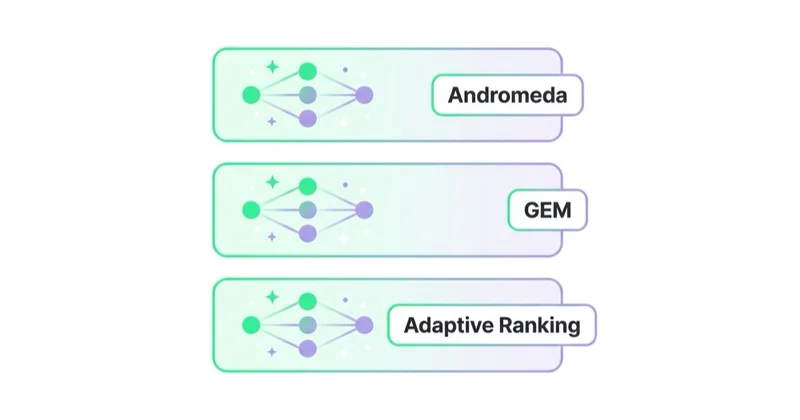
| System | Public Meta source | What it does | Practical meaning |
|---|---|---|---|
| Andromeda | Meta Engineering, December 2024 | Retrieval: selects candidate ads before deeper ranking | More value on creative variety and clean input signals |
| GEM | Meta Engineering, November 2025 | Generative Ads Recommendation Model used to improve recommendation and ranking models | More value on semantic understanding across ads and organic context |
| Adaptive Ranking Model | Meta Engineering, March 2026 | Runtime ads ranking model designed to scale toward LLM-level complexity efficiently | More automation and more importance of high-quality ranking signals |
| Advantage+ products | Meta for Business | Advertiser-facing automation tools for audience, budget, creative, placement and destination optimization | Simpler setup, less manual control, more dependence on signal quality |
This is the clean mental model:
- Retrieval asks: which ads should even be considered?
- Ranking asks: which candidate ad is most likely to produce value in this context?
- Auction asks: which ranked ad wins, at what effective price?
- Advertiser setup provides the inputs: objective, budget, creative, event data, catalog, audience controls, landing page and bid strategy.
When performance changes after an account moves to broader targeting or Advantage+ structures, the cause is rarely "Andromeda only". It is the combined effect of Meta's retrieval, ranking, auction and automation products operating on the advertiser's inputs.
What changed for audience targeting
The biggest practical change is the declining value of over-segmented audience structures.
| Older Meta Ads habit | Why it is weaker now | 2026 replacement |
|---|---|---|
| Many small interest ad sets | Fragments learning and constrains the system too early | Broad or Advantage+ audience structures with clear controls |
| Lookalikes as default prospecting | Often duplicates patterns the algorithm can infer from conversion data | Customer lists and first-party data as signals, not always hard limits |
| Heavy exclusions | Can remove useful learning paths and reduce delivery flexibility | Use only business-critical exclusions |
| Placement-by-placement campaigns | Limits cross-surface learning | Advantage+ placements unless creative or compliance requires separation |
| Retargeting-only budget silos | Can over-credit warm users and inflate platform ROAS | Incrementality checks, exclusions only where financially necessary |
This does not mean that every account should run one broad campaign forever. Regulated products, local services, B2B lead generation, multilingual markets, age-restricted products, premium positioning, and margin-sensitive catalogs still need controls. The difference is that controls should have a business reason, not exist because an old account structure had them. For warm-audience strategy, see Facebook remarketing.
What Andromeda reads from creative
Meta has not published a full advertiser-facing list of every feature its retrieval and ranking systems use. Still, the direction is obvious from Meta's engineering material and from how Advantage+ products work: ads are no longer just matched to predefined audiences; the creative itself becomes a signal.
In practice, creative signal includes:
- visual content: product, person, scene, packaging, usage context, brand marks;
- format: static, carousel, video, Reels-first, Stories-first, catalog creative;
- composition: framing, product scale, text overlay, color contrast, pace and motion;
- message: problem, solution, social proof, offer, urgency, comparison, education;
- landing-page alignment: whether the promise in the ad matches the next page;
- historical response: how similar ads performed for similar users and placements;
- catalog context: product attributes, price, availability, category, margins and variants.
The practical error is creating 20 ads that are technically different but strategically identical. Changing a background color, cropping the same image, or rewriting the first sentence usually does not create a new concept. A stronger creative pipeline creates different reasons to care.
Creative strategy after Andromeda
Creative strategy should move from "make more ads" to "make more distinct concepts".
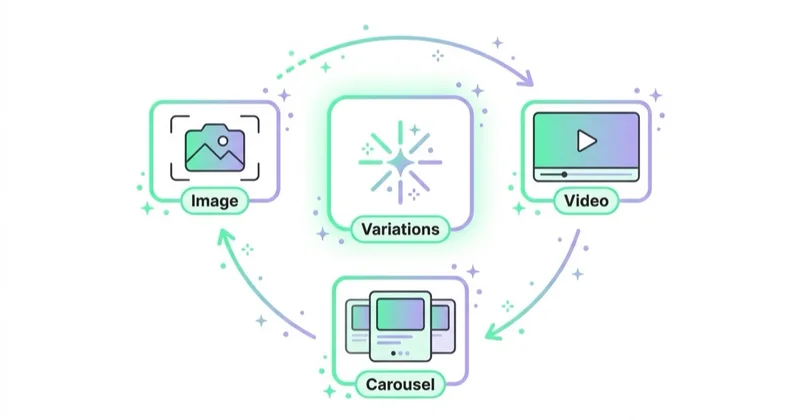
For most performance accounts, a useful monthly creative set includes the same logic used in dynamic creative testing on Facebook and Instagram: build genuinely different angles before multiplying small variations. A useful monthly set includes:
- 3-5 problem-led concepts;
- 3-5 product-benefit or feature-led concepts;
- 2-4 proof concepts, such as reviews, press, founder proof, UGC or before/after logic;
- 2-4 offer or promotion concepts;
- 2-3 category education concepts;
- multiple formats per concept: 9:16, 4:5, 1:1, static, video and catalog where relevant.
For e-commerce, the best creative rarely comes from the ad account alone. It needs product-margin context, stock context, customer reviews, return reasons, size/fit issues, customer-service objections, and category seasonality. Meta can optimize delivery, but it cannot invent a stronger offer or fix a weak product page.
For lead generation and B2B, the creative problem is different. The constraint is often conversion volume and lead quality, not only creative diversity. In those accounts, strong assets usually explain the problem clearly, qualify the audience through the message, and connect ad claims with CRM-stage outcomes rather than form submissions alone.
Measurement is the second major lever
Andromeda-era Meta Ads makes weak measurement more expensive. If the algorithm receives incomplete, duplicated, delayed or low-quality conversion signals, broader automation can amplify the problem.
The minimum measurement stack should include:
- Meta Pixel configured for the correct standard events;
- Conversions API sending server events;
- deduplication between browser and server events using
event_id; - high-quality customer information parameters where consent and law allow it;
- correct event values and currencies;
- product IDs aligned with the catalog;
- UTMs for analytics and cross-channel reporting;
- GA4 or warehouse reporting that does not rely only on platform ROAS;
- consent management that respects GDPR, UK GDPR, ePrivacy and other applicable rules.
Conversions API should not be framed as a way to bypass consent. It is a more resilient server-side measurement path that still needs appropriate consent, governance and data minimization. The business goal is not simply to send more events to Meta; it is to send cleaner, legally usable events that represent real business value. For implementation detail, see Meta Pixel setup and Meta Conversions API.
Recommended campaign structure in 2026
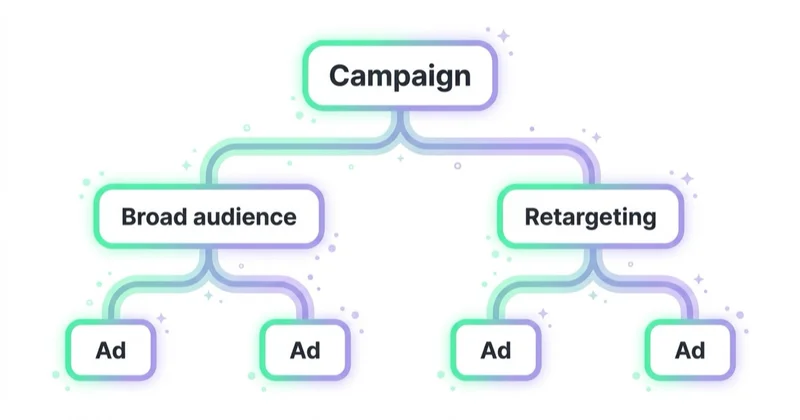
The right structure depends on budget, conversion volume, category and business model. Still, most accounts benefit from fewer campaigns than they used to run.
E-commerce accounts
A practical e-commerce structure often looks like this:
- one main sales campaign or Advantage+ Shopping / Advantage+ Sales structure for broad acquisition;
- one controlled retargeting or retention layer only if it changes messaging or economics;
- one testing lane for new concepts, offers or landing pages;
- product-set separation only when margins, stock, country, language or category behavior justify it.
This structure gives Meta enough signal to learn while still preserving business control. The campaign should not be split by every product category just because a feed has categories. Split only when the decision changes budget, margin or creative.
Lead generation accounts
Lead generation usually needs more quality controls:
- optimize for qualified lead or CRM-stage events where possible;
- connect offline conversion uploads or CRM events;
- separate low-intent lead magnets from high-intent demo or quote requests;
- watch lead quality, not only cost per lead;
- keep audience controls where compliance, geography or qualification requires them.
Broad delivery can generate many cheap leads that never become pipeline. The solution is better downstream signal, not only narrower targeting.
Local and regulated businesses
Local, financial, health, recruitment, political, housing or age-restricted categories need stricter controls. In those cases, the goal is not maximum automation. The goal is enough automation inside the limits required by law, policy, territory and business rules.
A 30-day adaptation plan
Week 1: audit the signal
- Check Pixel events, Conversions API, deduplication and event values.
- Compare Meta purchase / lead counts with GA4, CRM, platform backend and payment data.
- Review Event Match Quality, diagnostics and rejected server events.
- Confirm catalog item IDs, availability, price and product set logic.
- Document the current campaign structure before changing it.
Week 2: simplify the account
- Identify campaigns or ad sets with the same objective, same audience and same creative logic.
- Merge or pause structures that fragment conversion volume without a business reason.
- Keep separate only what needs separate budget, message, margin, geography or compliance treatment.
- Set clear learning windows before judging performance.
Week 3: rebuild the creative pipeline
- Define concept categories, not only asset counts.
- Produce creative around objections, use cases, offers, proof and category education.
- Tag ads by concept, format, angle, product category and landing page.
- Avoid judging new concepts before they receive enough delivery to learn.
Week 4: evaluate with business metrics
- Compare platform ROAS with blended MER, CAC, gross margin, refund rate and CRM quality.
- Separate creative fatigue from tracking issues and offer issues.
- Scale budgets gradually when performance is stable.
- Build a monthly rhythm for concept generation, not a one-off creative sprint.
Common mistakes
| Mistake | Why it hurts | Better approach |
|---|---|---|
| Treating Andromeda as a feature to "implement" | It is infrastructure, not an Ads Manager setting | Improve the inputs the infrastructure reads |
| Replacing strategy with broad targeting | Broad delivery cannot fix weak offer, tracking or creative | Use broad learning pools with stronger creative and measurement |
| Creating many near-duplicate ads | The system receives little new information | Build distinct concepts with different hooks and proofs |
| Moving to Advantage+ with broken tracking | Automation optimizes against noisy events | Fix Pixel, CAPI, deduplication and values first |
| Judging ads too quickly | Early delivery can be unstable and biased | Set minimum spend, event or time thresholds |
| Optimizing only to platform ROAS | Platform attribution can over-credit incremental value | Add blended reporting and holdout logic |
| Over-focusing on e-commerce rules for every account | B2B, lead gen and local services have different constraints | Match structure to business model and conversion quality |
How this applies to e-commerce
E-commerce is where the Andromeda shift is most visible because Meta has rich product, catalog and purchase signals. For catalogue-led campaign structure, see Meta Catalog Ads. The best accounts usually combine:
- a clean product catalog;
- correct content IDs across Pixel, CAPI and feed;
- strong product pages;
- broad acquisition with enough conversion volume;
- creative that explains the product from different angles;
- margin-aware reporting;
- retention and email/SMS flows that reduce dependence on paid acquisition.
For fashion, footwear, beauty and lifestyle brands, the creative pipeline should include lifestyle context, product education, social proof, creator content, size/fit handling, comparison content and offer-based assets. For high-AOV products, more education and trust-building are usually required before the conversion event.
Advantage+ Shopping can be valuable because Meta says it optimizes across creative, targeting, placements, budget and destination. But it is not magic. It works best when the account has enough conversion signal, a reliable catalog, enough creative variation and a business model where the platform's optimization goal matches actual profitability.
How this applies beyond e-commerce
For SaaS, services and B2B, Andromeda does not remove the need for positioning. It makes positioning more important because the creative has to qualify the audience before the form fill.
Good B2B and lead-gen creative should:
- name the problem clearly;
- identify the use case or role without relying only on job-title targeting;
- explain why the offer is different;
- route users to a landing page that continues the same message;
- optimize toward qualified leads, opportunities or revenue when possible;
- import offline conversion events so Meta learns what quality means.
If the only tracked event is a cheap form submission, the system will often find people likely to submit cheap forms. The signal has to match the business outcome. For native lead capture, see Facebook Lead Ads, but the same quality logic applies: raw leads and qualified opportunities are not the same signal.
How we approach this at Space Ads
At Space Ads, we do not treat Andromeda as a tactic to implement; we treat it as a reason to improve the inputs Meta already reads. We audit Pixel and CAPI events, deduplication, values, catalog IDs, product availability, campaign fragmentation, creative concepts, landing-page match and downstream quality before changing budgets. For ecommerce, the priority is a clean feed and margin-aware creative around products that can actually scale. For lead generation and B2B, the priority is qualified signal from CRM or offline events, because the system will otherwise learn toward cheap form submissions. The practical goal is simple: give Meta fewer noisy constraints and more reliable business signals, then judge results with blended reporting rather than platform ROAS alone.
FAQ
Is Meta Andromeda already active in ad accounts?
Yes, Andromeda is part of Meta's ad delivery infrastructure. It is not something that advertisers enable manually. The more useful question is whether the account gives Meta enough clean signal and creative variety for that infrastructure to work well.
Is Andromeda the same as Advantage+?
No. Andromeda is infrastructure for ad retrieval. Advantage+ is a family of advertiser-facing automation products. Advantage+ products may benefit from the same wider AI direction, but they are not the same thing.
Did Andromeda kill detailed targeting?
No. Detailed targeting still exists, but it is less often the main growth lever. In many conversion-focused accounts, excessive audience constraints reduce learning. Targeting should be used when it adds business control, compliance control or meaningful signal.
Should every account use broad targeting?
No. Broad targeting is often a strong default for conversion volume, but it is not universal. Local, regulated, low-volume, B2B, high-ticket and multilingual accounts may need stricter controls or different campaign separation.
How many creatives are needed?
There is no universal number. A small account may need a few strong concepts per month, while a larger account may need a weekly pipeline. The better question is whether the account is producing distinct concepts, not merely many versions of the same ad.
Is Conversions API required?
Conversions API is not technically required to run Meta Ads, but it is baseline infrastructure for serious performance work. It improves the stability of server-side event delivery when implemented correctly with consent, deduplication and strong event data.
Does Andromeda guarantee better ROAS?
No. Andromeda is Meta's infrastructure improvement, not an advertiser guarantee. Better outcomes still depend on product-market fit, offer, creative, landing pages, tracking quality, budget, competition and measurement discipline.
What should be optimized first?
Start with measurement. Fix Pixel, Conversions API, event values, deduplication and catalog IDs before restructuring campaigns. After that, simplify the account and improve the creative pipeline.
Key takeaways
- Meta Andromeda is the retrieval layer in Meta's ads recommendation system.
- GEM and Adaptive Ranking Model show that Meta is scaling the wider ranking and recommendation stack toward larger AI models.
- The advertiser's edge is shifting from manual audience engineering to better inputs: creative, tracking, feed quality, first-party data and business measurement.
- Broad or Advantage+ structures can work well, but only when they are fed clean data and distinct creative.
- E-commerce accounts should connect Andromeda-era strategy with catalog quality, margin, stock, landing pages and post-purchase economics.
- B2B and lead-gen accounts should focus on qualified downstream events, not only cheap leads.
Sources and further reading
- Meta Engineering — Meta Andromeda: Supercharging Advantage+ automation with the next-gen personalized ads retrieval engine
- Meta Engineering — Meta's Generative Ads Model (GEM): The Central Brain Accelerating Ads Recommendation AI Innovation
- Meta Engineering — Meta Adaptive Ranking Model: Bending the Inference Scaling Curve to Serve LLM-Scale Models for Ads
- Meta for Business — Advantage+ audience
- Meta for Business — Advantage+ shopping campaigns
- Meta for Developers — Conversions API documentation
- Space Ads — Meta Ads service overview
- Space Ads — Fashion and Footwear Paid Media
Continue learning
Continue reading
Facebook Remarketing: How Meta Retargeting Works and Why Use It
Facebook remarketing reaches people who already interacted with a brand. Learn how Meta retargeting works, which audiences to build, how to use Pixel, CAPI and catalog ads, and how to measure incrementality.
Meta Ads Audiences: How to Build Facebook Audiences
Meta Ads audiences are no longer just narrow interest groups. Learn how Custom Audiences, lookalikes, Advantage+ audience, exclusions, Pixel, CAPI and first-party data work together.
What Is Meta Pixel and How to Use It?
Meta Pixel is browser-side tracking for Meta Ads, but a useful setup depends on event design, parameters, consent, CAPI and deduplication. This guide explains which events to configure for ecommerce and lead generation, how to test them, and why Pixel data should be checked against GA4, CRM or backend results before campaigns rely on it.