Fashion influencer marketing is the use of creators, stylists, customers, tastemakers and social personalities to make a fashion brand easier to discover, trust and buy from. For apparel, footwear and accessories, it works because the product is visual, social and identity-driven: people want to see how an item looks on a real person, how it is styled, and whether it belongs in a world they want to join.
The weak version is a collection of one-off sponsored posts with no shared objective or learning record. The stronger version is a creator programme: a repeatable system for selecting suitable creators, protecting creative credibility, agreeing rights, reviewing claims, measuring commercial outcomes and testing selected content through paid social. In that model, influencer work becomes part of the fashion social media, merchandising and paid media system—not a pile of isolated deliverables.
TL;DR
- Fashion influencer marketing should be managed as a system. One-off posts rarely compound. A creator programme builds content, social proof, demand and ad creative over time.
- Audience fit matters more than follower count alone. Size, reach and engagement estimates are inputs; customer relevance, creative quality, brand context and credible demand evidence determine the role.
- Contractual rights and platform permission are different. A Spark or Partnership Ads authorization does not automatically grant every reuse, edit, territory or duration the brand may want.
- Paid amplification is the scaling layer. Spark Ads on TikTok and Partnership Ads on Meta can turn proven creator content into performance creative.
- Disclosure is not optional. Sponsored relationships, gifts, affiliate links and paid partnerships need clear disclosure under the relevant market rules.
- Measurement must include cost, uncertainty and downstream quality. Track creator and media cost, new-customer contribution, returns, paid-ad results and controlled lift where feasible—not likes alone.
- Premium and luxury brands need more restraint. Creator fit, taste, scarcity and context matter more than mass reach.
Why influencer marketing works so well in fashion
Fashion is not bought only for function. It is bought for identity, fit, taste, status, belonging, confidence and context. A product page can show the garment. A creator can show how the garment lives.
That makes creators useful in four ways:
- They show real-world fit. The same jacket looks different across body types, styling choices, lighting and movement.
- They translate the brand into an aesthetic. A creator can make a product feel streetwear, minimalist, premium, performance-led, festival-ready or office-friendly.
- They borrow trust from an existing community. The audience already understands the creator's taste and references.
- They create platform-native material. Creator content can provide new hooks, demonstrations and styling contexts to test against brand-made creative; performance should be established in the account, not assumed from the format.
For fashion brands, this matters because discovery usually starts before search. Many people do not search for a product until they have already seen it on TikTok, Instagram, Pinterest, a creator's Reel, a styling video or a friend's post. Influencer marketing therefore creates demand as much as it captures it.
The creator programme model
A proper fashion influencer programme has five connected layers.
| Layer | What it answers | Output |
|---|---|---|
| Creator strategy | Which audiences, aesthetics and segments matter? | Creator map and target tiers |
| Sourcing and vetting | Which creators are worth testing? | Shortlist, scorecard and outreach list |
| Briefing and rights | What should be created and how can it be used? | Brief, disclosure rules, usage terms |
| Organic learning | Which ideas earn meaningful attention or action? | Evidence across retention, saves, qualified comments, clicks and sales |
| Paid testing | Which authorized assets deserve more investment? | Controlled creative tests, Spark Ads, Partnership Ads and reporting |
The goal is not simply "get influencers to post." The goal is to build a repeatable pipeline where creators create culturally credible content, the brand learns which messages and styling angles work, and paid media scales the strongest assets.
Creator tiers: how to use each level
Creator size is a planning dimension, not a quality score. A portfolio can reduce dependence on one personality and generate more creative hypotheses, while a carefully chosen larger partnership may be appropriate for a cultural or launch objective. Assign each creator a job before choosing a tier.
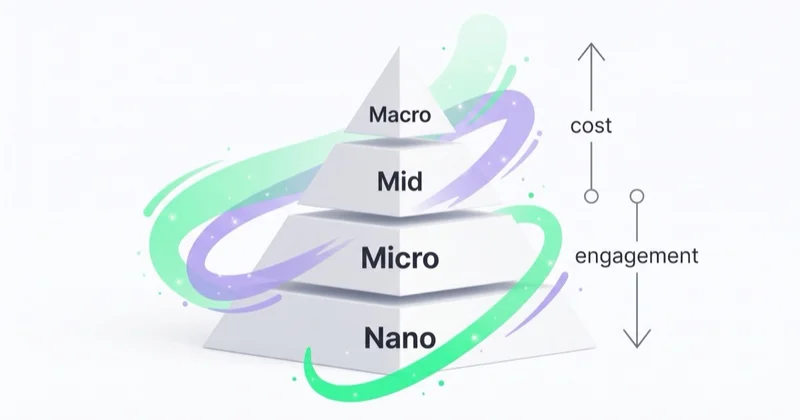
| Tier | Typical role | Best use | Main risk |
|---|---|---|---|
| Nano creators | Niche community context and product feedback | Seeding or small paid tests with explicit expectations | High coordination cost and limited predictable reach |
| Micro creators | Multiple creative perspectives and focused audiences | Always-on testing or ambassador development | Quality and audience validity vary |
| Mid-tier creators | More predictable reach and production quality | Product launches, seasonal pushes, ambassador tests | Higher fees require stronger vetting |
| Macro creators | Mass reach and cultural signal | Major launch moments, collaborations, brand awareness | Expensive and less precise |
| Customers and UGC creators | Practical product proof | Ad creative, product demos, reviews, try-ons | May need more production guidance |
Do not assume that a smaller creator is cheaper after management time, product cost, rights and unusable deliverables are included. Calculate cost per approved asset, cost per qualified reach and downstream contribution. A useful programme may combine customers, specialist creators and a few larger partners, but the mix should follow the objective and evidence.
How to find the right creators
Good sourcing starts with the brand's customer, not with a follower threshold. A streetwear label, a premium footwear brand, an activewear brand and a luxury accessories brand should not be looking for the same type of creator.
Useful sourcing routes:
- creators already tagging, mentioning or buying from the brand;
- customers who create high-quality styling content;
- TikTok One, TikTok Content Suite and current platform creator tools;
- Instagram and TikTok search around aesthetics, subcultures, occasions and product categories;
- affiliate networks and creator commerce platforms;
- stylists, editors, photographers, athletes, dancers, creators and niche community figures;
- public category conversations, events and editorial communities;
- organic social listening around product use cases.
TikTok One replaced TikTok Creator Marketplace and TikTok Creative Challenge for new brand campaigns after March 10, 2025. Content Suite can also surface eligible organic branded videos and support Spark authorization. Product availability still varies, so operating instructions should be checked in the live business account.
Existing affinity is a useful sourcing signal, but it does not remove the need for due diligence, a fair commercial agreement or disclosure. Treat self-reported audience screenshots as one input and request platform-native insights where appropriate. Sample recent posts rather than relying on a lifetime average that can hide a viral outlier or a changed audience.
Creator vetting scorecard
Follower count is a weak proxy. A practical creator scorecard should cover commercial fit, creative fit and operational risk.
| Criterion | What to check |
|---|---|
| Audience match | geography, age range, style identity, price tolerance, interests |
| Aesthetic fit | whether the creator's world matches the brand's positioning |
| Comment quality | real questions, outfit discussion, product curiosity, community language |
| Engagement pattern | consistency across posts, not one viral outlier |
| Content formats | try-ons, styling, GRWM, hauls, reviews, street interviews, edits, live shopping |
| Brand safety | past controversies, values mismatch, risky claims, competitor conflicts |
| Commercial discipline | responsiveness, deadlines, rights, invoicing, disclosure and audience-data accuracy |
| Paid potential | whether the content could credibly run as an ad |
| Accessibility and production | captions, safe zones, audio rights, file quality and usable variants |
The last point is easy to miss. If a creator's content is visually strong but too personal, too trend-dependent or too low-resolution to use in ads, it may still work organically but it will not feed the paid pipeline. For performance-oriented fashion brands, paid potential should be part of vetting from the start.
Brief the point of view, not the script
Over-scripting is one of the fastest ways to make creator content underperform. The audience follows the creator for taste, language, humor, references and format. A script written by the brand often removes the very thing the brand is paying for.
A strong brief should define:
- the campaign objective;
- the product or collection focus;
- the target customer or occasion;
- mandatory claims and claims to avoid;
- styling direction and brand guardrails;
- key product details such as fit, material, size, care or use case;
- disclosure requirements;
- deliverables, deadlines and review process;
- paid usage rights and the required Spark Ads or Partnership Ads permissions;
- reporting requirements and tracking links or codes.
It should not dictate every sentence, every hook and every transition. The better approach is to provide the strategic angle and let the creator translate it into the native format their audience already understands.
Usage rights, licensing and paid amplification
The contract often determines whether influencer marketing becomes a growth channel or a one-day post. Usage rights specify how the brand can reuse the content after it is created.
Important commercial terms to define:
- Organic reposting: use on the brand's own social channels.
- Paid media usage: use as ad creative in Meta, TikTok, Pinterest, YouTube or other channels.
- Creator identity and platform permission: running ads with the creator's handle or partnership context where supported.
- Duration: 30 days, 90 days, 6 months, 12 months or perpetual rights.
- Territory: markets where the content may be used.
- Exclusivity: whether the creator can work with competing brands.
- Editing rights: cropping, captions, cutdowns, subtitles, hooks and ad variations.
- Usage limits: channels, formats and contexts that are excluded.
- Deliverable acceptance: objective requirements, revision limits and what happens if a platform removes a post.
- Payment and cancellation: fees, expenses, deadlines, kill fees and treatment of shipped or loaned product.
- Claims and disclosure: approved evidence, prohibited claims, required labels and responsibility for corrections.
- Third-party rights: music, locations, photographers, models, trademarks and any other material in the asset.
- Synthetic alteration: whether generative edits, voice changes, body reshaping or new contexts are permitted.
Rights should be negotiated before the post goes live and described precisely enough for both parties to understand the use. Platform authorization is not the same as a licence. A creator can provide a Spark Ads code or Partnership Ads permission, but the contract must still cover the intended duration, territory, edit and media use. Conversely, a broad contractual licence does not bypass the platform's technical permissions or eligibility rules.
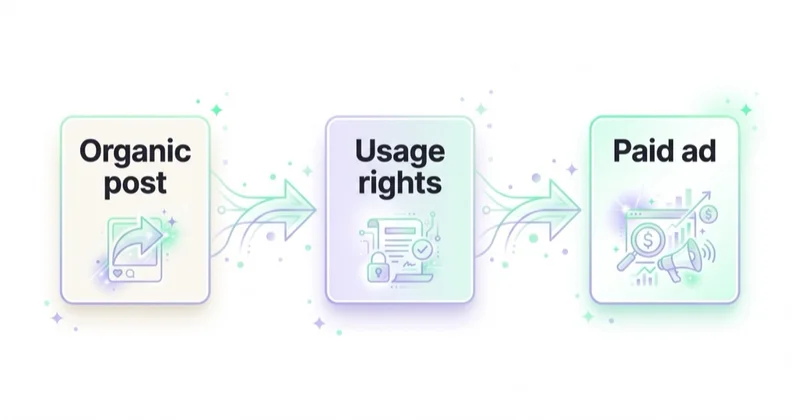
Turning creator content into paid ads
The biggest performance lever is often not the sponsored post itself. It is what happens after the post reveals a winning angle.
On TikTok, Spark Ads use eligible organic posts from a brand or an authorizing creator. TikTok attributes views, comments, shares, likes and follows generated during promotion to the organic post. Authorization duration can be set to match the campaign. Confirm the final text, music and edit before launch because the selected organic-post setup constrains what can be changed.
On Meta, Partnership Ads can run with creator identity or partnership context when the accounts, content and permissions are eligible. Creators and advertisers must remain compliant with Meta's requirements, and branded content—including gifted product and affiliate relationships—requires the paid partnership label under Meta's policy. Music that is acceptable in an organic post may not be cleared for advertising, so audio rights must be checked before an asset is promised for paid use.
A practical workflow:
- Seed and brief a portfolio of creators.
- Track organic signals: retention, saves, shares, qualified comments, profile visits, link clicks and fulfilled sales where observable.
- Shortlist posts that support a defined creative hypothesis; do not treat organic reach as proof of paid performance.
- Secure or activate usage rights and authorization.
- Test the winning posts as Spark Ads, Partnership Ads or standard paid social creatives.
- Compare creator assets with relevant brand-made controls using the same objective, audience conditions and decision window.
- Record which hook, product, creator context and offer may explain the result; avoid declaring the creator the cause from one ad.
- Feed the supported learning back into the next brief and merchandising decision.
This loop is especially important because platform targeting is increasingly automated. Creative quality, product-market fit, landing page relevance and measurement discipline are now more controllable than narrow audience targeting.
Disclosure and compliance
Influencer marketing is advertising when there is a material connection between the brand and the creator. That connection can include payment, free product, affiliate commission, discounts, trips, event access or any other benefit that could affect how the audience interprets the recommendation.
Rules vary by market, so legal review may be needed for international campaigns. In the US, the FTC expects material connections—including payment, free or discounted product, affiliate commission, employment and personal relationships—to be disclosed clearly and conspicuously with the endorsement. A video disclosure should appear in the video, not only in its description; livestream disclosures should recur. Platform labels can be required as well, but brands should not assume that a tool alone satisfies every applicable law.
Examples of risk:
- hiding disclosure only at the end of a caption;
- using ambiguous labels such as "thanks" or "collab" without clear ad context;
- letting a creator make product claims the brand cannot substantiate;
- using affiliate links without disclosure;
- reposting creator content as brand content without the right permissions;
- running paid ads from creator content without proper authorization or licensing.
- describing a gifted fashion item as “sustainable,” “green” or “eco-friendly” without specific, substantiated support;
- allowing an affiliate code to stand in for a disclosure when the financial relationship is not obvious.
Fashion claims require particular care. Material composition, performance, origin, scarcity, price comparisons and environmental benefits must be accurate. The UK Competition and Markets Authority's fashion guidance warns against broad, unexplained environmental claims and makes clear that each business remains responsible for claims about third-party products it sells. The US FTC similarly advises against broad, unqualified “green” or “eco-friendly” claims. Give creators a claim sheet linked to evidence, not a list of adjectives.
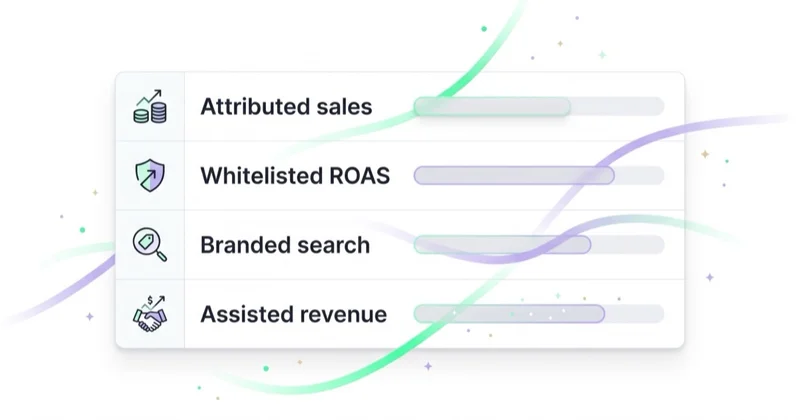
Compliance should not be treated as an afterthought. It belongs in the brief, agreement, training, pre-publication review and live monitoring. The FTC says advertisers that pay and direct endorsers need reasonable training and monitoring programmes; if regular monitoring is not feasible, pre-approval is the safer operating model.
Measurement: what to track
Fashion influencer marketing creates both immediate and delayed value. Last-click attribution captures only part of it.
| Metric | Why it matters |
|---|---|
| Promo code and affiliate sales | Useful for direct attribution, especially by creator |
| Creator content ad performance | Shows whether content can scale through paid media |
| Branded search change | A useful diagnostic; a causal lift claim needs a credible control or experiment |
| Direct and returning traffic | Captures users who remember the brand but do not click immediately |
| Assisted conversions | Describes observed paths, but does not prove the creator caused the purchase |
| Saves, shares and qualified comments | Signals creative resonance and purchase intent |
| New customer rate | Separates existing demand from new reach |
| Fulfilment, return and cancellation rate | Tests whether attributed demand becomes durable net sales |
| New-customer contribution | Connects fulfilled revenue with product, creator, affiliate, media and variable costs |
For fashion ecommerce, measurement should be reconciled against fulfilled net sales, not gross platform revenue. Returns, cancellations, discounts, creator fees, seeding cost, shipping, payment fees, media and affiliate commission all change the commercial result. Keep attributed revenue and incremental impact separate: codes and tracking links identify a recorded route to purchase, while a holdout, geographic comparison or well-designed lift study is needed for a stronger causal claim.
The reporting layer should connect creator activity with GA4, paid social, search demand, CRM data and the order book. Use consistent campaign parameters and creator identifiers, document attribution windows and deduplicate codes, links and paid ads at order level. A useful cross-channel reporting setup preserves disagreement between systems instead of forcing every platform claim into one total.
Premium and luxury fashion: a different rulebook
Premium and luxury fashion influencer marketing has less tolerance for random reach. The wrong creator can dilute the brand faster than the right creator can grow it.
For higher-positioned brands, the priorities change:
- taste and context over scale;
- long-term association over transactional posts;
- editorial quality over aggressive discount messaging;
- careful gifting and seeding over mass outreach;
- fewer, stronger relationships over creator volume;
- paid amplification used selectively to protect scarcity.
The same principle from luxury fashion marketing applies: build desire without turning the brand into a coupon-driven commodity. In this segment, creators should reinforce the world of the brand, not simply push product.
How Space Ads approaches fashion influencer marketing
Our standard approach treats creator work as part of a broader fashion growth system: merchandising, organic social, paid social, ecommerce measurement and brand positioning need shared decisions. An initial audit maps the objective, creator contracts, usage rights, disclosure controls, asset quality, media permissions, tracking and returns-adjusted economics before recommending scale.
The practical approach is to build the learning loop deliberately. Creators and organic social generate hypotheses about styling contexts, objections and product narratives. Paid media can test selected authorized assets through Spark Ads, Partnership Ads or standard formats. Reporting then connects creator cost, media spend, attributed outcomes, new-customer contribution and uncertainty. “Winner” means an asset that met a pre-agreed decision rule—not simply the post with the most views.
For fashion and footwear brands, that usually means connecting influencer activity with fashion and footwear paid media, Meta Ads, TikTok Ads, product feed quality, landing pages and retention. A marketing audit is often the best starting point when the brand already has creators but cannot tell which content, audience or channel is actually creating profitable growth.
Build order for a fashion influencer programme
- Define the role of creators. Decide whether the programme is mainly for awareness, content production, product education, launch support, affiliate sales or paid creative.
- Map the right creator universe. Build shortlists by aesthetic, segment, market, audience fit and product use case.
- Create a vetting scorecard. Check engagement quality, brand safety, content quality, audience match and paid-media potential.
- Write a usable brief. Provide the product, angle, proof points, guardrails and disclosure requirements without scripting the creator's voice.
- Secure rights upfront. Include paid usage, editing, creator-identity permissions, duration, territory and exclusivity in the agreement.
- Test organically first. Use creators to discover which hooks, styling ideas and formats generate real attention.
- Amplify winners. Put budget behind the posts that show signal, not behind every deliverable.
- Measure commercial evidence. Combine creator-level cost, fulfilled orders, returns, paid-ad performance, new-customer contribution and controlled lift where feasible.
- Renew selectively. Keep the creators whose content and audience compound; stop the partnerships that only produce vanity metrics.
Common mistakes
| Mistake | Better approach |
|---|---|
| Choosing creators mainly by follower count | Score audience fit, aesthetic fit, comment quality and paid potential |
| Paying for posts without usage rights | Negotiate paid usage, editing and creator licensing before content goes live |
| Over-scripting | Brief the point of view and guardrails, then let the creator speak naturally |
| Treating gifted posts as free media | Account for product cost, operations, shipping and creator management |
| Measuring only likes | Track fulfilled sales, returns, creator and media cost, contribution and lift evidence |
| Ignoring disclosure | Build disclosure and claim review into the process |
| Keeping influencer and paid teams separate | Use creator content as a tested input for paid social |
| Treating platform permission as a full licence | Align the contract, creator consent and platform authorization |
| Repeating vague sustainability language | Give creators specific, substantiated claims and necessary qualifications |
FAQ
What is fashion influencer marketing?
Fashion influencer marketing is the practice of partnering with creators to promote apparel, footwear or accessories through social content, product styling, reviews, affiliate links, ambassador relationships and paid amplification. It works best when it is run as a structured programme rather than isolated sponsored posts.
How do fashion brands find influencers?
Fashion brands can source creators from genuine customer content, existing brand mentions, TikTok One and Content Suite, Instagram's creator marketplace, social search, affiliates and relevant cultural communities. Shortlist by the programme's objective, audience evidence, creative fit, disclosure history and operating reliability—not follower count alone.
How much does fashion influencer marketing cost?
Costs range from product gifting and affiliate commission to flat fees, hybrid deals and larger ambassador contracts. The real budget should include product cost, creator fees, shipping, management time, usage rights and paid media spend for amplifying the best content.
Are micro-influencers better for clothing brands?
Neither tier is universally better. Smaller creators can offer niche context and more creative tests, but management and unusable-content costs can be high. Larger creators can provide reach or cultural signalling, but concentration and fee risk are greater. Compare total cost, qualified reach, asset usability and commercial outcomes for the assigned job.
How can influencer content become paid ads?
The brand needs both contractual usage rights and the relevant platform authorization. On TikTok, Spark Ads can use eligible organic posts from the brand or an authorizing creator. On Meta, Partnership Ads can use creator identity or partnership context when the accounts, content and permissions qualify. Organic signal helps shortlist assets, but paid performance still needs a fair test.
How should influencer marketing be measured for fashion?
Measure fulfilled sales through codes and links, paid performance of authorized creator assets, new-customer contribution, return and cancellation rates, and controlled lift where feasible. Branded search and assisted conversions are diagnostics, not automatic proof of causality. Likes and follower counts describe attention, not business value.
Do influencer posts need to be disclosed?
Yes. When a creator has a material connection to a brand, the relationship should be disclosed clearly according to the rules in the relevant market. Payment, gifting, commission and other benefits can all create a disclosure requirement. Ambiguous or hidden disclosure creates legal, platform and trust risk.
Key takeaways
- Fashion influencer marketing works because creators show product fit, styling, identity and social proof.
- A creator programme should connect sourcing, vetting, briefing, rights, organic testing, paid amplification and measurement.
- Usage rights and disclosure are operational foundations, not legal details to add later.
- Spark Ads and Partnership Ads can make authorized creator content available for paid testing; they do not guarantee performance.
- Measurement should connect creator and media cost with fulfilled sales, returns, new-customer contribution and credible lift evidence.
Sources and further reading
- TikTok for Business - About Spark Ads
- TikTok for Business - About TikTok Content Suite
- Meta Help Center - Partnership ads on Facebook and Instagram
- Meta Help Center - What is considered branded content
- U.S. Federal Trade Commission - Disclosures 101 for social media influencers
- U.S. Federal Trade Commission - Endorsement Guides: questions and answers
- ASA / CAP - Influencers' guide to making clear that ads are ads
- UK Competition and Markets Authority - Fashion retail: consumer law when making green claims
Continue learning
- Social Media Marketing for Fashion Brands: organic, creators and paid as one system
- How to Advertise a Clothing Brand
- Facebook, Instagram and TikTok Ads for Fashion Brands
- Spark Ads on TikTok: what they are and how to use them
- Luxury fashion marketing: how premium brands build desire without discounts
- Fashion marketing - Fashion and footwear paid media
Continue reading
Social Media Marketing for Fashion Brands: Organic, Creators, Commerce and Paid
Social media marketing for fashion brands works when organic content, creators, social commerce and paid amplification operate as one system. This guide explains platform roles, content pillars, creator rights, catalogue hygiene, measurement and how to turn attention into profitable demand.
How to Choose a TikTok Ads Agency (and When You Actually Need One)
Choose a TikTok Ads agency by examining creative research and production, creator rights, Spark Ads, measurement, Business Center access and commercial judgment—and decide whether an agency is the right model.
Fashion PR in 2026: What It Is and How It Works With Performance Marketing
Fashion PR builds credibility, desire and cultural relevance through earned attention: editorial coverage, events, gifting, stylists, creators and digital PR. This guide explains how PR should connect with performance marketing so demand is captured, not wasted.