Meta Advantage+ is not one single campaign type. It is a family of AI-powered automation features inside Meta Ads, covering areas such as audience expansion, placements, campaign budget allocation, creative enhancements and sales-focused automation. The practical question in 2026 is no longer only whether to run an Advantage+ Shopping campaign. The real question is which Advantage+ controls should stay on, which need business constraints and whether the account has enough creative, conversion data and measurement quality for automation to work well.
TL;DR
- Advantage+ is a family of automation features. It can affect audience, placements, budget, creative and sales campaign setup.
- It is not one magic switch. A campaign may use Advantage+ audience, Advantage+ placements or Advantage campaign budget without being fully automated in every area.
- Meta has moved automation deeper into campaign setup. The old manual-versus-Advantage+ distinction is less clear than it used to be, especially for sales, app and lead objectives.
- Advantage+ audience expands beyond suggestions. Meta says it uses advertiser inputs as suggestions and can search more widely, while strict constraints such as location, minimum age, language and custom-audience exclusions can still apply.
- Advantage+ placements automate where ads appear. Meta says it can show ads across Facebook, Instagram, Messenger, Reels, Stories, Feed, Marketplace and Audience Network where eligible.
- Automation needs good inputs. Pixel, Conversions API, event quality, catalog hygiene, creative variety and landing-page quality matter more when the system has more control.
- Do not disable everything by default. Limit automation only when there is a clear business, legal, creative or measurement reason.
What Meta Advantage+ is
Meta Advantage+ is the automation layer in Meta Ads. It uses Meta AI systems to help decide who sees ads, where ads are delivered, how budget is distributed and how creative assets can be adapted.
It is better to think about Advantage+ as a group of controls rather than one product.
Important parts include:
- Advantage+ audience for audience expansion and AI-led delivery;
- Advantage+ placements for automated placement delivery;
- Advantage campaign budget for distributing budget between ad sets;
- Advantage+ creative enhancements for creative and format optimisation;
- Advantage+ sales or shopping-style automation for more automated conversion campaigns;
- Advantage+ detailed targeting or custom audience expansion where available.
This distinction matters because advertisers often say "Advantage+ is bad" or "Advantage+ works" without naming the specific setting. One account may benefit from Advantage+ placements and broad audience expansion while still needing manual budget separation, exclusions or creative control.
What changed after the old ASC model
For a period, advertisers thought about Advantage+ mainly through Advantage+ Shopping Campaigns, often shortened to ASC. That format was strongly associated with e-commerce automation: broad delivery, automated placements and limited manual audience control.
Meta then started moving more Advantage+ features into the normal campaign setup flow. Industry reporting in 2025 described the shift from Advantage+ Shopping Campaigns toward Advantage+ Sales Campaigns and a more unified setup where AI optimisations are applied to sales, app and lead campaigns rather than living only in a separate shopping path.
The practical impact is clear in many accounts:
- automation is presented as the default path more often;
- manual and automated setup are less separated;
- individual Advantage+ controls can be enabled or disabled inside the campaign workflow;
- sales, leads and app objectives may show stronger Advantage+ defaults;
- advertisers need to evaluate settings one by one instead of judging only a campaign label.
This is why a modern Advantage+ discussion should focus on controls, inputs and business constraints, not only on the old ASC name.
Advantage+ audience
Meta says Advantage+ audience combines advertiser knowledge with AI to reach the most relevant audience. The system can use usual audience selections, such as customer lists, gender or interests, and expand beyond them.
Meta also explains that advertisers can still set strict criteria where AI should not expand beyond, including business constraints such as minimum age, location, language and custom audience exclusions.
This creates two layers:
| Layer | Meaning |
|---|---|
| Suggestions | Inputs that guide Meta, such as customer lists, interests or demographics |
| Controls | Strict limits Meta should respect, such as location, minimum age, language and exclusions |
The mistake is treating all audience inputs as hard targeting. In Advantage+ audience, some inputs are directional. If an advertiser needs a legally or commercially strict boundary, it should be configured as a real control where available.
Advantage+ placements
Advantage+ placements automate where ads appear across Meta technologies. Meta says automated placements can show ads where customers spend time, including Facebook, Instagram, Messenger, Reels, Stories, Feed and Audience Network where eligible.
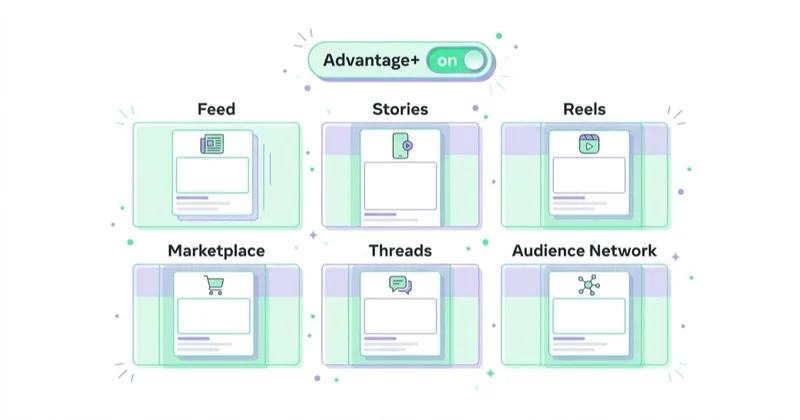
The idea is simple: instead of manually deciding that an ad should show only in Instagram Feed or only in Stories, the system can find cost-effective opportunities across placements.
Advantage+ placements usually make sense when:
- assets are prepared for multiple formats;
- the campaign objective is performance-based;
- the account has enough conversion signal;
- placement-level restrictions are not required;
- the creative can work across Feed, Stories, Reels and other surfaces.
Manual placements may be justified when:
- the creative is built for one format only;
- the brand has strict placement controls;
- a regulated product needs limited delivery;
- performance reports show persistent waste in a specific placement;
- a campaign has an awareness or creative test structure where placement isolation is intentional.
The best answer is not always full automation or full manual control. It is to match placement logic with creative readiness and business constraints.
Advantage campaign budget
Advantage campaign budget, historically similar to campaign budget optimisation, lets Meta distribute budget across ad sets based on performance opportunities. The benefit is flexibility. The risk is that the system may allocate budget away from a segment that the business still needs to support.
Use campaign-level budget when:
- ad sets are comparable;
- each ad set can serve the same business goal;
- the system has enough budget to learn;
- the advertiser trusts Meta to shift spend between segments;
- reporting does not require strict budget separation.
Use ad-set-level budgets or stricter controls when:
- markets need fixed spend;
- margins differ by product group;
- audiences represent different funnel stages;
- one country or product line must receive guaranteed spend;
- a test needs equal budget between variants.
Budget automation is useful, but it should not override business economics.
Advantage+ creative
Advantage+ creative features can adjust or optimise aspects of creative delivery. Depending on available settings, Meta may adapt format, text, images, music, background, standard enhancements or other creative elements.
These tools can help when creative assets are flexible and the goal is performance learning. They can hurt when brand control, compliance, product accuracy or legal approval is strict.
A practical rule:
- use creative automation for lower-risk assets and broad performance testing;
- review previews and diagnostics;
- keep controlled versions for regulated claims, luxury positioning, medical, financial or legal-sensitive categories;
- measure whether enhancements improve business outcomes, not only delivery volume.
Creative automation does not remove the need for a creative strategy. Meta can recombine, crop or adapt assets, but it cannot invent a better offer or fix weak positioning.
How Advantage+ connects with Meta Andromeda
Meta Andromeda is an ads retrieval system. Advantage+ is the advertiser-facing automation layer. They are not the same thing, but they point in the same direction: Meta Ads increasingly depends on broad learning pools, strong creative inputs and reliable conversion signals.
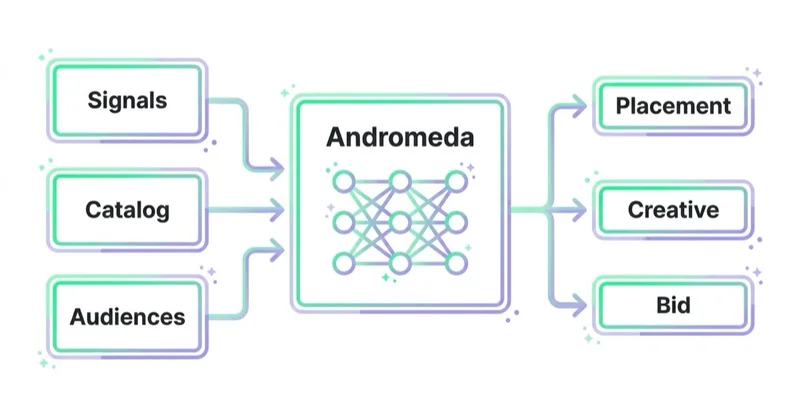
The operating model changes from manual micro-targeting toward:
- cleaner conversion tracking;
- stronger Conversions API implementation;
- better event value and deduplication;
- more distinct creative concepts;
- fewer unnecessary campaign fragments;
- clear business reporting beyond platform ROAS;
- catalog and product-feed hygiene for e-commerce.
When Advantage+ performs poorly, the cause is often not simply "AI bad". The cause may be weak tracking, thin creative, poor catalog data, low budget, bad landing pages or a mismatch between platform optimisation and real business value.
When to leave Advantage+ on
Leave Advantage+ controls on when:
- conversion tracking is reliable;
- the campaign has enough budget and event volume;
- the account has several distinct creative concepts;
- audience constraints are not legally or commercially strict;
- the business can accept automated budget distribution;
- placement variety is supported by assets;
- reporting uses business metrics, not only ad platform metrics.
E-commerce accounts often benefit when they have clean Pixel and Conversions API data, a strong catalog, enough purchase volume and creative that covers multiple angles.
Lead generation accounts can benefit too, but only if lead quality is measured. If the system optimises toward cheap low-quality leads, broader automation may amplify the wrong outcome.
When to limit Advantage+
Limit or adjust Advantage+ controls when:
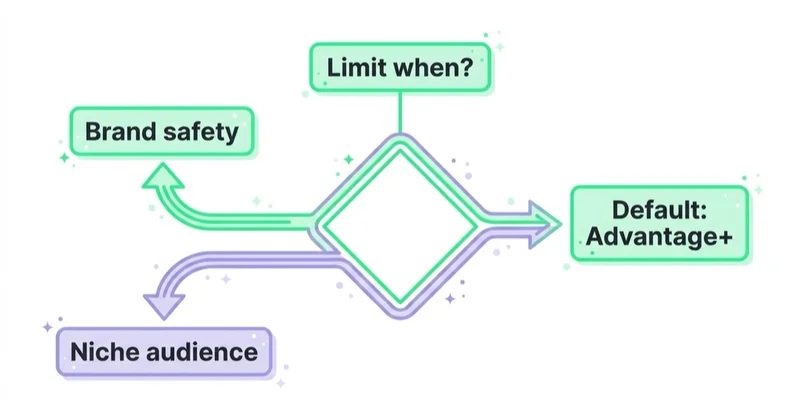
- legal requirements define audience boundaries;
- products are age-restricted or regulated;
- locations, languages or service areas are strict;
- different product groups have very different margins;
- budget must be guaranteed per market;
- assets are designed for one placement only;
- remarketing requires different messaging;
- CRM data shows poor lead quality from broad delivery;
- platform ROAS conflicts with profit or pipeline data.
The goal is not to fight automation. The goal is to give automation enough room where it helps and enough constraints where the business needs control.
Advantage+ for e-commerce
E-commerce is still the clearest use case for many Advantage+ workflows. The system can learn from purchase events, product interactions, catalog data and creative engagement.
A strong setup should include:
- Meta Pixel and Conversions API;
- deduplication between browser and server events;
- correct purchase values and currency;
- product IDs aligned with catalog IDs;
- clean product feed data;
- enough distinct creative concepts;
- product pages that match ad promises;
- margin and stock data in business reporting;
- retargeting and retention logic that does not over-credit warm users.
Advantage+ can scale a strong e-commerce system. It cannot fix poor product pages, weak offers, broken feeds or noisy conversion data.
Advantage+ for leads, B2B and services
For lead generation, Advantage+ can create volume, but lead quality is the main risk. Optimising toward form submissions can push the system toward people likely to submit forms, not necessarily people likely to buy.
Better lead-gen setup:
- track qualified leads where possible;
- import CRM or offline conversion stages;
- separate low-intent lead magnets from high-intent enquiries;
- use creative that qualifies the audience;
- review lead quality by campaign and ad;
- connect reporting to pipeline, not only cost per lead.
For B2B and services, automation should be judged by qualified pipeline, booked calls, sales feedback and customer fit. Cheap leads are not success if they waste sales time.
Practical setup checklist
Before judging Advantage+, check the inputs.
| Area | Question |
|---|---|
| Tracking | Are Pixel, Conversions API, event values and deduplication working? |
| Objective | Does the campaign optimise toward the real business outcome? |
| Audience | Are suggestions and strict controls configured correctly? |
| Placements | Are assets ready for all automated placements? |
| Creative | Are there distinct concepts, not only small variations? |
| Budget | Is there enough budget and time for learning? |
| Catalog | Are product IDs, availability, prices and titles clean? |
| Landing page | Does the page match the ad promise and load quickly? |
| Reporting | Are margin, lead quality or pipeline included in evaluation? |
| Constraints | Are legal, market, language and business limits documented? |
Only after this audit is it useful to decide which Advantage+ settings should be changed.
How we approach this at Space Ads
At Space Ads, we audit Advantage+ setting by setting instead of judging automation as one block. First we check whether Pixel, CAPI, event values, catalog data, creative variety, landing pages and lead-quality feedback are strong enough for broader delivery. Then we decide which controls can stay flexible and which need hard limits: location, language, age, exclusions, budget separation, regulated claims, market priorities or margin groups. We do not panic when Meta concentrates spend into a small number of creatives, but we do ask whether the winning concepts create business value beyond cheap delivery. Advantage+ works best when the account gives the system strong, different options and the business defines where automation is allowed to decide.
Common mistakes
| Mistake | Why it hurts | Better approach |
|---|---|---|
| Calling all automation Advantage+ without detail | Hides which setting is actually responsible | Name the specific control |
| Disabling all AI by default | Removes learning opportunities | Limit only where there is a real reason |
| Trusting automation with broken tracking | Optimises toward noisy events | Fix Pixel, CAPI and event values first |
| Using one creative concept | AI has little to test | Build distinct hooks, offers and formats |
| Ignoring lead quality | Cheap leads can look successful | Import CRM stages or evaluate sales quality |
| Letting budget automation override business priorities | Spend may move away from required segments | Use budget controls where needed |
| Judging after two days | Learning can be noisy | Use a realistic test window and thresholds |
| Measuring only ROAS | Platform attribution can mislead | Compare with MER, margin, pipeline and backend data |
FAQ
What is Meta Advantage+?
Meta Advantage+ is a family of AI-powered automation features inside Meta Ads. It can affect audience, placements, budget, creative and campaign setup.
Is Advantage+ still a separate campaign type?
Not in the same simple way it used to be. The old Advantage+ Shopping Campaign model has been folded into broader Advantage+ setup patterns, especially for sales, leads and app campaigns. Advertisers should now evaluate individual automation controls.
What is Advantage+ audience?
Advantage+ audience uses advertiser inputs as guidance and lets Meta search more widely for people likely to respond. Some criteria, such as location, language, minimum age and exclusions, can be set as stricter controls where available.
What are Advantage+ placements?
Advantage+ placements automatically choose eligible placements across Meta technologies, such as Facebook, Instagram, Messenger, Reels, Stories, Feed and Audience Network, to seek efficient delivery.
Should Advantage+ be turned off?
Not by default. It should be limited only when there is a clear business, legal, creative or measurement reason. Many accounts should start with automation enabled and then adjust based on evidence.
Does Advantage+ work only for e-commerce?
No. E-commerce is a common use case, but Advantage+ features also affect lead generation, app and other campaign types. Lead generation needs extra care because lead quality matters more than raw form volume.
What is the biggest risk with Advantage+?
The biggest risk is giving the system poor inputs: bad tracking, weak creative, unclear objectives, dirty catalogs or low-quality conversion events. Automation can amplify weak signals.
How should Advantage+ performance be measured?
Use platform results together with business metrics such as MER, margin, stock, refund rate, lead quality, pipeline, booked calls and backend sales. One Meta ROAS number is not enough.
Key takeaways
Meta Advantage+ is best understood as a set of automation controls. The advertiser role is shifting from manual micro-targeting toward better inputs, stronger creative, accurate measurement and clear business constraints.
Leave automation room to learn when the account has clean data and enough creative variety. Restrict it when there is a real business reason. The strongest Meta Ads accounts in 2026 combine Advantage+ automation with human judgment, not one at the expense of the other.
Sources and further reading
- Meta for Business - Advantage+ audience
- Meta for Business - Advantage+ placements
- Meta for Business - Meta Advantage+ advertising solutions
- Search Engine Land - Meta simplifies Advantage+ campaign setup, adds leads campaigns
- Space Ads - Meta Ads service
Continue learning
Continue reading
Why Your Meta Ads Stopped Working (and How to Diagnose It)
When Meta performance changes, diagnose the affected layer before editing campaigns. This guide covers delivery status, billing, event quality, funnel metrics, activity history, creative, offer, website and controlled recovery.
Scaling Meta Ads Without Killing ROAS
Scaling Meta ads is a commercial decision, not a promise to preserve the same ROAS at a higher spend. Learn how to set a profitable ceiling, diagnose constraints and increase budget through controlled tests.
Meta Advantage+ vs Manual Campaigns: When to Trust the Automation
Meta Advantage+ can automate audience expansion, placements and budget allocation, while manual settings preserve selected controls. This guide explains what each label actually means and how to test the right configuration for a business goal.