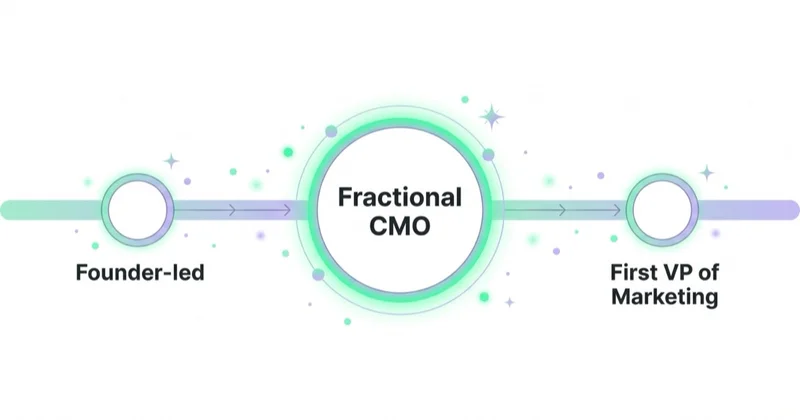
A fractional CMO for SaaS or a startup is a senior marketing leader engaged part-time to own direction, budget allocation, measurement and the operating rhythm of growth. The role sits between founder-led marketing, an execution-only agency and a permanent VP or CMO hire.
That sounds simple. In practice, the fit is narrow. Too early, and the company needs customer learning, positioning work and a hands-on channel specialist more than an executive layer. Too late, and the scale may justify a permanent leader. The useful window is usually after product-market fit, when marketing decisions have started to carry real financial weight, but before the company needs or can sensibly absorb a full-time marketing executive.
For SaaS, the role also cannot be generic. The leader needs to understand acquisition cost, payback, retention, product-led versus sales-led motion, CRM quality and the lag between a click, a demo, an opportunity and revenue. Without that context, "strategy" becomes a polished plan that does not survive contact with the sales cycle.
Key Takeaways
- A SaaS fractional CMO is a fit for a specific stage. The common window is post-product-market fit, with meaningful spend, unclear priorities and no senior marketing owner.
- The role is not a substitute for product-market fit. If the product, segment, pricing or sales motion is still unresolved, a fractional CMO can help diagnose the problem, but should not be sold as a scale layer.
- SaaS changes the mandate. The work has to connect positioning, channel mix and creative with CAC, payback, pipeline quality, activation and retention.
- The go-to-market motion decides the brief. Product-led growth, sales-led SaaS and hybrid motions require different conversion signals and different reporting.
- An agency and a fractional CMO do different jobs. An agency runs a channel inside a brief. A fractional CMO owns the brief, the metrics and the trade-offs across channels.
- A permanent VP or CMO is not automatically better. Spencer Stuart's 2025 study reports average Fortune 500 CMO tenure of 4.3 years, so even a permanent hire is a time-bound bet, not a forever solution.
- The first engagement should create clarity quickly. A useful first 90 days should fix measurement, define the motion, sharpen the budget split and name the next hires or partners.
Why SaaS Needs a Different Type of Fractional CMO
The general version of the role is easy to describe: a part-time senior marketer sets direction. SaaS makes the job more specific because revenue is delayed, buying groups are larger, and platform data is often several steps away from commercial truth.
In e-commerce, a campaign can often see product revenue within hours or days. In B2B SaaS, a click may become a form submission, then a meeting, then a qualified opportunity, then a closed deal weeks or months later. In product-led SaaS, the most useful signal may not be the signup itself, but activation, retained usage or a product-qualified account.
That difference changes the work. A SaaS fractional CMO should not judge marketing only by cost per lead, form volume or platform-reported conversions. Those metrics can be useful operational signals, but they are weak substitutes for revenue quality. The role should connect the account, the CRM, the product analytics layer and the financial model closely enough for marketing to learn from what actually becomes pipeline, customers and expansion.
Gartner describes B2B buying as nonlinear, with buyers revisiting tasks such as problem identification, solution exploration, requirements building, supplier selection, validation and consensus creation. That matters for SaaS because marketing is not only capturing existing intent. It is helping a buying group understand the problem, build confidence and return to the vendor with fewer unanswered questions.
Benchmarkit points to the same pressure from another angle. Its 2025 B2B SaaS benchmarks report median net revenue retention of 101% and a median new customer CAC ratio of $2.00 in sales and marketing expense for $1.00 of new customer ARR. The exact number will vary by ACV, market and growth stage, but the direction is important: acquisition decisions cannot be separated from efficiency, expansion and retention.
When a Startup Is Ready for One
A fractional CMO is useful when the company has enough signal for strategy to matter and enough complexity for founder intuition to start breaking down.
Clear fit signals:
- Paid acquisition is no longer a small experiment, and budget choices affect runway or board reporting.
- The founder still owns too many marketing decisions and has become the bottleneck.
- Multiple channels are active, but no one owns the overall allocation.
- Sales complains about lead quality, while marketing reports healthy form volume.
- The CRM, product analytics and ad platforms disagree about what is working.
- A new segment, market or funding round requires a more defensible plan.
- The first marketing hires are being considered, but the role sequence is unclear.
Poor fit signals:
- Product-market fit is still unproven.
- The company needs one channel executed well, not a senior direction layer.
- The real constraint is sales process, pricing, onboarding or product activation.
- The budget is too small for executive allocation decisions to matter.
- The team expects a fixed revenue number by a fixed date.
- The founder wants senior validation for a strategy they are not willing to change.
The last point matters. A fractional CMO is not useful as decoration around a decision already made. The role creates value when the company is ready to change the brief, not only improve the ads.
What the Role Should Own in SaaS
The mandate should be explicit. A vague "help us grow" brief creates the wrong engagement because every marketing problem can be made to fit that phrase. For SaaS, the work normally falls into six areas.
1. Positioning and ICP
Most acquisition problems start before the campaign. If the ideal customer profile is too broad, the landing page is unclear or the category narrative is weak, paid media will expose the problem faster than it fixes it.
A SaaS fractional CMO should clarify:
- which segment is being prioritised now;
- what pain or job-to-be-done the product is attached to;
- which alternatives the buyer compares against;
- what proof the market needs before it trusts the claim;
- which use cases are worth funding and which should wait.
This is not brand theory. It affects keyword choice, audience design, demo-page copy, sales enablement, onboarding and pricing-page emphasis.
2. Go-To-Market Motion
The same title can mean different work depending on the motion.
| Area | Product-led SaaS | Sales-led SaaS |
|---|---|---|
| Primary signal | Signup, activation, retained usage | Qualified opportunity, pipeline, closed-won value |
| Marketing risk | Optimising for signups that never activate | Optimising for leads that never qualify |
| Measurement need | Product analytics connected to campaigns | CRM stages imported back into ad platforms |
| Budget emphasis | Acquisition, onboarding, activation, lifecycle | Demand creation, intent capture, sales enablement |
| First fix | Define activation and product-qualified signals | Clean CRM stages and offline conversion feedback |
Hybrid companies need a deliberate split. Self-serve users, sales-assisted accounts and enterprise opportunities should not be forced into one generic conversion goal.
3. Unit Economics and Board Reporting
The role should translate marketing activity into the language the business actually uses. In SaaS, that normally means:
- CAC: the cost to acquire a customer, ideally split by segment and motion.
- CAC payback: how long gross-margin revenue takes to repay acquisition cost.
- Pipeline quality: whether marketing-sourced and marketing-influenced opportunities reach later stages.
- Win rate: whether demand quality is improving or only volume is rising.
- Net revenue retention: whether acquired customers stay, expand or churn.
- Sales and marketing efficiency: how spend turns into new ARR and expansion ARR.
This does not mean every startup needs a heavy board deck. It means marketing should stop reporting activity as if it were commercial progress.
4. Measurement Architecture
In a sales-led SaaS account, the ad platform usually sees the easiest conversion first: a form fill, call, demo request or content download. If bidding only learns from that event, it may optimise toward cheap volume rather than qualified demand.
Google's own documentation on offline conversion imports and enhanced conversions for leads is relevant here because it describes how later offline outcomes can be sent back to Google Ads. For SaaS teams, the practical principle is simple: the platforms need better signals than "someone submitted a form."
A fractional CMO does not need to personally implement every tag or API connection. They do need to own the measurement decision:
- which events count as primary conversions;
- which CRM stages are imported;
- how duplicate or low-quality leads are handled;
- when the account should optimise to form volume, qualified opportunity or value;
- how consent, privacy and data quality are managed.
5. Channel Allocation
The channel mix should follow the market and motion, not habit.
Search can capture known intent. Competitor search can work when the comparison is credible and the landing page is specific. Paid social and video can build problem awareness, teach the category and create future search demand. Retargeting can support buying groups, but it should not be credited as if it created all the demand it touches. Review platforms, partner ecosystems, email, content and sales enablement often matter as much as paid media in complex B2B categories.
The fractional CMO's job is not to claim every channel is important. It is to decide which few deserve budget now, what each channel is meant to do, and what evidence would justify changing the split.
6. Team and Partner Design
Many startups hire marketing roles in the wrong order. They hire a content person before the ICP is clear, a demand generation manager before CRM stages are usable, or an agency before the brief is stable.
A useful fractional CMO should define the next operating model:
- what stays with the founder;
- what is handled by an internal hire;
- what should be outsourced;
- which role should be hired first;
- what the eventual VP or CMO should inherit.
Sometimes the best recommendation is not "keep me longer." It is "hire this role next, keep this specialist, and stop funding this channel until the data is cleaner."
Fractional CMO vs Agency vs VP of Marketing
The decision is rarely binary. SaaS founders usually compare four options.
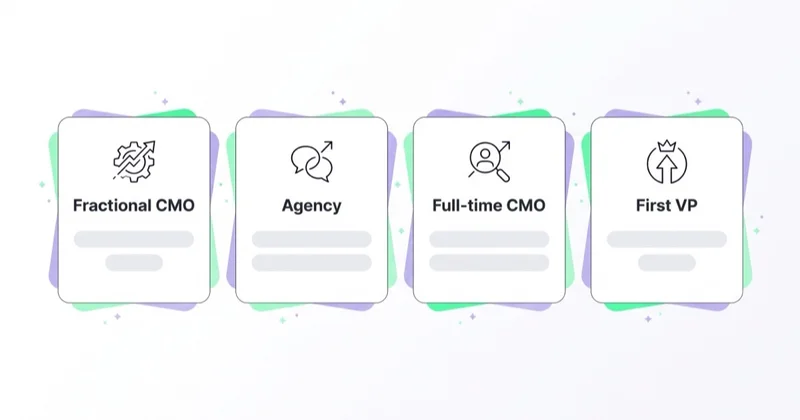
| Option | Best fit | Main limitation |
|---|---|---|
| Fractional CMO | Senior direction is needed, but a permanent executive is too early | Limited time; mandate must be tight |
| Agency | Strategy is clear and one or more channels need execution | Usually does not own positioning, motion or board reporting |
| Full-time VP of marketing | Scale, team and spend justify a permanent leader | Hiring takes time and the wrong hire is expensive |
| Founder-led marketing | Early learning, close customer contact and small budgets | Eventually becomes a bottleneck |
An agency can be the right answer when the brief is clear. A fractional CMO is the right answer when the brief itself is the problem. A VP of marketing is the right answer when the company needs a permanent owner, has enough team and spend for that person to manage, and can afford the hiring time.
Spencer Stuart's 2025 CMO Tenure Study is a useful reminder that "permanent" does not mean permanent in practice. The study reports average Fortune 500 CMO tenure of 4.3 years in 2024. That is not a SaaS startup benchmark, but it does show why senior marketing leadership should be treated as a high-consequence hire, not a default next step.
Cost and Engagement Model
The common market range for a fractional CMO is broad because the role can mean anything from a few advisory days a month to a hands-on operating model with a team. Space Ads' own pricing guide uses roughly $3,000 to $20,000 per month as the typical range, with the higher end reserved for deeper operator-advisory work.
The number matters less than the structure.
A good first engagement usually has:
- a fixed diagnostic scope;
- clear access to CRM, analytics, product and ad account data;
- named decisions to make, not only meetings to attend;
- an agreed cadence with the founder, sales and finance;
- a definition of what happens after the first 60 or 90 days.
Pricing patterns to question:
- percentage-of-spend fees for the strategy layer;
- long retainers before the diagnostic is complete;
- unclear ownership between the fractional CMO, agency and internal team;
- advice-only work when the company needs operating change;
- performance fees tied to a metric the CMO does not fully control.
For SaaS, incentive alignment is especially important because the easiest metric to grow is often the wrong one. More leads, more signups or more traffic can all be bad outcomes if they move the company away from better accounts, higher retention or cleaner payback.
A Practical First-90-Days Plan
The first quarter should create decision clarity. It should not disappear into workshops.
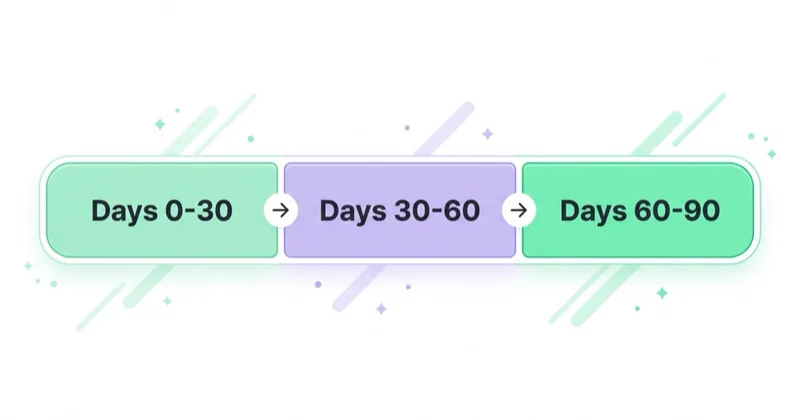
Days 1-15: diagnose the commercial model. Review the current ICP, positioning, pricing-page logic, sales motion, funnel stages, source reporting and recent board or investor reporting. Separate what is known from what is assumed.
Days 16-30: fix the measurement brief. Define the conversion hierarchy. Decide which events are primary, which CRM stages matter, which offline conversions should be imported and where product-qualified signals are needed. Remove conversion actions that teach the platforms to chase low-quality volume.
Days 31-45: clarify the motion and segment focus. Decide whether the current priority is self-serve activation, sales-led pipeline, expansion, a new vertical or a specific ACV band. Rewrite the channel brief around that decision.
Days 46-60: reset the budget split. Name the role of each channel: intent capture, demand creation, retargeting, sales support, partner support or lifecycle. Pause the work that does not fit the current stage.
Days 61-75: improve the sales and marketing handoff. Align form fields, qualification rules, CRM stages, feedback loops and sales enablement around the segment being prioritised.
Days 76-90: design the next operating model. Decide the first hire, the agency or specialist roles, the reporting cadence and the decisions that stay with the founder until a permanent VP or CMO is justified.
By day 90, the company should have a clearer growth model, cleaner measurement, a defensible budget split and a practical view of what to hire or outsource next.
How Space Ads Approaches the Role
Space Ads treats fractional CMO work as operator-advisory, not slide-only consulting. The reason is practical: SaaS strategy often fails between the plan and the account. The positioning sounds precise, but the ads drift. The CRM stages exist, but they are not sent back to the platforms. The board deck reports leads, while sales cares about opportunity quality.
Our role is to close that gap. We connect strategy, media buying, measurement and commercial reporting so the account is optimised against the business model, not only against platform convenience. When the need is only channel execution, the right scope is performance marketing. When the issue is direction, allocation and measurement together, the fractional CMO model is the better fit.
That distinction matters for startups. The work should make the company easier to run after the engagement, not dependent on a permanent external executive.
Common Mistakes
| Mistake | Better decision |
|---|---|
| Hiring a fractional CMO before product-market fit | Keep founder-led learning close to the customer and use specialists where needed |
| Asking an agency to solve an unclear strategy | Clarify ICP, motion, positioning and measurement first |
| Reporting lead volume as success | Report qualified pipeline, payback, win rate and retention quality |
| Optimising campaigns to the earliest form fill | Feed qualified stages or value back into the platform where possible |
| Hiring a VP before the operating model is clear | Use a fractional leader to define the brief and first hires |
| Treating PLG and sales-led SaaS as the same funnel | Separate activation, product-qualified and CRM-qualified signals |
FAQ
What is a fractional CMO for SaaS?
A fractional CMO for SaaS is a senior marketing leader engaged part-time to own strategy, budget allocation, measurement and the operating model of growth. In SaaS, the role should connect marketing decisions with CAC, payback, pipeline quality, activation and retention, not only campaign metrics.
When should a startup hire a fractional CMO?
The best window is usually after product-market fit, when paid spend and channel decisions matter, founder-led marketing has become a bottleneck, and the company is not yet ready for a permanent VP or CMO. If the product, pricing or market is still being validated, the role may be premature.
Is a fractional CMO better than an agency?
Not categorically. An agency is better when the strategy is clear and the company needs channel execution. A fractional CMO is better when the company needs the brief defined: ICP, positioning, channel allocation, measurement and operating rhythm.
What should a SaaS fractional CMO measure?
At minimum, the measurement should connect campaign data with CRM and product outcomes. Depending on the motion, that can include activation, product-qualified accounts, qualified opportunities, pipeline value, CAC, payback, win rate and net revenue retention.
How much does a fractional CMO for SaaS cost?
Market pricing varies by depth, but a common range is roughly $3,000 to $20,000 per month. Light advisory sits at the lower end; hands-on operator-advisory with account ownership and team direction sits higher. The first engagement should ideally be a fixed-scope diagnostic before an open-ended retainer.
Is "fractional marketing director" the same role?
Often, yes. "Fractional marketing director" is more common in the UK, while "fractional CMO" is more common in US-facing content. The useful distinction is not the title. It is whether the person owns senior direction, measurement and operating decisions.
In Short
- A fractional CMO for SaaS is useful when the company needs senior marketing direction before it can justify a permanent executive.
- The role fits best after product-market fit, once spend, channels and reporting have become commercially important.
- SaaS requires fluency in CAC, payback, CRM quality, activation, retention and the difference between product-led and sales-led growth.
- The first 90 days should produce cleaner measurement, a sharper motion, a better budget split and a practical hiring or partner plan.
- The role should make the company more disciplined, not more dependent.
Sources
- Spencer Stuart - CMO Tenure Study 2025
- Benchmarkit - 2025 B2B SaaS Performance Metrics Benchmarks
- Gartner - The B2B Buying Journey
- Google Ads Help - About offline conversion imports
- Google Ads Help - About enhanced conversions
- Space Ads - How much does a fractional CMO cost?
Continue Learning
- What is a fractional CMO - and when you should NOT hire one
- Fractional CMO vs agency vs full-time CMO: how to choose
- How much does a fractional CMO cost?
- Demand generation vs lead generation in B2B
- SaaS paid acquisition: running Google and Meta for B2B SaaS
- Fractional CMO: board-level marketing that also runs the accounts
Continue reading

Your First Senior Marketing Hire: CMO, VP, or Fractional?
When founder-led marketing hits its ceiling, the instinct is to hire a CMO. Often that is too senior, too early, and too expensive — a VP who still executes, or a fractional lead for direction plus specialist hands, fits better until the company is large enough for a full CMO to have leverage.

How to Structure a Modern Marketing Team (In-House, Agency, Fractional)
There is no universal modern marketing org chart. Build the team from business outcomes, recurring work, decision rights and capacity, then choose the right mix of employees, agencies, freelancers and fractional leadership.

Go-to-Market Strategy: The Paid-Acquisition Layer Most Launch Plans Skip
A go-to-market strategy connects a defined customer, problem, offer, buying motion and route to market. This guide shows where paid acquisition fits, when it should wait and how to test demand without confusing platform leads with viable growth.