A fractional CMO is an experienced marketing leader engaged for a defined share of their time rather than as a full-time executive. The company gets senior ownership of decisions such as positioning, priorities, budget, team design and measurement without immediately creating a permanent C-suite role.

That definition sounds simple. The scope is not. “Fractional CMO” is a commercial label, not a standardised job specification. One provider may act as an adviser for two calls a month; another may lead the team, manage agencies and take part in executive decisions several days a week. Before comparing candidates or fees, define the business problem, the authority the person will have and who will implement the decisions.
TL;DR
- A fractional CMO provides part-time marketing leadership. The role should own agreed decisions and outcomes, not merely attend meetings or produce a strategy deck.
- Hire for a constraint, not a title. The model fits when the company needs senior direction and coordination but does not yet need — or cannot yet justify — a full-time executive.
- Do not hire one to disguise an execution gap. If the strategy is clear and the problem is insufficient specialist capacity, an agency or in-house practitioner is usually the better answer.
- Define authority before activity. Decision rights, executive access, team capacity, budget authority and reporting lines determine whether the leader can be effective.
- Compare total delivery cost. A fractional fee rarely includes every specialist, tool, media budget and production resource required to execute the plan.
- Use a time-bound first mandate. A diagnostic and 90-day operating plan make fit, priorities and expectations easier to assess than an undefined retainer.
Why companies use fractional marketing leadership
The need for senior judgement often appears before the need for a permanent executive. A founder-led business may already have specialists, agencies and meaningful acquisition spend, yet still lack one person who can connect customer insight, commercial targets, brand, channels and measurement.
The CMO remit is also broader than campaign management. The US Bureau of Labor Statistics describes marketing management work as including market demand, customer acquisition and retention, pricing, research, budgets and coordination with product, sales, finance and external agencies. The 2025 CMO Survey likewise shows that executives expect marketing to contribute to growth, profitability and spending efficiency. A channel specialist cannot reasonably absorb all of that ownership as a side task.
A fractional arrangement can close this leadership gap while the company validates the role, prepares for a permanent hire, enters a new market or navigates a defined transition. It is one operating model among several — not evidence that a full-time CMO is inherently too risky.
Spencer Stuart reported an average tenure of 4.3 years for Fortune 500 CMOs in 2024, but that statistic needs context: the sample covers large US companies, and 65% of departing CMOs moved into a similar or more senior role. It should not be used as a universal benchmark for smaller businesses or as proof that permanent marketing leadership fails.
A quick glossary
- Fractional CMO — a senior marketing leader who owns an agreed remit for part of the working week or month.
- Interim CMO — a temporary executive who usually works close to full-time while the company manages a transition or recruits a permanent leader.
- Marketing consultant or adviser — an expert who diagnoses and recommends. They may influence decisions without owning the team, budget or implementation.
- Marketing agency — an external delivery team responsible for an agreed service or set of channels. Some agencies contribute to strategy, but their authority depends on the scope.
- Head or director of marketing — a permanent leader who is typically closer to day-to-day management and execution than a C-suite executive, although titles vary by company.
- Outsourced CMO — a non-standard term that may describe a fractional leader, a consultant or an agency-led service. Ask what it means in the proposed contract.
What a fractional CMO actually does
The exact remit should follow the diagnosis, but it commonly covers six areas:
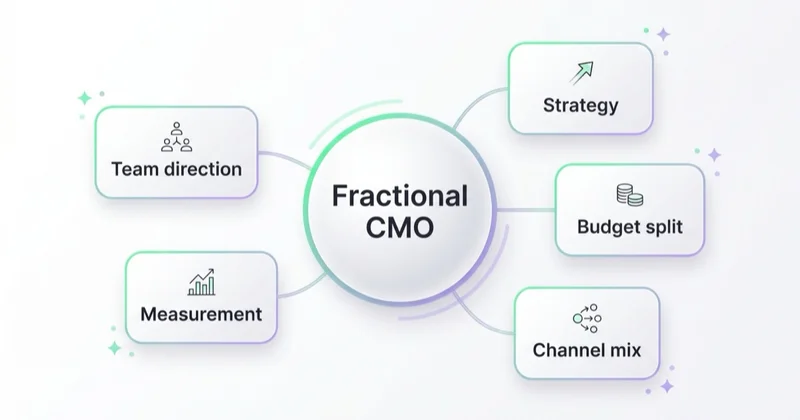
- Commercial direction: translating company goals into a marketing strategy, priority segments, positioning and an explicit value proposition.
- Portfolio and channel choices: deciding the role of brand, demand generation, lifecycle marketing, partnerships, content and paid acquisition rather than optimising each channel in isolation.
- Budget and economics: connecting investment decisions to margin, payback, sales capacity and cash constraints — not only to platform-reported ROAS.
- Measurement: defining the metric hierarchy, data ownership, attribution limits, experiment plan and reporting cadence.
- People and partners: clarifying roles, closing capability gaps, managing agencies and supporting recruitment where necessary.
- Operating cadence: setting priorities, decision forums, review cycles, escalation paths and accountability.
The fractional CMO may also execute selected work, but this is a scope choice rather than part of the definition. A leader who personally operates paid media, analytics or lifecycle programmes can reduce hand-offs in a smaller organisation. In a larger one, their highest-value contribution may be leading specialists and resolving cross-functional decisions. What matters is that implementation has a named owner and enough capacity.
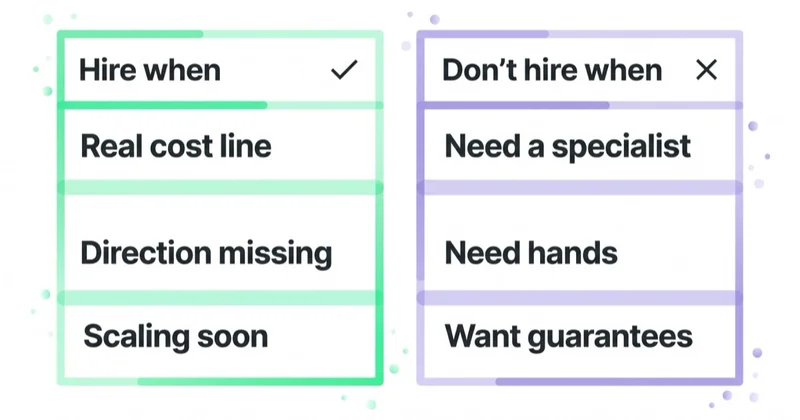
When you should NOT hire a fractional CMO
A fractional CMO is not a universal solution. Avoid the hire — or change the brief — in the following situations.
You have not validated the market or offer
At a very early stage, founders usually need direct customer contact, rapid product learning and focused commercial experiments. Senior marketing leadership cannot compensate for weak product-market evidence, unclear economics or an offer customers do not value.
The strategy is clear and delivery capacity is the bottleneck
If priorities, positioning and measurement are already sound but campaigns, content or CRM work are not getting done, buy specialist capacity. Adding another person to direct an under-resourced team creates more plans, not more output.
The role requires full-time presence
A complex transformation, high-stakes crisis, large team or heavily regulated environment may require an executive who is continuously available and deeply embedded. A part-time leader can still advise, but limited capacity should not be disguised as full ownership.
Nobody can implement the decisions
Strategy has no value without production, technology, analytics, sales alignment and channel execution. Before hiring, identify the internal team and external partners that will deliver the roadmap, as well as the budget available beyond the fractional fee.
The founder or CEO will not delegate authority
A fractional leader cannot be accountable for outcomes while every budget change, message and priority is repeatedly reversed. The executive sponsor must define which decisions are delegated and which remain with the board or founder.
You expect guaranteed short-term revenue
A credible leader can commit to process, deliverables and decision quality. They cannot guarantee a revenue number without controlling the offer, pricing, product, sales process, inventory and market conditions. Treat a universal “30-day ROI” promise as a risk signal.
The mandate is deliberately vague
“Fix marketing” is not a workable scope. If the company cannot name the constraint, a short diagnostic may be appropriate; an open-ended executive retainer is not.
When it is the right call
The model is more likely to fit when several of these conditions are true:
- Marketing decisions now affect meaningful revenue, margin or investment.
- Specialists and agencies are active, but no senior owner connects their work.
- The company has outgrown founder-led marketing but is not ready for a permanent C-suite hire.
- Growth has stalled and teams disagree about whether the cause is the market, offer, funnel, channel mix, sales process or measurement.
- A launch, market entry, acquisition, fundraising process or leadership transition creates a time-bound need.
- The business wants to define and test the future full-time CMO remit before recruiting.
- The CEO is ready to share information, grant decision rights and hold the leader accountable through an agreed cadence.
The strongest signal is not company size or media spend alone. It is a costly coordination and decision gap that genuinely requires senior, cross-functional ownership.
Fractional CMO vs agency vs full-time vs DIY
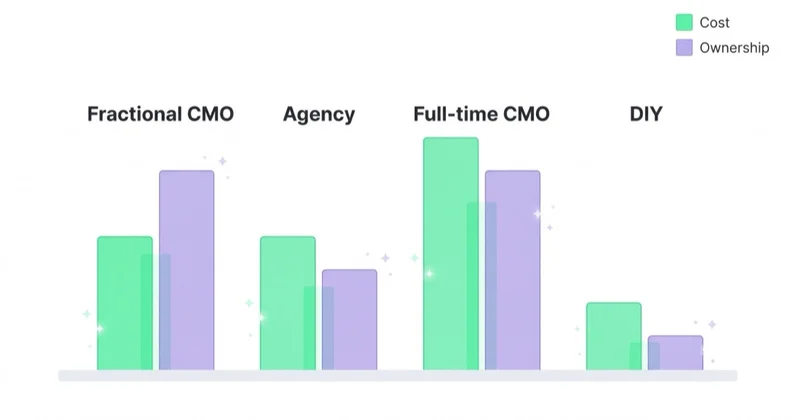
The decision is rarely "fractional CMO: yes or no." It's "which of these four is right for where we are":
| Option | Primary value | Typical involvement | Best fit | Main risk |
|---|---|---|---|---|
| Fractional CMO | Cross-functional leadership and decision ownership | Part-time, recurring | Senior gap with delivery capacity already available | Too little authority or time for the mandate |
| Interim CMO | Temporary executive continuity or transformation | Near-full-time, time-bound | Departure, turnaround or bridge to permanent hire | Expensive bridge without a handover plan |
| Consultant/adviser | Diagnosis, expertise and recommendations | Project or limited advisory cadence | A defined question or independent challenge | Recommendations have no implementation owner |
| Agency | Specialist execution and scalable delivery | Recurring service or campaign scope | Strategy is sufficiently clear and delivery is the constraint | Channel activity becomes disconnected from business priorities |
| Full-time CMO | Permanent leadership, culture and organisational ownership | Full-time | Complexity and workload justify an embedded executive | Hiring before the remit, resources or expectations are clear |
| Founder/in-house lead | Customer proximity and speed | Continuous | Early stage or a focused, manageable marketing system | Leadership becomes a bottleneck as complexity grows |
These options can be combined. A fractional CMO may lead an internal team and agency; an interim may prepare the permanent role; a consultant may support a specific measurement or positioning problem. The right design makes ownership explicit and minimises duplicated management layers. For a deeper decision framework, see Fractional CMO vs agency vs full-time CMO.
What should be delivered in the first 90 days?
A useful first mandate produces decisions and an operating system, not just observations. The pace will vary with data quality and organisational complexity, but a practical sequence is:
Days 1–30: establish the baseline
- Interview the CEO, sales, product, finance and delivery leaders.
- Review customer evidence, positioning, offer, funnel, channel performance and retention.
- Reconcile marketing reports with CRM, revenue, margin and sales data.
- Map the team, partners, technology, contracts and decision rights.
- Identify urgent risks and the few questions that need further evidence.
Days 31–60: make the choices
- Agree commercial objectives and the metric tree beneath them.
- Define priority segments, positioning and channel roles.
- Set budget scenarios, assumptions and stop/scale rules.
- Assign owners and close the most important capability gaps.
- Create an experiment and measurement plan.
Days 61–90: install the cadence
- Launch the highest-priority initiatives.
- Establish weekly operating and monthly commercial reviews.
- Document decisions, dependencies and unresolved risks.
- Confirm the longer-term team and partner model.
- Decide whether the engagement should continue, narrow, expand or hand over.
The 90-day plan is a management framework, not a promise that every commercial outcome will mature within one quarter.
How to define the scope of work
The statement of work should be specific enough for a third party to tell what is included. Cover at least:
- the business problem and desired outcomes;
- named deliverables and decision deadlines;
- days or hours of availability, meeting cadence and response expectations;
- decision rights, reporting line and executive sponsor;
- teams, agencies, markets and channels in scope;
- work explicitly outside scope, including hands-on execution;
- data and system access, confidentiality, conflicts and account ownership;
- how additional work is requested and priced;
- termination, documentation and handover arrangements.
Do not make one person “responsible for growth” while withholding control of the budget, team, offer and prioritisation. Match accountability to actual authority.
How we approach this at Space Ads
At Space Ads, we treat fractional leadership as an operating mandate rather than a sequence of advisory calls. We start by connecting commercial goals, customer evidence, unit economics, channel data and the resources available to execute. The result should explain not only what to do, but also what to stop, who owns each decision and how the business will know whether the change worked.
Our preferred model keeps leadership close to delivery. Depending on the agreed scope, that can mean coordinating internal specialists and partners, or combining strategic ownership with selected hands-on channel and measurement work. The purpose is not to make the fractional CMO the person who does everything. It is to prevent strategy, execution and commercial reporting from becoming three disconnected systems.
We also separate platform indicators from business outcomes. Campaign dashboards help diagnose delivery, but investment decisions should ultimately reconcile with qualified pipeline, orders, margin, payback and retention as relevant to the business model. Our fractional CMO engagement is structured around that connection between decisions and implementation.
What does a fractional CMO cost?
There is no reliable universal price because the same title can describe a few advisory hours or several operating days each week. Compare proposals using the underlying capacity and responsibility:
- seniority and relevant experience;
- days per month and availability between scheduled sessions;
- number of markets, brands, teams and partners;
- complexity of the offer, sales cycle and regulation;
- whether research, analytics, creative or channel execution is included;
- whether a supporting team is included;
- travel, tools and other pass-through costs;
- contract length and handover obligations.
Calculate the total cost of the marketing operating model, not only the leadership retainer. Add the people, agency services, production, technology and media required to implement the plan. Then compare that total with realistic alternatives: a permanent hire, interim support, an internal promotion plus coaching, or direct specialist delivery.
A fixed-scope diagnostic can be a sensible first step when the problem or future remit is unclear. A recurring engagement is more appropriate when the company already knows it needs ongoing leadership. Neither structure is automatically superior; the contract should fit the constraint.
How to evaluate a fractional CMO
Ask candidates to work through the actual situation rather than deliver a generic credentials pitch:
- What evidence would you request first, and why? Strong answers include customer, financial, sales and operational evidence — not only ad accounts.
- Which decisions would you expect to own? Look for clarity about authority and escalation.
- What would you deliver in the first 30, 60 and 90 days? The answer should adapt to uncertainty rather than promise a template outcome.
- Who implements the plan? Confirm named capacity for channel, creative, analytics, CRM and web work.
- How many other mandates do you hold? Portfolio load affects availability, conflicts and response time.
- How do you measure marketing when attribution is incomplete? Expect triangulation, experimentation and commercial reconciliation.
- What might you recommend stopping? Leadership includes resource trade-offs, not just adding initiatives.
- How will you hand over? Documentation, account ownership and team development protect the company.
Relevant experience matters, but avoid selecting only on an impressive former employer or one case-study result. Ask what the candidate personally owned, what conditions enabled the outcome and what they would do differently in your context.
Common mistakes when hiring a fractional CMO
- Hiring a title before diagnosing the constraint — creating a leadership layer when the real need is product learning, sales capacity or specialist execution.
- Leaving decision rights implicit — expecting accountability without authority.
- Buying a plan without implementation capacity — approving initiatives that nobody has time or budget to deliver.
- Confusing activity with executive value — judging the role by meeting volume or campaign edits rather than better choices and business outcomes.
- Using platform attribution as the whole scorecard — ignoring margin, sales quality, incrementality, payback and retention.
- Failing to plan the end state — allowing a temporary solution to become permanent by default, with no internal capability or handover.
FAQ
What does a fractional CMO do?
A fractional CMO owns an agreed set of senior marketing decisions for part of the week or month. The remit may include positioning, customer strategy, budget, channel roles, measurement, team design and agency leadership. Hands-on execution is optional and should be stated in the scope.
How is a fractional CMO different from a marketing agency?
The fractional CMO usually owns cross-functional direction and priorities; an agency usually supplies specialist capacity within an agreed scope. However, both labels cover different models. Check the actual decision rights, deliverables and team rather than assuming an agency never advises or a fractional CMO always executes. They can work together effectively.
How much does a fractional CMO cost?
Cost depends on seniority, time commitment, complexity, included specialists and whether execution is part of the scope. Compare the total cost of leadership plus delivery with the relevant alternatives. A price without stated capacity, deliverables and exclusions is not meaningfully comparable.
When should you NOT hire a fractional CMO?
Do not hire one when the market or offer is still unvalidated, specialist capacity is the real bottleneck, the role requires full-time presence, nobody can implement the decisions, leadership will not delegate authority, or the expected outcome is a guaranteed short-term revenue number.
Is a fractional CMO worth it?
It can be worth it when a senior decision and coordination gap is materially constraining the business and the company has authority, data and delivery capacity to support the role. Establish a baseline and evaluate the engagement against agreed commercial, capability and operating outcomes rather than a vendor-wide ROI claim.
Fractional CMO vs interim CMO — what's the difference?
A fractional CMO works part-time and may be engaged for a short or extended period. An interim CMO is normally a temporary, near-full-time executive who bridges a vacancy or leads a transition. Contract language varies, so confirm capacity and mandate rather than relying on the title.
In short
- A fractional CMO provides senior marketing leadership for an agreed share of time; the title alone does not define the scope.
- The model fits a genuine leadership and coordination gap supported by clear authority, evidence and delivery capacity.
- It is the wrong tool for an unvalidated offer, a pure execution shortage or a mandate that requires full-time presence.
- Compare fractional, interim, consulting, agency and permanent options using the actual problem and total operating cost.
- Start with explicit outcomes, decision rights, capacity, exclusions, measurement and handover.
Sources and further reading
- Spencer Stuart — CMO Tenure Study 2025
- The CMO Survey — Spring 2025 results
- US Bureau of Labor Statistics — Advertising, promotions and marketing managers
- Space Ads — Fractional CMO engagement (operator-advisory)
Continue learning
- Fractional CMO: board-level marketing that also runs the accounts
- How to plan a marketing budget for effective digital marketing
- Incrementality testing and geo experiments with Meta, Google and Meridian
- Marketing mix modelling: Meridian, Robyn and MMM in 2026
- Ad management software in 2026: from dashboards to one AI workspace
Continue reading
Marketing Consultant vs Consultancy vs Agency: Which One Do You Need?
Use this when the business knows marketing is under-led but the buying category is fuzzy. The guide translates consultant, consultancy, agency and fractional CMO into practical differences around advice, ownership and execution so the next hire matches the real gap.

How Much Does a Fractional CMO Cost? (Real Ranges and Pricing Models)
Pricing only makes sense once the scope and incentive model are visible. This guide gives realistic monthly ranges, explains why retainers, day rates and percentage-of-spend fees push different behaviours, and shows what a useful first engagement should include.
Fractional CMO vs Marketing Agency vs Full-Time CMO: How to Choose
The real decision is not a job title; it is what kind of marketing leadership gap you have. This guide compares the three options by ownership, cost, speed, risk and execution depth so you can decide whether to buy strategy, hands-on channel delivery or a permanent executive role.