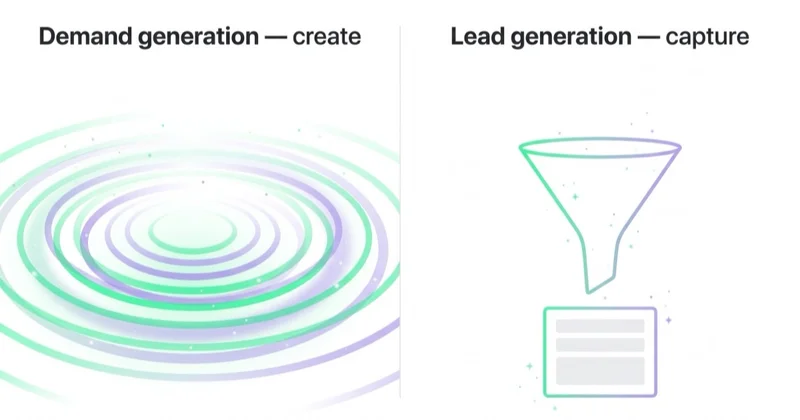
Demand generation and lead generation are not two names for the same work. Demand generation builds awareness, category understanding, mental availability and preference among potential buyers, including many who are not ready to speak with sales. Lead generation provides ways to capture identifiable interest: a demo request, form submission, call, quote request or booked meeting.
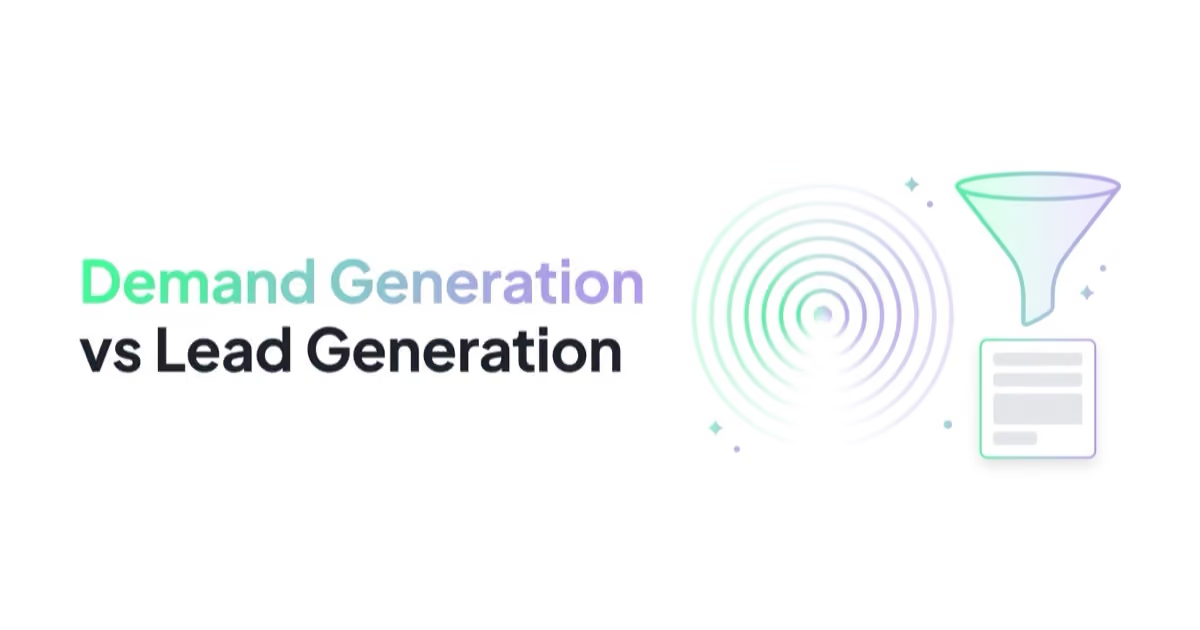
The mistake in B2B is forcing both jobs onto the same scoreboard. Lead generation can be judged quickly: cost per form, meeting rate, opportunity rate, cost per opportunity. Demand generation needs longer windows and different evidence: branded search, direct demand, engaged accounts, sales feedback, win rate and the quality of opportunities that arrive already informed. When demand creation is judged only by short-term cost per lead, it usually gets cut, and future demand weakens.
Key Takeaways
- Demand generation creates future demand. It makes the market more likely to know, trust and remember the brand when a buying window opens.
- Lead generation captures current demand. It turns active interest into a record that sales can follow up.
- B2B needs separate scoreboards. Demand creation should not be judged only on cost per lead. Lead capture should not be judged only on form volume.
- The 95:5 rule is a useful warning. In many B2B categories, only a small share of potential buyers are actively in market at a given time.
- Downstream feedback is essential for scalable lead generation. Cheap form submissions are not success if they do not progress to outcomes the business values; a CRM is a common way to record that evidence, not the only possible system.
- Offline conversion imports matter. Google Ads and other platforms can learn from later-stage outcomes only when those outcomes are sent back.
- Budget split depends on stage. Unknown brands and new categories need more demand creation. Mature categories with search demand can lean more into capture.
The Simple Difference
Demand generation and lead generation answer different questions.
| Question | Demand generation | Lead generation |
|---|---|---|
| Who is it for? | Buyers who may need the category later | Buyers showing active intent now |
| What does it create? | Memory, trust, category understanding, preference | A contactable enquiry or meeting |
| Typical channels | LinkedIn, YouTube, search-led content, webinars, podcasts, events, thought leadership | Search, retargeting, comparison pages, demo pages, forms, calls |
| Time horizon | Months and quarters | Days and weeks |
| Main risk | Being cut because attribution undercounts it | Scaling low-quality enquiries |
| Better evidence | branded search, direct demand, engaged accounts, opportunity quality, win rate | cost per qualified lead, meeting rate, opportunity rate, sales value |
The relationship is connected but not strictly sequential. Demand generation can influence buyers before and during active evaluation, while lead generation can capture interest at more than one stage. A business that only captures existing demand competes within the active market without building much future mental availability. A business that invests only in creation may build awareness without an effective route into a commercial conversation.
What Demand Generation Actually Does
Demand generation is not just “top of funnel”. It is the work of making a company easier to remember and easier to trust when a buying situation appears. In B2B, that can include:
- useful category education,
- strong point-of-view content,
- founder or expert visibility,
- webinars and events,
- ungated guides and comparison pages,
- YouTube and LinkedIn distribution,
- analyst, partner or community presence,
- remarketing that reinforces a real buying problem,
- search content that answers early and mid-stage questions.
The strongest demand generation does not only make people aware of the company. It links the brand to a concrete buying situation. For example: “CRM reporting is unreliable”, “paid media is generating weak leads”, “our sales cycle is slowing”, “we need to compare vendors before the budget cycle”. Those are category entry points. If the brand is associated with them before procurement starts, the sales conversation is easier.
The 95:5 rule, popularised by John Dawes and the Ehrenberg-Bass Institute, is useful here. It is not a precise law for every category, but it captures an important B2B reality: many buyers are not actively buying in the current quarter. Advertising and content still matter because they build memory links that can be activated later.
What Lead Generation Actually Does
Lead generation captures people or accounts that are showing intent now. It turns that intent into a record the business can act on.
Examples:
- a demo request,
- a pricing-page form,
- a quote request,
- a phone call,
- a booked consultation,
- a product comparison download with high buying intent,
- a finance, integration or technical assessment request.
Lead generation is not inferior to demand generation. It is simply closer to the transaction. It should be measured harder because the feedback loop is shorter. If a campaign is buying high-intent search traffic and sending people to a demo page, there is no reason to wait a quarter to judge whether the enquiries are qualified.
The trap is volume. Lead generation can often increase form submissions by widening targeting, lowering form friction or gating broader content. That does not mean the business has created more sales potential. It may have created more contacts that sales will reject.
For B2B, a lead is not a result until its quality is known.
The MQL Problem
The traditional MQL model can be useful, but it often becomes a reporting shortcut. A marketing qualified lead may only mean that someone matched a firmographic rule, downloaded content or crossed an engagement score. That is not the same as buying intent.
Common failure pattern:
- Marketing is measured on cost per MQL.
- Campaigns that produce many low-friction forms look efficient.
- Sales receives contacts that are not ready, not relevant or not senior enough.
- The team buys more of the same traffic because the cost per MQL looks good.
- Opportunity rate and win rate fall, even while lead volume rises.
This is not a channel problem. It is a measurement problem. The fix is to connect marketing data to CRM outcomes:
- MQL to sales accepted lead,
- sales accepted lead to qualified opportunity,
- opportunity to closed won,
- closed won to revenue and margin where possible.
Google’s own lead-generation guidance for Performance Max makes the same operational point: automation needs strong inputs and should be steered toward conversion actions the business actually values. In 2026, offline conversion imports and enhanced conversions for leads are also moving through Data Manager API paths, which makes the data pipeline an implementation issue, not just a reporting preference.
Attribution: What Software Sees And What Buyers Remember
B2B attribution is always partial. A buyer may see a LinkedIn post, hear a podcast, read a comparison article, discuss a vendor in Slack, search the brand, return through a remarketing ad and then fill a form. The platform that receives the last measurable interaction can report the conversion, but it cannot fully explain why the buyer trusted the company.

GA4 describes attribution as assigning credit to ads, clicks and touchpoints along the path to an important action. That is useful, but it is still based on observable interactions. In B2B, many important influences are private, offline or delayed.
The practical response is not to abandon attribution. It is to combine several views:
- platform data for immediate efficiency,
- GA4 for cross-channel paths,
- CRM data for quality and revenue,
- branded search and direct demand for market response,
- sales notes and self-reported “how did you hear about us?” for qualitative context.
Self-reported attribution should not be treated as complete data. Buyers misremember. Sales teams forget to ask. Forms can bias answers. But it often reveals sources that click-based reports undercount: word of mouth, podcasts, events, community, founder content and peer recommendations.
How To Measure Demand Generation
Demand generation needs a slower and broader scoreboard.
| Metric | Why it matters | Review cadence |
|---|---|---|
| Branded search | shows whether more people are looking for the company by name | monthly and quarterly |
| Direct and organic demand | shows whether more users arrive without paid capture | monthly |
| Engaged target accounts | shows whether the right companies are paying attention | monthly |
| Sales feedback | shows what buyers already know before calls | monthly |
| Opportunity quality | shows whether demand is commercially relevant | quarterly |
| Win rate and sales cycle | shows whether preference is affecting sales efficiency | quarterly |
| Self-reported source | reveals influence that software may miss | monthly and quarterly |
The most useful demand-generation question is not “How many leads did this LinkedIn post produce last week?” A better question is: “Are more of the right buyers entering sales conversations already aware, informed and biased toward the company?”
That requires patience, but not blind faith. Demand creation should still have clear hypotheses: which audience, which category problem, which message, which proof, which account segment and which expected business signal.
How To Measure Lead Generation
Lead generation should be measured closer to revenue.
| Metric | Weak version | Better version |
|---|---|---|
| Cost per lead | cost per form | cost per qualified lead |
| Conversion rate | landing-page form rate | form to meeting rate |
| Lead quality | MQL count | sales accepted rate |
| Commercial value | lead volume | opportunity value |
| Efficiency | cost per MQL | cost per opportunity and cost per closed won |
This changes optimisation. A campaign with a high cost per form may be the best campaign if those forms become qualified opportunities. A campaign with a low cost per form may be waste if sales rejects most contacts.
For Google Ads, enhanced conversions for leads and offline conversion imports help connect later-stage data back to the original ad interaction. The technical setup matters: captured identifiers, consent, CRM stage names, upload cadence and value logic need to be consistent. Without that, bidding systems optimise toward whatever shallow signal is easiest to collect.
Budget Split: How To Decide
There is no universal demand generation vs lead generation budget split. The split depends on category, stage, sales cycle, brand awareness and available search demand.
| Situation | Lean toward | Reason |
|---|---|---|
| New category | Often demand generation | buyers may need category education before they search |
| Unknown brand in known category | Often demand generation plus search capture | buyers may search the category without knowing the brand |
| Established brand with high search demand | Often lead generation | active demand may be captured efficiently |
| Rising cost per lead and falling close rate | Diagnose before reallocating | demand, offer, targeting, measurement, follow-up or qualification may be the constraint |
| Long enterprise buying group | Often demand generation | familiarity and preference can form before the form fill |
| Short transactional B2B purchase | Often lead generation | intent may be clearer and the cycle shorter |
A useful starting exercise is to label every activity as one of three jobs:
- Create demand: reach future buyers and build memory.
- Capture demand: convert active demand into enquiries.
- Convert demand: improve forms, sales follow-up, proof and qualification.
Many B2B teams overfund capture because it reports faster. Others overfund creation without enough capture infrastructure. The right split is the one that reflects the current bottleneck.
Channel Roles
Channels should be assigned by job, not by fashion.
| Channel or tactic | Better role |
|---|---|
| High-intent search | capture active demand |
| Comparison and alternative pages | capture evaluation-stage demand |
| LinkedIn organic and paid | create demand, educate buying committees, retarget engaged accounts |
| YouTube | create and reinforce demand through explainers, proof and POV |
| Webinars | both: education for future buyers, qualification for active buyers |
| Retargeting | capture and reinforce demand, but not create the whole market |
| Ungated guides | create demand and build trust |
| Gated assets | capture intent when the asset is close to a buying decision |
| Email and CRM nurture | convert and progress known accounts |
The mistake is assuming a channel is always one thing. LinkedIn can be demand creation or lead capture depending on the offer. Search can capture demand or educate early-stage buyers depending on the query. The channel is not the strategy; the job is.
How a Space Ads engagement can connect the two
A suitable engagement treats demand generation and lead generation as connected jobs with distinct scoreboards. The first question is how much active demand can realistically be captured. Where people are already searching, comparing and requesting pricing, the priority may be campaign structure, landing pages and downstream feedback. Where search demand is thin or the brand is unfamiliar, demand creation may need a larger role.
Measurement should distinguish low-intent content contacts from demo requests, qualified enquiries, sales-accepted opportunities and closed revenue. Without that, automation can scale the easiest signal instead of the most valuable one.
Space Ads offers performance marketing, Google Ads, Meta Ads, and strategic support through a fractional CMO engagement. The proposal should define which demand-creation, media, landing-page, measurement and CRM responsibilities are included for the particular client.
Practical Plan
- Define the two jobs. Label current activity as demand creation, demand capture or conversion improvement.
- Separate reporting. Do not average demand creation and lead capture into one cost-per-lead report.
- Clean lead stages. Agree what counts as contact, qualified lead, sales accepted lead, opportunity and closed won.
- Send quality back to ad platforms. Use enhanced conversions for leads, offline conversion imports or CRM integrations where appropriate.
- Measure demand creation quarterly. Use branded search, direct demand, engaged accounts, sales feedback and opportunity quality.
- Measure lead generation weekly and monthly. Use cost per qualified lead, meeting rate, opportunity rate and cost per opportunity.
- Adjust budget by bottleneck. If qualified demand is scarce, fund creation. If active demand is available but conversion is weak, improve capture and conversion.
Common Mistakes
| Mistake | Result | Better approach |
|---|---|---|
| Judging demand generation by cost per lead | future demand gets cut too early | evaluate demand creation on trends and opportunity quality |
| Treating every form as equal | automation scales weak contacts | import CRM stages and values |
| Gating all useful content | buyers avoid early education | keep creation content accessible |
| Funding only active demand | the future buyer pool weakens | maintain demand creation around key buying situations |
| Reporting only platform conversions | sales reality is missing | reconcile ad data with CRM and revenue |
| Copying a fixed budget split | wrong fit for stage and category | adjust by bottleneck and market maturity |
FAQ
What is the difference between demand generation and lead generation?
Demand generation builds future demand, awareness and preference. Lead generation captures current demand into a contactable record such as a demo request, form submission or call. B2B companies usually need both, but they should not be measured with the same metric.
Is demand generation the same as Google Demand Gen?
No. Google Demand Gen is a campaign type. Demand generation is a broader B2B strategy for building demand before buyers are ready to buy. A Google Demand Gen campaign can be one tactic inside that strategy, but it is not the strategy itself.
Why does demand generation look weak in attribution?
Because much of its influence happens before the measurable conversion and outside trackable clicks: content, social posts, referrals, events, internal discussions and peer recommendations. Attribution software sees observable touchpoints, not every reason a buyer trusted the company.
What should B2B lead generation optimise for?
Qualified outcomes, not raw form volume. Better metrics include cost per qualified lead, meeting rate, sales accepted rate, opportunity rate, opportunity value and cost per closed won. Offline conversion imports and CRM feedback help advertising platforms learn from those later-stage outcomes.
How much budget should go to demand generation?
There is no universal split. New categories, unknown brands and long buying cycles usually need more demand creation. Mature categories with strong search demand can lean more into capture. The split should change when the bottleneck changes.
Does gated content still work?
It can work when the asset signals real buying intent, such as a pricing guide, implementation checklist or vendor comparison. Gating broad educational content often creates low-intent contacts and limits reach. Demand creation content is usually better left accessible.
In Short
Demand generation creates future demand and preference. Lead generation captures active demand. The two are connected, but they need different metrics, different time horizons and different budget logic.
The strongest B2B systems do not choose one permanently. They create demand among future buyers, capture demand when it becomes active, and send CRM quality back into the media platforms so optimisation follows revenue instead of form volume.
If you want support turning the framework into an acquisition plan, explore our lead generation service. The agreed scope should state which demand-capture, landing-page, routing and measurement responsibilities sit with Space Ads and which remain with your team or other suppliers.
Sources
- The 95:5 Rule — John Dawes
- The 95:5 Rule — Ehrenberg-Bass Institute
- B2B buying journey — Gartner
- About offline conversion imports — Google Ads
- About enhanced conversions — Google Ads
- Performance Max best practices for lead generation — Google Ads
- Get started with attribution — Google Analytics
Continue Learning
- What is a Demand Gen campaign in Google Ads
- SaaS paid acquisition on Google and Meta for B2B
- What is a sales funnel and how to use it
- How to plan a marketing budget for effective digital marketing
- Marketing mix modelling: Meridian, Robyn and MMM in 2026
- Performance marketing: Google, Meta and TikTok run as one system
Continue reading
B2B Lead Generation: How to Build a Predictable Pipeline From Paid Media and SEO
A predictable B2B pipeline is built from agreed stage definitions, cohort conversion rates and closed-loop feedback—not form volume. Learn how paid media, SEO, landing pages, CRM data and sales follow-up work as one measurable system.
How to Choose a Lead Generation Agency (Questions to Ask, Red Flags)
A practical framework for comparing lead generation agencies: scope, measurement, pricing, account ownership, security, contracts and the questions worth asking before you sign.
Cost Per Lead (CPL): Benchmarks, What's 'Good', and How to Set Your Target
CPL is easy to calculate and easy to misuse. Learn how to compare valid benchmarks, separate media CPL from fully loaded CPQL, and derive an affordable target from your own unit economics.