SaaS paid acquisition is the paid side of customer acquisition for a software business. In B2B, it should not be judged by how many people submit a form. It should be judged by whether paid media creates qualified pipeline, closes customers at an acceptable CAC and pays back inside the financial model.
That sounds obvious, but most weak SaaS accounts fail at the same point: the ad platform sees the form submission and the CRM sees the revenue. If those two systems never meet, Google and Meta optimise toward the cheapest visible event. The campaign becomes efficient at buying contacts, not customers.
TL;DR
- The form submission is not the business outcome. It is an early signal that may or may not turn into qualified pipeline, ARR and retention.
- The CRM feedback loop decides campaign quality. Google and Meta need qualified-stage and closed-won outcomes, not only web conversions.
- Google should be fed through enhanced conversions for leads and offline conversion data. As of June 15, 2026, Google says offline conversion import and enhanced conversions for leads uploads move to the Data Manager API and are blocked in the Google Ads API outside legacy allowlisting.
- Meta needs CRM-stage events through the Conversions API. For long B2B cycles, earlier qualified stages often make better optimisation signals than waiting for closed-won volume.
- B2B buyers do not move in a neat funnel. Gartner describes repeated buying jobs such as problem identification, solution exploration, requirements building, supplier selection, validation and consensus creation.
- CAC has to be separated by motion. Product-led, self-serve, sales-assisted and enterprise motions need different conversion events, payback targets and reporting.
- Benchmarks are context, not targets. Benchmarkit's 2025 private SaaS report put new customer CAC ratio at a median $2.00 of sales and marketing spend for $1.00 of new customer ARR; its 2026 top findings report blended CAC ratio at $1.30. New-logo and blended economics must be read separately.
Why B2B SaaS paid acquisition breaks simple PPC reporting
E-commerce gives ad platforms a clean feedback loop: click, session, purchase, revenue. B2B SaaS rarely does. A buyer may click an ad, read a comparison page, return through brand search, invite a colleague, join a webinar, book a demo, enter a procurement process and close months later. The platform can see the early touch. The CRM holds the commercial outcome.
That creates a structural problem. When the only conversion sent to Google or Meta is a form submission, the bidding system learns to find people who submit forms. Some are legitimate buyers. Others are students, vendors, consultants, competitors, job seekers, tiny accounts outside the ICP or users who want free advice. The account can show lower CPL while pipeline quality declines.
The cure is not more manual bid work. The cure is better signal. Paid acquisition has to send the platform a more truthful event: qualified demo, sales-qualified lead, opportunity, stage-weighted pipeline or closed-won value. Once the platform sees quality, automation has a better chance of finding more of it.
Lead volume vs pipeline quality
The decision is not cosmetic. It changes what the algorithm is paid to find.
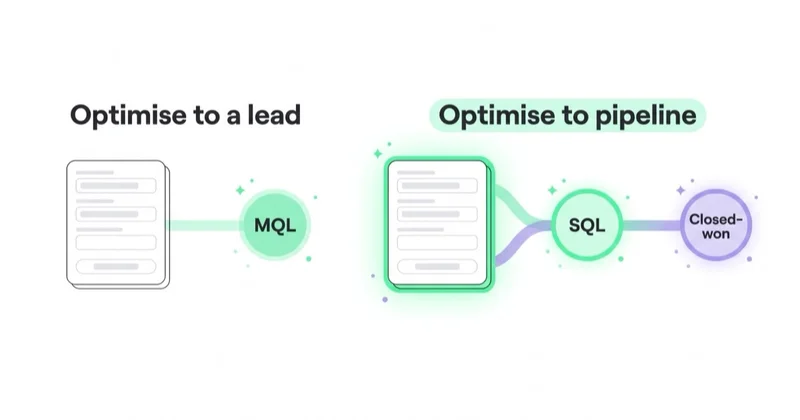
| Dimension | Optimising to lead volume | Optimising to pipeline quality |
|---|---|---|
| Conversion sent to platform | Form submission, download, demo request | Qualified stage, opportunity, closed-won or weighted value |
| What delivery learns | People likely to submit | People likely to progress |
| Main dashboard number | CPL | CAC, payback, pipeline value, revenue |
| Typical outcome | More leads, uneven quality | Fewer leads, stronger sales efficiency |
| Data requirement | Low | CRM hygiene, match keys, stage definitions |
| Best use case | Very early learning or low-volume accounts | Any account with enough CRM feedback |
There is still a place for early-stage proxies. A seed-stage SaaS company may not have enough closed-won events to train bidding. In that case, use the strongest honest proxy available: qualified demo, activated trial, invited teammate, completed onboarding or a score based on firmographic and behavioural fit. The mistake is treating that proxy as the final measure of success.
The economics: CAC ratio, payback and LTV
SaaS paid acquisition should connect to finance language early. The key numbers:
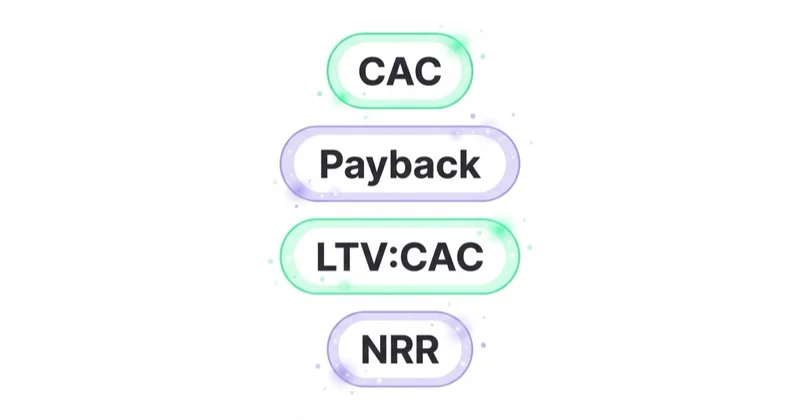
- CAC: the cost to acquire a new customer, usually including paid media and, in finance reporting, broader sales and marketing costs.
- New customer CAC ratio: sales and marketing expense divided by new customer ARR.
- Blended CAC ratio: sales and marketing expense divided by new customer ARR plus expansion ARR.
- CAC payback: how long gross margin takes to recover acquisition cost.
- LTV or gross-margin LTV: the value a customer can produce over its expected lifetime.
- MER: marketing efficiency ratio, used as a high-level direction check when attribution is noisy.
Benchmarkit is useful here because it separates new-logo and blended economics. Its 2025 private SaaS benchmark reported a median new customer CAC ratio of $2.00 of sales and marketing expense to acquire $1.00 of new customer ARR. Its 2026 SaaS and AI-native top findings reported blended CAC ratio at $1.30 and rising expansion dependency. Those two facts can both be true: expansion can make blended efficiency look healthier while new-logo acquisition remains expensive.
That is why paid reporting should not hide all motions in one blended number. A self-serve plan, a sales-assisted mid-market deal and an enterprise contract have different CAC tolerance. Paid acquisition should carry separate targets for each.
The minimum data model
Before changing campaigns, define the data that will travel from click to CRM and back.
| Layer | What needs to be captured | Why it matters |
|---|---|---|
| Ad click | GCLID, GBRAID/WBRAID where applicable, landing page, UTM data | Connects Google traffic to later outcomes |
| Lead identity | Hashed email, phone where consented, company domain | Supports enhanced conversions and CRM matching |
| CRM stage | MQL, SQL, opportunity, closed-won, closed-lost | Gives platforms a quality signal |
| Value | Stage-weighted score, pipeline value, ARR, expected gross margin | Allows value-based bidding and finance reporting |
| Segment | ICP fit, company size, country, plan, ACV band, motion | Prevents one average CAC from hiding weak segments |
| Timing | Created date, stage date, close date | Shows conversion lag and payback |
The event names must be boring and stable. If "SQL" means different things in sales, marketing and the CRM, the ad platform will learn from noise. If the value of an opportunity is updated inconsistently, value-based bidding will chase accounting artefacts. Plumbing is part of strategy in B2B SaaS because the campaign can only optimise to the truth it receives.
Google: enhanced conversions for leads and offline outcomes
Google's offline conversion setup exists for exactly this problem: an ad starts a journey that finishes later in the CRM. The older method is offline conversion import. A Google click ID is captured at lead creation, stored in the CRM and later uploaded with the offline event and value.
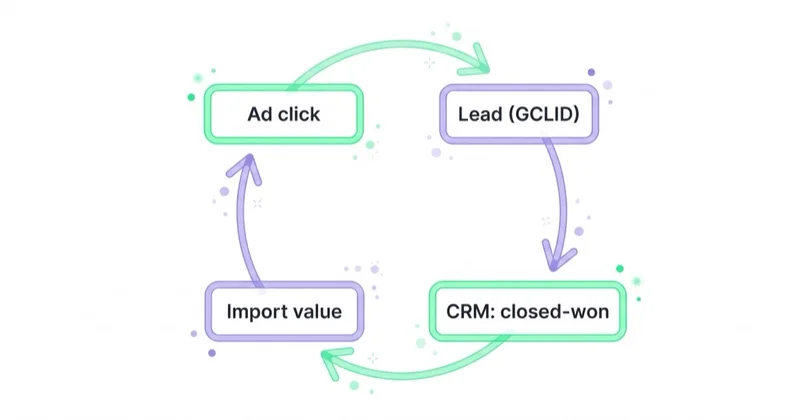
Google now recommends enhanced conversions for leads as the upgraded path. It uses hashed first-party data such as an email address, together with Google identifiers where available, to match later offline outcomes back to ad interactions. Google's own documentation says this can improve durability, cross-device measurement and reporting accuracy compared with standard offline imports.
The current implementation detail matters. Google states that from June 15, 2026, offline conversion import and enhanced conversions for leads uploads migrate to the Data Manager API and are blocked in the Google Ads API unless legacy allowlisting applies. For a SaaS team building the integration now, the default should be Data Manager or a current supported partner path, not a new legacy API dependency.
For bidding, the practical sequence is:
- Capture first-party lead data and click identifiers at the form or signup.
- Store those identifiers in the CRM record.
- Send qualified-stage events back first, because they arrive sooner and at higher volume.
- Add opportunity and closed-won value as reporting and, where volume supports it, as bidding signals.
- Move toward Maximize conversion value or Target ROAS only when conversion values are stable enough to train on.
The long-cycle account needs discipline here. If closed-won events are too rare, use a stage-weighted value model. For example, an SQL can be worth less than an opportunity, and an opportunity can be worth less than closed-won ARR. It is rough, but it gives the system a signal closer to revenue than a raw form submission.
Google channel roles in B2B SaaS
Google is not one channel. Each part of the account has a different job.
| Channel | Job | What to measure | Risk |
|---|---|---|---|
| Brand search | Capture and defend existing demand | Incremental value, not only low CAC | Over-crediting demand that already existed |
| Non-brand search | Capture active intent | SQL rate, opportunity rate, CAC | Expensive clicks without strict query control |
| Competitor search | Reach in-market buyers comparing suppliers | Cost per opportunity and assisted pipeline | Low click-through rate and legal/positioning constraints |
| Performance Max | Extend Google inventory when signal is clean | Conversion value, qualified pipeline | Brand harvesting and low-quality inventory if fed weak conversions |
| Demand Gen | Create and shape demand across visual inventory | Qualified engagement, pipeline assist, MER | Judged unfairly on last click alone |
| Retargeting | Stay present during evaluation | Assisted pipeline and frequency | Small B2B audiences can burn out quickly |
Brand search should not be allowed to make the account look better than it is. It can be useful, but it needs incrementality checks. Non-brand search deserves separate reporting because it is usually where true acquisition cost appears. Performance Max can work in B2B only when it receives value and guardrails; if it is pointed at low-quality leads, it will scale low-quality leads.
For broader demand creation, Google Demand Gen and YouTube can support education and category framing, but they should be judged against blended outcomes and assisted pipeline, not only last-click demo requests. The same logic sits behind incrementality testing: separate demand creation from demand harvesting before reallocating budget.
Meta: Conversions API, CRM stages and demand creation
Meta is rarely a pure intent-harvesting channel for B2B SaaS. People are not usually scrolling Instagram or Facebook to search for procurement software, customer data infrastructure or security tooling. Meta's job is often to make the problem visible, introduce a point of view and bring the right buyer group into the retargeting pool before a search exists.
That makes signal quality important. Meta lead campaigns can generate volume quickly, but raw lead volume is not the same as pipeline. For B2B SaaS, CRM-stage events should be sent back through the Conversions API so campaigns can learn from lead quality. The most useful optimisation event is often not closed-won. It is an earlier qualified stage with enough volume: qualified demo, SQL, opportunity created or a score that combines ICP fit and product intent.
Good Meta structure for SaaS is usually simpler than teams expect:
- Prospecting campaigns built around clear buyer problems, not feature lists.
- Retargeting separated by intent, such as pricing visitors, demo-page visitors, webinar viewers or high-intent content readers.
- CRM exclusions for customers, open opportunities and poor-fit leads.
- Creative grouped by problem, objection, proof point and use case.
- Lead quality reported back to Meta, not only collected in the CRM.
The creative has to do more work than the targeting. B2B SaaS buyers respond to specificity: the cost of the problem, the workflow that breaks, the metric that improves, the risk of inaction, the comparison point and the reason the product is credible. Vague "transform your business" ads create poor signal because they attract broad curiosity.
PLG, self-serve, sales-assisted and enterprise need different signals
One SaaS company can contain several acquisition motions. They should not share one conversion event.
| Motion | Useful paid signal | Main reporting metric |
|---|---|---|
| PLG / free signup | Activated user, invited teammate, first key action | Activated CAC, free-to-paid conversion |
| Self-serve paid | Paid signup, subscription start, gross-margin value | CAC, payback, churn-adjusted ROAS |
| Sales-assisted | Qualified demo, SQL, opportunity | Cost per SQL, pipeline CAC, payback |
| Enterprise | Account engagement, target-account opportunity, stage progression | Account-level pipeline, sales cycle impact |
Optimising PLG to raw signups is the same mistake as optimising sales-led SaaS to raw demo requests. The event must predict revenue. For PLG, that may be the activation event that historically predicts paid conversion. For enterprise, it may be account-level engagement from several stakeholders plus opportunity creation.
Blending the motions hides the economics. A low-ACV self-serve product may need fast payback and tight CAC. A high-ACV enterprise product can tolerate higher acquisition cost if win rate, retention and gross margin support it. Paid media should reflect those differences in campaign structure, conversion actions and reporting.
B2B buying is not linear, so content and retargeting cannot be linear
Gartner's current B2B buying-journey guidance is useful because it frames buying as repeated jobs, not a neat stage funnel. Buyers move through problem identification, solution exploration, requirements building, supplier selection, validation and consensus creation. The same account can revisit those jobs multiple times.
That matters for paid acquisition. A campaign that only offers "book a demo" assumes the buyer is ready for supplier selection. Many are not. Paid media needs assets for each buying job:
- Problem identification: point-of-view ads, benchmark content, symptoms and cost of inaction.
- Solution exploration: category guides, comparison pages, educational webinars.
- Requirements building: checklists, calculators, architecture notes, security and integration content.
- Supplier selection: demo pages, use cases, pricing guidance, objection handling.
- Validation: case studies, ROI material, customer proof, implementation detail.
- Consensus creation: board-level summaries, stakeholder-specific pages, procurement and legal assets.
Gartner also reports that many B2B buyers prefer a rep-free experience, while supplier-provided digital tools combined with sales interaction can increase the likelihood of a high-quality deal. The paid-media implication is not "remove sales." It is to make digital touchpoints useful enough that sales enters a more informed conversation.
Reporting: what the board should see
A SaaS paid report should be short, financial and tied to decisions. The board or leadership team does not need a table of every campaign metric. It needs to know whether paid media is creating profitable growth.
Report these numbers monthly:
- Spend by motion and channel.
- Qualified pipeline created.
- Closed-won ARR influenced or sourced, using a clear attribution definition.
- CAC and CAC payback by motion.
- Stage conversion rates from lead to SQL to opportunity to close.
- Revenue-weighted performance by channel, not only lead count.
- MER and blended CAC as guardrails.
- Self-reported attribution themes from high-intent forms.
- Notes on conversion lag and data completeness.
Platform attribution should be treated as one view, not the truth. B2B has long cycles, buying groups, cross-device research and dark social. A "How did you hear about us?" field will not reconcile to the ad platform, but it often reveals channels and communities that last-click reporting misses. For larger budgets, geo holdouts and marketing-mix modelling are more defensible than arguing over attribution settings.
A practical 90-day plan
| Phase | Work | Output |
|---|---|---|
| Days 1-15 | Audit tracking, CRM stages, conversion actions, UTMs and existing lead quality | One agreed revenue path from click to closed-won |
| Days 16-30 | Implement enhanced conversions for leads, Data Manager or partner imports, and Meta CAPI CRM events | Qualified-stage feedback loop live |
| Days 31-60 | Restructure campaigns by motion and channel role; separate brand, non-brand, prospecting and retargeting | Campaigns aligned to business jobs |
| Days 61-90 | Shift bidding toward stage-weighted value where volume supports it; rebuild reporting around CAC and payback | Leadership report that connects spend to pipeline economics |
The plan starts with measurement because creative and media work can only be judged properly after the signal is usable. Once that is in place, search structure, Meta creative, Demand Gen, retargeting and landing pages become much easier to evaluate.
Stop doing / Do instead
| Stop doing | Do instead |
|---|---|
| Reporting success on CPL | Report CAC, payback and qualified pipeline |
| Sending only web form submissions to platforms | Send qualified-stage and value data from the CRM |
| Blending PLG and enterprise into one target | Separate motions, events and CAC thresholds |
| Letting brand search define account efficiency | Separate brand from true acquisition and test incrementality |
| Feeding Performance Max weak conversions | Feed value and apply brand/account guardrails |
| Asking Meta to produce immediate demand only | Use Meta for problem framing, retargeting and quality-led lead capture |
| Treating benchmarks as rules | Use benchmarks to pressure-test the model, then set targets from gross margin and LTV |
How Space Ads approaches SaaS paid acquisition
Across the 25+ client accounts we audit daily, the pattern in weak B2B SaaS paid media is consistent: the ad account reports conversions, but the CRM does not confirm revenue quality. The first job is usually not a new campaign idea. It is to connect the data path and define which events deserve budget.
Our work usually starts with:
- CRM and conversion-action audit.
- Google enhanced conversions for leads and offline outcome mapping.
- Meta Conversions API and CRM-stage event setup.
- Separation of brand, non-brand, prospecting, retargeting and product-led motions.
- Value-based bidding where volume supports it.
- Reporting that shows CAC, payback, pipeline quality and attribution caveats.
From there, the creative and channel work becomes more precise: Google captures and extends intent, Meta creates and qualifies demand, and reporting shows whether the spend moves revenue rather than activity. That is the operating core of performance marketing. When the missing piece is ownership of positioning, budget allocation and revenue strategy, fractional CMO is the better fit.
FAQ
What is SaaS paid acquisition?
SaaS paid acquisition is the use of paid channels such as Google, Meta, LinkedIn, YouTube and retargeting to acquire software customers. In B2B SaaS, it should be measured on qualified pipeline, CAC, payback and ARR quality, not only on leads or demo requests.
Why is CPL a weak metric for B2B SaaS?
CPL measures the cost of a form submission. It does not show whether the lead matches the ICP, becomes qualified, turns into pipeline or closes. Optimising to CPL can make campaigns cheaper while making the sales pipeline worse.
How should Google Ads be connected to a SaaS CRM?
Capture click identifiers and first-party lead data at the form or signup, store them in the CRM, then send qualified-stage and closed-won events back through enhanced conversions for leads, Data Manager, supported partner integrations or current offline conversion paths. Use value-based bidding only when the values are stable enough to trust.
How should Meta be used for B2B SaaS?
Meta is strongest when it creates and shapes demand, retargets engaged buyers and uses CRM-stage feedback to optimise for quality. For B2B SaaS, raw lead campaigns should be paired with Conversions API events that show which leads became qualified.
Should a SaaS company optimise paid media to closed-won revenue?
Only when closed-won volume is high enough and arrives quickly enough to train bidding. Many B2B SaaS companies should optimise to earlier qualified stages first, then use closed-won and ARR in reporting or as a secondary value signal until volume supports direct revenue bidding.
What is a good CAC payback period for SaaS?
There is no universal payback target. It depends on ACV, gross margin, retention, expansion and funding model. A low-ACV self-serve product usually needs faster payback than an enterprise product with higher retention and larger contract value.
How do PLG and sales-led SaaS differ in paid acquisition?
PLG paid acquisition should optimise to activation and paid conversion, not free signups. Sales-led acquisition should optimise to qualified demos, opportunities and closed-won value. Combining both motions under one conversion action hides the economics of each.
What should a SaaS paid report include?
At minimum: spend by motion and channel, qualified pipeline, closed-won ARR, CAC, payback, stage conversion rates, MER, blended CAC and key attribution caveats. Campaign-level CPL can remain in the appendix, but it should not lead the conversation.
In short
- B2B SaaS paid acquisition should optimise toward pipeline quality and payback, not raw form submissions.
- The main technical job is connecting Google, Meta and CRM outcomes so bidding learns from qualified stages and revenue.
- Enhanced conversions for leads, Data Manager and offline outcomes matter on Google; Meta needs CRM-stage events through the Conversions API.
- PLG, self-serve, sales-assisted and enterprise motions need separate events and CAC targets.
- Benchmarks are useful pressure tests, but channel decisions should be made from gross margin, LTV, payback and measured pipeline quality.
Sources
- Google Ads Help - About offline conversion imports
- Google Ads Help - About enhanced conversions for leads
- Google Ads Help - About Target ROAS bidding
- Meta for Developers - Conversions API for CRM (conversion leads)
- Gartner - The B2B Buying Journey
- Benchmarkit - 2025 B2B SaaS Performance Metrics Benchmarks
- Benchmarkit - 2026 B2B SaaS and AI-Native Metrics
Continue learning
- Enhanced conversions in Google Ads - what they are and how to set them up
- Customer Match in Google Ads - what it is and how to use it
- Server-side tagging and the Conversions API - feeding clean signals back
- Incrementality testing: geo experiments across Meta and Google
- Fractional CMO vs agency vs full-time CMO: how to choose
- Performance marketing built around pipeline economics
- Fractional CMO: board-level marketing that also runs the accounts
Continue reading
Consumer Lending and BNPL Marketing: Rules and Channels
Consumer lending and BNPL marketing requires clear information about the obligation, costs and terms. Campaigns should be judged by originated-loan quality — not application volume.
Wealth Management and Investment Firm Marketing
Investment firm marketing requires clear communication of risk, costs and past performance. Success is a client who fits the service and retains assets — not simply a lead or account opening.
Bank Marketing: Acquisition and Campaigns for Retail and Business Banks
Bank marketing combines continuous customer acquisition with time-limited product and seasonal campaigns. Success is an active, funded customer relationship — not simply an account opening.