
A fractional CMO typically costs between roughly $3,000 and $20,000 a month, depending on scope, your spend and complexity, and whether the engagement is advice-only or also runs the accounts. That's a fraction of a full-time CMO's loaded cost — around $150k to $570k a year — for the share of executive leadership you actually need. But the monthly number matters less than the model behind it: a flat retainer, a percentage of your ad spend, a day rate, or a productized scope each create very different incentives. Here's how fractional CMO pricing actually works, and what you should be paying for.
TL;DR
- Typical range: ~$3,000–$20,000/month, by scope and depth — light advisory at the low end, hands-on operator-advisory at the high end.
- The model matters more than the number. Flat retainer, % of spend, day rate, performance, and productized scope each align the incentives differently.
- Avoid percentage-of-spend for the strategy layer — it pays your advisor more when you spend more, which is the opposite of what a CMO should optimise for.
- Cost is driven by: advice-only vs operating the accounts, your spend and complexity, whether a team comes with the leader, and engagement depth.
- A credible engagement starts with a fixed-scope diagnostic — a known deliverable for a known fee — not a 12-month lock-in or a fully-gated quote.
- Don't price it against an agency — they're different jobs. Price it against the cost of not having senior direction.
The honest ranges
Most providers hide this behind "request a quote," so here are the real numbers. Fractional CMO engagements generally run:
- ~$3,000–$6,000/month — light advisory: a few days a month, strategy and direction, no hands-on operation.
- ~$6,000–$12,000/month — the common middle: ongoing direction plus oversight of execution, deeper involvement.
- ~$10,000–$20,000+/month — hands-on, operator-advisory: the leader sets the strategy and runs the accounts, often with a small team.
For comparison, a full-time CMO costs roughly $150k–$570k a year once you load salary, equity and overhead — so even a deep fractional engagement lands below a junior full-time package, for senior judgement. (For the full three-way cost comparison with agencies and full-time hires, see fractional CMO vs agency vs full-time CMO.)
The pricing models — and the incentives they create
The fee structure quietly shapes the advice you get. Five models, and what each one rewards:
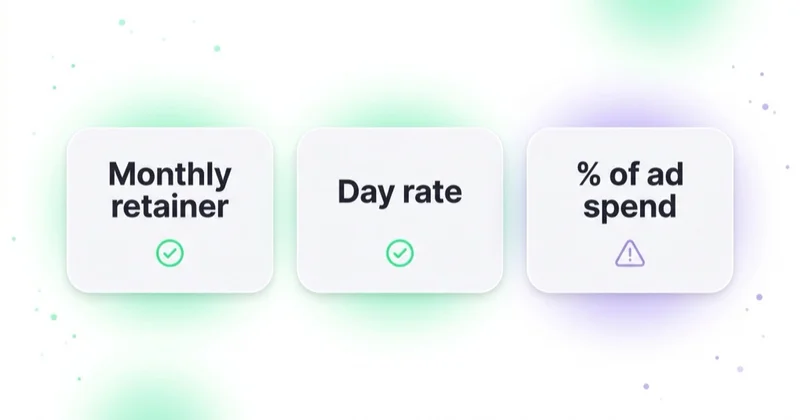
| Model | How it works | What it rewards | Best when |
|---|---|---|---|
| Flat monthly retainer | Fixed fee for an agreed scope | Outcomes, not hours or spend | Ongoing direction; the cleanest default |
| Day / hour rate | Billed per day or hour worked | Hours logged | Defined, time-boxed projects |
| Percentage of ad spend | Fee scales with your media budget | Spending more of your money | Rarely a fit for the strategy layer |
| Performance / commission | Paid on results (CPA, revenue share) | A specific metric (sometimes the wrong one) | When the funnel is fully in their control |
| Productized scope | Fixed fee for a defined deliverable | Shipping the deliverable | The first engagement (e.g. 90-day diagnostic) |
The one to scrutinise is percentage of spend. It's common because it's easy to quote, but it aligns your advisor's income with spending more, not with your profit — and the entire job of a marketing leader is sometimes to tell you to spend less. A flat retainer removes that conflict. If a fractional CMO proposes a percentage-of-spend fee, ask directly what stops them from inflating the budget.
What actually drives the cost
Four variables explain most of the range:
- Advice vs operation. Advising on strategy is cheaper than also running the accounts. Operator-advisory — strategy plus hands-on execution — sits at the top of the range because it's two jobs in one engagement.
- Your spend and complexity. More channels, more markets, a bigger catalogue and higher spend all mean more to direct, which raises the fee.
- Whether a team comes along. A lone fractional executive costs less than one who brings specialists to execute under them.
- Depth and cadence. A few days a month is a different fee from a leader embedded weekly in your business.
What you should actually be paying for
Buy the outcome, not the hours. The trap with day rates is that they invite you to count days; the value of a fractional CMO isn't time logged, it's the decisions made — the budget reallocated, the strategy corrected, the measurement fixed. Price the engagement against the cost of not having senior direction: the spend leaking into the wrong channels, the plateau no one can explain, the full-time hire you'd otherwise make too early.
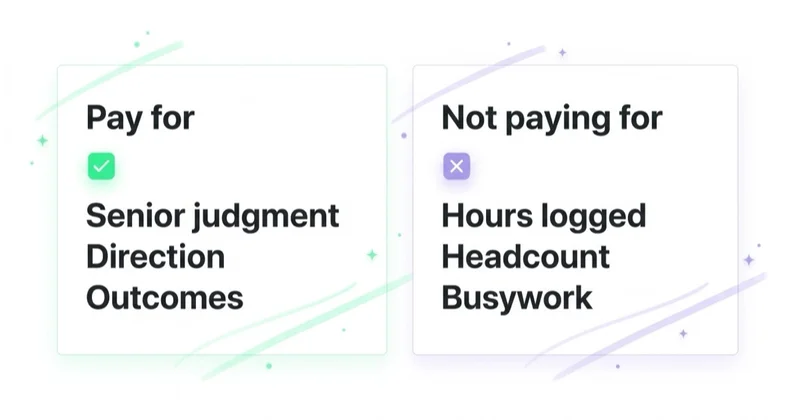
The best engagements make this concrete by starting with a productized diagnostic — a fixed fee for a defined deliverable (a full diagnosis and roadmap) — so you can judge the thinking and the value before committing to an ongoing retainer. That's the opposite of the open-ended, gated quote that dominates the market.
Pricing red flags
- Percentage of spend with no efficiency incentive — pays them to grow your budget, not your profit.
- A 12-month lock-in — good work earns the renewal month to month; a long handcuff signals otherwise.
- Fully gated pricing — "request a quote" with no indicative range at all is a negotiating tactic, not confidentiality.
- Day-rate creep — open-ended hourly billing with no scope, where the meter is the product.
- A guaranteed number on a date — anyone pricing a guarantee is selling, not operating.
How we approach pricing at Space Ads
Across the 25+ accounts we audit daily, the cost question is usually framed wrong. Companies ask "what does a fractional CMO cost?" when the decision-grade question is "what is the absence of senior direction costing us?" In practice, that absence shows up in budget splits no one owns, platform numbers that are not reconciled to the business, creative that drifts from positioning, and paid spend scaled before the economics are clear. The fractional CMO isn't a cost line to minimise; it is the role that finds and prioritises those decisions. That's why we price our fractional CMO engagement on a flat, scoped basis starting with a fixed-fee diagnostic — so the incentive matches your profit, not our invoice.
FAQ
How much does a fractional CMO cost per month?
Typically $3,000–$20,000 a month: roughly $3k–$6k for light advisory, $6k–$12k for ongoing direction with oversight, and $10k–$20k+ for hands-on operator-advisory where the leader also runs the accounts. The exact figure depends on scope, your spend and complexity, and whether a supporting team is included.
Is a fractional CMO cheaper than a full-time CMO?
Yes — significantly. A full-time CMO runs about $150k–$570k a year fully loaded, plus a months-long hiring process and a roughly four-year average tenure. A fractional CMO gives you senior direction for a fraction of that, starting in days and scaling to the share of leadership you actually need.
Should a fractional CMO charge a percentage of ad spend?
Usually not for the strategy layer. A percentage-of-spend fee aligns the advisor's income with spending more of your budget, which conflicts with a marketing leader's job of allocating spend efficiently — sometimes by spending less. A flat retainer avoids that conflict. If percentage-of-spend is proposed, ask what stops them recommending more spend than you need.
Why do most fractional CMOs hide their pricing?
Partly because scope genuinely varies, partly as a negotiating tactic. Variable scope is a fair reason not to publish a single fixed price — but it's not a reason to refuse any indicative range. A credible provider will give you a floor and a model, and ideally a fixed-scope first engagement, rather than gating everything behind a quote.
What's a fair way to pay a fractional CMO?
A flat monthly retainer for an agreed scope, ideally starting with a productized, fixed-fee diagnostic so you can judge the value before an ongoing commitment. Avoid percentage-of-spend (misaligned incentive), open-ended day rates (pays for hours, not outcomes) and long lock-ins. Price the engagement against the cost of not having senior direction, not against an agency retainer.
In short
- Expect ~$3k–$20k/month, by scope and depth — a fraction of a full-time CMO's $150k–$570k/year.
- The pricing model matters more than the number; a flat retainer aligns incentives best.
- Avoid percentage-of-spend for the strategy layer — it rewards spending more, not profit.
- Cost is driven by advice-vs-operation, your spend, whether a team is included, and depth.
- Start with a fixed-scope diagnostic; treat gated pricing and 12-month lock-ins as red flags.
Sources and further reading
- Spencer Stuart — CMO Tenure Study 2025
- Space Ads — Fractional CMO vs agency vs full-time CMO
- Space Ads — Fractional CMO engagement (operator-advisory)
Continue learning
Continue reading
Marketing Consultant vs Consultancy vs Agency: Which One Do You Need?
Use this when the business knows marketing is under-led but the buying category is fuzzy. The guide translates consultant, consultancy, agency and fractional CMO into practical differences around advice, ownership and execution so the next hire matches the real gap.
Fractional CMO vs Marketing Agency vs Full-Time CMO: How to Choose
The real decision is not a job title; it is what kind of marketing leadership gap you have. This guide compares the three options by ownership, cost, speed, risk and execution depth so you can decide whether to buy strategy, hands-on channel delivery or a permanent executive role.
What Is a Fractional CMO — and When You Should NOT Hire One
A fractional CMO can close a senior leadership gap without a permanent executive hire — but only when the mandate, authority and delivery capacity are clear. Use this guide to decide whether you need fractional leadership, an interim CMO, an agency, a consultant or an in-house hire.


































