Cost per click (CPC) in Google Ads can often be reduced, but a lower average is not automatically an improvement. CPC reflects the auctions the campaign enters, its bids, competition, ad and landing-page quality, search context, Ad Rank thresholds, assets and bidding strategy. Cutting bids or expanding into cheaper queries can lower the number while removing valuable demand or weakening traffic quality.
The better question is: how can CPC be reduced without damaging conversion volume, lead quality or revenue? The answer starts with relevance. The account should buy fewer irrelevant clicks, match ads more closely to intent and send users to pages that convert. Only then does a lower CPC have business value.
TL;DR
- Lower CPC through relevance and control, not only lower bids. Cheaper clicks are useful only when conversion quality holds.
- Quality Score is diagnostic. Google's 1-10 Quality Score helps diagnose expected CTR, ad relevance and landing page experience, but it is not the auction-time formula.
- Search terms and negatives are practical controls. Use both the search terms report and search terms insights; neither provides a literal list of every low-volume query.
- Long-tail intent can reduce waste. More specific queries may have lower competition and better conversion rates.
- Landing pages affect both CPC and CPA. Better relevance and conversion rate can lower cost per click and cost per result.
- Automation needs the right objective and controls. Smart Bidding and AI Max can widen reach, but only useful conversion values, URLs, brand rules and exclusions make the result commercially meaningful.
- The goal is profitable incremental demand. CPA and ROAS are better than CPC, but they too need validation against lead quality, margin and sales that would have happened anyway.
How Google Ads CPC is actually determined
Google Ads works through auctions. When a user searches, Google decides which ads are eligible, where they can appear and what the advertiser pays. Ad Rank is based on several factors, including bid, ad and landing page quality, Ad Rank thresholds, auction competitiveness, search context and expected impact of ad assets.
A common oversimplification says "Ad Rank = bid x Quality Score." That is not precise enough today. Google's visible Quality Score is a keyword-level diagnostic score from 1 to 10. Google states that Quality Score is an aggregated estimate and is not used at auction time to determine Ad Rank. The auction uses real-time quality signals such as expected click-through rate, ad relevance and landing page experience, among other factors.
The practical conclusion still matters: stronger relevance and landing-page experience can improve auction performance, but they do not guarantee that average CPC will fall. The campaign may enter more competitive, valuable auctions at the same time. Improve the user journey and conversion economics rather than chasing the visible score.
Start with cost per conversion, not CPC
Before optimising CPC, calculate what a click is allowed to cost and what counts as a valuable outcome.
| Scenario | CPC | Landing page conversion rate | Cost per conversion |
|---|---|---|---|
| Relevant, higher-intent clicks | $10 | 5% | $200 |
| Cheap, weak clicks | $5 | 1% | $500 |
| Same CPC, better landing page | $10 | 8% | $125 |
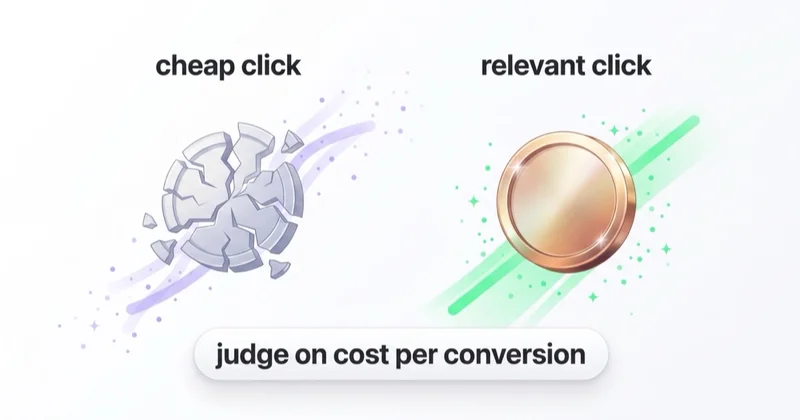
The table illustrates the interaction, not a forecast: CPA equals CPC divided by conversion rate when one click can produce at most one counted conversion. A lower CPC is useful only when it maintains or improves qualified-lead cost, customer-acquisition cost or contribution. Check that duplicate, low-value and micro-conversions are not making automated bidding look more successful than the business result. This is why Google Ads cost should be read through CPA, ROAS and customer value.
1. Use Quality Score as a diagnosis, not a KPI
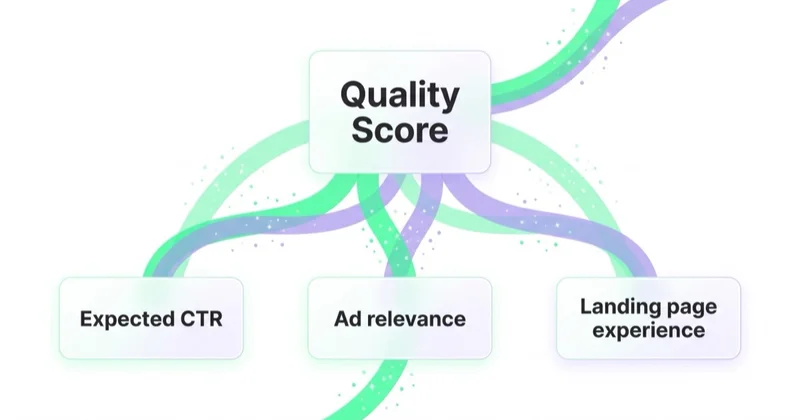
Quality Score has three components:
| Component | What it indicates | What to inspect |
|---|---|---|
| Expected CTR | Whether the ad is likely to earn clicks compared with competitors | headline, offer, asset strength, intent match |
| Ad relevance | Whether the ad matches the search intent behind the keyword | ad group structure, RSA assets, keyword grouping |
| Landing page experience | Whether the page is useful and relevant after the click | page content, speed, mobile UX, next step and trust |
If a component is "Below average," it points to work. It does not mean the campaign should blindly optimize for a 10/10 score. A keyword with lower Quality Score but strong conversion economics may deserve monitoring rather than emergency changes. A keyword with high spend, low quality and weak CPA deserves action.
2. Tighten ad group structure around intent
High CPC often appears when one ad group tries to serve too many intents. Keywords such as "Google Ads audit," "Google Ads course," "Google Ads agency" and "Google Ads jobs" contain the same words but represent different users.
Better structure can reduce wasted CPC because:
- ads match the query more closely;
- CTR usually improves;
- ad relevance becomes stronger;
- negatives are easier to apply;
- landing pages can be more specific;
- reporting shows which intents are expensive and valuable.
Build ad groups around shared intent, not around a loose list of related words.
3. Clean the search terms report regularly
The search terms report shows queries with enough activity that triggered ads. Google omits some low-volume terms for privacy. Search terms insights groups query activity into themes and can include low-volume demand within subthemes or "other queries," but it does not expose every query either. Use both views to understand demand; do not mistake visible rows for the full query universe.
Common waste patterns:
- jobs, careers, internships, salary and training;
- "free," "template," "PDF," "forum," "course" or DIY intent;
- unsupported cities, regions or countries;
- B2C queries in a B2B campaign or the reverse;
- support or login queries;
- irrelevant product variants;
- competitor or brand terms that should be isolated;
- informational terms that belong in SEO, not paid Search.
Negative keywords protect the budget. Their job is not to block every broad theme. Add them only after checking meaning, match type, spelling variants and the risk of excluding valuable searches. Shared lists can create account-wide damage when applied without context.
4. Use match types according to risk
Match type choice affects CPC because it controls how widely keywords can enter auctions.
| Approach | When it fits | CPC impact |
|---|---|---|
| Exact and phrase focus | when tighter steering and interpretable testing matter | narrows reach relative to broad match, but still matches searches with the same meaning or intent |
| Broad match with Smart Bidding | when reliable conversion or value signals and wider discovery justify it | can find additional intent; needs query review and business-relevant goals |
| Brand vs non-brand split | accounts with brand demand | prevents cheap brand CPC from hiding acquisition cost |
| AI Max test | Search campaigns ready to test broader matching, asset optimisation and URL expansion | can extend beyond keywords; requires URL, brand, creative and measurement controls |
Exact match does not mean "identical wording," and phrase match is not limited to a literal phrase. Both can match searches with the same meaning or intent, while broad match can use additional contextual signals. Judge the actual queries and outcomes rather than assuming a match-type label guarantees traffic quality.
AI Max is an optional optimisation layer within Search campaigns, not a separate campaign type. Its search term matching can use broad-match and keywordless technology; asset optimisation can customise text and expand final URLs. In return, review the AI Max source and landing-page columns, exclude unsuitable URLs, set brand controls and check tracking templates. When final URL expansion chooses another page, pinned RSA assets may not be respected because they may not fit that page.
5. Target more specific, long-tail intent
High-volume head terms can be competitive and ambiguous. More specific queries reveal additional context and may convert better, but low volume does not guarantee low CPC. A commercially valuable niche query can be expensive, and modern matching can reach it without a dedicated keyword.
Examples:
| Broad query | More specific query |
|---|---|
| marketing agency | Google Ads agency for fashion ecommerce |
| dentist | emergency dental implant consultation Austin |
| running shoes | women's trail running shoes wide fit size 8 |
| Google Ads audit | Google Ads audit for Merchant Center feed issues |
Use specific intent to improve messages, landing pages, negatives and reporting themes rather than building thousands of near-duplicate keywords. Evaluate the traffic by qualified conversion cost and customer value, not CPC alone.
6. Improve ads and assets
Better ads can improve expected CTR, user qualification and auction performance.
Practical improvements:
- write headlines that answer the query, not only repeat the keyword;
- include specific offer, scope, location, product type or proof;
- use sitelinks, callouts, structured snippets and other relevant assets;
- separate copy for brand, non-brand, local, comparison and problem-led queries;
- test RSA assets for meaning, not only variation count;
- avoid misleading copy that raises CTR but lowers conversion quality.
Good ad copy should qualify the click. Sometimes a more precise ad gets fewer clicks but better CPA because it filters out low-intent users.
7. Improve landing page relevance and conversion rate
Landing pages can reduce both CPC pressure and CPA.
Useful improvements:
- match the page headline to the ad promise;
- answer the search intent immediately;
- show proof: case studies, reviews, process, examples or credentials;
- make pricing, scope or next step clear where appropriate;
- improve mobile speed and usability;
- align form length with lead value;
- remove distractions that do not support the conversion;
- make the product or service category specific, not generic.
If clicks are affordable but conversions are weak, CPC optimization is the wrong first move. Diagnose the conversion path. See why Google Ads are not converting.
8. Choose bidding strategy by data quality
Manual bid changes can lower CPC, but they can also remove the account from valuable auctions. Smart Bidding sets a bid for each auction to optimise conversions or conversion value. It still follows the conversion goals and values supplied by the advertiser; it cannot know that a form submission was unqualified unless that information is returned to Google Ads.
Use bidding based on maturity:
- early test with sparse or uncertain data: narrow the scope, simplify goals and avoid aggressive targets unsupported by evidence;
- reliable lead or sales measurement: Smart Bidding can optimise toward conversions, CPA, value or ROAS;
- e-commerce: use conversion value, margin or return-adjusted values where possible;
- lead generation: import qualified-lead and closed-sale outcomes through Data Manager or another supported method when appropriate.
As of June 2026, Google is simplifying Search bidding labels: "Maximise conversions with a target CPA" is becoming "Target CPA," and "Maximise conversion value with a target ROAS" is becoming "Target ROAS"; the underlying behaviour is unchanged. There is no single conversion-volume threshold that makes every strategy safe. Requirements and learning needs vary by campaign type and objective.
Lower CPC is not usually the right bidding objective by itself. Even Maximise clicks should have budget, query and conversion-quality controls. The commercial objective should be profitable customers, qualified pipeline or contribution-adjusted value.
9. Segment by location, device and schedule
Not every click has the same value. Review CPC and CPA by:
- location;
- device;
- day and hour;
- brand vs non-brand;
- landing page;
- new vs returning users;
- campaign type;
- query intent.
If one region has high CPC and poor lead quality, first check whether location settings, small samples or sales handling explain the pattern, then restrict or separate it if the evidence holds. If mobile CPC is low but the mobile form is broken, fix the page before shifting budget. If evening clicks are cheap but consistently unqualified, schedule controls may help.
Do not assume every segment needs a manual bid adjustment. With Target CPA, Target ROAS, Maximise conversions and Maximise conversion value, Google says manual bid adjustments are generally unsupported because auction-time bidding already uses contextual signals. A device adjustment under Target CPA changes the target rather than directly changing the bid; support varies by strategy.
10. Reduce CPC by removing waste, not demand
The healthiest CPC reduction removes low-value auctions while preserving high-value demand. The unhealthy version cuts bids until the account disappears from profitable auctions.
Use this distinction:
| Healthy CPC reduction | Risky CPC reduction |
|---|---|
| Adding negatives for irrelevant queries | Cutting bids across all keywords |
| Improving landing page relevance | Sending every intent to one generic page |
| Splitting brand and non-brand | Optimizing to cheap traffic campaigns |
| Using conversion value | Ignoring lead quality and CRM data |
| Pausing spend with weak CPA | Pausing expensive clicks that drive profitable customers |
| Testing AI Max with guardrails | Enabling or rejecting automation without a controlled test |
The goal is a lower cost per useful click and a lower cost per conversion.
How Space Ads approaches CPC reduction
At Space Ads, a CPC review starts by asking whether CPC is the constraint. The audit connects search themes, brand/non-brand structure, Quality Score diagnostics, ads, selected landing pages, conversion goals and downstream customer quality. It also separates a change in auction mix from a genuine improvement within comparable demand.
If CPC is high, the cause may be commercially valuable intent, broader matching, competition, location mix, bid targets, weak relevance or a shift into auctions with higher expected value. If CPA is high, the cause may instead sit after the click. Only after that diagnosis does it make sense to adjust matching, AI Max controls, targets, budgets, campaigns or landing pages.
This work connects Google Ads, marketing audit, CRO, analytics and CRM quality. The objective is not the lowest CPC in the report. The objective is a lower cost per qualified lead, purchase or revenue unit.
Common mistakes
| Mistake | Why it hurts | Better approach |
|---|---|---|
| Cutting bids before checking CPA | CPC drops but high-value auctions disappear | Review cost per conversion and lead quality |
| Treating Quality Score as the auction formula | It creates the wrong optimization target | Use it as diagnostic guidance |
| No brand/non-brand split | Cheap brand hides expensive acquisition | Separate reporting and budgets |
| Treating exact match as literal | Close-meaning searches are missed in the diagnosis | Review actual search terms and insights |
| Broad or AI Max matching without controls | Unwanted themes or URLs can spend budget | Use reports, negatives, URL and brand controls |
| Optimizing for cheap clicks | Low-intent traffic lowers CPC and raises CPA | Optimize for valuable conversions |
| Ignoring landing pages | The same click cost converts poorly | Improve page relevance and CRO |
| Judging changes too quickly | Auction volatility and conversion lag mislead | Use enough data and a stable window |
FAQ
How can CPC be lowered in Google Ads?
Lower CPC by improving relevance, excluding unwanted demand, strengthening ads and landing pages, choosing suitable matching and bidding settings, and separating segments with materially different economics. With AI Max, also review match sources, selected URLs and brand controls. Validate every change against qualified conversions, customer value and incremental contribution.
Why is CPC high in Google Ads?
CPC can be high because of competition, high commercial intent, auction mix, bid targets, broad or keywordless matching, location, weak relevance or landing-page experience. A high CPC is not automatically a problem if the traffic produces profitable incremental customers. Compare like-for-like intent before diagnosing deterioration.
Does Quality Score lower CPC?
Quality Score is a diagnostic metric, not the auction-time formula. Google says Quality Score is not used at auction time to determine Ad Rank. However, the underlying quality areas it diagnoses - expected CTR, ad relevance and landing page experience - can influence auction performance. Improving them can often lower real CPC and improve results.
Is lower CPC always better?
No. Lower CPC is better only if conversion rate, lead quality and revenue hold up. Cheap clicks with weak intent can increase cost per conversion. A higher CPC with much stronger conversion rate can be the better business result.
Do negative keywords lower CPC?
They can lower average CPC by preventing ads from entering unwanted auctions, but that is not guaranteed. Their primary value is relevance, budget protection and cleaner conversion signals. Apply the correct negative match type and check variants so valuable demand is not blocked accidentally.
Do long-tail keywords have lower CPC?
Often, but not always. Long-tail queries are more specific and may face less competition, but their main benefit is clearer intent. Judge them by cost per conversion and lead quality, not only CPC.
Key takeaways
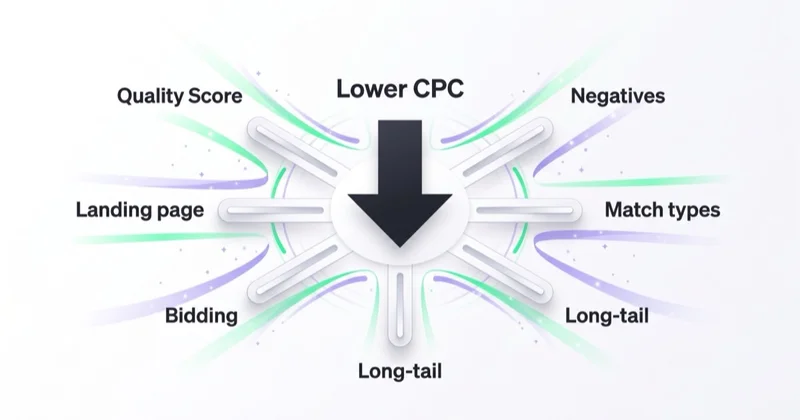
- CPC should be reduced through relevance, intent control and better conversion paths, not blind bid cuts.
- Quality Score is a diagnostic tool; the visible 1-10 score is not the auction formula.
- Search terms, insights, negatives, match types and AI Max controls help govern which demand the campaign enters.
- Landing pages and conversion tracking matter because the real goal is lower cost per conversion.
- The healthiest CPC reduction removes waste without cutting profitable demand.
Sources and further reading
- Google Ads Help - About Ad Rank
- Google Ads Help - About Quality Score
- Google Ads Help - How to optimize your ads with Quality Score
- Google Ads Help - Manage your spend in Google Ads
- Google Ads Help - About the search terms report
- Google Ads Help - How AI Max for Search campaigns works
- Google Ads Help - About Smart Bidding
- Google Ads Help - About bid adjustments
Continue learning
Continue reading
Google Ads Benchmarks by Industry (CTR, CPC, Conversion Rate)
Google Ads benchmarks can provide context, but only when the campaign type, market, conversion action, attribution and time period match. Learn how to make a valid comparison and turn it into a useful decision.
How Much Does Google Ads Cost? Pricing, CPC and Budgets Explained for 2026
Google Ads has no fixed price. You set the budget, while the auction determines actual CPC, CPM or CPV based on competition, bid, ad quality, context and campaign type. This guide explains pricing, budgets, CPA math and the full cost of running Google Ads.
Gemini Ad Formats: When the Ad Is Generated, Not Written
Google is testing and announcing Gemini-powered ad experiences across AI Mode and Search. Learn what each format does, what remains uncertain and how to prepare data, content and measurement.