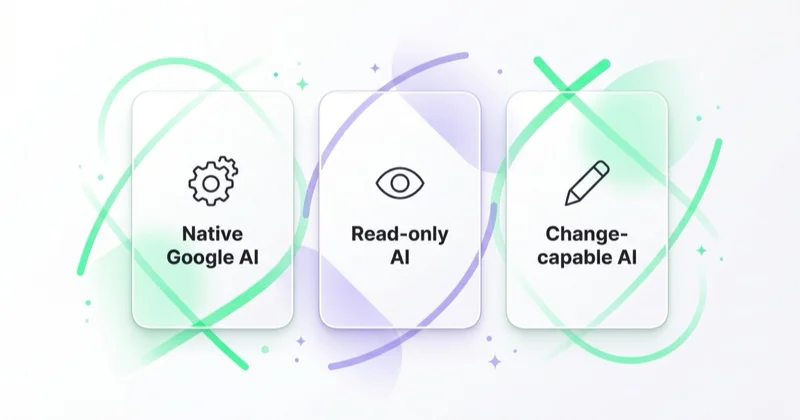
AI for Google Ads in 2026 means two distinct things that often get blurred. The first is Google's native AI — Smart Bidding, Performance Max and AI Max — which already runs your auctions and decides who sees your ads; you don't install it, it's how the platform works. The second is third-party AI: tools that use models to read your account, find issues and help you act. Within that second category there's a further split that decides everything — read-only AI that can only analyze, and change-capable AI that proposes and applies changes through the API. Knowing which "AI for Google Ads" someone means is the difference between a sensible decision and a confused one.
TL;DR
- "AI in Google Ads" splits in two: Google's native AI (runs the auction) and third-party AI (helps you manage the account). They solve different problems.
- Native AI already won the bidding. Smart Bidding, Performance Max and AI Max optimize with signals no external tool can match.
- Third-party AI splits again: read-only connectors that analyze, and change-capable workspaces that act.
- Read-only is safe by design but stops at "here's what I'd do." The official Google Ads MCP server is the clearest example.
- Change-capable AI is faster but needs guardrails — limits, previews, verification and an audit log, or it's an account incident waiting to happen.
- AI doesn't replace judgement; it replaces the manual labour around it. What to optimize toward, and why, is still human.
- The human job moved up the stack — from pulling levers to setting objectives, judging trade-offs and keeping the signal clean.
For the broader category this sits in, see the pillar on ad management software; for the agency angle, agentic AI in marketing.
A quick glossary
- Smart Bidding — Google's native AI bid strategies (Target ROAS, Target CPA, Maximize Conversions) that set bids per auction.
- Performance Max — a Google campaign type where AI manages targeting, placement and creative assembly across Google's surfaces.
- AI Max for Search — Google's AI layer that expands matching and asset creation within Search campaigns. See what it changes.
- Read-only AI connector — an AI integration that can query account data but cannot change anything, like the official Google Ads MCP server.
- Change-capable AI / agentic workspace — AI that reads accounts and also applies changes through the API, after approval and within limits.
- Guardrails — the limits, previews, verification and audit log that constrain what a change-capable system can do.
Google's native AI: the part you don't install
Most of the highest-volume "AI for Google Ads" interest is really about Google's own AI — what it does and whether to trust it. The honest summary: it already runs the auction, and fighting it usually loses.
Smart Bidding sets bids per auction using signals — user context, device, time, query nuance — that no third-party tool can see, because Google owns the auction. Performance Max extends that to targeting, placement and creative assembly across Search, Shopping, YouTube, Display and Gmail. AI Max brings similar expansion into Search campaigns. None of these is optional in the way third-party software is; they're the modern default of how Google Ads operates.
The implication for anyone managing Google Ads: the value-add is no longer beating the algorithm at bidding. It's giving the algorithm what it needs — clean conversion signals, accurate values, strong creative assets, and a clearly defined objective — and then judging whether the outcome maps to the business. That's the human work native AI created, not eliminated.
Third-party AI: read-only vs change-capable
Once you set native AI aside, "AI tools for Google Ads" means software that uses models to help you manage the account. This is where a distinction decides everything about safety and usefulness.
Read-only AI connectors let an assistant query your account through the API and answer questions — "which campaigns lost efficiency last week?", "where is spend concentrated?". The official Google Ads MCP server is the canonical example: it reads data via GAQL and deliberately cannot change anything. This is safe by construction and excellent for analysis and ad-hoc reporting. Its limit is equally clear: it stops at "here's what I'd do." Nothing gets done.
Change-capable AI reads and writes: it proposes a budget shift or a negative-keyword addition, shows the exact change, and applies it through the Google Ads API after approval. This is faster and closes the loop, but only as trustworthy as its guardrails.
| Native Google AI | Read-only AI | Change-capable AI | |
|---|---|---|---|
| What it does | Runs the auction | Analyzes the account | Analyzes and applies changes |
| You install it? | No — it's the platform | Yes (connector) | Yes (workspace) |
| Can it change accounts? | It is the change (delivery) | No | Yes, with approval |
| Main risk | Trusting it without clean signals | None — read-only | Acting without guardrails |
| Best for | Bidding, delivery, matching | Analysis, ad-hoc reporting | Operating accounts at speed |
The guardrails that make change-capable AI safe
The moment AI can move a budget or change a bid, the interesting question stops being "how smart is it?" and becomes "what stops it doing something costly?" A serious change-capable system has, at minimum:
- Hard limits per account — a maximum daily budget and a cap on how much any single change can move.
- A preview of the exact change before anything is sent.
- Verification that the applied outcome matches the intent.
- A complete audit log — every change recorded with its reason.
Without those, an AI workspace is just a faster way to make an expensive mistake. With them, it's the speed of automation with the accountability of a careful human.
What we see using AI on real accounts
Across the 25+ client accounts we audit daily — analyzing on the order of 14M data points a month — the most useful thing AI does isn't clever optimization, it's tireless attention. It reads every account every morning and surfaces the quiet problems a person would only catch by chance: a tracking break starving Smart Bidding of signal, a feed dropping products, a conversion getting double-counted after a rename. Those are the failures that actually cost money, and they're boring enough that manual review misses them on a busy week.
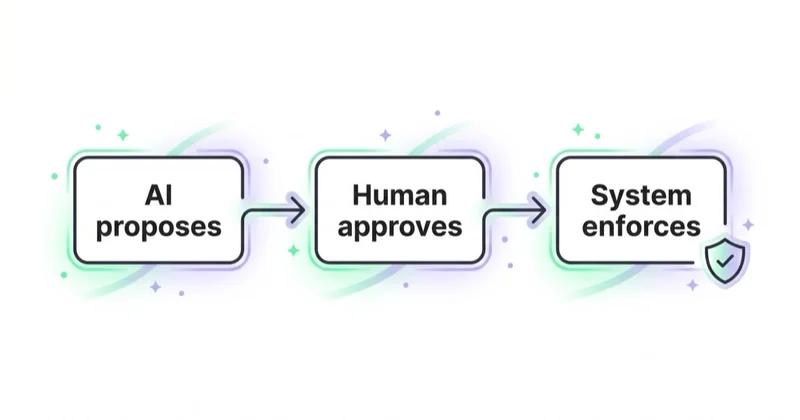
What AI consistently does not do well is judgement without context. It will happily propose a confident, plausible change that's wrong because it doesn't know the client is protecting margin this quarter, or that a "low-converting" campaign is a deliberate brand play. That's why we keep the decision with a person and use AI for coverage and speed. The pattern that works is narrow: let AI find and propose, let a human decide, let the guardrails enforce. The teams that get burned are the ones that skip the middle step.
A practical way to adopt AI for Google Ads
- Step 1 — feed the native AI properly. Before adding any AI tool, make sure Smart Bidding has clean conversion data and accurate values. Most "AI isn't working" is a signal problem.
- Step 2 — start read-only. Use a read-only connector to analyze accounts and build trust in the AI's reasoning with zero risk.
- Step 3 — add change capability with limits. Move to a change-capable workspace on one account, with hard limits, reviewing every preview.
- Step 4 — keep the human on judgement. Let AI find and propose at scale; keep consequential decisions with a person and the guardrails enforcing the boundaries.
Stop doing / do instead
| Stop doing | Do instead |
|---|---|
| Fighting Smart Bidding with manual bids | Feed it clean signals and a clear objective |
| Blaming "AI" for poor results | Check conversion tracking and value data first |
| Letting change-capable AI act without limits | Require caps, previews, verification and a log |
| Treating read-only AI as a full solution | Use it to analyze; pair with a human to act |
| Handing judgement to the model | Let AI propose; keep the decision with a person |
| Assuming more automation = less oversight | More automation raises the value of good oversight |
Where Space Ads OS fits
Space Ads OS is the change-capable end of this spectrum, built deliberately around the read-only/change-capable distinction. You can ask it to analyze any account — like a read-only connector — but you can also ask it to apply a change, and that's where the guardrails do their work: a per-account limit, a preview of the exact change, a verification step, and a logged reason. It runs across Google, Meta, TikTok and GA4 from one chat, so the analysis isn't siloed to a single platform.
The design choice that matters is keeping the human on judgement. The system handles the tireless reading — every account, every day — and proposes; a person decides; the guardrails enforce. That's the opposite of "AI on autopilot," and it's deliberate, because the failures we see come from removing the human, not from the AI being insufficiently clever. If you want AI that acts on Google Ads without giving up control, that's the gap it closes — you can see how it works here.
FAQ
Can AI run Google Ads on its own?
Parts of it already do — Google's native AI (Smart Bidding, Performance Max, AI Max) runs the auction and delivery automatically. Third-party AI can analyze accounts and, if change-capable, apply changes through the API. But fully autonomous management without human judgement is risky: AI proposes confident changes that can be wrong without business context it doesn't have, so the reliable pattern keeps a person on consequential decisions and uses AI for coverage and speed.
What is the difference between Google's AI and an AI tool for Google Ads?
Google's native AI — Smart Bidding, Performance Max, AI Max — is built into the platform and runs the auction; you don't install it. An AI tool for Google Ads is third-party software that uses models to help you manage the account, either read-only (analysis) or change-capable (proposing and applying changes). One runs the ads; the other helps you operate the account around them.
Is it safe to let AI change Google Ads campaigns?
It can be, with guardrails: hard per-account limits, a preview of every change before it's sent, verification that the outcome matched intent, and a complete audit log. Read-only AI carries no such risk because it can't change anything. Change-capable AI is safe when it acts within those controls and a human approves consequential changes — and unsafe when it doesn't.
What's the best AI for Google Ads?
There's no single answer because the categories solve different problems. For better bidding and delivery, Google's native AI is already the best available and you should feed it well rather than replace it. For analysis, a read-only connector like the Google Ads MCP server is excellent. For operating accounts at speed, a change-capable workspace with proper guardrails adds the most — the right choice depends on whether you need analysis or action.
Does AI replace a Google Ads specialist?
No — it changes what the specialist does. With bidding and delivery automated and AI handling the tireless monitoring, the human work moves up: defining objectives, judging trade-offs the AI can't see (margin, brand, seasonality), keeping conversion signals clean, and deciding which proposed changes to approve. AI replaces the manual labour, not the judgement.
Can ChatGPT manage Google Ads?
ChatGPT and similar models can analyze exported data or, via a connector, read account data and suggest changes — but raw chat models acting directly on live accounts without limits, previews and logs are risky. The safe pattern is a purpose-built workspace where the AI proposes and a human approves within guardrails, rather than giving an unconstrained model write access to spend.
In short
- "AI for Google Ads" means two things: Google's native AI (runs the auction) and third-party AI (helps you manage).
- Native AI already won the bidding — feed it clean signals rather than fighting it.
- Third-party AI splits into read-only (safe, analysis-only) and change-capable (faster, needs guardrails).
- Guardrails — limits, previews, verification, audit log — are what make change-capable AI safe.
- AI's best contribution is tireless attention; its weakness is judgement without business context.
- Keep the human on decisions; let AI find, propose and cover — that's the pattern that holds up.
Sources and further reading
- Google Ads Help — About Smart Bidding
- Google Ads Help — About Performance Max campaigns
- Google Ads Developers — Google Ads API overview
- Space Ads — Google Ads MCP server: connecting AI to your data
- Space Ads — Google AI Max for Search: what changes
Continue learning
Continue reading
The First 90 Days of Google Ads: A Launch Playbook
A practical 90-day Google Ads launch plan: define the economics, validate measurement, launch the right campaign mix, and scale only after the data is mature enough to support the decision.
Can ChatGPT Manage Your Google Ads? What AI Agents Can and Can't Do Safely
A raw model is useful for reasoning, not for unrestricted account changes. The article lays out the control layer a team needs around AI work: data access, proposed edits, approval rules, budget limits and logs.
Google Local Services Ads: The Pay-Per-Lead Channel for Local Businesses
A current guide to Google Local Services Ads and pay-per-lead Performance Max: eligibility, Google Verified, screening, billing, ranking, lead credits, migration and measurement beyond raw leads.