Quality Score in Google Ads is a 1-10 diagnostic score available at keyword level in Search campaigns. It estimates how relevant and useful the ad and landing page are for searches that match the keyword. Google says Quality Score is not a key performance indicator and not an input in the ad auction. The real value is diagnostic: it shows whether expected CTR, ad relevance or landing page experience may need improvement.

TL;DR
- Quality Score is a diagnostic tool. Google explicitly says it should not be treated as a KPI or aggregated with the rest of performance data.
- It is measured from 1 to 10. The score is available at keyword level in Search campaigns.
- It has three components. Expected click-through rate, ad relevance and landing page experience.
- Each component has a status. Above average, Average or Below average.
- The score itself is not used in the auction. Google says Quality Score is not an input in the ad auction, but real-time ad quality signals do affect the auction through Ad Rank.
- Improve the underlying issue, not the number. A low score should trigger diagnosis, not blind optimisation.
- It is mostly a Search campaign concept. Performance Max does not expose Quality Score in the same keyword-level way.
What Quality Score is
Quality Score is a Google Ads diagnostic metric for Search keywords. It helps understand how the combination of keyword, ad and landing page compares with other advertisers that appeared for the same keyword.
Google defines it as a tool that gives a sense of how ad quality compares with other advertisers. A higher score means the ad and landing page are more relevant and useful to someone searching for that keyword.
The score is useful because it points to friction in the search experience:
- the ad may not match search intent;
- the expected click-through rate may be weak;
- the landing page may not deliver what the ad promised;
- the keyword may be too broad for the ad group;
- the page may be slow, thin or hard to use.
It is not useful when it becomes a vanity number disconnected from revenue, conversion rate, margin and search-term quality.
What Quality Score is not
Quality Score is often misunderstood.
It is not:
- a campaign-level health score;
- a replacement for profit, ROAS or CAC;
- a direct Smart Bidding instruction;
- a metric to average across the whole account;
- a Performance Max diagnostic;
- a guarantee of low CPC;
- a direct auction-time input.
Google states that Quality Score is not a key performance indicator and should not be optimised or aggregated with the rest of the data. Google also states that Quality Score is not an input in the ad auction.
That does not mean quality is irrelevant. It means the visible 1-10 score is a diagnostic reflection. The real auction uses live quality signals, Ad Rank, bid, expected impact of assets and other context.
Quality Score components
Google calculates Quality Score from three components.
| Component | What it means | Status shown |
|---|---|---|
| Expected CTR | How likely the ad is to be clicked when shown | Above average, Average, Below average |
| Ad relevance | How closely the ad matches the intent behind the search | Above average, Average, Below average |
| Landing page experience | How relevant and useful the landing page is for people who click | Above average, Average, Below average |
Each component should be read separately. A keyword with Quality Score 5 can have different problems depending on the component statuses.
The component split is more useful than the number because it turns a vague score into a diagnosis. A keyword with 5/10 and Below average landing page experience requires different work than a keyword with 5/10 and Below average expected CTR.
Example:
- Expected CTR below average: the ad may not earn attention compared with competing ads.
- Ad relevance below average: the ad text may not match the keyword or intent.
- Landing page experience below average: the page may be slow, irrelevant, thin or hard to use.
Quality Score and Ad Rank
Ad Rank determines whether and where an ad appears. It is not the same as Quality Score.
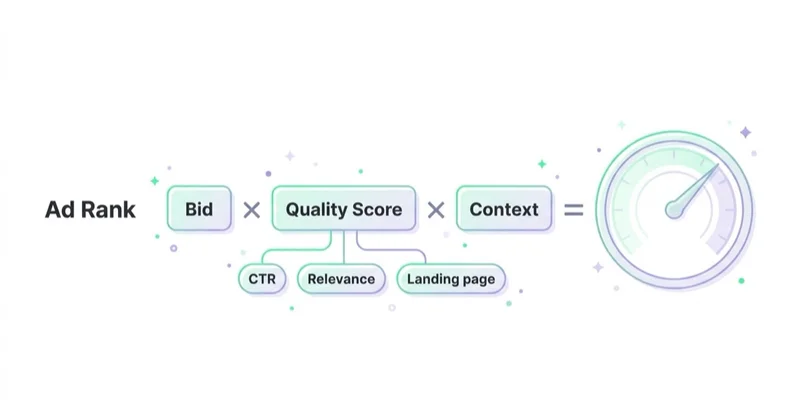
Quality Score is a diagnostic score shown in the interface. Ad Rank is calculated during the auction and considers bid, ad and landing-page quality, Ad Rank thresholds, auction competitiveness, user context and expected impact of assets and other ad formats.
Practical interpretation:
- Quality Score can help diagnose weak quality areas.
- Ad Rank decides auction eligibility and position.
- Improving expected CTR, relevance and landing page experience can improve the real quality signals used in auctions.
- The visible 1-10 Quality Score should not be treated as the auction formula.
This distinction prevents a common mistake: chasing a 10 out of 10 score while ignoring conversions, revenue and search-term quality.
How to check Quality Score
In Google Ads, Quality Score and its components can be added as keyword columns in Search campaigns.
Useful columns:
- Quality Score;
- Landing page experience;
- Expected CTR;
- Ad relevance;
- historical Quality Score;
- historical landing page experience;
- historical ad relevance;
- historical expected CTR.
Google documentation also notes that a dash in the Quality Score column can appear when there are not enough searches that exactly match the keyword to determine a score.
Quality Score diagnosis workflow
Use a consistent workflow instead of reacting to every low number.
- Filter to important Search keywords, not every low-volume term.
- Add Quality Score and the three component columns.
- Segment by campaign, ad group, match type, device and conversion performance.
- Prioritise keywords with spend, impressions or strategic importance.
- Check whether the search terms behind the keyword match the intended offer.
- Identify the component marked Below average.
- Decide whether the issue is ad message, keyword grouping, landing page relevance, page experience or traffic quality.
- Make one meaningful change at a time where possible.
- Review business metrics after the change, not only the score.
This order matters. A keyword with a low Quality Score and no meaningful spend may not deserve immediate work. A keyword with Below average landing page experience, high spend and poor conversion rate deserves attention quickly. A keyword with low Quality Score but strong lead quality and acceptable CAC may need monitoring rather than emergency changes.
Quality Score should therefore sit inside a wider Search campaign review. For keyword structure, match types and search intent, see keyword match types in Google Ads. For the search campaign layer, see Search advertising in Google Ads.
How to use Quality Score correctly
1. Start with component statuses
Do not start with the total number. Start with the component marked Below average.
| Below-average component | First area to inspect |
|---|---|
| Expected CTR | Ad hook, offer, keyword intent, ad assets, search terms |
| Ad relevance | Keyword grouping, ad copy, intent match, RSA assets |
| Landing page experience | Page relevance, content depth, speed, mobile UX, trust |
This makes the work practical.
2. Review search intent
Quality Score problems often start with intent mismatch. A keyword may be technically relevant but too broad for one ad and one landing page.
Examples:
- "crm software" and "free crm template" need different messages;
- "emergency plumber" and "plumbing maintenance" have different urgency;
- "best running shoes" and "buy Nike running shoes size 10" represent different funnel stages;
- "google ads course" and "google ads agency" should not share the same landing page.
Better intent grouping usually improves ad relevance and landing page experience.
3. Tighten ad groups where needed
Overly broad ad groups make it difficult for one ad to match many searches well.
A good ad group usually has:
- a clear theme;
- keywords with similar intent;
- ad copy that reflects the theme;
- landing page aligned with the promise;
- negative keywords to remove mismatched queries.
This does not mean every keyword needs a separate ad group. It means the ad group should have enough semantic focus for the ad and page to make sense.
4. Improve ad relevance
Ways to improve ad relevance:
- reflect the main keyword or intent in headlines;
- write ads for the search problem, not only the product name;
- use responsive search ad assets with distinct angles;
- avoid generic copy that could fit any competitor;
- align the CTA with intent;
- use assets where they improve clarity;
- remove keywords that do not match the ad promise.
Ad relevance improves when the user can immediately see that the ad answers the search.
5. Improve expected CTR
Expected CTR is comparative. It estimates whether the ad is likely to be clicked when shown for a keyword, compared with competitors.
Useful improvements:
- test stronger headlines;
- make the benefit specific;
- add proof or differentiator;
- use numbers where they are meaningful;
- align ad assets with the offer;
- remove misleading impressions with negative keywords;
- improve brand trust and recognition over time.
Do not chase clicks that lower lead or sale quality. A high CTR from poor-fit users can make business performance worse.
Expected CTR work should be tied to query quality. If a headline increases clicks by attracting users who are looking for a free template, but the offer is a paid service, the score may improve while the account gets worse. Strong ads earn clicks from the right users, not from everyone.
6. Improve landing page experience
Landing page experience depends on usefulness and relevance after the click.
Checklist:
- the headline matches the ad promise;
- the page answers the search intent quickly;
- the offer is clear above the fold;
- trust signals are visible;
- the page loads quickly on mobile;
- form or checkout friction is reasonable;
- navigation does not distract from the goal;
- content is specific, not generic;
- privacy and contact information are easy to find;
- the page works for the device and location being targeted.
A landing page should not be optimised only for Google. It should help the user decide.
Quality Score in e-commerce
For e-commerce Search campaigns, Quality Score issues often come from weak category relevance or product-page mismatch.
Common examples:
- generic category page used for a specific product keyword;
- product unavailable but ads still running;
- ad promises free delivery but page hides delivery cost;
- keyword intent suggests comparison but page only pushes one product;
- mobile product page loads slowly;
- filters, sizes or variants are hard to use.
Improving product data, category pages and page speed can help both Quality Score diagnostics and real conversion performance.
For ecommerce, diagnose by intent type:
- product keywords usually need a specific product or tightly matched category page;
- category keywords need a relevant selection, filters and clear buying support;
- comparison keywords need differences, alternatives, reviews or decision support;
- promotional keywords need the offer visible on the landing page;
- availability keywords need stock, delivery and store information to be accurate.
If a keyword says "buy", the landing page should make buying easy. If a keyword says "best" or "compare", a hard-sell product page may not answer the intent well enough.
Quality Score in B2B and services
For B2B and service campaigns, Quality Score issues often appear when ads send every query to the same generic service page.
Examples:
- "google ads audit" and "google ads agency" need different proof and CTA;
- "crm implementation consultant" and "crm training" need different landing-page context;
- local service queries need location and availability clarity;
- emergency service queries need fast contact options.
Service pages should match the decision stage. A user searching for a guide may need education. A user searching for a quote may need proof, process and contact friction reduced.
For B2B and services, diagnose by promise:
- audit keywords need methodology, deliverables and sample outcomes;
- agency keywords need proof, scope, process and fit;
- consultant keywords need expertise and availability;
- software keywords need product capabilities, integrations and pricing context;
- local service keywords need location, response time and contact clarity.
The landing page should not simply repeat the keyword. It should prove that the business can solve the specific problem behind the search.
How we approach this at Space Ads
Quality Score is a diagnostic for us, not a goal in itself. Nobody buys sales with a 10/10, but a low score almost always points to something out of sync: the keyword doesn't match the ad, the ad doesn't match the page, or the page is slow. We don't chase the number. We read its three parts — ad relevance, expected CTR, landing page quality — and fix the weakest. In practice that's tighter keyword groups, an ad written for one specific intent, and a page that delivers what the headline promised. The score then climbs on its own and the click gets cheaper, because good structure is the cause and the number is only the readout.
Common mistakes
| Mistake | Why it hurts | Better approach |
|---|---|---|
| Treating Quality Score as a KPI | It distracts from revenue and profit | Use it as a diagnostic tool |
| Averaging scores across an account | The score is keyword-level and context-specific | Analyse important keywords individually |
| Ignoring component statuses | The total number hides the problem | Start with Expected CTR, Ad relevance or Landing page experience |
| Chasing CTR at any cost | Can attract poor-fit traffic | Improve CTR for the right intent |
| Fixing ads but not pages | Landing page experience stays weak | Align keyword, ad and page |
| Using one page for every intent | Relevance suffers | Map intent to landing-page type |
| Judging low-volume keywords too quickly | Data may be insufficient | Wait for meaningful impressions or use diagnostics carefully |
| Applying Search logic to Performance Max | PMax has different diagnostics | Use asset, audience, feed and conversion data instead |
Practical improvement checklist
When Quality Score diagnostics point to a real issue, use this checklist:
- split mixed-intent ad groups where one ad cannot serve all keywords well;
- review search terms before rewriting ads;
- remove irrelevant traffic with negative keywords;
- write responsive search ad assets around distinct benefits and objections;
- make the landing page headline match the ad promise;
- add proof, process, pricing context or product detail where the user needs reassurance;
- improve mobile speed and usability before testing small copy changes;
- ensure forms, phone numbers, checkout and tracking work correctly;
- compare conversion rate and lead quality before and after changes;
- avoid declaring success only because the visible score moved upward.
The checklist keeps the work user-centred. Better Quality Score is valuable when it reflects a better search experience and stronger business performance.
When not to prioritise Quality Score
Quality Score should not dominate every PPC decision. It may be a lower priority when:
- the keyword has very low volume and little spend;
- conversion rate, CAC and lead quality are already strong;
- the component status is Average and the business issue is elsewhere;
- the campaign is not a Search keyword campaign;
- the main problem is budget allocation, offer strength or tracking quality;
- the account is using automation where the key issue is conversion signal quality.
In those cases, time may be better spent on conversion tracking, offer testing, search term cleanup, landing page CRO or budget reallocation. For conversion-focused work, see CRO strategy.
FAQ
What is Quality Score in Google Ads?
Quality Score is a 1-10 diagnostic score at keyword level in Search campaigns. It estimates ad and landing-page relevance compared with other advertisers for the same keyword.
Does Quality Score directly affect Ad Rank?
Google says the visible Quality Score is not an input in the ad auction. However, real-time quality signals related to expected CTR, ad relevance and landing page experience do affect Ad Rank.
What are the three parts of Quality Score?
The three parts are expected click-through rate, ad relevance and landing page experience. Each can be Above average, Average or Below average.
Should Quality Score be optimised as a KPI?
No. Google says Quality Score is not a key performance indicator and should not be optimised or aggregated with other performance data. Use it as a diagnostic tool.
Does Quality Score exist in Performance Max?
Not in the same keyword-level Search format. Quality Score is primarily a Search keyword diagnostic. Performance Max should be assessed through asset quality, conversion data, feed quality, search term insights and business outcomes.
Can a low Quality Score keyword still convert?
Yes. A low score signals potential relevance or experience problems, but business performance should still be judged by conversions, revenue, margin and lead quality.
What should be fixed first?
Fix the component marked Below average. If landing page experience is weak, work on the page. If ad relevance is weak, tighten keyword and ad alignment. If expected CTR is weak, improve ad appeal and intent fit.
Is 10 out of 10 always necessary?
No. A perfect score is not required for profitable campaigns. The goal is useful relevance, healthy auction competitiveness and profitable traffic, not a perfect diagnostic number.
How often should Quality Score be reviewed?
Review it during regular Search campaign audits, after meaningful landing page or ad structure changes, and when CPC, impression share or conversion quality changes unexpectedly. It does not need daily reaction unless the affected keywords are commercially important.
Can broad match keywords have Quality Score issues?
Yes. Quality Score is still shown at keyword level where eligible, but broad match can trigger many different searches. Search term quality, negative keywords and conversion outcomes should be reviewed carefully before judging the keyword only by the visible score.
Conclusion
Quality Score is useful when it is treated as a diagnostic tool. It helps identify whether keyword intent, ad copy or landing-page experience may be limiting Search campaign performance.
The best optimisation work is not chasing the 1-10 number. It is improving the real user path: query, ad, landing page, offer and conversion experience. When those pieces align, quality signals and business results usually improve together.
Sources and further reading
- Google Ads Help - About Quality Score for Search campaigns
- Google Ads Help - About ad quality
- Google Ads Help - About Ad Rank
- Google Ads whitepaper - Settling the Quality Score
- Space Ads - Google Ads service
Continue learning
Continue reading

How Much Does Google Ads Cost? Pricing, CPC and Budgets Explained for 2026
Google Ads has no fixed price. You set the budget, while the auction determines actual CPC, CPM or CPV based on competition, bid, ad quality, context and campaign type. This guide explains pricing, budgets, CPA math and the full cost of running Google Ads.

Gemini Ad Formats: When the Ad Is Generated, Not Written
Google is testing and announcing Gemini-powered ad experiences across AI Mode and Search. Learn what each format does, what remains uncertain and how to prepare data, content and measurement.

Google Ads Experiments: Testing That Produces a Decision
A useful Google Ads experiment starts with a decision, an effect worth detecting and enough statistical power. Learn how to choose the test, split, metric and interpretation.