Google Ads Smart Bidding is a group of automated bid strategies that use Google AI to optimize bids for conversions or conversion value in every auction. Instead of setting a static keyword bid, the advertiser defines the business objective, and Google sets the bid based on auction-time signals such as device, location, time, query, audience context and product attributes.
The strategy choice matters because Google will optimize toward exactly what the account tells it to buy. A lead form, a booked call, a high-margin purchase and a low-margin order should not all be treated as the same outcome. Smart Bidding is powerful when the conversion signal is clean. It is dangerous when tracking, values or goals are wrong.
This guide explains how to choose between Maximize Conversions, Target CPA, Maximize Conversion Value and Target ROAS after Google's 2026 naming changes.
TL;DR
- Smart Bidding sets bids at auction time. Google uses AI and contextual signals to optimize for conversions or conversion value in each auction.
- In June 2026, Google updated bidding labels. "Maximize conversions with a Target CPA" is labeled "Target CPA", and "Maximize conversion value with a Target ROAS" is labeled "Target ROAS"; Google says the underlying behavior is unchanged.
- The first choice is count or value. Lead generation usually starts with conversion count. Ecommerce and revenue-variable campaigns usually need conversion value.
- Maximize strategies are volume/value starters. Maximize Conversions and Maximize Conversion Value try to get the most result within budget.
- Target CPA and Target ROAS add constraints. A target is not a wish. If it is much stricter than recent performance, delivery can fall sharply.
- Data volume affects stability. Google recommends evaluating Smart Bidding over longer periods with at least about 30 conversions, and 50 for Target ROAS.
- Tracking quality matters more than strategy labels. Broken tags, duplicate conversions, shallow leads and fake values create bidding problems.
- Do not judge by one bad day. Learning periods, conversion lag, seasonality and data outages all affect short-term results.
What Smart Bidding means in Google Ads
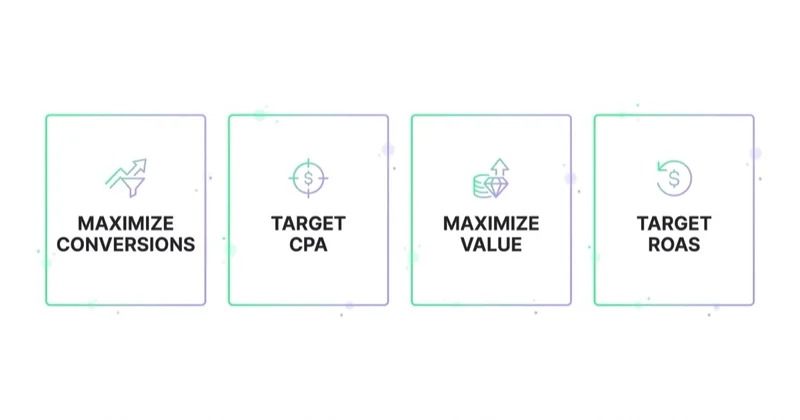
Google defines Smart Bidding as bidding strategies that use Google AI to optimize for conversions or conversion value in every auction. The core strategies are:
- Maximize Conversions;
- Target CPA;
- Maximize Conversion Value;
- Target ROAS.
The common mechanism is auction-time bidding. The system evaluates how likely a click is to create the defined outcome and how valuable that outcome might be. It can use more signals than a manual bidder can process, including the actual search query, device, physical location, location intent, weekday, time of day, remarketing list, ad characteristics, language, browser and product attributes for Shopping.
That does not remove the need for strategy. Smart Bidding does not know margin, sales quality, lead qualification or business capacity unless those signals are built into the conversion setup.
The 2026 naming change
Google's Smart Bidding documentation notes that starting in June 2026, labels are being updated:
- "Maximize conversions with a Target CPA" becomes Target CPA.
- "Maximize conversion value with a Target ROAS" becomes Target ROAS.
Google states that the underlying bidding behavior remains the same and no account action is required because of the label change.
The practical translation:
- no target = maximize the chosen result within budget;
- target CPA = maximize conversions while aiming for an average CPA target;
- target ROAS = maximize conversion value while aiming for an average ROAS target.
During the transition, accounts, docs, scripts or exports may show slightly different naming. The decision logic remains unchanged.
The four main strategies
| Strategy | Optimizes for | Needs | Best fit |
|---|---|---|---|
| Maximize Conversions | as many conversions as possible within budget | clean conversion tracking | new lead-gen campaigns, low volume, early learning |
| Target CPA | conversions at an average cost target | stable conversion volume and realistic CPA | lead generation with known acceptable acquisition cost |
| Maximize Conversion Value | highest total conversion value within budget | conversion values | ecommerce or value-based lead gen before adding a ROAS constraint |
| Target ROAS | conversion value at an average return target | accurate values and enough volume | ecommerce, retail, lead scoring or revenue-variable campaigns |
The mistake is choosing based on preference rather than economics. A campaign that sells products with very different order values should not optimize only for conversion count. A lead-generation campaign with no reliable lead value should not pretend it has value-based bidding data.
How to choose the right family
Lead generation and local services. If conversions are similar in value, start with Maximize Conversions. Move toward Target CPA when volume is stable and there is a realistic target. For better lead quality, feed qualified calls, booked appointments or CRM stages into Google Ads. A raw form fill is usually a weaker signal than a qualified lead.
Ecommerce and retail. If order values vary, use Maximize Conversion Value or Target ROAS. Revenue is better than flat conversion count, but margin is better than revenue when product profitability varies. For that workflow, see margin-based conversion value in Google Ads.
B2B and high-value services. A demo request from a qualified buyer and a student research enquiry are not equal. If the CRM can send offline stages or values, Smart Bidding can learn quality. If not, Target CPA on shallow forms may scale the wrong leads.
Hybrid businesses. Ecommerce with offline sales, clinics with calls, showrooms, dealerships and service firms often need multiple conversion actions. Primary conversions should represent business value; secondary conversions can stay available for diagnostics.
Data volume and evaluation period
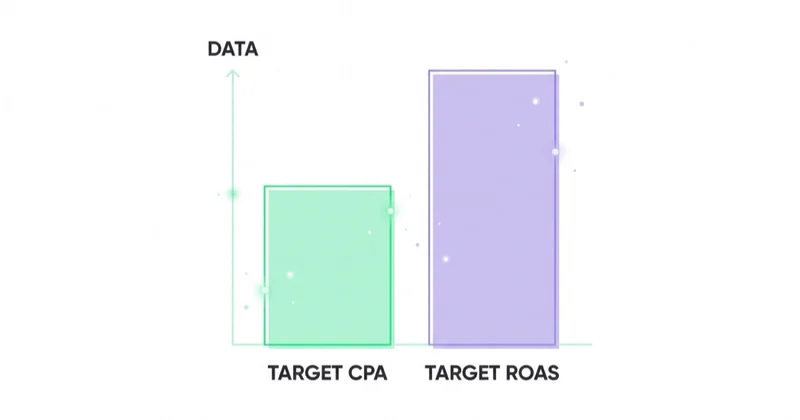
Smart Bidding can technically run with low data, but stable evaluation needs enough examples. Google's Smart Bidding guidance recommends measuring performance over longer periods with at least 30 conversions, such as a month or longer, and 50 conversions for Target ROAS.
Practical interpretation:
- below meaningful conversion volume, avoid tight targets too early;
- consolidate campaigns when data is split too thinly;
- use Maximize Conversions or Maximize Conversion Value while building signal;
- avoid judging strategy changes before conversion lag has cleared;
- use experiments where the change has meaningful risk.
Target ROAS is usually more demanding than Target CPA because it predicts not only whether a conversion will happen, but also how much value it may generate.
Setting Target CPA
Target CPA aims for an average cost per conversion, not a fixed cost for every individual conversion. Some conversions will cost more, some less.
Target CPA works when:
- conversion tracking is accurate;
- the conversion is close to real business value;
- there is enough stable volume;
- the budget is not too low for the target;
- lead quality does not vary wildly;
- the target is close to recent achieved CPA.
The common failure is setting the target based on desire instead of history. If a campaign recently produced leads at $180 CPA and the target is changed to $70, Google may sharply restrict auctions. The account then appears to "stop spending", but the real problem is an unrealistic constraint.
Setting Target ROAS
Target ROAS aims for an average return on ad spend based on conversion value. It needs accurate values and enough volume.
Target ROAS works when:
- conversion values are passed correctly;
- revenue or margin is reliable;
- products or leads vary meaningfully in value;
- conversion lag is understood;
- returns, cancellations or offline quality are considered where possible;
- the ROAS target is close to recent performance.
For ecommerce, tROAS based on gross revenue can still produce poor profit if products have very different margins or return rates. A stronger setup passes margin-adjusted values, uses conversion adjustments for returns and segments products with feed labels or campaign structure where needed.
What Smart Bidding cannot fix
Smart Bidding will not repair a broken account signal.
Common signal problems:
- duplicate purchase conversions;
- confirmation page firing on reload;
- lead form starts counted as primary conversions;
- no call tracking in a phone-led business;
- all ecommerce orders assigned the same value;
- offline conversions imported late or inconsistently;
- Consent Mode or enhanced conversions implemented incorrectly;
- budget split across too many campaigns;
- high-quality and low-quality leads mixed as one action.
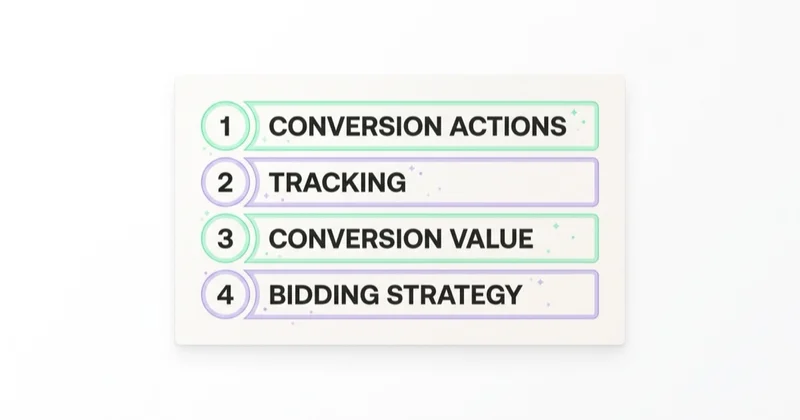
Before changing bidding strategy, audit conversion actions, primary/secondary settings, values, attribution, conversion lag and CRM feedback. Enhanced conversions, call tracking and offline imports can improve the signal when implemented carefully.
Seasonality, data exclusions and learning
Not every bad week requires a bidding change. Smart Bidding reacts to data, so unusual data needs context.
Use these controls carefully:
- Seasonality adjustments for short, expected conversion-rate shifts such as sales or major events.
- Data exclusions when conversion data is wrong because of tracking outages, broken tags or faulty offline imports.
- Experiments when testing a major bidding change.
- Bid strategy reports and status to understand learning, limited data, limited budget or target constraints.
Data exclusions are not a way to hide weak performance. They are for periods when Google received incorrect conversion data.
Troubleshooting symptoms
| Symptom | Likely cause | First diagnostic |
|---|---|---|
| Campaign stopped spending after target change | target too strict | compare target with recent CPA/ROAS |
| More leads, worse sales | conversion too shallow | review CRM stages and import quality |
| Good ROAS, weak profit | values based on revenue, not margin | review margin and return-adjusted value |
| Strategy unstable | low volume or conversion lag | check 30/50 conversion guidance and lag |
| Smart Bidding "does not work" | bad tracking signal | audit primary conversions and duplicates |
| Ecommerce ignores high-margin products | value signal incomplete | pass margin or segment feed/campaigns |
How Space Ads approaches Smart Bidding
Across the 25+ accounts audited daily and roughly 14M monthly data points analyzed through Space Ads OS, most "bidding problems" turn out to be measurement or structure problems. A broken conversion action, fake lead signal or missing value can make any strategy look bad.
The audit order is:
- conversion actions and primary goals;
- duplicate and missing tags;
- enhanced conversions, Consent Mode and offline imports;
- value quality and margin logic;
- conversion lag and attribution;
- campaign split and volume;
- recent target changes;
- bid strategy reports and status.
Only after that does it make sense to change the strategy. A marketing audit can show whether the issue is actually bidding, tracking, structure, landing page quality or business economics. Ongoing channel work sits under Google Ads management.
Common mistakes
| Mistake | Why it hurts | Better approach |
|---|---|---|
| Using Target ROAS with too little value data | model predicts value from noise | build volume with Maximize Conversion Value first |
| Using Target CPA for variable-value ecommerce | big and small orders count equally | optimize for conversion value |
| Setting an unrealistic target | delivery collapses | anchor to recent achieved performance |
| Changing targets every few days | learning never stabilizes | move gradually and account for lag |
| Counting weak micro-conversions as primary | system buys cheap, shallow actions | use business-quality primary conversions |
| Blaming bidding before tracking | hides the real issue | audit signal quality first |
FAQ
What is Smart Bidding in Google Ads?
Smart Bidding is Google's set of automated bid strategies that use AI to optimize for conversions or conversion value in every auction. It includes Maximize Conversions, Target CPA, Maximize Conversion Value and Target ROAS.
What changed with Target CPA and Target ROAS in 2026?
Google updated labels starting in June 2026. "Maximize conversions with a Target CPA" is labeled "Target CPA", and "Maximize conversion value with a Target ROAS" is labeled "Target ROAS". Google says the underlying bidding behavior remains the same.
What is the difference between Target CPA and Target ROAS?
Target CPA optimizes for conversion volume at an average cost target. It fits lead generation when conversions are similar in value. Target ROAS optimizes for conversion value at an average return target. It fits ecommerce or campaigns where conversions have different values.
How many conversions does Smart Bidding need?
Google recommends evaluating Smart Bidding over longer periods with at least 30 conversions, such as a month or longer. For Target ROAS, Google references 50 conversions because value prediction needs more data.
Why did performance drop after switching bidding strategy?
Common causes include an unrealistic target, low conversion volume, conversion lag, duplicate or missing conversions, wrong primary goals, weak lead quality or values that do not represent revenue or margin. The first step is usually a conversion and value audit, not another bidding change.
Should ecommerce use Target CPA?
Usually no, unless all conversions are genuinely similar in value. Ecommerce normally benefits from Maximize Conversion Value or Target ROAS because order values, margins and return rates vary. Counting every order equally can push budget toward low-value sales.
In short
Smart Bidding is not a magic setting. It is a bidding system that amplifies the conversion signal the account gives it. Lead generation usually starts with conversion volume and Target CPA. Ecommerce usually needs conversion value and Target ROAS. Low-volume accounts need signal first. Mature accounts need realistic targets, clean values and diagnostic discipline.
Sources and further reading
- Google Ads Help - About Smart Bidding
- Google Ads Help - About Target CPA bidding
- Google Ads Help - About Target ROAS bidding
- Google Ads Help - About data exclusions
- Google Ads Help - Use data exclusions for conversion data outages
Continue learning
Continue reading
The First 90 Days of Google Ads: A Launch Playbook
A practical 90-day Google Ads launch plan: define the economics, validate measurement, launch the right campaign mix, and scale only after the data is mature enough to support the decision.

AI for Google Ads in 2026: Google's Native AI vs a Control Layer on Top
Google's AI and third-party AI tools solve different problems. This guide draws the line between platform automation that already controls bidding and creative assembly, and external control layers that audit, explain, propose changes and help teams govern execution.
Gemini Ad Formats: When the Ad Is Generated, Not Written
Google is testing and announcing Gemini-powered ad experiences across AI Mode and Search. Learn what each format does, what remains uncertain and how to prepare data, content and measurement.