Google Ads does not have a fixed price list. The advertiser sets budgets and bidding objectives; eligible ads enter auctions. The amount charged and the business result depend on campaign type, competition, bid, auction-time quality, search or placement context, landing experience and the conversion signals used for optimization.
So the honest answer to "how much does Google Ads cost?" is not one number. It is a calculation:
- What does the business pay Google for media?
- What does a click, lead, purchase or customer need to cost to be profitable?
- How much data is needed for the campaign to learn?
- What is the full cost once management, tracking, landing pages and feed work are included?
This guide explains the pricing mechanics, CPC, CPM, CPV, budgets, Smart Bidding, agency fees and how to calculate a useful test budget.
TL;DR
- There is no fixed Google Ads price. The advertiser sets a budget; the auction determines actual costs for eligible clicks, impressions or views.
- Google does not charge a setup or management fee. Google's own cost is media spend. Agency, freelancer or internal team costs are separate.
- Ad Rank is not only bid. Google considers bid, ad and landing page quality, Ad Rank thresholds, auction competitiveness, search context and expected impact of ad assets.
- Quality Score is diagnostic. It helps evaluate expected CTR, ad relevance and landing page experience; it is not a simple auction-time formula.
- CPC means little without conversion rate. A high CPC can be profitable if it converts; a cheap click can be expensive if it never becomes revenue.
- Budget should come from a decision and an economic range. Expected CPA × desired outcomes is a planning estimate, not a guarantee.
- The full cost includes media, management, measurement and landing pages. Bad tracking or a weak page can make any CPC too expensive.
- Several Google Ads systems changed in 2026. Target bidding labels changed in June, Display began moving into Demand Gen and most offline uploads moved to the Data Manager API.
What "Google Ads cost" actually means
Google Ads can bill for different interactions, while automated strategies optimize toward goals that are not necessarily the billing event.
| Model or strategy | What it represents | Common use |
|---|---|---|
| CPC | Cost per click | Search, Shopping, traffic-focused campaigns |
| CPM / vCPM | Cost per 1,000 impressions | Display, awareness, some video/display contexts |
| CPV | Cost per view | YouTube and video campaigns |
| Target CPA | Automated bidding goal around average cost per conversion | Conversion-focused Smart Bidding |
| Target ROAS | Automated bidding goal around conversion value relative to spend | Value-based bidding |
For Search campaigns, CPC is often the first number advertisers ask about. But CPC is only an input. The business result is cost per qualified lead, cost per booking, cost per purchase, cost per customer, ROAS or contribution margin. A $20 click can be cheap if it produces a high-value customer. A $1 click can be expensive if it is irrelevant.
How the Google Ads auction works
Google runs an auction when an ad is eligible to show. Ads are not ranked by bid alone. Google uses Ad Rank values to determine whether ads are eligible and where they can appear.
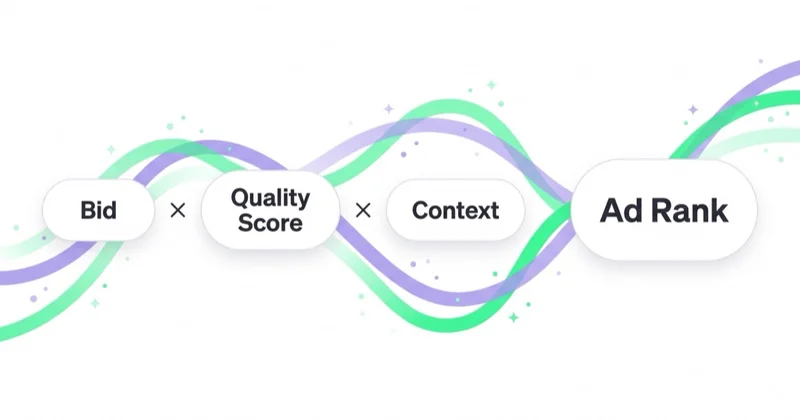
Google's Ad Rank factors include:
- the advertiser's bid;
- quality of ads and landing page;
- Ad Rank thresholds;
- auction competitiveness;
- the context of the user's search, such as query, location, device, time and other signals;
- expected impact of ad assets and other ad formats.
Higher-quality ads can support lower prices and better positions, but the mechanism should be described accurately. Quality Score is a 1–10 keyword-level diagnostic. Google states that the score itself is not used in the auction to determine Ad Rank; auction-time quality signals are. Use the score to investigate expected CTR, relevance and landing-page experience, not as a literal multiplier.
The practical translation:
- use Quality Score to find weak expected CTR, ad relevance and landing page experience;
- improve the actual ad, keyword and landing page alignment;
- test whether improved quality changes qualified cost and position;
- avoid treating Quality Score as a literal formula that automatically sets CPC.
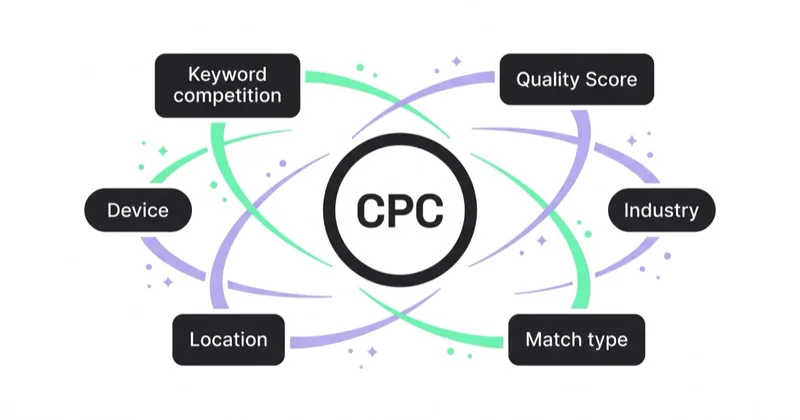
What drives Google Ads CPC and cost per result
| Factor | How it affects cost |
|---|---|
| Industry and competition | High-value categories such as legal, finance, insurance, medical, B2B and home services often have higher CPC |
| Query intent | "Buy," "near me," "price," "agency," "quote" and urgent queries usually cost more than informational queries |
| Ad quality and landing page | Stronger relevance and page experience can reduce costs and improve eligibility |
| Match types | Broad, phrase and exact match create different reach and waste profiles |
| Negative keywords | Poor negative keyword coverage lets irrelevant searches spend budget |
| Location, device and schedule | CPC and conversion rates vary by geography, device and time |
| Campaign type | Search, Shopping, Performance Max, Display and YouTube have different pricing mechanics |
| Conversion tracking | Smart Bidding needs reliable conversion and value data |
| Landing page conversion rate | The same CPC becomes cheaper or more expensive depending on how well the page converts |
Because these factors interact, public CPC benchmarks are only context. They do not price a specific account or establish profitability. Build a range from relevant auction estimates, eligible search or audience volume, landing-page evidence, conversion lag and business economics.
Budget vs actual spend
In most campaigns, the advertiser sets an average daily budget. Google can spend more than the average on some days and less on others. For most campaigns, Google states that spend on a given day can reach up to twice the average daily budget, while the monthly spending limit is generally the average daily budget multiplied by 30.4. Exceptions exist, so check the current spending-limit documentation for the campaign type.
Example:
- $100 average daily budget means a monthly charging limit of about $3,040.
- Some high-opportunity days may spend more than $100.
- Monthly charging is still constrained by the budget x 30.4 rule for that campaign.
Cash planning should account for daily overdelivery even when management works from a monthly limit. Budget edits during a month can change the applicable limit, so review the budget report instead of assuming every month will equal one static calculation.
How to calculate a Google Ads budget before launch
Use three numbers first:
- estimated CPC;
- expected landing page conversion rate;
- allowable cost per conversion or customer.
| Question | Formula | What it shows |
|---|---|---|
| How many clicks will the budget buy? | media budget / average CPC | traffic sample size |
| How many conversions might it produce? | clicks x landing page conversion rate | expected result volume |
| What will CPA be? | media budget / conversions | whether the economics work |
Example: a $4,000 budget divided by an assumed $8 CPC suggests 500 clicks. At an assumed 3% conversion rate, the planning model suggests 15 recorded conversions; at 6%, it suggests 30. None of those inputs is guaranteed. Use downside and upside ranges, then state which result would justify continuing, revising or stopping.
Now add economics. If an acquired customer is expected to produce $2,000 in contribution under a documented model and finance allows $500 for acquisition, a 20% qualified-lead-to-customer rate implies a planning ceiling of $100 per qualified lead. Replace assumptions with realized cohorts and include sales or onboarding cost where the business definition requires it.
Minimum useful budget: the data problem
Google does not require a minimum budget, but campaigns have practical data requirements. A budget can be too small to produce reliable learning.
Useful budget thresholds depend on:
- average CPC;
- conversion rate;
- target CPA;
- conversion value;
- campaign type;
- bidding strategy;
- market size;
- number of services, products, locations or keywords in scope.
A small test can work when the question is narrow: one valuable service, one market, a coherent intent group, clean measurement and a defined response process. It becomes weak when many services, locations, campaign types and conversion meanings compete for too little evidence.
Example of a weak setup: $2,000/month split across five campaigns, many ad groups, several regions and multiple conversion goals. After a month, there are clicks but no clear decision. The account does not know whether the problem is channel, offer, landing page, keywords, tracking or simply insufficient sample size.
A better first test defines one valuable demand hypothesis, an expected CPC and CPA range, maximum exposure, conversion maturity window and decision threshold. The exact structure can still use several keywords or assets when they answer the same commercial question.
Cost by campaign type
| Campaign type | Typical cost model | Main cost drivers |
|---|---|---|
| Search | CPC | keyword competition, intent, ad quality, landing page, match type |
| Shopping | CPC | product feed, competition, price, reviews, availability, margin |
| Performance Max | Mixed delivery, judged by CPA/ROAS | feed, assets, audience signals, conversion value, URL relevance |
| Demand Gen / migrating Display | CPM, CPC or conversion-focused bidding | channel controls, audience, placements, creative and conversion goal |
| YouTube | CPV / CPM / CPA depending on goal | creative, audience, view quality, offer, attribution window |
| Demand Gen | CPM / CPC / CPA depending on setup | visual creative, audience, offer, measurement and landing page |
Google began offering eligible advertisers migration of Display campaigns into Demand Gen in June 2026; remaining timelines depend on Google's rollout. Demand Gen can include YouTube, Discover, Gmail, Maps and the Google Display Network. Review migrated inventory, assets, attribution windows and bidding rather than assuming the historical Display setup is unchanged.
The same budget behaves differently by job. Search may buy higher-intent clicks; Demand Gen may buy visual discovery; Shopping and Performance Max depend heavily on feeds and conversion value. Compare qualified or incremental outcomes, not unlike billing metrics.
Full cost: media, management, measurement and landing pages
Google's media spend is only one part of Google Ads cost.
| Cost item | What it includes |
|---|---|
| Media spend | Budget spent in Google Ads auctions |
| Management | Strategy, setup, optimization, search term work, reporting |
| Measurement | Conversion tracking, GA4, enhanced conversions, call tracking, CRM imports |
| Landing pages | Copy, UX, form, checkout, speed, CRO and testing |
| Product feed | Merchant Center, titles, attributes, custom labels, availability, margin data |
| Creative | Display, YouTube, Demand Gen and Performance Max assets |
| Commercial overhead | Applicable taxes, currency conversion, payment terms and working-capital timing |
Agency or specialist pricing commonly uses one of four models:
| Pricing model | How it works | When it fits |
|---|---|---|
| Percentage of spend | Fee based on media budget | Growing accounts where workload scales with spend |
| Fixed retainer | Stable monthly fee | Predictable accounts with a defined scope |
| Performance fee | Fee tied to conversions or revenue | Only when tracking is complete and trusted |
| Hybrid | Retainer plus performance component | Common compromise between stability and incentive |
Performance-based fees require an agreed baseline, source of truth, value adjustments and rules for brand demand, returning customers, cancellations and delayed outcomes. Otherwise the fee can reward attribution rather than incremental contribution.
Google Ads cost changes to know in 2026
Three platform changes affect current planning and account reviews:
- Smart Bidding labels changed in June. “Maximize conversions with a Target CPA” is now labeled Target CPA, and “Maximize conversion value with a Target ROAS” is now Target ROAS. Google says the underlying behavior did not change because of the rename.
- Offline lead uploads moved. From 15 June 2026, most offline conversion and enhanced-conversion-for-leads uploads moved to the Data Manager API and are blocked in the Google Ads API unless legacy access applies. A broken import can make qualified CPA look worse and teach bidding from shallow leads.
- Target-based bidding will change on 17 August 2026. Google announced new behavior for campaigns that are limited by budget and use Target CPA, Target ROAS or eligible Demand Gen Target CPC. Review constrained campaigns and targets before the rollout; Google says it will not automatically change the budget or target.
These changes do not create a universal price increase or decrease. They change labels, data plumbing or bidding behavior in defined conditions. Annotate their rollout dates in reporting so a structural change is not misread as market demand.
How to lower Google Ads cost
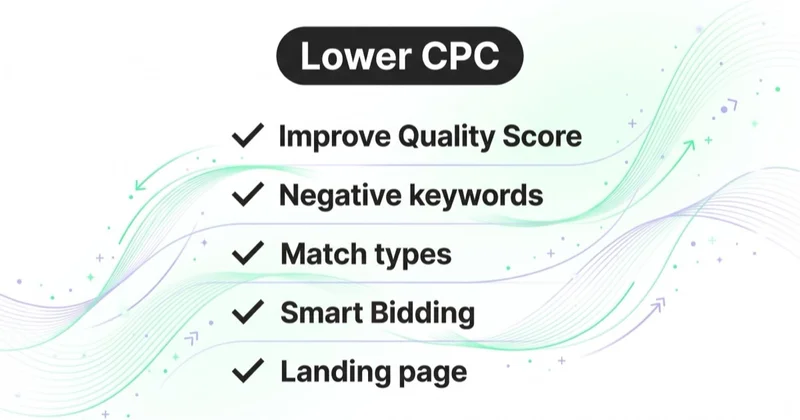
Lowering Google Ads cost should mean lowering cost per valuable conversion, not simply lowering CPC.
Practical levers:
- Improve ad and landing page relevance. Better quality can support lower CPC and better eligibility.
- Use negative keywords. Negative keywords prevent irrelevant searches from spending budget.
- Review visible search terms. Exclude irrelevant intent and investigate useful themes, remembering that low-volume terms may be omitted for privacy.
- Use match types deliberately. Broad match can work with suitable Smart Bidding and conversion data, but it can explore traffic the business cannot profitably serve.
- Fix conversion tracking. Smart Bidding needs accurate, timely conversion and value data. Apply consent, data minimization and access controls; hashing does not eliminate privacy obligations.
- Improve landing page conversion rate. A higher conversion rate lowers CPA even if CPC stays the same.
- Separate brand and non-brand. Brand campaigns can hide weak acquisition performance.
- Feed margin or value where possible. E-commerce and lead generation both benefit when bidding understands value, not just volume.
- Prune or isolate waste. Stop or constrain terms, products, placements or assets after accounting for lag, role and sufficient evidence.
For a deeper CPC-specific guide, see how to lower CPC in Google Ads.
How Space Ads approaches Google Ads cost
At Space Ads, cost analysis starts with business value and measurement, not a generic CPC benchmark. We establish the qualified or realized outcome, reconcile it with CRM or commerce records and then decompose cost into auction exposure, query or placement quality, post-click conversion and downstream value.
The work is separated into three questions:
- How much media budget is needed to test or scale the opportunity?
- How much work is required to manage the account properly?
- What cost per qualified lead, purchase or customer is profitable?
If measurement is weak, the first fix is the event definition and data path. If qualified traffic is expensive, the audit reviews intent, match behavior, negatives, quality diagnostics and landing pages. If recorded leads are cheap but weak, the work moves into qualification, response, CRM stages and adjusted value signals.
This connects Google Ads, performance marketing, marketing reporting, call tracking and marketing audit. The goal is not to chase the lowest click price. The goal is to buy enough of the right intent at a cost the business can profitably absorb.
Step-by-step budget plan
- Define the valuable conversion. Purchase, qualified lead, booking, call, demo or opportunity.
- Calculate allowable CPA. Use margin, lead-to-sale rate, close rate, LTV and cash-flow tolerance.
- Estimate CPC for real intent. Use market research and Keyword Planner data for the target location and language.
- Estimate conversion rate. Use current landing page data or conservative assumptions.
- Calculate a first test range. Expected CPA range × desired outcomes, adjusted for lag and affordable downside.
- Narrow the first test. Start with the highest-intent segment rather than every service, product and location.
- Set measurement before spend. Conversion tracking, analytics, consent, call handling and CRM feedback should be tested before scale.
- Review after outcomes mature. Do not judge a campaign on a handful of clicks or conversions still inside the normal lag window.
Common mistakes
| Mistake | Why it hurts | Better approach |
|---|---|---|
| Asking only "what is CPC?" | CPC does not show conversion value | Calculate CPA and customer economics |
| Setting budget from leftover money | The campaign may never answer a decision | Use an expected CPA range, outcome need and loss limit |
| Treating Quality Score as a formula | It is diagnostic, not the auction-time formula | Improve real ad quality and page relevance |
| Copying US benchmarks into another market | CPC depends on local competition and intent | Use benchmarks as context, then estimate locally |
| Launching without conversion tracking | The account cannot learn or prove value | Set measurement before media spend |
| Ignoring search terms | Wasteful queries quietly raise CPA | Review search terms and negatives regularly |
| Ignoring 2026 migration notices | Data or delivery can change unexpectedly | Audit Data Manager, Demand Gen and target-bidding status |
| Splitting a small budget too widely | No segment gets enough evidence | Narrow scope before scaling |
FAQ
How much does Google Ads cost per month?
The advertiser sets the budget, subject to campaign-specific spending rules. For most campaigns, the monthly limit is the average daily budget × 30.4 and an individual day can reach twice the daily average. A useful amount depends on a CPC and CPA range, outcome maturity, test design and affordable downside.
Is there a minimum budget for Google Ads?
Google does not set one universal minimum. A practical budget must buy enough eligible traffic and mature outcomes to answer the defined question. Narrow scope, suitable conversion data and a realistic observation window matter more than an arbitrary monthly amount.
Does Google charge a setup or management fee?
Google's advertising charge is the media cost under the applicable campaign and billing model. Strategy, setup, management, creative, analytics, feeds and landing pages are separate internal or external costs. Taxes and currency effects may also apply to the advertiser's billing.
What is a good CPC in Google Ads?
A good CPC is one that leads to a profitable cost per conversion or customer. There is no universal good CPC. A $25 click can be profitable in legal, B2B or high-ticket services. A $1 click can be wasteful if it brings low-intent traffic that never converts.
Does a higher budget lower CPC?
Not directly. CPC is shaped by the auction, competition, bid, ad quality and context. A higher budget can buy more data and conversions faster, which may help optimization, but it does not automatically reduce cost per click.
How does Quality Score affect cost?
Quality Score is a keyword-level diagnostic of expected CTR, relevance and landing-page experience. Google says the score itself is not used at auction time to determine Ad Rank. Use it to investigate components; validate improvement through qualified cost and business outcomes.
Is a small Google Ads test worth it?
It can be, if the test has one commercial question, a coherent intent group, accurate measurement, a CPC/CPA range and explicit decision thresholds. A small budget spread across many services, regions and goals usually produces activity without decision-quality evidence.
Key takeaways
- Google Ads has no fixed price; cost is determined by auction mechanics and campaign inputs.
- CPC is only one metric; cost per valuable conversion or customer is the real decision point.
- Quality Score is useful for diagnosis, but Ad Rank depends on auction-time quality, bid, context, thresholds, competition and assets.
- Budget should be estimated as a range from expected CPA, desired outcomes, lag, uncertainty and maximum acceptable loss.
- The full cost includes media, management, measurement, landing pages, feeds and creative.
Sources and further reading
- Google Ads Help - Manage your spend in Google Ads
- Google Ads Help - About Ad Rank
- Google Ads Help - About Quality Score
- Google Ads Help - About spending limits
- Google Ads Help - About Smart Bidding
- Google Ads Help - About Demand Gen campaigns and Display migration
- Google Ads Help - About enhanced conversions for leads
- Google Ads Help - Changes to target-based bid strategies
Continue learning
Continue reading
Google Ads Benchmarks by Industry (CTR, CPC, Conversion Rate)
Google Ads benchmarks can provide context, but only when the campaign type, market, conversion action, attribution and time period match. Learn how to make a valid comparison and turn it into a useful decision.
How to Lower CPC in Google Ads Without Hurting Conversions
Lowering CPC in Google Ads should not mean buying cheaper, weaker traffic. This guide explains how to reduce cost per useful click through relevance, search term control, Quality Score diagnostics, long-tail intent, landing pages and bidding strategy without hurting conversions.

Quality Score in Google Ads: What It Is and How to Improve It
Quality Score is a 1-10 keyword-level diagnostic for Search campaigns. Use it to find relevance, CTR and landing page issues, not as a standalone KPI.