Dynamic creative in Meta Ads lets advertisers provide multiple creative elements, such as images, videos, primary text, headlines, descriptions and calls to action, so Meta can assemble and deliver different ad combinations. The goal is to find combinations that work for different people, placements and contexts without manually building dozens of separate ads.
Dynamic creative can be useful, but it is not a replacement for creative strategy. Meta can only combine the inputs it receives. If the concepts are weak, repetitive or off-brand, automation will only distribute weak combinations faster.
TL;DR
- Dynamic creative combines multiple ad assets into different Meta ad variations.
- It is useful for testing messages, hooks, formats and creative angles across Facebook and Instagram placements.
- Meta's creative automation has shifted toward Advantage+ Creative, flexible formats and AI-assisted enhancements, so feature availability can vary by objective and account.
- Dynamic creative should test distinct concepts, not ten nearly identical banners.
- Advantage+ Creative may crop, resize, generate text variations, expand images, add music or animate static images depending on settings and eligibility.
- Brands with strict guidelines should review previews and control which enhancements are allowed.
- Dynamic creative needs reliable conversion signals, ideally Pixel plus Conversions API where appropriate.
- Results should be read at concept and asset level, not only campaign-level CPA or ROAS.
What is dynamic creative in Meta Ads?
Dynamic creative is a Meta Ads feature that automatically creates variations from the creative elements an advertiser provides. Instead of uploading one finished ad, the advertiser supplies a set of ingredients.
Possible ingredients include:
- images;
- videos;
- primary text options;
- headlines;
- descriptions;
- calls to action;
- destination URLs;
- product or category angles;
- placement-ready formats.
Meta then tests and serves combinations based on delivery signals.
The important distinction: dynamic creative mixes supplied assets. Advantage+ Creative and newer creative enhancements may also modify, resize, generate or adapt assets depending on account settings and feature eligibility.
Dynamic creative, Advantage+ Creative and flexible formats
Meta's creative tools have changed over time, so terminology can be confusing.
| Feature | Main role | Practical use |
|---|---|---|
| Dynamic creative | Mix supplied assets into combinations | Test copy, visuals, headlines and CTAs |
| Advantage+ Creative | Apply creative enhancements and AI-assisted variations | Adapt one ad to placements and audiences |
| Flexible format | Let Meta choose format variations from supplied creative | Useful where Dynamic Creative availability is limited |
| Catalog ads | Show product-level assets from a catalog | Ecommerce and retargeting at SKU/category level |
| Classic A/B test | Test controlled hypotheses | Offer vs offer, landing page vs landing page, concept vs concept |
Meta's own Ads Manager guidance notes that Dynamic Creative may no longer be available for some sales or app promotion setups, with flexible ad format recommended for similar outcomes. This is why the exact workflow should be checked inside the current Ads Manager account.
When to use dynamic creative
Dynamic creative can be useful when:
- there are several strong creative concepts;
- the account has enough budget and traffic to learn;
- the campaign needs multiple placements;
- the team wants to test hooks quickly;
- copy, headline and visual combinations may matter;
- the campaign has clear conversion measurement;
- the brand can tolerate some automated combination logic;
- creative learnings will be documented for future production.
It is less useful when:
- the budget is too small;
- there is only one concept;
- assets are nearly identical;
- strict brand rules require full control;
- the product has heavy compliance restrictions;
- the campaign needs a clean A/B test;
- measurement is unreliable.
What to prepare before launch
A strong dynamic creative test starts before Ads Manager.
Prepare:
- 4-8 distinct creative concepts;
- several hooks;
- multiple proof angles;
- product or service benefits;
- objection-handling copy;
- vertical video for Reels and Stories;
- square or feed-friendly assets;
- clear headlines;
- short primary text variants;
- CTA options;
- landing page alignment;
- brand safety rules;
- tracking and event quality.
The concepts should be structurally different.
Example concept differences:
- product demonstration;
- customer proof;
- founder explanation;
- before-and-after;
- problem/solution;
- price or offer;
- comparison;
- social proof;
- educational tip;
- urgency or seasonality.
Ten versions of the same product image with slightly different text colours are not a meaningful creative test.
Creative asset matrix
A dynamic creative test should be planned as a matrix, not a random upload folder.

| Asset type | What to vary | What to keep consistent |
|---|---|---|
| Hook | problem, result, question, objection, proof | promise and offer truth |
| Visual | product demo, UGC, founder, testimonial, lifestyle | product accuracy and brand basics |
| Primary text | pain-led, benefit-led, proof-led, offer-led | landing page match |
| Headline | category, outcome, offer, trust | claim accuracy |
| CTA | shop, learn, book, message, download | funnel stage |
| Format | 9:16 video, 4:5 feed, square, carousel | core concept |
This matrix helps distinguish creative learning from delivery noise. If all assets use the same hook, the test cannot reveal whether another angle would work. If every visual uses a different offer, the team cannot tell whether the winner was the visual or the offer.
The best setup balances variation and interpretability. There should be enough difference for Meta to learn, but not so much that results become impossible to explain.
Creative diversity vs cosmetic variation
Meta delivery systems can learn more from real variation than from cosmetic edits.
| Weak variation | Stronger variation |
|---|---|
| Same image with different background colour | Product demo vs review vs objection answer |
| Same headline with one word changed | Price-led headline vs proof-led headline |
| Same static ad cropped three ways | Static, UGC-style video and carousel |
| Same offer repeated | Offer, education and comparison angles |
| Same audience message | Separate messages for new buyers and returning customers |
The goal is to help the system test different reasons to care, not only different layouts.
Dynamic creative and Meta Andromeda
Meta's delivery environment has become more automated. Audience targeting is broader, campaign setups rely more on Advantage+ systems and creative quality has become a larger lever.
In that environment, dynamic creative should be used as part of a creative testing system:
- Generate distinct concepts.
- Launch controlled creative tests.
- Identify winners and weak patterns.
- Produce new variants based on learnings.
- Refresh concepts before fatigue dominates.
- Feed learnings back into landing pages and offers.
For the broader automation context, see Meta Andromeda guide and Meta Advantage+.
How to structure a dynamic creative test
Step 1: Define the hypothesis
Examples:
- product demonstration will beat benefit-led static ads;
- UGC-style proof will beat polished studio imagery;
- problem-first copy will beat discount-first copy;
- vertical video will outperform square image for prospecting;
- founder-led explanation will improve lead quality.
Without a hypothesis, the test becomes random asset mixing.
Step 2: Build concept groups
Group assets by concept before upload. This makes later analysis easier.
Example:
| Concept | Assets |
|---|---|
| Problem | 2 videos, 2 headlines, 2 primary texts |
| Proof | customer review image, testimonial video, proof headline |
| Demo | product-use video, step-by-step copy, benefit headline |
| Offer | promotion image, discount copy, urgency headline |
Step 3: Keep enough control
Dynamic creative can mix assets, but the team still controls inputs.
Control:
- claims;
- legal wording;
- brand tone;
- pricing;
- disclaimers;
- product availability;
- landing page match;
- creative format;
- exclusions and account-level settings.
Step 4: Watch previews
Preview combinations before publishing. Check whether text overlays cover product details, headlines conflict with visuals, crops damage the message or automated enhancements make the ad look off-brand.
Step 5: Monitor beyond CPA
Use campaign performance metrics, but also creative diagnostics.
Review:
- which concept received spend;
- which concept received conversions;
- whether Meta concentrated spend too early;
- spend distribution by asset;
- conversion value;
- CPA or ROAS;
- CTR;
- thumb-stop or hook metrics where available;
- video retention;
- comments and sentiment;
- placement performance;
- frequency;
- creative fatigue;
- landing page performance;
- lead quality or order quality.
How to read asset-level results
Asset-level reporting can be useful, but it should be interpreted carefully. An asset that receives little spend may not be bad; it may simply not have received enough delivery. An asset that receives high spend may be efficient, but it may also be the easiest for the system to deliver rather than the best strategic concept.
Use three questions:
- Did the asset receive enough delivery to judge?
- Did the asset create business outcomes or only cheap engagement?
- Does the learning repeat when the concept is rebuilt in a cleaner test?
When a concept appears promising, rebuild it intentionally. Create a separate ad or test where the winning idea is expressed with stronger visuals, clearer copy and a controlled landing page. Dynamic creative is often best used to discover direction, not to make the final strategic decision alone.
Dynamic creative and measurement quality
Dynamic creative needs good signals. If Meta receives weak conversion data, the system may optimize toward the wrong combinations.

For ecommerce, check:
- Pixel events;
- Purchase value and currency;
- product IDs;
- catalog match;
- deduplication with Conversions API;
- checkout tracking;
- return and margin analysis outside Meta.
For lead generation, check:
- lead event quality;
- spam filtering;
- qualified lead feedback;
- CRM stages;
- offline conversions;
- phone or appointment quality;
- deduplication;
- form completion accuracy.
For measurement infrastructure, see Meta Conversions API.
Dynamic creative for ecommerce
Ecommerce use cases:
- product demonstrations;
- product category concepts;
- customer reviews;
- bundle offers;
- seasonal promotions;
- before-and-after;
- UGC;
- retargeting;
- new collection launches;
- objections around delivery, returns or sizing.
Dynamic creative is not the same as catalog ads. Catalog ads use product feed data to show relevant items. Dynamic creative tests messaging and asset combinations. Many stores need both.
Use dynamic creative when the question is:
- Which hook sells this category?
- Which proof angle works?
- Which format works in Reels?
- Which offer message performs?
- Which product story improves prospecting?
Use catalog ads when the question is:
- Which product should this person see?
- Which SKU should be retargeted?
- Which product set should be promoted?
Dynamic creative for services and B2B
For services and B2B, dynamic creative can test:
- problem framing;
- industry-specific messages;
- case study proof;
- expert-led video;
- webinar promotion;
- lead magnet angles;
- pricing or audit offers;
- comparison messages;
- risk reduction.
Lead quality matters more than form volume. A creative that produces fewer leads but more sales-qualified conversations can be the real winner.
When manual creative testing is better
Dynamic creative is not always the right method.
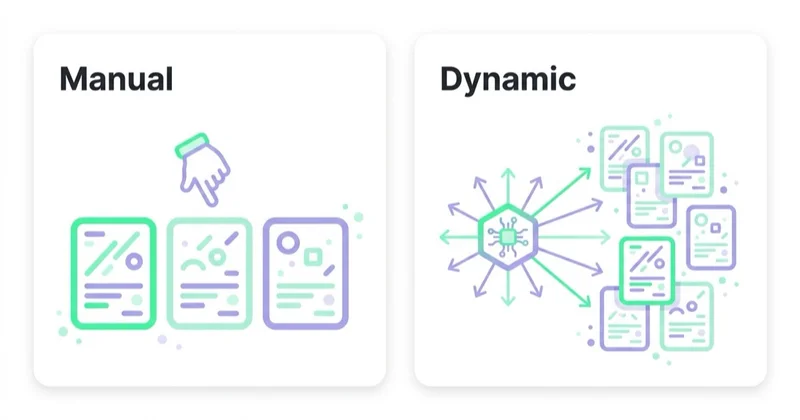
Manual testing is usually better when:
- one specific hypothesis must be isolated;
- legal approval is required for every final ad;
- the creative contains precise pricing or regulated claims;
- the brand needs exact art direction;
- the budget is too small for many combinations;
- the team needs equal spend across concepts;
- the landing page differs by concept;
- the sales team needs clean lead-source comparison.
For example, if the question is "does the audit offer beat the free checklist?", build a cleaner A/B test. If the question is "which of these hooks deserves more production?", dynamic creative can be useful.
Advantage+ Creative control checklist
Before publishing, check:
- Are automatic enhancements enabled?
- Are text variations allowed?
- Can Meta add overlays?
- Can image expansion alter the frame?
- Can static images be animated?
- Can music be added?
- Are placement crops acceptable?
- Does the ad still match brand guidelines?
- Are claims still legally accurate after variation?
- Does every variant match the landing page?
This matters especially in regulated categories, luxury brands, medical claims, financial services and brands with strict visual systems.
Post-launch control
Creative automation should be checked after launch, not only before publishing.
After the ad starts delivering, review:
- live previews in major placements;
- comments and user sentiment;
- whether enhancements remained as intended;
- whether generated text variations still match the claim;
- whether crops hide product, price or disclaimer details;
- whether spend is concentrated in one concept too quickly;
- whether high CTR traffic converts after the click;
- whether lead or order quality matches the reported CPA or ROAS.
This review is important because the visible ad can differ across placements and users. The campaign may look fine in the account summary while some generated combinations are weak, confusing or off-brand.
30-day dynamic creative plan
Week 1: Build the test system
Define hypotheses, create concept groups, prepare assets, check tracking and document brand rules.
Week 2: Launch with controlled variation
Launch enough concepts to learn, but avoid overwhelming the budget. Confirm previews, placements and tracking.
Week 3: Read early signals
Review spend distribution, CTR, video retention, conversion quality, comments and landing page behaviour. Do not judge only on day-one CPA.
Week 4: Refresh and scale
Turn winning concepts into new variants. Pause clearly weak assets. Keep the best learning, not only the best individual ad.
How we approach this at Space Ads
At Space Ads, we plan dynamic creative tests around a hypothesis, not an upload folder. Before launch, we define the concept groups, claim boundaries, placements, landing-page match and measurement setup, then check previews for Feed, Stories, Reels and other eligible formats. We want the system to choose between real creative angles: demo, proof, offer, objection handling or founder explanation, not between ten cosmetic versions of the same asset. After launch, we look at spend distribution, comments, post-click quality, lead or order value and repeatability of the learning. If a concept looks strong, we rebuild it deliberately instead of treating the automated combination as the final answer.
Common mistakes
| Mistake | Impact | Better approach |
|---|---|---|
| Uploading similar assets | Little creative learning | Test distinct concepts |
| No hypothesis | Results are hard to interpret | Define what is being tested |
| Ignoring previews | Off-brand combinations run | Review formats and enhancements |
| Too little budget | No meaningful learning | Match test size to budget |
| Measuring only campaign CPA | No creative insight | Review concepts and assets |
| Weak tracking | Algorithm learns from noise | Improve Pixel, CAPI and event quality |
| Letting AI change regulated claims | Compliance risk | Control enhancements and wording |
| No refresh process | Creative fatigue | Plan new concepts regularly |
FAQ
What is dynamic creative in Meta Ads?
Dynamic creative is a Meta Ads feature that combines multiple creative elements, such as text, headlines, images, videos and CTAs, into different ad variations.
Is dynamic creative still available in Meta Ads?
Availability can vary by objective, account and setup. Meta guidance notes that Dynamic Creative may no longer be available for some sales or app promotion ad set setups, with flexible format recommended for similar outcomes.
Is dynamic creative the same as Advantage+ Creative?
No. Dynamic creative mixes supplied assets. Advantage+ Creative can apply automated enhancements and AI-assisted variations such as cropping, text generation, image expansion, animation or music depending on settings.
Does dynamic creative replace A/B testing?
No. It is useful for exploratory creative testing. A/B testing is better when a team needs a cleaner comparison of one hypothesis, such as offer A vs offer B.
How many assets should be added?
Use enough assets to create meaningful variation, but avoid chaos. A practical starting point is several distinct concepts with a few asset variants each, rather than many nearly identical creatives.
Can dynamic creative hurt brand consistency?
Yes, if automated combinations or enhancements change the ad in ways that conflict with brand guidelines, legal claims or landing page context. Preview and control settings matter.
How should results from dynamic creative be used?
Use them as creative direction, not only as a final answer. Winning themes should be rebuilt, tested and documented so the next production cycle improves.
Is dynamic creative useful for ecommerce?
Yes, especially for testing product demos, UGC, social proof, offers and category angles. For SKU-level personalization, catalog ads may be more appropriate.
Conclusion
Dynamic creative is useful when it is treated as a creative testing system, not a dumping ground for random assets. The strongest results come from distinct concepts, reliable conversion signals, brand control and disciplined learning.
Meta's automation can help deliver variations, but the advertiser still owns the strategy: what to say, which proof to show, what not to automate and how to use learnings in the next production cycle.
We test and run dynamic creative (Advantage+ Creative) within Facebook and Instagram ads.
Sources and further reading
- Meta for Business: Advantage+ Creative
- Meta Help Center: Create ad campaigns in Meta Ads Manager
- Meta for Developers: Conversions API
- Meta Business Help Center
Continue learning
Continue reading
Meta Ads Audiences: How to Build Facebook Audiences
Meta Ads audiences are no longer just narrow interest groups. Learn how Custom Audiences, lookalikes, Advantage+ audience, exclusions, Pixel, CAPI and first-party data work together.
What Is a Sales Campaign and How to Plan It?
A sales campaign needs a clear offer, conversion goal, tracking, creative, landing page and optimisation plan across Meta, Google and owned channels.

Messenger Ads: What You Need to Know
Messenger Ads can generate valuable conversations, but performance depends on channel fit, response speed, automation, CRM handoff and business outcomes.