Effective ad copy connects audience intent, a clear benefit, credible proof and a logical next step. It is not just a clever slogan. Strong copy has to match the channel, the offer, the creative asset, the landing page and the user's stage of decision-making.
Modern ad platforms also treat copy as modular input. Google Responsive Search Ads, Meta dynamic creative and Advantage+ systems can combine or adapt text elements in different ways. That means each headline, description and primary text option should make sense on its own and work as part of a larger creative system.
TL;DR
- Good ad copy starts with intent: what the audience is trying to solve, compare, buy or understand.
- The core ingredients are problem, benefit, proof, differentiation and CTA.
- Search ad copy should match query intent and landing page relevance.
- Social ad copy should create fast context because the user is usually not actively searching.
- Automated ad systems need modular copy that can work in multiple combinations.
- Claims need proof. Strong promises without evidence reduce trust.
- A/B tests should compare clear hypotheses, not random word changes.
- Conversion rate depends on copy, creative, offer, landing page, audience and tracking quality together.
What makes ad copy effective?
Ad copy is effective when it helps the right person understand why an offer is relevant and what should happen next.
It should answer:
- Who is this for?
- What problem does it solve?
- What outcome can be expected?
- Why should this brand be trusted?
- What makes the offer different?
- What is the next step?
- Does the message match the page after the click?
The best copy is usually simple, specific and supported by proof. It does not need to sound "creative" if creativity hides the message.
Start with a copy brief
Ad copy gets weaker when it starts with a blank document. Before writing variants, define the commercial context.
A practical copy brief should include:
- audience segment;
- funnel stage;
- primary pain or motivation;
- offer;
- proof available;
- objections to address;
- channel and placement;
- landing page destination;
- conversion action;
- claims that must be avoided;
- brand tone boundaries;
- test hypothesis.
This brief prevents the most common problem: writing copy that sounds good but has no clear job. A search headline for a high-intent query, a Meta prospecting ad, a remarketing ad and a YouTube script may all promote the same offer, but they should not use the same message structure.
The brief should also define what the ad must not promise. If the landing page cannot prove a claim, the ad should not make it. If a result depends on eligibility, timing, location, budget, product availability or approval, the copy should make the condition clear enough to avoid misleading users.
The five core elements of converting ad copy
1. Intent
Intent is the reason behind the user's attention.
In Search, intent is often visible in the query:
- "google ads audit price" suggests commercial or transactional intent;
- "what is consent mode v2" suggests informational intent;
- "best running shoes for winter" suggests commercial investigation;
- "facebook lead ads setup" suggests practical implementation intent.
In social media, intent is less explicit. The ad must create context quickly through the visual, opening line and offer.
2. Benefit
A benefit explains why the feature matters.
| Feature | Benefit-oriented copy |
|---|---|
| Server-side tracking | Recover cleaner conversion signals for campaign optimization |
| Waterproof material | Keep feet dry during long wet walks |
| CRM lead import | Optimize campaigns toward qualified leads, not every form |
| Guest checkout | Reduce friction for mobile buyers |
Benefits should be specific. "Save time" is weaker than "build a weekly campaign report without copying data from three platforms."
3. Proof
Proof makes the promise believable.
Proof can include:
- case study;
- review;
- demo;
- certification;
- customer count;
- before-and-after;
- process detail;
- data where it can be verified;
- transparent explanation;
- expert credibility;
- product demonstration.
If the ad makes a strong claim, it needs strong evidence.
4. Differentiation
Differentiation explains why this offer is worth choosing over alternatives.
It can come from:
- specialization;
- product design;
- speed;
- service model;
- expertise;
- guarantee;
- pricing model;
- technology;
- customer support;
- niche focus;
- delivery experience;
- implementation process.
Generic claims such as "high quality" or "best service" rarely differentiate unless the proof is visible.
5. CTA
The call to action should match the user's readiness.
Examples:
- buy now;
- compare plans;
- check availability;
- book an audit;
- request a quote;
- download the checklist;
- view the collection;
- start trial;
- read the guide;
- send a message.
The CTA should not ask for too much too early. Cold traffic may need a softer step. High-intent traffic may need a direct conversion path.
Match copy to awareness level
The same offer needs different copy depending on how much the audience already understands.
| Awareness level | User mindset | Copy angle | Example CTA |
|---|---|---|---|
| Unaware | Does not know the problem clearly | Situation, symptom, education | Read the guide |
| Problem-aware | Knows the pain but not the solution | Cost of inaction, diagnosis | Check what is wrong |
| Solution-aware | Compares solution types | Method, process, category benefit | Compare options |
| Product-aware | Knows the brand or product | Proof, differentiation, offer | See pricing |
| Most aware | Ready to act | Urgency, availability, direct step | Book now |
This matters because many ads ask for a sale too early. A cold B2B user may respond better to an audit, checklist or comparison than to a direct sales demo. A high-intent search user may prefer a direct quote request instead of a long educational article.
For broader funnel planning, see what a sales campaign is and how to plan it.
Ad copy for Google Search
Search copy must reflect the user's query and intent. It should also improve relevance between keyword, ad and landing page.
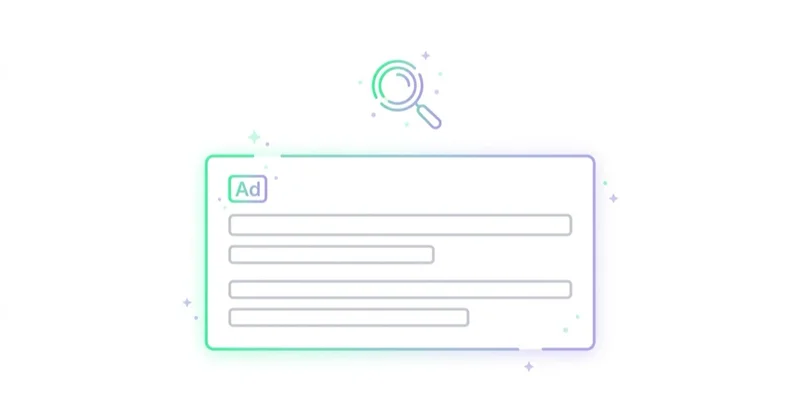
For Responsive Search Ads, Google allows multiple headlines and descriptions. The system then tests combinations to show ads expected to perform well for different searches and contexts.
Practical rules:
- write headlines with distinct roles;
- avoid repeating the same phrase in every headline;
- include the main keyword only when natural;
- include benefits and proof;
- use descriptions to clarify the offer;
- pin assets only when legally or strategically necessary;
- align the ad with the landing page;
- avoid claims that the landing page does not support.
Useful headline types:
| Headline type | Example |
|---|---|
| Intent | Google Ads Audit |
| Problem | Budget Spent, Leads Weak? |
| Benefit | Find What Wastes Spend |
| Proof | GA4 + Google Ads Review |
| Offer | Book a PPC Account Audit |
| Risk reduction | Clear Fix Roadmap Included |
For broader ad quality context, see Quality Score in Google Ads.
Ad copy for Meta and social media
In social media, the user usually did not search for the offer. The ad has to earn attention and create relevance.
Strong social ad copy:
- starts with a problem, situation or outcome;
- matches the visual or video hook;
- avoids repeating the exact same text that is already on the image;
- uses simple sentences;
- moves from problem to value quickly;
- includes proof or specificity;
- leads to one action;
- matches the funnel stage.
In many Meta Ads, the visual earns the first attention and the copy explains why it matters.
For creative testing, see dynamic creative on Facebook and Instagram.
Social copy by placement
Social ads are not one format. The copy should adapt to how the placement is consumed.
| Placement context | Copy priority | Common mistake |
|---|---|---|
| Feed | Fast relevance and proof | Long setup before the offer |
| Stories or Reels | Hook, overlay and CTA clarity | Caption explains what the video should show |
| Remarketing | Objection handling and reassurance | Repeating the same prospecting message |
| Click-to-message | Clear reason to start a conversation | Generic "message us" CTA |
| Lead ads | Qualification and expectation setting | Making the form too easy and lead quality weak |
In social campaigns, the first sentence should connect to the creative. If the video shows a product comparison, the copy should not start with a generic brand statement. If the image shows a result, the copy should explain how the user can reach it and why the claim is credible.
Ad copy for video
Video copy is not only the caption. It includes:
- first frame;
- spoken hook;
- text overlay;
- subtitles;
- scene order;
- proof;
- end card;
- CTA.
A useful video structure:
- Hook: name the problem or result.
- Context: explain who it is for.
- Value: show the benefit or process.
- Proof: demonstrate, compare or show evidence.
- CTA: give the next step.
For short-form video, the first seconds matter. Long introductions usually lose attention.
Ad copy for ecommerce
Ecommerce ad copy should not speak only about the store when the user cares about the product.
Important elements:
- product type;
- use case;
- key attribute;
- price or promotion where relevant;
- delivery;
- returns;
- reviews;
- availability;
- sizing;
- material;
- seasonality;
- bundle or offer;
- risk reduction.
Examples:
| Weak copy | Better copy |
|---|---|
| Best shoes online | Waterproof hiking boots for wet trails |
| New collection available | Lightweight linen shirts for hot-weather travel |
| Shop now | Check sizes and colours in stock |
| Quality skincare | Fragrance-free moisturizer for sensitive skin |
Ecommerce copy works best when product data, creative and landing page are consistent.
Ecommerce copy examples by intent
| Intent | Weak copy | Stronger direction |
|---|---|---|
| Category browsing | Shop our collection | Compare waterproof hiking boots by terrain and season |
| Product comparison | Best jacket online | Lightweight rain jacket with taped seams and two-way zipper |
| Promotion | Big sale today | 20% off selected linen shirts until Sunday, sizes S-XL |
| Gift purchase | Perfect gifts | Gifts under £50 with delivery before Friday |
| Repeat purchase | Buy again | Reorder the fragrance-free moisturiser used in the last order |
The strongest ecommerce copy is often built from product truth: material, fit, availability, use case, delivery, compatibility, guarantee and reviews. The copy should not force a general brand message when the user's decision depends on a specific product detail.
Ad copy for B2B and services
B2B and service copy should reduce risk and make the next step feel useful.

Useful angles:
- problem diagnosis;
- cost of inaction;
- implementation clarity;
- expert proof;
- case study;
- industry specialization;
- audit offer;
- comparison;
- process;
- compliance or security;
- sales enablement.
Example structure:
| Element | Example |
|---|---|
| Problem | Google Ads spend is rising, but lead quality is falling |
| Consequence | Sales wastes time on contacts that never convert |
| Solution | Audit tracking, search intent, landing pages and CRM feedback |
| Proof | Review GA4, Google Ads, forms and sales-stage data |
| CTA | Book a PPC audit |
For message sequencing, see AIDA model in marketing.
Writing modular copy for automated systems
Automation changes how copy should be prepared.
Google, Meta and other platforms may combine assets, test variations or adapt ad delivery based on predicted performance. This means every asset should be able to stand alone.
Checklist:
- Does each headline make sense without the others?
- Are there different angles, not only repetitions?
- Does every description support the offer?
- Are claims accurate when combined with different visuals?
- Does each CTA match the landing page?
- Are legal or brand-required phrases pinned or protected where needed?
- Are similar assets grouped by concept for analysis?
Modular copy should be varied but coherent.
Claim control and trust
Conversion-focused copy should still be careful. Strong claims can improve attention, but unsupported claims damage trust and can create compliance problems.
Review every claim against three questions:
- Is it factually true?
- Can the landing page prove it?
- Does the claim remain true in every ad placement and asset combination?
Risky claim types include:
- guaranteed results;
- unrealistic timelines;
- unverified comparisons;
- exaggerated savings;
- medical, financial or legal promises;
- superlatives without evidence;
- scarcity that is not real;
- testimonials used without context;
- AI-generated claims that were not checked.
Better copy is specific without overpromising. "Reduce wasted spend by finding tracking and query issues" is more credible than "double revenue instantly." "Book a GA4 and Google Ads audit" is clearer than "unlock unlimited growth."
For trust and people-first content principles, the same logic applies beyond ads: see Google's guidance on helpful, reliable content.
Copywriting frameworks
Problem - Agitate - Solve
Useful when the audience feels a known pain.
- Problem: identify the issue.
- Agitate: show why it matters.
- Solve: present the offer.
AIDA
Useful for ads, landing pages and emails.
- Attention.
- Interest.
- Desire.
- Action.
Feature - Advantage - Benefit
Useful for product copy.
- Feature: what it has.
- Advantage: what it does.
- Benefit: why it matters.
Before - After - Bridge
Useful for transformation messages.
- Before: current pain.
- After: desired state.
- Bridge: how the offer helps.
Frameworks are tools, not formulas. The best one depends on the channel and audience.
How to test ad copy
Ad copy tests should be based on hypotheses.
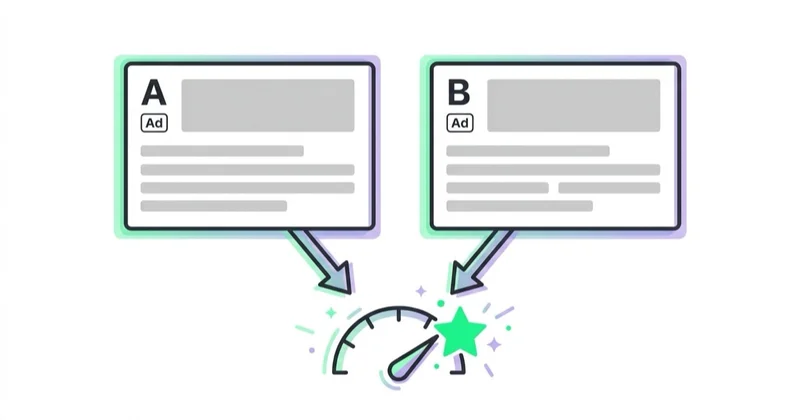
Good hypotheses:
- proof-led headlines will improve qualified lead rate;
- pricing clarity will reduce unqualified leads;
- problem-first social copy will improve click quality;
- product-use images plus benefit copy will improve add-to-cart rate;
- softer CTA will work better for cold traffic;
- direct CTA will work better for high-intent search.
Weak tests:
- changing three things at once;
- testing tiny word differences without a reason;
- comparing ads with different audiences and budgets;
- judging results before enough data;
- ignoring landing page mismatch;
- measuring only CTR when conversion quality matters.
Metrics to review
The right metrics depend on channel and goal.
| Goal | Useful metrics |
|---|---|
| Search relevance | CTR, conversion rate, Quality Score components, search term quality |
| Lead generation | cost per qualified lead, form quality, sales acceptance |
| Ecommerce | conversion rate, ROAS, margin, add-to-cart, checkout completion |
| Social prospecting | thumb-stop, CTR, engaged sessions, assisted conversions |
| Video | hook rate, retention, completion, click quality |
| Brand | recall, direct traffic, branded search, engagement quality |
CTR alone can mislead. A clickbait ad may get clicks and poor conversion quality.
Ad-to-landing-page continuity
Ad copy should be checked together with the landing page. The user should not feel that the ad promised one thing and the page delivered another.
Check continuity across:
- headline promise;
- product or service name;
- price, discount or availability;
- audience segment;
- location;
- proof or case study;
- CTA wording;
- form fields;
- imagery;
- delivery or fulfilment details;
- legal or eligibility conditions.
If the ad says "book a PPC audit," the landing page should make the audit visible immediately. If the ad promotes a specific product category, the user should not land on a generic homepage. If the ad uses a price or promotion, the page should repeat the same terms.
This alignment affects both user trust and platform learning. Poor continuity can create high click volume with weak conversion quality. For landing-page improvement context, see conversion rate optimization guide.
How we approach this at Space Ads
We don't hunt for the one "perfect" ad text, because almost nobody nails it first time. Instead we write several genuinely different angles: one hits the problem, one the outcome, one a concrete proof point or offer. Then we let the data pick the winner, not someone's opinion in a meeting. We also match the copy to how warm the audience is: we speak differently to someone who doesn't know us than to someone who just came back to the site. We test a lot and continuously, because it's one of the few things that move results quickly and for real — creative and message do more for performance today than small setting tweaks. Weak variants we cut without sentiment, and write the next ones straight away.
Common mistakes
| Mistake | Impact | Better approach |
|---|---|---|
| Writing features without benefits | Audience does not see value | Translate features into outcomes |
| Same copy for every funnel stage | Intent mismatch | Match message to awareness level |
| No proof | Claims feel weak | Add evidence or specificity |
| Keyword stuffing | Ads feel unnatural | Use keywords only where useful |
| Vague CTA | Next step unclear | Make action specific |
| Ad-page mismatch | Conversions drop | Align ad promise and landing page |
| Testing without hypotheses | No reusable learning | Define what is being tested |
| Ignoring mobile | Copy and CTA get cut off | Preview placements before launch |
Practical writing checklist
Before launching, check:
- the first line explains relevance quickly;
- the main benefit is specific;
- the proof is visible or available on the page;
- the CTA matches the user's readiness;
- the copy matches the placement and creative;
- the landing page repeats the promise;
- the claim is accurate and supportable;
- mobile previews do not cut off key meaning;
- variants test different angles, not only synonyms;
- tracking can distinguish leads, sales or revenue quality.
This checklist is intentionally practical. Ad copy is only useful when it survives the real campaign environment: short attention, limited space, automated combinations, policy checks, mobile previews and a user who may compare several options at once.
FAQ
What is ad copy?
Ad copy is the text used in advertisements, including headlines, descriptions, primary text, calls to action, overlays and scripts.
What makes ad copy convert?
Converting ad copy matches intent, explains a specific benefit, provides proof, differentiates the offer and gives a clear next step.
Should ad copy be short?
It depends. Short copy can work for high-intent or simple offers. Complex services, B2B products and unfamiliar offers often need more context.
Should keywords be used in ad copy?
In Search ads, keywords can help when they match intent naturally. They should not be forced into every headline at the expense of clarity.
How many ad copy variants should be tested?
Test a few meaningfully different hypotheses rather than many tiny variations. Differences should relate to angle, promise, proof, CTA or audience stage.
Can AI write ad copy?
AI can help generate variants and angles, but final copy needs human review for accuracy, brand tone, compliance, offer fit and landing page alignment.
How should ad copy be briefed to an agency or freelancer?
Provide audience, offer, funnel stage, proof, objections, landing page, conversion goal, compliance limits and examples of claims that are allowed or not allowed.
What is the biggest ad copy mistake?
The biggest mistake is writing a message that sounds attractive but does not match the audience's intent, the offer or the page after the click.
Conclusion
Effective ad copy is clear, specific and connected to the whole conversion path. It should match the audience's intent, communicate value, prove the claim and make the next step obvious.
In automated campaigns, copy also has to work as a modular system. The strongest advertisers create distinct angles, test them with discipline and turn results into repeatable creative learning.
Sources and further reading
- Google Ads Help: About responsive search ads
- Google Ads Help: Set up your ads for success
- Meta for Business: Advantage+ Creative
- Google Search Central: Creating helpful, reliable, people-first content
Continue learning
Continue reading
What Is the AIDA Model in Marketing and How to Use It?
The AIDA model structures marketing messages around Attention, Interest, Desire and Action. Use it for ads, landing pages, emails, product pages and sales messages.

Is It Worth Building an Online Store on Magento?
Magento and Adobe Commerce can power complex ecommerce, but the decision should depend on catalogue complexity, B2B needs, integrations, team ownership and total cost.

What Is an Online Advertising Campaign and How to Run One?
An online advertising campaign is a planned system of goal, audience, channel, budget, creative, landing page, measurement and optimisation.