An online advertising campaign is a planned set of paid marketing activities designed to achieve a specific goal, such as sales, qualified leads, signups, traffic, brand awareness, product launch, customer retention or remarketing.
A campaign is not only the setup inside Google Ads, Meta Ads, TikTok Ads or another platform. It includes strategy, audience, channel choice, budget, creative, landing page, tracking, optimisation and reporting. The ad account is only one part of the system.
The most common mistake is launching ads before the goal, measurement and destination page are ready. Paid media can bring traffic quickly, but it cannot fix a weak offer, broken tracking, unclear landing page or poor checkout.
TL;DR
- An online advertising campaign should start with a clear business goal and measurement plan.
- The campaign setup must include audience, channel, budget, creative, landing page, conversion tracking and KPI definition.
- Search, Shopping, Performance Max, Demand Gen, Meta Ads, TikTok Ads, YouTube, LinkedIn and programmatic each have different roles.
- A campaign for sales is planned differently from a brand awareness campaign or lead generation campaign.
- AI-powered bidding and automation need good conversion data, clear goals and enough budget to learn from.
- Creative is often the biggest lever in social, video and demand generation campaigns.
- Landing page quality and message match can decide whether traffic turns into results.
- Campaign optimisation should be based on data and hypotheses, not random daily changes.
- Ecommerce campaigns must account for feed quality, stock, margin, price, delivery, returns and checkout.
- B2B campaigns must measure lead quality and pipeline, not only form fills.
What is an online advertising campaign?
An online advertising campaign is a coordinated paid media activity run through digital channels.
It can include:
- Google Search ads;
- Shopping ads;
- Performance Max;
- Demand Gen;
- YouTube ads;
- Meta Ads;
- TikTok Ads;
- LinkedIn Ads;
- display advertising;
- programmatic campaigns;
- remarketing;
- sponsored content;
- marketplace ads.
The campaign should have one primary goal. It may have several supporting metrics, but one outcome should define success.
Examples:
- increase qualified demo requests;
- sell a product category profitably;
- launch a new service;
- recover abandoned carts;
- promote a webinar;
- build awareness in a new market;
- drive store visits;
- increase repeat purchases.
Campaign vs ad group vs ad
The terminology differs by platform, but the hierarchy is usually similar.
| Level | Role |
|---|---|
| Campaign | Main objective, budget, settings and strategy |
| Ad group or ad set | Audience, keywords, placements or product groups |
| Ad | Creative, copy, destination and format |
| Landing page | Destination where the user acts |
| Conversion | Measured business action |
Optimisation can happen at every level. A campaign can have a good strategy and weak ads. An ad can have strong copy and a poor landing page. A landing page can convert well but receive the wrong traffic.
Step 1: Define the campaign goal
Start with the business outcome.
Common campaign goals:
- purchases;
- qualified leads;
- booked calls;
- trial signups;
- newsletter signups;
- webinar registrations;
- app installs;
- store visits;
- product awareness;
- remarketing conversions;
- customer retention.
The goal should be measurable and realistic. "More sales" is too broad. "Increase profitable purchases for the spring collection with a target ROAS range" is clearer. "Generate 40 qualified demo requests from UK finance teams in Q3" is clearer than "get leads".
For goal and budget planning, see marketing budget planning and marketing plan.
Step 2: Define the audience and funnel stage
A campaign should know who it is for.
Useful audience questions:
- Is the audience cold, warm or returning?
- Does the user know the problem?
- Does the user know the brand?
- Is the user comparing suppliers?
- Is the user ready to buy?
- Is the user an existing customer?
- Is the decision individual or committee-based?
- Which country, language or market is targeted?
Cold users need more context. Warm users may need proof and comparison. Returning users may need a stronger CTA, offer or reminder.
For journey mapping, see sales funnel strategy.
Step 3: Choose the right channel
Channel choice should follow the goal and demand type.
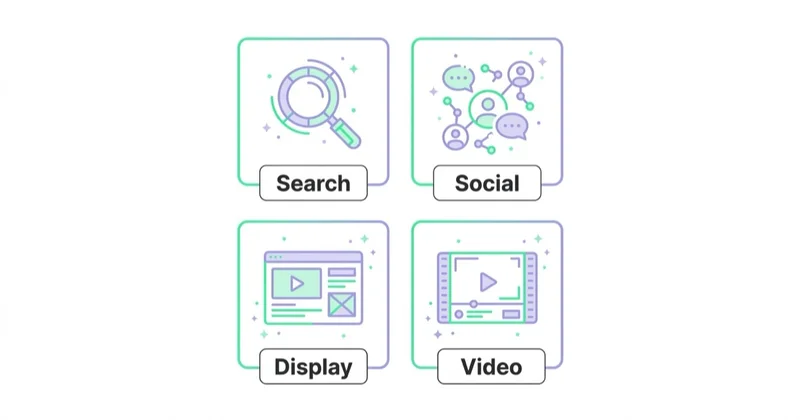
| Channel | Best for | Watch out for |
|---|---|---|
| Google Search | Capturing active demand | Keyword intent, landing page relevance, conversion tracking |
| Shopping / product ads | Ecommerce product demand | Feed quality, price, stock, margin |
| Performance Max | Cross-network performance goals | Asset quality, feed quality, conversion data |
| Demand Gen | Visual demand creation and mid-funnel activity | Creative, audience signals, measurement |
| YouTube | Awareness, education, product demonstration | Creative hook, view quality, attribution |
| Meta Ads | Demand creation, remarketing, creative testing | Creative fatigue, audience breadth, tracking |
| TikTok Ads | Short-form video demand and discovery | Creative volume, platform-native format |
| LinkedIn Ads | B2B targeting and account-based campaigns | Higher CPC, lead quality, offer strength |
| Programmatic | Reach, awareness, controlled placements | Brand safety, measurement, incrementality |
| Email or CRM paid support | Retention and reactivation | List quality, consent, offer relevance |
Small budgets usually work better with fewer channels. Splitting a small budget across many platforms can prevent every campaign from collecting useful data.
For channel-specific guides, see Performance Max, Demand Gen, TikTok Ads and Meta Advantage+.
Step 4: Set budget and success thresholds
The budget must be large enough to test the idea. A campaign with too little spend may generate impressions and clicks but not enough conversions to judge performance.
Budget planning should account for:
- expected CPC or CPM;
- conversion rate;
- conversion value;
- sales cycle length;
- creative production;
- landing page work;
- tracking setup;
- testing period;
- seasonality;
- margin or lead value.
Useful threshold questions:
- How many conversions are needed to evaluate the campaign?
- How long is the conversion window?
- Is the budget enough for meaningful learning?
- Is the campaign budget split too thinly?
- What is the maximum acceptable CPA?
- What is the target ROAS or revenue value?
- What lead quality threshold will count as success?
Do not judge a campaign only after one day unless something is technically broken. However, do not wait for weeks if tracking is wrong, the landing page is broken or the offer is clearly mismatched.
Step 5: Prepare creative and messaging
Creative should match the channel, user intent and funnel stage.
Search ads need:
- relevant keywords;
- clear headlines;
- benefit-led copy;
- strong landing page match;
- sitelinks and useful assets;
- conversion-focused CTA.
Social and video ads need:
- strong first seconds;
- platform-native format;
- clear visual demonstration;
- multiple concepts;
- proof and examples;
- captions or text overlays where appropriate;
- consistent brand signals;
- clear next step.
The same message should not be reused everywhere without adaptation. A search ad responds to demand. A social ad often creates interest. A YouTube ad may need to educate before asking for action.
For copywriting, see ad copy that converts.
Step 6: Build or choose the landing page
The landing page must continue the promise of the ad.
Good message match means:
- the headline matches the ad intent;
- the offer is visible quickly;
- the CTA is clear;
- proof appears before heavy commitment;
- forms are not longer than necessary;
- mobile layout works;
- page speed is acceptable;
- pricing, delivery or process information is clear;
- trust signals are present;
- tracking is implemented.
Sending every ad to the homepage is often inefficient. It can work for broad brand campaigns, but high-intent campaigns usually need a more specific destination.
For conversion foundations, see conversion rate optimisation and CTA strategy.
Step 7: Set up measurement before launch
Measurement should be ready before traffic starts.
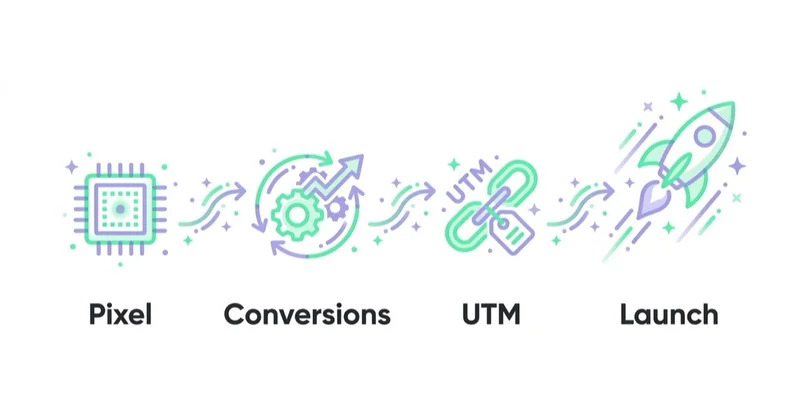
Check:
- conversion actions;
- key events;
- purchase value;
- lead form submissions;
- phone clicks;
- CRM imports;
- ecommerce events;
- consent mode;
- UTM parameters;
- deduplication;
- thank-you pages;
- tag firing;
- remarketing audiences;
- dashboard definitions.
Google Ads conversion measurement helps identify valuable actions such as purchases, signups and phone calls, and it supports Smart Bidding strategies that optimise toward business goals.
For a deeper setup, see conversion tracking, UTM parameters and Consent Mode v2.
The role of AI and automation
Modern ad platforms use automation heavily.
Examples:
- Smart Bidding in Google Ads;
- Performance Max;
- Demand Gen automation;
- broad match with conversion signals;
- Meta Advantage+ placements or campaign automation;
- dynamic creative testing;
- automated product recommendations;
- audience expansion and modelling.
Automation is useful when the inputs are good:
- clean conversion tracking;
- meaningful conversion values;
- strong creative;
- clear campaign goal;
- good landing page;
- enough budget and data;
- reliable product feed;
- exclusions and brand controls where needed.
Automation is not a replacement for strategy. If the campaign goal is wrong, the conversion action is too soft or lead quality is not imported, the platform may optimise toward the wrong outcome faster.
Online advertising campaign for ecommerce
Ecommerce campaigns need more than traffic.
Before launch, check:
- product feed;
- product titles and images;
- availability;
- price competitiveness;
- margin;
- promotions;
- delivery cost and delivery time;
- return policy;
- checkout flow;
- payment methods;
- product reviews;
- category landing pages;
- purchase tracking and revenue value.
Campaign performance can be limited by business factors outside the ad account. A product with poor stock, weak photos, unclear shipping or low margin may not scale profitably.
For ecommerce growth, see how to increase online sales, Google Merchant Center and Shopping campaigns.
Online advertising campaign for B2B and services
B2B and service campaigns need lead quality control.
Before launch, define:
- what counts as a qualified lead;
- which industries or company sizes matter;
- which locations are targeted;
- which job roles influence the decision;
- what happens after form submission;
- how fast sales follow-up happens;
- which CRM stage is imported back;
- what disqualifies a lead.
The biggest B2B mistake is optimising only for cheap form fills. A campaign can look efficient in the ad platform and still fail if leads are unqualified.
Better measurement includes:
- form submission;
- booked call;
- marketing-qualified lead;
- sales-qualified lead;
- opportunity;
- pipeline value;
- closed revenue.
Online advertising campaign for local businesses
Local campaigns need clear geography and intent.
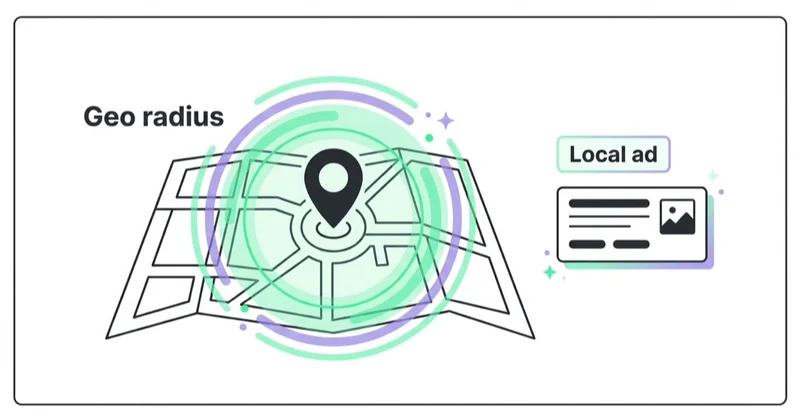
Important elements:
- service area;
- local landing page;
- phone tracking;
- opening hours;
- review signals;
- location assets;
- appointment booking;
- call quality;
- local search terms;
- mobile experience.
Local advertisers should avoid paying for traffic outside their real service area. Location settings and search terms need regular review.
How to optimise a campaign
Optimisation should follow a hypothesis.
Good optimisation questions:
- Is the traffic relevant?
- Are search terms aligned with the offer?
- Which creative concepts convert?
- Which audience segments produce quality leads?
- Does the landing page match the promise?
- Are mobile users converting?
- Are forms creating friction?
- Are conversion values accurate?
- Are products with low margin wasting budget?
- Is remarketing helping or just taking credit?
Common optimisation areas:
- budget allocation;
- bidding strategy;
- search terms;
- negative keywords;
- creative testing;
- landing page tests;
- audience exclusions;
- product feed improvements;
- conversion action quality;
- ad scheduling;
- device performance;
- geography;
- CRM lead feedback.
Avoid changing too many variables at once. If everything changes, learning what worked becomes difficult.
Campaign reporting
A useful report should connect platform metrics with business outcomes.
Report:
- spend;
- impressions;
- clicks;
- CTR;
- CPC or CPM;
- conversions;
- cost per conversion;
- conversion value;
- ROAS;
- lead quality;
- revenue;
- margin where available;
- creative learnings;
- landing page issues;
- next actions.
For awareness campaigns, include reach, frequency, video completion, brand search lift signals or post-view behaviour where appropriate. For lead generation, include CRM quality. For ecommerce, include revenue and margin, not only purchases.
How we approach this at Space Ads
A campaign is a chain for us, not a single ad: offer, targeting, creative, landing page, measurement. The result is capped by the weakest link, and that link gets attention first — not whatever happens to be easiest to fix. The common mistake is polishing the ad for hours while the real brake is a weak page, or miscounted conversions dragging the whole picture down. Before "tuning" anything we walk the chain backwards: does measurement tell the truth, does the page close, is the offer even competitive — ads and bids come after that. Reinforcing a strong link while another leaks is wasted effort. A campaign is only as good as its weakest element, so the value is in finding that element, not in another tweak where things are already fine.
Common mistakes
Launching without tracking
If conversion tracking is broken, optimisation and reporting are unreliable from day one.
One message for everyone
Cold, warm and returning users need different information.
Too many channels too early
A small budget split across many platforms often creates weak data everywhere.
Weak landing page
Paid traffic cannot compensate for a page that does not answer the user's question.
Judging only by clicks
Clicks are not the business goal. Conversions, value, lead quality and profit matter more.
Ignoring creative fatigue
Social and video campaigns need fresh creative testing.
No post-campaign plan
A campaign should end with learnings: what to scale, stop, improve or test next.
FAQ
What is an online advertising campaign?
It is a planned paid media activity designed to achieve a measurable goal, such as sales, leads, signups, awareness or remarketing.
Which channel should be used first?
It depends on the goal. Search is strong for active demand, Shopping and Performance Max for ecommerce, Meta and TikTok for visual demand creation, and LinkedIn for selected B2B targeting.
Can a campaign run without a landing page?
Yes, but it often performs worse when the destination is too generic. A dedicated page usually helps when the ad has a specific promise or audience.
How long should an online campaign run?
Seasonal campaigns can be short. Always-on campaigns can run continuously with optimisation. The campaign should run long enough to collect meaningful data unless tracking or setup issues require immediate correction.
Is AI enough to optimise a campaign?
No. AI-powered bidding and automation need good inputs: tracking, creative, landing page, budget, values and clear goals. Strategy and data quality still matter.
What should be checked before launch?
Goal, audience, channel, budget, creative, landing page, tracking, consent, conversion values, UTM parameters and reporting definitions.
Conclusion
An online advertising campaign is a system, not a button in an ad platform. The campaign works when the goal, audience, channel, budget, creative, landing page and measurement all support the same outcome.
The strongest campaigns are planned before launch and improved after launch. Automation can help scale decisions, but only when the inputs are reliable. Start with the business goal, set up measurement properly, match the message to the audience and optimise based on data that reflects real value.
If your campaigns are already running but you are not sure they are not wasting budget, a marketing audit of Google, Meta and TikTok accounts will check.
Sources and further reading
- Google Ads Help: About conversion measurement
- Google Ads Help: Smart Bidding guide
- Google Ads Help: Use Keyword Planner
- Google Analytics Help: URL builders and campaign data
Continue learning
Continue reading
What Is Storytelling in Marketing and How to Use It?
Storytelling in marketing uses narrative structure to explain a customer problem, transformation and result. Learn how to use it in ads, landing pages, ecommerce, B2B and case studies.

What Is Benefit-Led Copywriting and How to Use It?
Benefit-led copywriting translates features into customer value. Learn feature vs advantage vs benefit, with examples for ads, ecommerce, B2B, landing pages and CTAs.
How to Write Ad Copy That Converts
Effective ad copy connects intent, benefit, proof, offer fit and CTA. Use a clear brief, channel-specific variants, claim control and landing-page continuity.