The AIDA model is a classic marketing and copywriting framework that structures a message around four stages: Attention, Interest, Desire and Action. It helps turn a raw idea into a sequence that first earns attention, then makes the audience care, then builds preference and finally asks for a clear next step.
AIDA is not a complete customer journey model. It does not explain retention, referrals, complex buying committees or multi-touch attribution. Its value is simpler: it helps organize an ad, landing page, email, product page, script or sales message so the call to action does not arrive before the audience understands the value.
TL;DR
- AIDA stands for Attention, Interest, Desire and Action.
- It is useful for ads, landing pages, emails, video scripts, product pages, sales decks and campaign messaging.
- Attention earns the first moment of focus; Interest explains why the topic matters.
- Desire connects the offer with the reader's problem, proof, outcome and risk reduction.
- Action gives a clear, appropriate next step.
- AIDA works best when it is adapted to intent, channel, funnel stage and audience awareness.
- It should not be used mechanically. Some users already have high intent and do not need a long persuasion sequence.
- Modern variants often add Satisfaction, Search, retention or sharing, but the original four-step structure remains useful for message design.
What is the AIDA model?
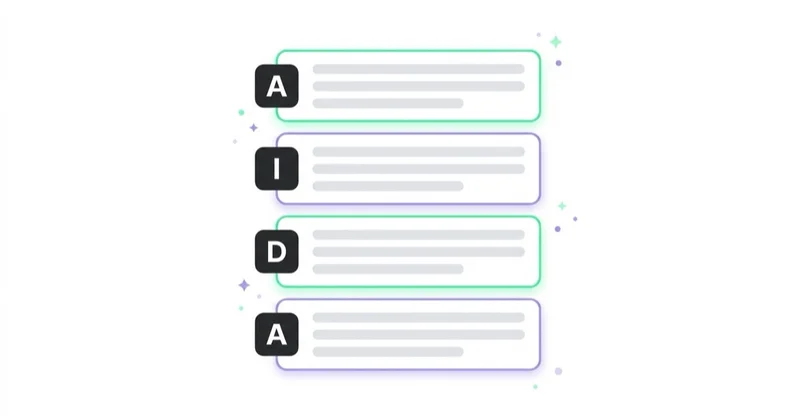
AIDA is a hierarchy-of-effects model used in advertising, sales and copywriting. The four letters describe the order in which a marketing message often needs to work:
| Stage | Meaning | Core question |
|---|---|---|
| Attention | Capture focus | Why should this be noticed now? |
| Interest | Build relevance | Why does this matter? |
| Desire | Create preference | Why is this solution attractive? |
| Action | Prompt a step | What should happen next? |
The model is especially useful when a message feels flat or disorganized. It forces a simple discipline: do not ask for action before creating enough context and value.
When AIDA is most useful
AIDA is particularly useful when:
- an ad gets clicks but the landing page does not convert;
- a landing page jumps from headline to form too quickly;
- an email subject line is strong but the body feels weak;
- a product page lists features but does not build desire;
- a video hook is good but the CTA feels disconnected;
- a B2B sales page lacks proof before asking for a demo;
- a campaign has too many messages competing at once.
It is less useful as a full analytics model. AIDA can help structure communication, but it will not explain attribution, repeat purchase, customer service, product-market fit or lifetime value. Use it for message design, not as the only way to understand the customer journey.
AIDA vs the marketing funnel
AIDA and the marketing funnel are related, but they are not the same thing.
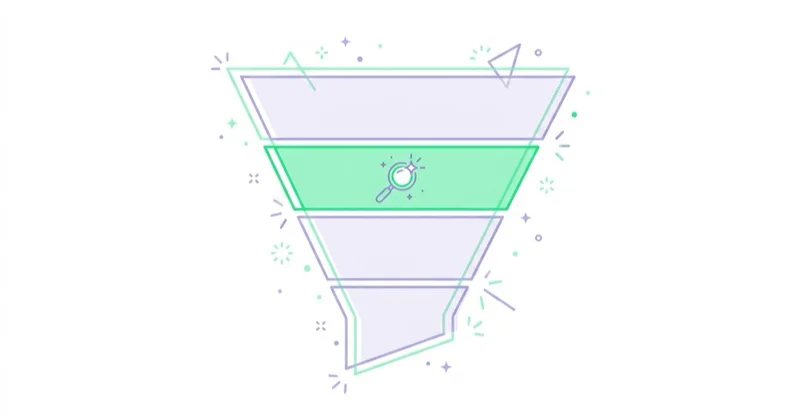
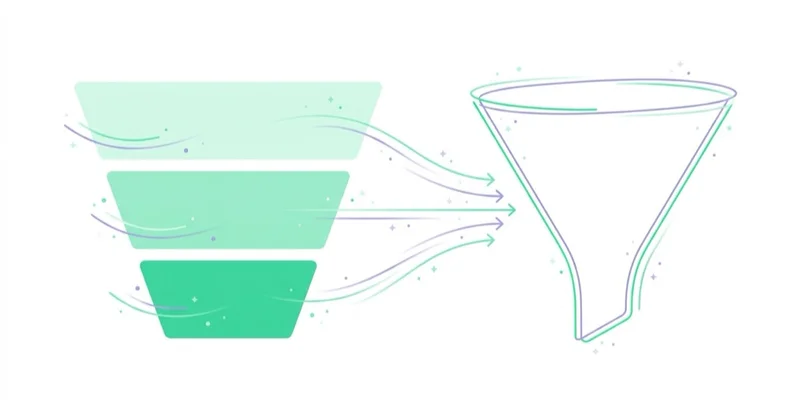
The funnel describes the broader customer journey: awareness, consideration, conversion, retention and sometimes advocacy. AIDA describes the structure of a message that moves a person from noticing to acting.
They can work together:
| Funnel stage | AIDA emphasis | Example |
|---|---|---|
| Awareness | Attention and Interest | Short video, social ad, educational hook |
| Consideration | Interest and Desire | Landing page, comparison article, webinar |
| Conversion | Desire and Action | Offer page, checkout, consultation CTA |
| Retention | Satisfaction or repeat action | Email, onboarding, loyalty message |
For funnel planning, see Precise ad targeting and the marketing funnel.
A: Attention
Attention is the first job of the message. It can come from a headline, image, opening sentence, video hook, subject line, search ad asset, product title or first screen of a landing page.
Good attention is not the same as clickbait. It should be relevant, truthful and connected to the offer.
Useful ways to earn attention:
- name a specific problem;
- show a specific outcome;
- use the audience's language;
- challenge a common assumption;
- lead with a timely trigger;
- show a visual contrast;
- ask a practical question;
- start with a clear benefit;
- reference a pain point;
- use a concrete number only when it is true and useful.
Weak attention usually looks like this:
- generic headline;
- overpromising;
- vague emotional claim;
- trend word without substance;
- clever line that hides the offer;
- dramatic hook that the page cannot support.
Attention should stop the right person, not everyone.
I: Interest
Interest explains why the topic is relevant. It turns a moment of attention into a reason to keep reading, watching or clicking.
This stage can include:
- context;
- problem explanation;
- consequences of doing nothing;
- examples;
- pain point expansion;
- education;
- data or observation;
- a better framing of the situation.
For example:
| Weak interest | Stronger interest |
|---|---|
| "Our agency improves campaigns." | "Many campaigns waste budget because the landing page, tracking and keyword intent are misaligned." |
| "Buy our shoes." | "Wet terrain needs grip, ankle support and waterproofing, not just a rugged design." |
| "Use better analytics." | "If payment providers appear as referrals in GA4, revenue can be attributed to the wrong source." |
Interest should make the audience think: "This is about my situation."
D: Desire
Desire is where the message connects the solution with a valued outcome. It is not about aggressive manipulation. It is about making the value concrete and credible.
Desire can be built through:
- benefits;
- proof;
- case studies;
- reviews;
- demonstrations;
- product details;
- comparison;
- before-and-after logic;
- risk reduction;
- guarantees or policies where appropriate;
- expert explanation;
- social proof;
- pricing clarity.
The biggest mistake in the Desire stage is listing features without translating them into value.
Example:
| Feature | Desire-building translation |
|---|---|
| Server-side tracking | More resilient conversion data and cleaner campaign optimization |
| Waterproof membrane | Better comfort in wet conditions during long walks |
| CRM lead import | Campaign optimization can learn from qualified leads, not just forms |
| Guest checkout | Fewer unnecessary steps for mobile buyers |
Desire is also where trust matters. If the claim is important, it needs proof.
A: Action
Action is the next step. It should be clear, visible and proportional to the level of intent.
Examples:
- buy now;
- add to cart;
- book a consultation;
- download the guide;
- start free trial;
- compare plans;
- request a quote;
- view products;
- check availability;
- subscribe;
- contact sales.
A good CTA:
- says what happens next;
- matches the offer;
- matches the funnel stage;
- does not ask for too much too early;
- is easy to find;
- is supported by surrounding copy;
- works on mobile;
- avoids vague wording where clarity matters.
For cold traffic, "Book a sales call" may be too much. For high-intent search traffic, a soft CTA may be too weak.
AIDA examples by channel
Search ad
| Stage | Example |
|---|---|
| Attention | "Google Ads spending more but leads getting weaker?" |
| Interest | "The issue is often tracking, search intent or landing page quality." |
| Desire | "An account audit can show which campaigns waste budget and which deserve scale." |
| Action | "Request a Google Ads audit" |
Search ads have limited space, so the full AIDA sequence may be compressed into headline, description and landing page.
Landing page
| Stage | Example section |
|---|---|
| Attention | Hero headline that names the problem and outcome |
| Interest | Short explanation of the pain, context and who the offer is for |
| Desire | Benefits, proof, process, testimonials, cases and risk reduction |
| Action | CTA, form, booking widget or checkout |
Landing pages can develop the full model because they have more space.
Email campaign
| Stage | Email element |
|---|---|
| Attention | Subject line and preview text |
| Interest | First paragraph and problem framing |
| Desire | Main value, proof, example or offer |
| Action | Button or reply prompt |
Email needs a particularly strong match between subject line and body. A subject line that creates attention but disappoints after opening damages trust.
Product page
| Stage | Product-page use |
|---|---|
| Attention | Product title, image, price or standout claim |
| Interest | Key use case and product details |
| Desire | Reviews, benefits, comparison, delivery, returns and guarantees |
| Action | Add to cart, buy now, choose size or check availability |
For ecommerce, AIDA works well when combined with conversion rate optimization and m-commerce.
Short-form video
| Stage | Video element |
|---|---|
| Attention | First 1-3 seconds |
| Interest | Problem, scene or context |
| Desire | Demonstration, result, proof or transformation |
| Action | CTA, offer or next step |
In video, Attention is often visual. The opening frame can matter as much as the script.
AIDA copy templates
These templates should be adapted, not copied mechanically.
Problem-led template
- Attention: Name the problem clearly.
- Interest: Explain why it happens or why it matters now.
- Desire: Show the better outcome and proof.
- Action: Offer the next step.
Example: "Campaigns spend more, but lead quality is falling. The issue is often query intent, tracking or landing page mismatch. A PPC audit shows where budget leaks and which fixes matter first. Book an audit."
Product-led template
- Attention: Show the product use case.
- Interest: Explain the situation it solves.
- Desire: Add benefit, proof, reviews or risk reduction.
- Action: Move to product, category or checkout.
Example: "Waterproof boots for wet city walks. Designed for daily use, not only mountain trails. Lightweight, grippy and easy to clean. Check available sizes."
Proof-led template
- Attention: Start with credible evidence.
- Interest: Explain the context.
- Desire: Connect the proof with the user's problem.
- Action: Invite a relevant next step.
Proof-led structures work well when trust is the main barrier.
AIDA for B2B
In B2B, AIDA needs more proof and less hype.
The buying process may include:
- multiple stakeholders;
- budget approval;
- technical evaluation;
- risk review;
- procurement;
- long sales cycle;
- implementation concerns;
- measurable business outcomes.
That means the Desire stage should often include:
- case studies;
- implementation process;
- integrations;
- risk controls;
- security or compliance notes;
- ROI logic;
- team experience;
- clear next steps.
The Action stage may be a demo, audit, consultation, technical call or downloadable business case rather than an instant purchase.
AIDA for ecommerce
In ecommerce, AIDA appears across ads, product pages, category pages, email, SMS, push messages and checkout.
Practical uses:
- ad creative: problem and offer;
- product title: attention and search relevance;
- product description: interest and desire;
- reviews: proof;
- delivery and returns: risk reduction;
- checkout CTA: action;
- abandoned cart email: desire and action;
- category copy: interest and product selection support.
For ecommerce, the model should not hide practical buying information. Size, delivery, returns, stock, compatibility and payment options often create more desire than decorative copy.
AIDA and audience awareness
Not every person needs the same sequence.
| Awareness level | Communication need |
|---|---|
| Unaware | Start with problem, symptom or trigger |
| Problem-aware | Explain causes and consequences |
| Solution-aware | Show approaches and trade-offs |
| Product-aware | Prove why this offer is a strong fit |
| Most aware | Make the CTA, offer and risk reduction clear |
Using AIDA without awareness creates awkward messaging. A highly aware user searching for a specific product does not need a long educational build-up. A cold social user usually does.
For audience work, see Target audience: how to define who your customers are.
Diagnosing weak AIDA messages
If a message underperforms, identify which stage is weak.
| Symptom | Likely AIDA issue | What to improve |
|---|---|---|
| Low click-through rate | Attention | Hook, headline, first frame, relevance |
| High clicks but short sessions | Interest | Message-page match, context, clarity |
| Users read but do not convert | Desire | Proof, benefits, objections, risk reduction |
| Users reach form but abandon | Action | CTA clarity, form friction, next-step expectation |
| Many leads but poor quality | Interest or Desire | Better qualification and more accurate promise |
| High engagement but no sales | Action | Stronger conversion path and offer fit |
This diagnosis is more useful than rewriting everything. Sometimes the hook works and the proof is weak. Sometimes the proof is strong but the CTA asks for too much. Sometimes the CTA is fine but the audience is at the wrong awareness level.
AIDA checklist
Use this before publishing an ad, page or email:
- Does the first line or visual clearly earn attention?
- Is the hook relevant rather than clickbait?
- Does the message explain why the topic matters?
- Is the audience's problem clear?
- Are benefits translated into real outcomes?
- Is there proof, example or risk reduction?
- Is the CTA specific?
- Is the CTA appropriate for the funnel stage?
- Does the page or message work on mobile?
- Is there one primary action, not five competing actions?
- Does the message match the traffic source?
How we approach this at Space Ads
AIDA is a checklist for creative, not a rigid script. We go down it in order: does the ad grab attention, hold interest, build desire, ask for action? Where a rung is missing, we know what to fix. The catch in 2026 is that in a scrolling feed attention and interest have to land in the first second, or nothing after them gets a chance. So we compress the top of the model, the grab and the hook, into the opening, rather than assume the viewer will patiently climb each stage. AIDA is excellent for auditing whether an ad does all four things at all. In practice, though, the result turns on one question: do the first fractions of a second stop the thumb? Without that, even the finest "desire" never gets seen.
Common mistakes
| Mistake | Why it hurts | Better approach |
|---|---|---|
| Starting with the CTA | The audience may not understand the value | Build context before asking |
| Using clickbait for attention | Trust drops after the click | Make the hook relevant and truthful |
| Listing features only | The value remains unclear | Translate features into outcomes |
| Skipping proof | Desire stays weak | Add examples, reviews, cases or details |
| One message for every audience | Intent mismatch | Adapt AIDA to awareness and channel |
| Too many CTAs | Decision friction | Define one primary next step |
| Making AIDA too rigid | Copy feels formulaic | Use it as a structure, not a script |
AIDA and measurement
AIDA can also guide measurement, but each stage needs different signals.
| Stage | Example metrics |
|---|---|
| Attention | impressions, reach, thumb-stop, open rate, CTR |
| Interest | scroll depth, time on page, video retention, engaged sessions |
| Desire | saves, product views, comparison clicks, case study views, add to cart |
| Action | form submits, purchases, bookings, trials, qualified leads |
These metrics should not be treated as equal. Attention without action may be useful for awareness, but it is not proof of revenue. Action without quality can also mislead when forms generate poor-fit leads.
FAQ
What does AIDA stand for?
AIDA stands for Attention, Interest, Desire and Action. It is a framework for structuring marketing communication and persuasive copy.
Is AIDA still useful?
Yes. AIDA is still useful as a simple message structure, especially for ads, landing pages, emails and sales copy. It should be adapted to modern channels and not treated as a complete customer journey model.
Is AIDA the same as a marketing funnel?
No. A funnel describes the broader customer journey. AIDA describes how a specific message can move someone from noticing to acting.
Can AIDA be used in B2B marketing?
Yes. In B2B, the model usually needs more proof, more risk reduction and a CTA that fits a longer decision process, such as a demo, audit or consultation.
Can AIDA be used for ecommerce?
Yes. It can structure product pages, ads, category descriptions, email campaigns and abandoned cart messages. Ecommerce AIDA should include practical buying information, not only persuasive copy.
Does every message need all four AIDA stages?
No. A short search ad may only begin the sequence, while the landing page completes it. A high-intent product page may need less Attention and more Desire and Action.
What is AIDAS?
AIDAS adds Satisfaction after Action. It reminds marketers that the experience after conversion affects repeat purchase, reviews, retention and referrals.
What is the main limitation of AIDA?
The main limitation is that AIDA simplifies a complex journey into one message sequence. It is useful for communication structure, but it does not replace research, offer strategy, retention work or measurement.
Conclusion
The AIDA model remains useful because it solves a common communication problem: asking for action before the audience understands the value. Attention earns the first moment, Interest builds relevance, Desire makes the solution credible and Action gives a clear next step.
The model works best when it is treated as a flexible structure. Strong marketing still needs audience research, a good offer, proof, channel fit and measurement. AIDA helps organize the message, but it cannot rescue a weak strategy.
Sources and further reading
- American Marketing Association Dictionary: AIDA
- International Research Journal of Business Studies: The development of hierarchy of effects model in advertising
- Google Search Central: Creating helpful, reliable, people-first content
- Google Ads Help: About responsive search ads
Continue learning
Continue reading
How to Write Ad Copy That Converts
Effective ad copy connects intent, benefit, proof, offer fit and CTA. Use a clear brief, channel-specific variants, claim control and landing-page continuity.

Is It Worth Building an Online Store on Magento?
Magento and Adobe Commerce can power complex ecommerce, but the decision should depend on catalogue complexity, B2B needs, integrations, team ownership and total cost.
ChatGPT Ad Formats and Character Limits: What Actually Fits
A ChatGPT ad appears below the response and carries six elements, with specific limits: title 3–50 characters, body up to 100. The "24 / 48 character" figures in trade coverage do not match the documentation, so this guide gives the full limits table, shows how to fit a useful message, and covers the image, product ads and end-to-end consistency with the landing page.